A suitable sheet-mask manufacturer gives you OEM/ODM formulation, substrate sourcing, sachet filling, packaging and GMP-level testing, including microbiological and stability testing, under one roof. In your first contact, ask for the minimum order quantity (MOQ), the lead time and a pilot sample batch, because those three answers separate serious suppliers quickly. We at Harmony Skin Lab are one option for skincare manufacturing.
TL;DR:
- Custom formulas, premium substrates, and printed sachets raise minimum orders and unit costs; compare quotes only after fixing those choices.
- Choose the sheet before finalizing the essence: cotton and nonwoven suit economical ranges, while hydrogel or biocellulose support premium positioning and require compatibility checks.
- Set written pilot acceptance criteria for texture, fragrance, fit, and seal strength, then assess fill weights and saturation across the full production run.
- Require preservative challenge, microbial limit, and stability testing for the finished formula in its final sachet; bulk testing alone does not confirm package performance.
- Map target market rules early: the brand owner remains responsible for claims and labels, while local ingredient lists, notifications, and safety documents can differ.
Table of Contents
- What sheet mask manufacturers do and which services to expect
- Which sheet substrate suits your product: cotton, non-woven, hydrogel or biocellulose?
- How sheet masks are made: the production workflow, step by step
- Which production specifications should you confirm: MOQ, lead times, capacity and certifications?
- Formulation considerations: actives, preservatives and substrate compatibility
- Which packaging and finishing choices affect cost and shelf presence?
- Which questions should you ask a manufacturer before you sign?
- Why consider us for sheet-mask manufacturing?
- What happens after production: storage, logistics and distribution support
- Regulatory compliance and safety testing: what changes by region
- Scaling up from prototype to mass production: challenges and best practices
- How can sheet mask manufacturing become more sustainable?
- What first-time brands underestimate about timelines
- How we can support your sheet-mask launch
- FAQ
- Sources
What sheet mask manufacturers do and which services to expect
A sheet mask is a formulation, a fabric and a sealed sachet that all have to work together, so a good manufacturer handles far more than filling. Here is the scope you should expect to see on a supplier’s service list:
- Custom formulation or private label: a bespoke essence developed for your brand, or an existing base adapted to your positioning.
- Substrate procurement: sourcing and testing the sheet material you choose.
- Essence blending and dosing: preparing the serum and soaking each sheet consistently.
- Sachet filling and sealing: filling, heat sealing and checking seal integrity.
- Label and carton printing: artwork, sachet printing and outer packaging.
- Stability and microbiological testing: proof the product stays safe and effective over its shelf life.
- Regulatory paperwork: the documentation your target market asks for.
In-house R&D matters more than most buyers expect. When the lab that develops your essence also runs the production line, a failed test goes back to the formulator within days rather than bouncing between two companies. GMP discipline lowers risk further, because every batch is documented and traceable.
Which sheet substrate suits your product: cotton, non-woven, hydrogel or biocellulose?
The substrate is the delivery vehicle for your actives, and it changes how fast the essence is released, how the mask feels and where the product sits on the shelf. Sheet masks are made from cotton pulp, non-woven, hydrogel and biocellulose fabrics, and the tissue strongly influences contact time and ingredient delivery.
- Cotton and non-woven: economical and breathable, a sensible base for volume ranges.
- Microfiber: softer and closer-fitting, which suits products sold on comfort.
- Hydrogel: an occlusive, cooling gel sheet that supports a premium position.
- Biocellulose: a premium sheet with very high water-holding capacity.
Biocellulose masks showed statistically significant improvements in skin hydration, firmness and wrinkle measures in an in vivo study where the masks were formulated and tested under GMP guidelines. For you, the point is that a premium substrate can back a premium claim, but only when the formula and testing are done to the same standard.
Choose the substrate first, then build the essence around it. A formula that suits cotton may behave very differently on hydrogel.
How sheet masks are made: the production workflow, step by step
Knowing the sequence tells you when approvals, tests and samples land on your calendar. A typical workflow runs like this:
- Formula development and preservative selection: the essence is designed with a preservative system suited to a water-rich product.
- Substrate sourcing and testing: the chosen sheet is checked for compatibility with the formula.
- Essence preparation and dosing: the batch is blended, and a measured amount is prepared for each sheet.
- Die-cutting and sheet placement: sheets are cut to shape and folded or placed for filling.
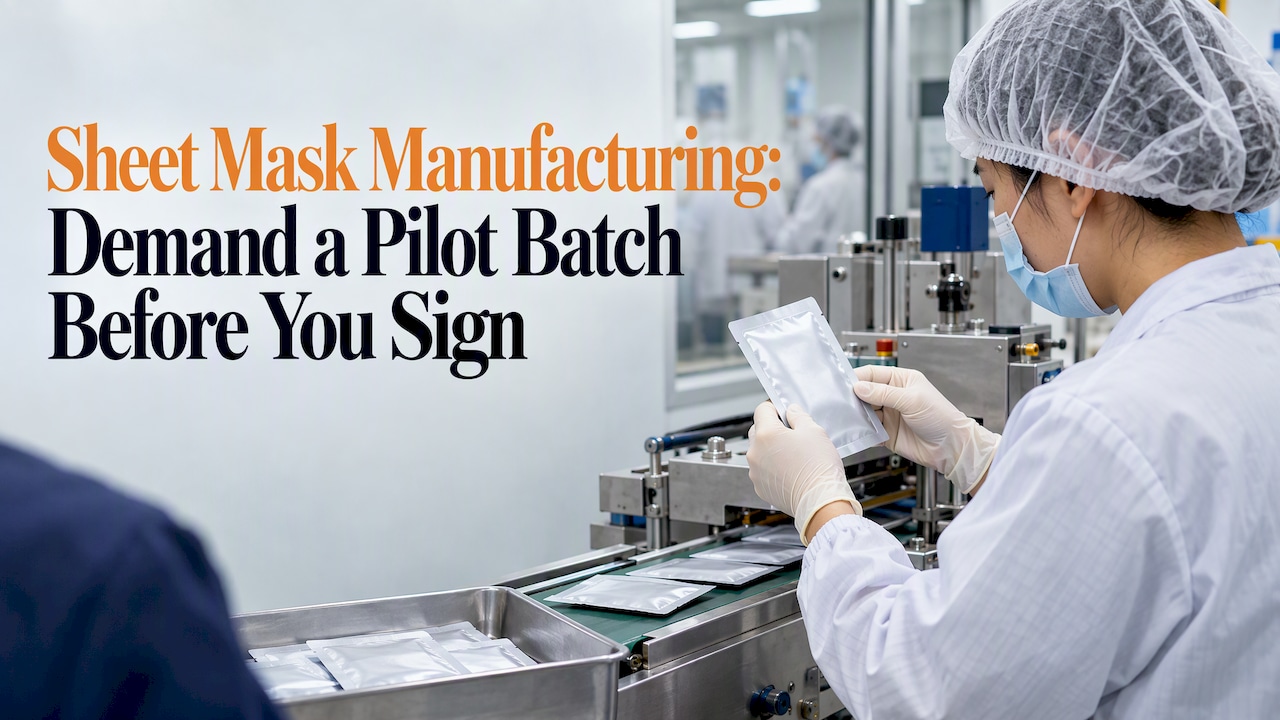
- Sachet filling and heat sealing: the sheet and essence go into the sachet, which is sealed. In the biocellulose study above, the sheets were soaked with an active solution and packed in PET/aluminium/PE sachets.
- Labelling and secondary packing: sachets are coded, boxed and prepared for dispatch.
Challenge (preservative efficacy) and stability testing run alongside these steps, and your samples normally arrive in stages: lab sample, pilot run, then a pre-production batch. Our guides to cosmetic microbiological testing and stability testing and QC explain what each test involves.
Pro Tip: Ask for written acceptance criteria for your pilot sample (texture, fragrance, sheet fit, seal strength) before production starts, so approval is a checklist rather than a debate.
Which production specifications should you confirm: MOQ, lead times, capacity and certifications?
Comparing suppliers like for like means asking each one the same questions about the same variables. Start with these:
- MOQ drivers: a custom formula, a premium substrate or printed sachets will each push the minimum order and the unit cost up, so settle your priorities before requesting quotes.
- Lead-time components: formulation development, testing windows, tooling and packaging print runs, and the next available production slot all add up. A supplier who quotes one number without explaining this is guessing.
- GMP certification: ask to see it, and ask what it covers. Our overview of GMP-certified skincare manufacturing explains why it is a core trust signal.
- Test evidence: preservative challenge results, microbial limits and stability data for a comparable product.
- Batch traceability: the ability to trace any sachet back to its materials and production date.
Certifications and standard test metrics are what serious mask makers lead with. Manufacturers of other mask types publish test levels and microbial cleanliness claims alongside automated production to show consistency. Expect the same transparency from a cosmetic supplier.
Formulation considerations: actives, preservatives and substrate compatibility
Sheet-mask essences are water-rich and single-use, which shapes what works. Keep these points in mind when briefing a formulator:
- Suitable actives: humectants such as hyaluronic acid and glycerin, peptides and botanical extracts sit well in a water-based essence.
- Ingredients needing care: oils can leave sheets greasy or separate in the sachet, and pH-sensitive actives need buffering so they stay stable.
- Preservation: a high-water formula is a friendly environment for microbes, so the preservative system and water activity are central to safety and shelf life.
- Efficacy validation: a responsible manufacturer runs preservative efficacy (challenge) testing and confirms the result on the final formula in its final sachet, not just on the bulk.
- Substrate interaction: some substrates bind certain ingredients or react with preservatives, which is why formula and sheet should be tested together.
Our article on how custom skincare formulation works walks through the path from concept to production.
Which packaging and finishing choices affect cost and shelf presence?
Packaging is where unit cost and brand impression are decided, and it often drives MOQ more than the essence does. The main choices:
- Single sachets: the sachet needs barrier properties to protect a wet product. The study above used PET/aluminium/PE sachets, a structure built for that job.
- Boxed multipacks: cartons lift perceived value and suit gifting, but add a print run and a packing step.
- Printed sachets and special finishes: metallic, matte or spot finishes set you apart, and they raise both MOQ and lead time.
- Sustainability trade-offs: mono-material or recyclable structures may change barrier performance, so test them before committing.
Packaging also decides how your claims appear on pack, which affects labelling review. Our guides to sachet packaging and choosing skincare packaging cover the options in more depth.
Which questions should you ask a manufacturer before you sign?
Use this checklist on your first call, and keep the answers in a comparison sheet. Decide first whether the supplier offers formulation and R&D, what its MOQ and pilot sample policy are, which tests and certifications it can evidence, what packaging it handles, how it protects your IP under an NDA, and how pricing and payment terms are structured. Then ask these:
- Do you develop formulas in-house, and who owns the finished formula?
- What is your MOQ for my chosen substrate, and how does it change with printed packaging?
- Can I receive a lab sample and a pilot batch before committing to a full run?
- Which GMP certification do you hold, and can I see it?
- Can you share preservative challenge and stability results for a similar product?
- How long does each stage take, from formulation to pre-production batch?
- What happens if a pilot batch fails a test?
- Will you sign an NDA before I share my brief?
For a broader list, see our nine questions before choosing a skincare manufacturer.
Why consider us for sheet-mask manufacturing?
We are an OEM/ODM skincare manufacturer based in Singapore, and we hold GMP certification. Our work covers product design, customised formulation, quality control and packaging solutions. Our approach is collaborative: we build around your market and customers, backed by R&D. You can see the full scope on our services page and follow the stages of a launch in our skincare launch roadmap, then ask for a sample or quote.
What happens after production: storage, logistics and distribution support
Manufacturing ends when the cartons are packed, but your product still has to reach customers in good condition. Sheet masks are wet, sealed products, so storage conditions matter. Ask any supplier how finished goods are stored, how long they can be held before dispatch, and whether pallets are protected from heat and crushing.
Logistics deserves the same scrutiny. Confirm who arranges shipping, how batches are labelled for traceability, and what documentation travels with each consignment. If you sell across several markets, check whether the supplier can split a run into smaller shipments or hold stock for staged releases. That flexibility keeps your cash from being tied up in a warehouse of one large delivery.
Distribution support is where manufacturers differ most. Some stop at the factory door. Others help with fulfilment, packing for retail or e-commerce, and coordination with your distributors. We offer skincare product distribution, so you can discuss it alongside manufacturing rather than arranging a separate vendor.
Finally, agree what happens if something goes wrong after dispatch. A clear process for complaints, batch tracing and recalls is part of a mature quality system, and it is far easier to set up before launch than during a problem. Put these terms in your contract alongside price and lead time, and review them again when your volumes grow.
Regulatory compliance and safety testing: what changes by region
Sheet masks are cosmetics, so the rules depend on where you sell, and a product made for one market may need changes for another. Your manufacturer should help you map the requirements, but the responsibility for compliant claims and labelling sits with the brand owner.
The core safety work is similar everywhere: ingredient review against the local permitted and restricted lists, preservative efficacy testing, microbial limit testing, stability testing and, for many markets, a documented safety assessment of the finished formula. Patch testing on volunteers is common for new products. Our microbiological testing guide covers the lab side in plain terms.
Regional differences show up in the details. Ingredient lists differ, labelling must follow local language and format rules, and some markets require a product notification or a named responsible person before you can sell. Claims are treated differently too: wording that passes as a cosmetic claim in one place can count as a medical claim elsewhere. Check the current rules for each target market with the regulator or a qualified adviser, and do not rely on a supplier’s general assurance.
Bring regulatory questions into the first call. Ask which markets the supplier has produced for, what documents it can supply, and whether its GMP certification is recognised by your buyers. It is much cheaper to design the formula and pack for your destination markets from the start than to rework them after a rejection.
Scaling up from prototype to mass production: challenges and best practices
A prototype that wins on the bench can behave differently in a large tank and a high-speed filling line. Scale-up is where mixing times, temperatures, viscosity and sheet handling all change, so plan for it as a project in its own right.
The usual challenges are predictable. Essence viscosity that suited hand-dosing may foul filling nozzles. Sheets that soak evenly in a sample can absorb unevenly during large-scale production. Seal quality can drift as machine speed rises, and a preservative system that passed on a small batch needs to be confirmed on the production formula.
Best practice follows the sample stages described earlier: a lab sample, then a pilot run on production equipment, then a pre-production batch. Treat the pilot as a rehearsal. Test fill weights, seal integrity, sheet saturation and appearance across the whole run, not only the first units. Fix your acceptance criteria in writing so the pass mark does not move as the order grows.
Lock down your supply chain at the same stage. Confirm that the sheet material, sachet film and cartons can be sourced at volume with consistent quality, and agree what happens if a component changes. Finally, set a review point after the first full run to capture what to adjust before reorders. Our skincare launch roadmap and R&D support guide describe how these stages fit together.
How can sheet mask manufacturing become more sustainable?
Sheet masks are single-use by design, so sustainability needs attention in both the sheet and the pack. Consumer interest is pushing the industry towards natural and biodegradable polymer options, and that is a useful direction for any new range.
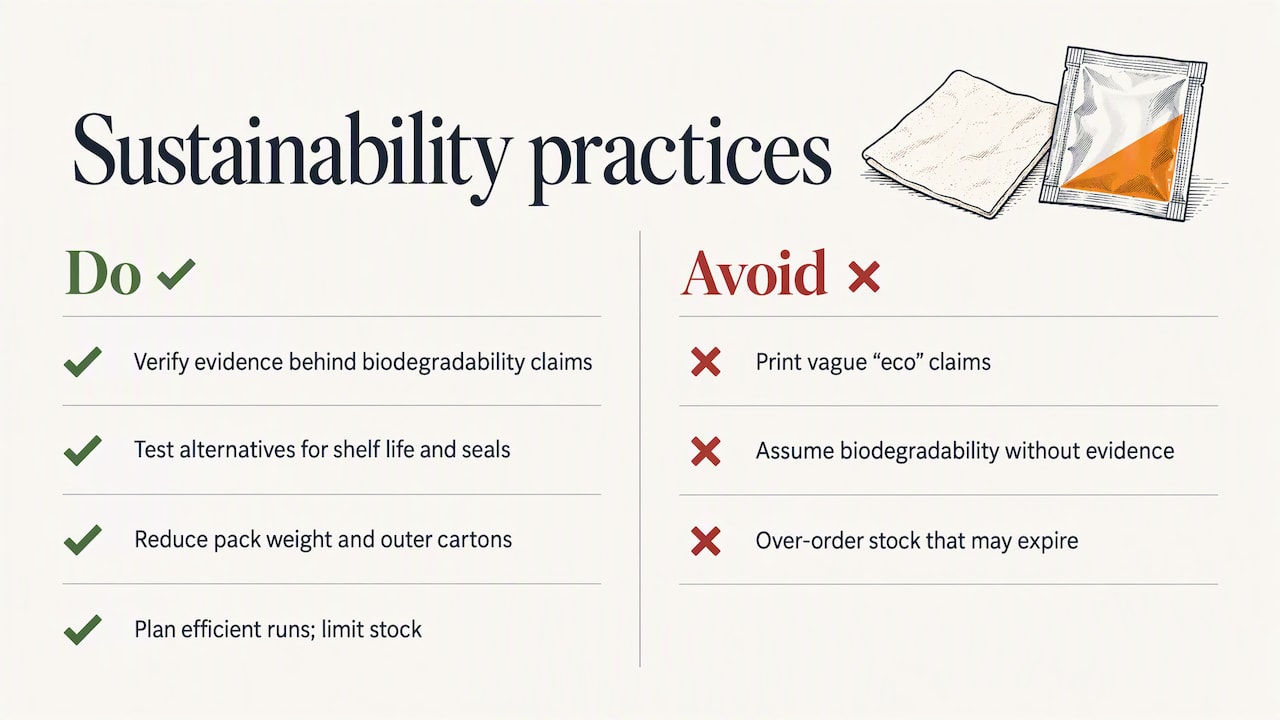
Start with the sheet. Cotton and other plant-derived fibres, and biocellulose, are routes to more bio-based materials. Biodegradability depends on the material and on the disposal conditions, so ask suppliers what evidence stands behind any claim before you repeat it on pack. Avoid vague wording such as “eco” when you cannot substantiate it.
The sachet is the harder part. Barrier films protect a wet formula, and the foil-laminate structures used for that job are difficult to recycle. Alternatives exist, but each needs testing for shelf life, seal strength and compatibility with the essence. Reducing pack weight, trimming outer cartons and using fewer print colours are simpler gains that also lower cost.
Think about the whole system too. Efficient production runs cut waste from rejected batches, and good planning avoids over-ordering stock that later expires. Raise sustainability early in the brief, because it affects the substrate, the film and the MOQ together. We can discuss material and packaging options with you during design, and our guide to skincare packaging options is a good place to compare formats first.
What first-time brands underestimate about timelines
Delays can come from printed packaging and preservative testing. Artwork revisions and print runs can hold up an otherwise finished product, and a formula that fails a challenge test goes back to the lab for reformulation and a fresh testing window. Agree sample acceptance criteria in writing before the pilot, and treat your first production run as a project with buffer time, not a fixed date.
— Edmund
How we can support your sheet-mask launch
Whether you are choosing a substrate or briefing a formulator, we can support your project with GMP-certified production and R&D.
- Review our services to see how design, formulation, packaging and distribution fit together.
- Follow our skincare launch roadmap to plan your timeline.
- Request a pilot sample or quote and tell us your substrate, volume and target market.
FAQ
What material are sheet masks made of?
Sheet masks are made from several fabrics, including cotton pulp, non-woven material, hydrogel and biocellulose. The choice changes how the mask feels and how it delivers ingredients, as described in a review of beauty mask materials. Your formula and price point should guide the selection.
How do you manufacture a sheet mask?
The process runs from formula development and substrate testing to essence dosing, die-cutting, sachet filling, heat sealing and packing. Challenge and stability testing happen alongside production. Brands may approve a lab sample, a pilot run and a pre-production batch before the full order.
What should I look for when choosing a sheet mask manufacturer?
Look for GMP certification, in-house formulation, documented microbiological and stability testing, and clear MOQ and lead-time answers. A supplier should also offer a pilot sample and written acceptance criteria. Our list of questions to ask a skincare manufacturer gives you a starting script.
Can I get private label sheet masks without a custom formula?
Yes, many manufacturers adapt an existing base essence to your brand, which usually lowers development time and minimum order size. A custom formula gives you more control over claims and differentiation. Decide which suits your budget and positioning before requesting quotes.
Sources
- In vivo evaluation of the effectiveness of biocellulose facial masks as active delivery systems to skin – PMC
- Beauty Mask: Market and Environment
- ASTM Level 2 Surgical Mask – Racer Technology