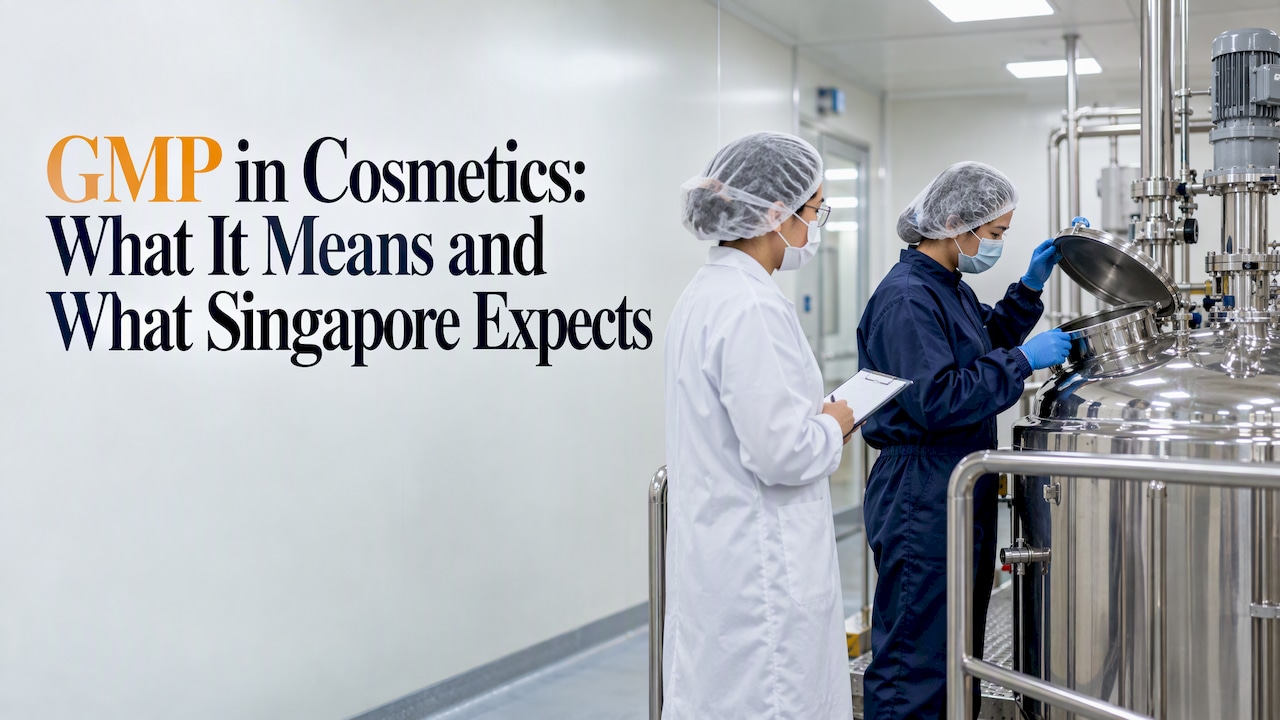
Good Manufacturing Practice (GMP) in cosmetics is a quality management system. It makes sure every batch of a product is made, controlled, stored and shipped to a consistent standard that suits its intended use. In Singapore, the benchmark is the ASEAN Guidelines for Cosmetic GMP, and the Health Sciences Authority (HSA) audits manufacturers against them. Certification is voluntary, but it matters far more than that word suggests, especially if you plan to export or want your brand to stand on a verified supply chain.
This guide explains what GMP covers, what is and is not legally required in Singapore, how HSA certification compares with ISO 22716, and what to ask a contract manufacturer before you sign.
TL;DR
- GMP for cosmetics is a documented system covering people, premises, equipment, raw materials, production, quality control and records, not just a clean factory.
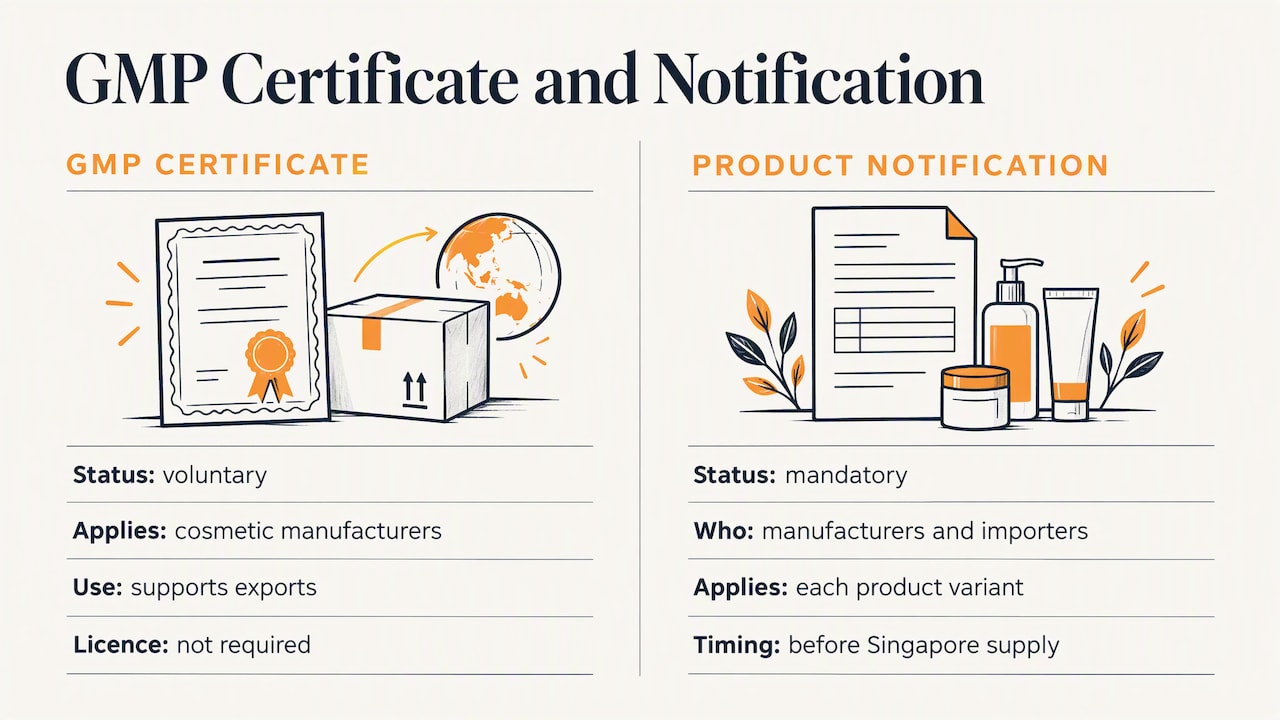
- In Singapore, GMP certification is voluntary: manufacturers do not need a licence, but a certificate helps with exports.
- Every product must still be notified to HSA before supply, and notification is not an approval. Safety stays with the company placing the product on the market.
- ISO 22716 is the international GMP guideline. HSA certification follows the ASEAN guidelines. They overlap heavily but are not the same document.
- For a brand, salon or clinic, a GMP-certified contract manufacturer reduces risk. It does not replace your own duties.
Table of Contents
- What GMP means in a cosmetics factory
- Is GMP legally required in Singapore?
- HSA GMP certification: how it works
- ISO 22716 versus HSA GMP certification
- Why GMP matters to the people who buy from a manufacturer
- Questions to ask a manufacturer about GMP
- Our perspective: GMP as a working habit
- From idea to a GMP-made product
- Working with Harmony Skin Lab
- FAQ
- Sources
What GMP means in a cosmetics factory
The ASEAN guidelines were written to help the industry comply with the ASEAN Cosmetic Directive. They treat GMP as a way of managing risk across the whole life of a batch. The aim is to minimise contamination, mix-ups and errors, and to prove afterwards what happened.
In practice, a GMP system rests on a few pillars:
- Personnel: trained staff with defined responsibilities, hygiene rules and clear reporting lines.
- Premises and equipment: layouts that prevent cross-contamination, with cleaning and maintenance written down and followed.
- Raw materials and packaging: approved suppliers, identification, quarantine on arrival, release only after checks.
- Production: written procedures, controlled processing conditions, line clearance between products.
- Quality control: testing against specifications, retained samples, handling of out-of-specification results.
- Documentation: the backbone of everything. If it is not recorded, an auditor treats it as not done.
Traceability is the real test
A batch record should show which materials went in, the processing conditions used and the results of in-process checks. That lets a manufacturer trace a finished jar back to the raw material lots in it. The same system has to handle consumer complaints and recalls. The ASEAN text expects a company to be able to reconcile what was delivered against what was recovered, and auditors look closely at that exercise. Many young brands never think about it until a problem arrives.
Is GMP legally required in Singapore?
Not as a certificate. HSA states that cosmetic manufacturers in Singapore do not need a manufacturer’s licence, but may apply for a voluntary GMP certificate to support exports. Many foreign markets ask for proof of GMP compliance on imported cosmetics, which is where the certificate earns its keep.
What is mandatory is notification. Manufacturers and importers must notify their products to HSA through the PRISM portal before supplying them in Singapore. Each product variant needs its own notification, and the notification is valid for one year.
The legal framework is the Health Products (Cosmetic Products – ASEAN Cosmetic Directive) Regulations. HSA’s own explanation of how cosmetic products are regulated makes the key point: dealers must ensure their products comply. A notification is an administrative step that supports post-market surveillance. It is not a safety endorsement.
The misconception that costs brands money
Founders often assume that because HSA received the paperwork, someone has checked the formula. Nobody has. If a product causes harm, responsibility sits with the company that placed it on the market. That is why the GMP status of your manufacturer, and your own file of safety and stability evidence, matter. If you are building a brand, read our note on product liability insurance for cosmetics in Singapore as well.
HSA GMP certification: how it works
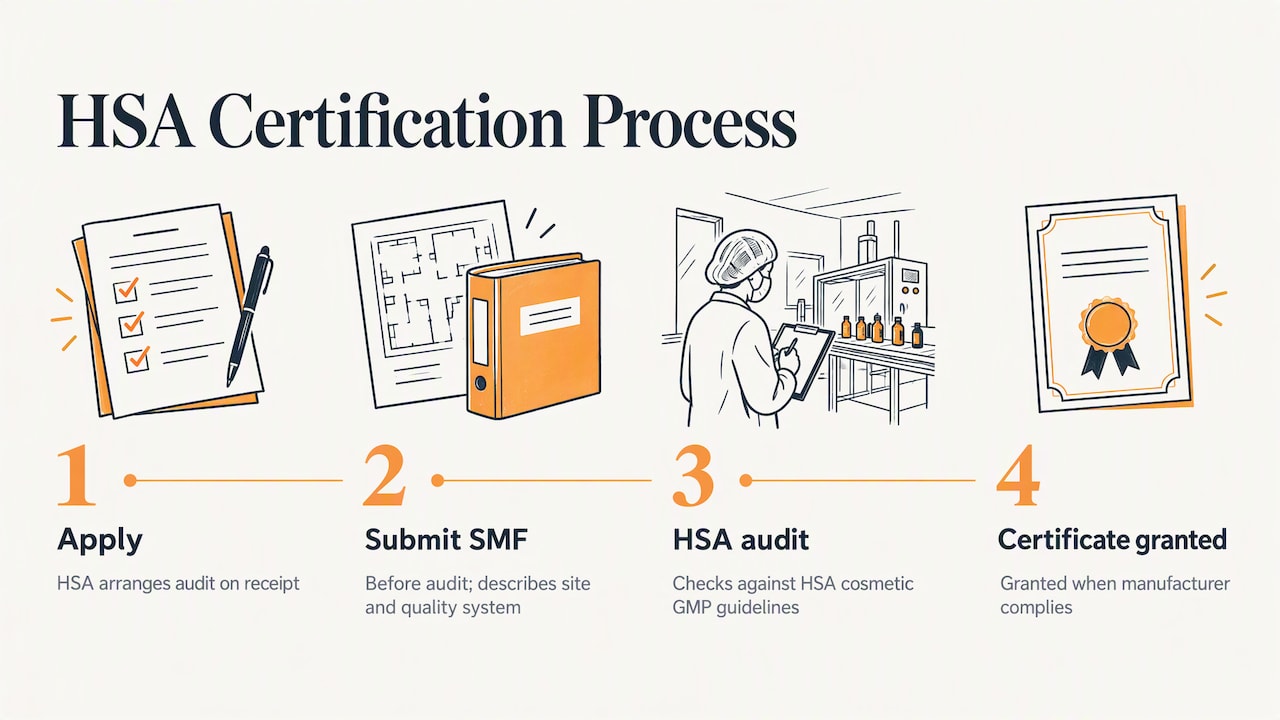
HSA arranges a certification audit once it receives your application. The audit is carried out against HSA’s GMP guidelines for manufacturers of cosmetic products, which encompass the recommendations of the ASEAN Cosmetic Directive on GMP. Before the audit, the manufacturer submits a Site Master File (SMF). HSA publishes a guide to preparing an SMF for a cosmetic manufacturer that sets out what the document should contain.
The SMF is a standing description of the site and its quality system: what is made, how the facility is laid out, who is responsible for what, and how quality is controlled. Think of it as the manufacturer’s own account of how it works, which the auditor then checks against reality on site.
A certificate is granted when the manufacturer is deemed to comply with the standard. HSA has also said that from 30 June 2026 it issues GMP certificates as verifiable electronic certificates, which makes it easier for an overseas buyer or regulator to confirm one is genuine. Ask any manufacturer for the certificate and check its scope: which site, which product categories, and whether it is current.
For a closer look at how the SMF fits with the international standard, see our page on ISO 22716 and HSA’s SMF, and our seven facts about HSA GMP.
ISO 22716 versus HSA GMP certification
ISO 22716:2007 is the international guideline for cosmetic GMP. ISO describes it as covering production, control, storage and shipment of cosmetic products. It addresses quality aspects, not worker safety or environmental protection, and it does not apply to research and development or to the distribution of finished products.
That last exclusion is worth pausing on. A GMP system, whichever version, tells you how a product is made and controlled. It says little about how well a formula was designed or how a product is distributed afterwards. If you are buying development as well as production, you need to ask separately about R&D practice and stability work.
| HSA GMP certification | ISO 22716 | |
|---|---|---|
| Basis | ASEAN Cosmetic GMP guidelines, as applied by HSA | International guideline, ISO 22716:2007 |
| Who audits | HSA, after an SMF is submitted | Accredited third-party certification bodies |
| Status in Singapore | Voluntary | Voluntary |
| Main use | Supports exports and shows regulator-verified compliance | Widely recognised by international buyers and retailers |
| Scope limits | Manufacturing quality system | Excludes R&D and distribution of finished goods |
There is also a US-oriented standard, NSF/ANSI 455-3, which NSF offers audits and certification for. It is relevant mainly if you intend to sell into the United States and want to align with the expectations that came with that country’s cosmetics legislation. For a Singapore brand selling in Singapore and ASEAN, the HSA and ASEAN route is the natural baseline.
Treat the table as a map, not a ranking. The right choice depends on where you sell and who your buyers are. Some brands hold both.
Why GMP matters to the people who buy from a manufacturer
If you are launching a private label line, running a salon range or commissioning a clinic formulation, you are the dealer in the regulator’s eyes. You put your name on the product. A manufacturer with verified GMP gives you three practical things:
- Consistency. The product in batch twelve behaves like the product in batch one, because materials, processes and checks are controlled.
- Evidence. When a retailer, distributor or overseas regulator asks questions, there is a record to answer them. The records also support your own product information file.
- A faster recall response. If something goes wrong, traceability lets you identify affected lots and act on them instead of guessing.
Industry certifiers argue that a verified GMP supplier also reduces product liability exposure and the burden of repeated audits on the brand side. That is a reasonable expectation, but it is a risk reduction, not a shield. You remain responsible for the claims you make on your label and for the final product you sell.
Questions to ask a manufacturer about GMP
Certificates are a start. These questions separate a real quality system from a logo on a website:
- Can I see the current GMP certificate, its scope and its date?
- Which standard is it against: the ASEAN guidelines through HSA, ISO 22716, or both?
- How do you record batches, and can you show me an anonymised batch record?
- How are raw materials approved, and how do you handle a failed incoming check?
- What is your procedure for complaints and recalls, and have you tested it?
- Who does stability testing, and how are results shared with me? Our page on stability testing and QC services shows what that work involves.
- Who is responsible for product notification, and what will you need from me?
Our longer checklist, nine questions before choosing a skincare manufacturer, goes into pricing, minimum quantities and timelines as well.
Our perspective: GMP as a working habit
We see GMP as something a team does every day, not a certificate that hangs on a wall. Harmony Skin Lab is a Singapore OEM and ODM skincare manufacturer, and our GMP certification comes from Singapore’s HSA. That matters to us because the audit looks at how we actually work, not how we describe ourselves.
Our view is that the most useful GMP conversations happen before a project starts. When a client brings an idea, we want to talk about the full path: formulation, stability, packaging, filling, records and notification. A formula that cannot be reproduced consistently, or packaging that was never tested with the product, is a problem waiting for a launch date.
We also push clients to separate three things that get blurred. GMP says the factory is controlled. Notification says the product has been declared to the regulator. Safety and claims substantiation say the product is right for the people who will use it. All three are needed, and the last two belong to the brand. We would rather explain that plainly at the start than see a client surprised later.
Finally, GMP works best alongside collaboration. We work with clients on market trends, research and development, and the practical details of packaging, because a well-controlled process still has to produce something people want to buy.
— Edmund
From idea to a GMP-made product
If you are planning a launch, this is the order in which GMP touches the project:
- Define the product and market. Home-use, salon or clinical lines carry different expectations. A medical-style formulation needs more documentation than a body oil. See our guide to OEM versus ODM to decide how much of the formula you want to own.
- Develop and test the formula. Development sits outside ISO 22716’s scope, so ask how the manufacturer documents it. Our article on developing a skincare formulation covers the stages.
- Choose packaging early. Compatibility between formula and container should be tested, not assumed. Read what labs need from you for packaging compatibility testing.
- Manufacture and fill under controlled records. Each batch gets its own record and release decision.
- Notify through PRISM. Every variant needs notification before supply in Singapore, and it must be renewed annually.
- Keep your own file. Safety information, stability data and supplier records should be accessible to you, not only to the factory.
The full sequence is mapped in 7 steps to launch private label cosmetics in Singapore and our skincare launch roadmap.
Working with Harmony Skin Lab
If you are a brand owner, salon operator or clinician looking for a GMP-certified Singapore manufacturer, our OEM and ODM services cover R&D and manufacturing, design and packaging, sachet packaging and filling, filtration and distribution. Our product lines include home-use essential skincare, professional salon skincare and aesthetic or doctor’s formulations. Tell us what you want to make and who it is for, and we will walk you through the route from formula to finished, notified product. You can learn more about what a GMP-certified manufacturer offers brands or the benefits of choosing one in Singapore.
FAQ
What does GMP mean in cosmetics?
GMP stands for Good Manufacturing Practice. It is a system of organised, documented activities that ensures cosmetic products are consistently made and controlled to a quality suited to their use. It covers staff, premises, equipment, raw materials, production, quality control, storage and shipment.
Is GMP legally required for cosmetics in Singapore?
A GMP certificate is not required to make or sell cosmetics in Singapore, and manufacturers do not need a licence. Certification is voluntary and mainly supports export. Product notification to HSA is mandatory before any product is supplied.
Does HSA notification mean a product is approved?
No. Notification is an administrative step that lets HSA carry out post-market surveillance. The company placing the product on the market stays responsible for safety and compliance with the ASEAN Cosmetic Directive.
What is the difference between ISO 22716 and HSA GMP certification?
ISO 22716 is an international guideline audited by certification bodies. HSA certification is an audit by Singapore’s regulator against guidelines that follow the ASEAN Cosmetic Directive. Both are voluntary in Singapore and share the same principles, so many buyers accept either, depending on the export market.
What is a Site Master File?
It is a document describing a manufacturer’s site and quality system, submitted to HSA before a GMP certification audit. HSA publishes a guide that sets out its contents. It gives the auditor a baseline to check against on site.
Sources
- HSA: Good Manufacturing Practice certification for cosmetic products
- HSA: Submit notification and re-notification
- HSA: How cosmetic products are regulated
- ASEAN: Appendix VI, Guidelines for Cosmetic GMP
- ISO 22716:2007 Cosmetics, Good Manufacturing Practices
- NSF/ANSI 455-3: Cosmetics GMP certification