If you sell skincare or cosmetics in Singapore, you need product liability insurance, and a manufacturer’s policy will not do the job for you. Singapore’s Health Sciences Authority (HSA) does not approve cosmetics before sale. The company that puts the product on the market carries the responsibility for its safety. The policy that responds when a customer says your serum burned their face has to be in your name.
This guide is for founders of private label brands, salon owners and clinicians who commission their own formulations. It explains what the cover includes, what it leaves out, what insurers ask to see, and how your manufacturing partner’s paperwork makes the process easier.
TL;DR
- Product liability insurance pays for legal liability when your product causes third-party injury or property damage. It does not pay for recalls, which need separate cover.
- In Singapore, cosmetics are notified to HSA, not approved. The responsible person carries the liability, and that is usually the brand owner.
- Basic policies start from around S$2,000 a year, depending on turnover and risk. Your actual quote will differ.
- Insurers look for written quality control procedures, a recall plan and third-party lab testing. Ask your manufacturer for the documents early.
- Use an experienced broker and say plainly that you sell cosmetics or skincare. Do not rely on a generic policy description.
Table of Contents
- Why cosmetics brands in Singapore need their own cover
- What product liability insurance covers
- What it does not cover
- How much it costs in Singapore
- What insurers ask for before they bind cover
- Reporting duties that sit alongside your policy
- Where your manufacturer fits in
- Our perspective on liability and manufacturing
- Cover for different types of skincare business
- Working with us
- FAQ
- Sources
Why cosmetics brands in Singapore need their own cover
Cosmetics in Singapore run on a notification system. HSA’s overview of cosmetic products states that products are not pre-market approved. The responsible person or supplier answers for product safety, ingredient compliance and the accuracy of claims. Notifying a product is not an endorsement of its safety. You must keep a Product Information File (PIF) containing safety assessments, and you must be ready to recall the product if a safety concern arises.
The point that catches new brands out is that “notified” is often mistaken for “approved”. Industry guidance on cosmetic registration stresses that the burden of showing ingredient compliance, safety and label accuracy sits with the responsible person under the ASEAN Cosmetic Directive framework. HSA’s April 2026 draft guidance on adverse effects, defects and recalls defines the person responsible as the Singapore company that causes the product to be available for sale. That can be an importer, manufacturer, distributor or retailer, and the company must be registered with ACRA.
In practice, if you own the brand and the label carries your name, you are very likely the responsible person. A customer with a rash will contact you, not the factory.
The private label trap
A common mistake is assuming the manufacturer’s insurance protects the brand. Insurance specialists who cover beauty brands point out that under strict liability, every link in the distribution chain can be held liable, including the brand owner. A manufacturer’s policy typically stops at the factory door. It does not cover the brand owner’s legal costs or reputational damage.
The same applies to sellers who source finished products from overseas. A Singapore analysis for e-commerce beauty sellers notes that indemnities from overseas manufacturers are hard to enforce in practice, so the seller is exposed even though they did not make the product. A contractual indemnity from your manufacturer is useful, but it is not a substitute for your own policy.
What product liability insurance covers
Product liability insurance covers your legal liability for third-party personal injury or property damage caused by a product you make, supply or sell. Sleek’s Singapore guide describes it as a core risk-management tool for any business dealing in goods. For cosmetics, the typical claims are:
- allergic reactions and skin sensitisation
- irritation, burns or rashes
- contamination, including microbial contamination
- harm linked to a wrong or missing warning on the label
Defence costs are normally part of the cover, which matters because a disputed claim can be expensive even if you win. Check that your policy wording includes legal costs and whether they erode the limit.
Experts note that for beauty and private label brands, sensitisation claims are the main driver of liability exposure. They also advise looking beyond product liability to professional indemnity and cover for specific risks such as cross-contamination or ingredient sourcing failures. If you are a salon or clinic that applies products to clients, ask your broker how treatment liability and product liability fit together, because they are often separate sections.
What it does not cover
Product liability insurance responds after harm has happened. Contract manufacturing insurance specialists are clear that it does not pay the cost of a recall: pulling stock, redesigning packaging or issuing refunds. You need a standalone recall policy or a specific endorsement for that.
This matters in Singapore because HSA can require a recall. Under the HSA guidance mentioned above, where a product is judged to present a risk, the responsible person may be required to remove the affected batch or, in extreme cases, all batches. A recall can occur without any injury, for instance after a labelling error or a failed stability result, so a product liability policy would not respond.
Other things to check for exclusions:
- known defects or claims you did not disclose at proposal
- products or ingredients outside the descriptions you gave the insurer
- territories you sell to beyond Singapore, including export orders and marketplace sales
- claims arising from unlicensed or misleading product claims on the label or in advertising
How much it costs in Singapore
Prices vary with turnover, product type, claims history and the limit you choose. Sleek’s Singapore guide says basic policies start from S$2,000 a year, with SME limits commonly between S$1,000,000 and S$5,000,000 per occurrence. It also notes that some SME packages, such as Chubb’s Assembly, offer S$1,000,000 limits for businesses with under S$1M in revenue for roughly S$1,000 a year. That guide was first published in 2021 and the figures are indicative only, so treat them as a rough range and get live quotes.
Two routes are common:
| Route | Good for | Watch for |
|---|---|---|
| SME package policy that bundles public and product liability | Small brands with modest turnover and simple products | Whether cosmetics are accepted without special terms, and the limit per occurrence |
| Standalone product liability policy through a broker | Brands with higher turnover, exports, or higher-risk products | More detailed proposal, but cover tailored to what you sell |
Singapore insurers publish their proposal forms, which tell you what they will ask. Chubb’s SME proposal form combines public and product liability with manufacturers’ E&O questions and asks for details of your current policies and limits. Reading one before you speak to a broker saves time.
What insurers ask for before they bind cover
Insurers price manufacturing risk by looking at how products are made and controlled. The AIG Singapore general liability proposal form includes a product liability section, and businesses that cannot show written quality control procedures and a recall plan, or that have not done third-party lab testing, often face hurdles or exclusions, particularly for private label or custom formulations.
This is the part of the process where your manufacturer’s documents help. Gather these before you request quotes:
- Product description and ingredient list for every product you sell.
- Your PIF, including safety assessments, and your HSA notification details. A short guide to the three label checks for cosmetics sold in the UK is a useful reference if you plan to export there, since labelling rules differ by market.
- Manufacturer’s GMP evidence and its quality control procedures.
- Stability, compatibility and microbial test reports from an independent lab where possible.
- A written recall plan naming who does what, how you trace batches and how you notify HSA and customers.
- Sales channels and territories, including marketplaces and exports.
- A claims history, even if it is blank.
On that last point, be exact. A broker such as the one quoted by Steadfast Singapore advises that product liability has many contingencies. Businesses should work with an experienced broker to match cover to their objectives, finances and products, instead of relying on general policy descriptions.
Reporting duties that sit alongside your policy
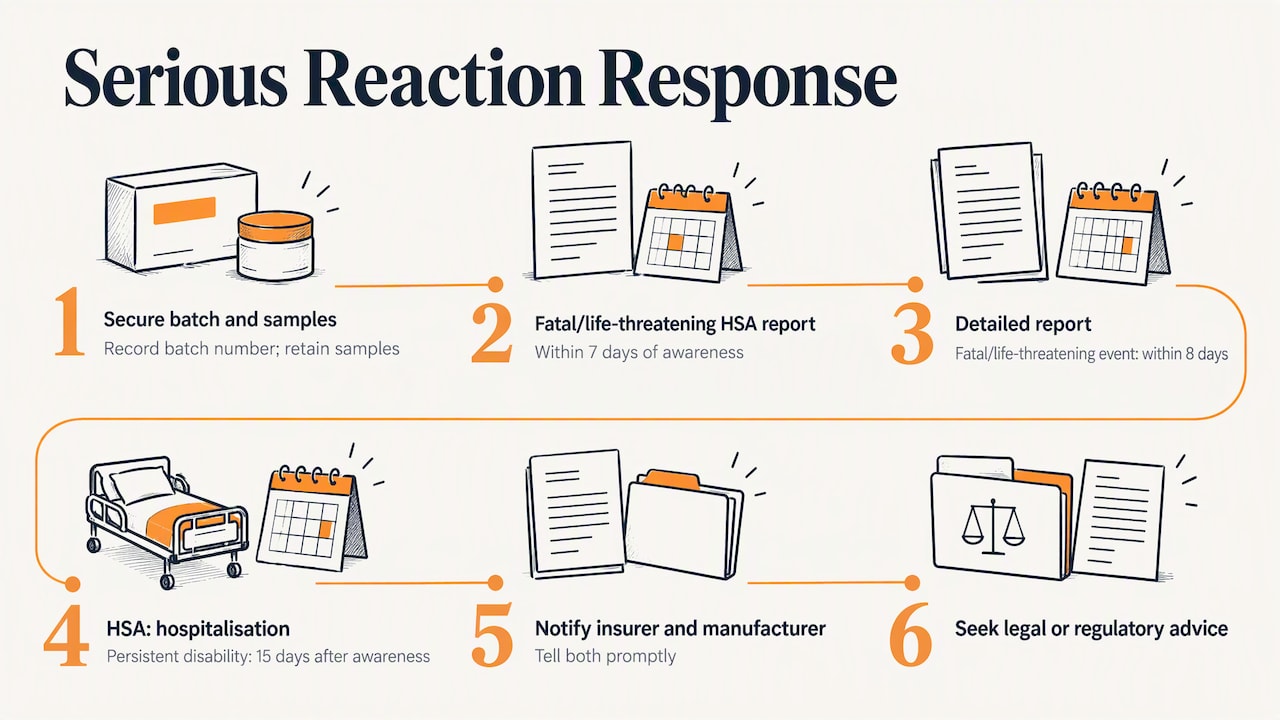
Insurance does not replace your regulatory duties. Under the Health Products regulations, suppliers must report serious adverse effects to HSA within set deadlines. Events causing death or life-threatening harm must be reported no later than 7 days after you become aware of them, with a detailed report following within 8 days. Events resulting in hospitalisation or persistent disability need a detailed report no later than 15 days after you become aware.
Tell your insurer promptly as well. Most policies require notice of a claim or a circumstance that could lead to one, and late notice can put cover at risk. Check the notification clause in your wording and keep a named contact for incidents. If a customer reports a serious reaction, the sequence is: secure the batch number, keep retained samples, report to HSA within the deadline, notify your insurer and your manufacturer, then take legal or regulatory advice.
Where your manufacturer fits in
A good contract manufacturer reduces your risk and speeds up your insurance application, but it does not transfer your liability. Look for these things when you choose one:
- GMP certification that you can verify. Our own explainer on HSA GMP and skincare manufacturing standards sets out what the standard means in practice.
- Stability and QC testing with reports you can hand to an insurer. See our page on cosmetic stability testing and QC services in Singapore and the note on packaging compatibility testing.
- Batch records and traceability, which make a recall quicker and cheaper.
- A clear contract on who owns the formula, who holds the PIF, what warranties apply and what each side insures.
- Documented formulation work. Safe, well-documented R&D is the best defence against a sensitisation claim. Read how R&D guides OEM skincare production.
If you are still choosing, how to choose an OEM skincare manufacturer covers the questions to ask, and the seven steps to launch private label cosmetics in Singapore shows where insurance fits in the timeline.
Our perspective on liability and manufacturing
We make skincare for other people’s brands, so we see the same pattern often. A founder spends months on packaging and positioning, then asks about insurance a week before launch. Insurers then ask for a stability report, a PIF and a recall plan, none of which exist yet. The launch slips.
We suggest working backwards. Decide early which sales channels and markets you want, because they shape the policy you need. Ask for your insurance documents at the formulation stage, not the launch stage. Our approach to R&D is collaborative, and that includes keeping safety assessment, ingredient choices and testing records in a form your broker can read. We are a GMP-certified manufacturer under HSA, and we believe the quality system matters as much as the formula.
We are not insurers or brokers, and we cannot advise on which policy you should buy. What we can do is make sure the manufacturing paper trail is complete, so that when your broker asks, you have answers.
— Edmund
Cover for different types of skincare business
The right questions depend on what you sell.
Private label brands. You are the responsible person. Insure your own brand, confirm that your policy covers products made by a third party, and keep the contract manufacturing agreement on file.
Salons and spas. You apply products to clients and may also retail them. Ask whether product liability and treatment liability are both included, and keep patch-test and consent records. Our professional salon skincare manufacturing page explains what a salon line involves.
Medical and aesthetic practices. Formulations used under clinical supervision raise their own questions. Your professional indemnity insurer and your product liability insurer should both understand how the product is used. A guide on trust signals clinicians use to vet medical-grade skincare shows the kind of evidence practitioners expect from a product, and an insurer will look for much the same.
Start-ups with low volumes. A small first batch does not remove the risk. One bad reaction costs the same legal fees whether you sold 200 units or 20,000. A low MOQ approach lets you launch cautiously, but insure from the first sale.
Working with us
If you are planning a private label, salon or medical-grade line in Singapore, we can take you from formulation through quality control to packaging, with the documentation insurers like to see. Details of our work are on our services page, and you can see the finished lines on our products page. To discuss a project, start from our private label skincare services overview.
FAQ
Is product liability insurance compulsory for cosmetics in Singapore?
We have not found a rule that makes it compulsory for cosmetics sellers. The legal duty is on the responsible person to ensure the product is safe and compliant, as HSA’s overview explains. Insurance is how you fund the cost if that goes wrong, and retailers, marketplaces or landlords may require it by contract. Check your agreements.
Does my manufacturer’s insurance cover my private label brand?
Usually not. Manufacturer policies typically stop at the factory door and do not cover the brand owner’s legal costs or reputation. Under strict liability, the brand owner can be held liable alongside the manufacturer, so take out your own policy and ask to be named in contract terms where appropriate.
How much does cosmetics product liability insurance cost?
Sleek’s Singapore guide says basic policies start from S$2,000 a year, depending on turnover and risk, while some SME packages have been quoted around S$1,000 a year for small businesses. Your price depends on your products, sales, export markets and claims record. Ask a broker for quotes on at least two limits.
Does product liability insurance cover a product recall?
No. It responds to injury or damage that has already occurred. Recall costs such as removing stock, reworking packaging and refunds need a separate recall policy or an endorsement. Ask your broker to price both together.
Sources
- Product Liability Insurance in Singapore, Sleek
- Cosmetic products overview, Health Sciences Authority
- Health Products (Cosmetic Products) regulations, Singapore Statutes Online
- Guidance for industry on adverse effects, defects and recalls, HSA (draft, April 2026)
- Registration of cosmetics in Singapore, GOL Solution
- Product liability insurance for beauty brands, Ashlin Hadden Insurance
- Contract manufacturer insurance, The Coyle Group
- Product liability insurance for e-commerce sellers in Singapore, Tzyco
- Commercial general liability proposal form, AIG Singapore
- Chubb Assembly SME proposal form, Chubb Singapore
- Product liability insurance for high-risk businesses, Steadfast Singapore
- Three label checks for cosmetics under UK regulations, M-Shop.UK
- Trust signals clinicians use to vet medical-grade skincare, Bloom Society