Molecular weight decides where hyaluronic acid (HA) sits on your skin and what it does there. High molecular weight HA stays on the surface and forms a moisture-holding film. Smaller fractions, below roughly 100 kDa, can reach deeper into the epidermis. No single size is “best”. Most well-built products combine several, and the rest of this guide explains why, with the numbers, the trade-offs and the practical points a brand owner needs before briefing a manufacturer.
TL;DR
- HA is usually grouped as low (below 50 kDa), medium (100 to 500 kDa) and high (above 700 kDa to 1 MDa and beyond) molecular weight, according to a 2025 review in PMC.
- High molecular weight HA hydrates by forming a surface film. HA below 100 kDa shows the greatest ability to penetrate the stratum corneum.
- Chasing the lowest weight is a marketing trap: HA below 50 kDa has been linked to pro-inflammatory behaviour in skin.
- A multi-weight blend gives immediate smoothing plus deeper hydration, and one clinical study reports improvements within two weeks.
- In Singapore, a finished cosmetic must be notified to the HSA before it is supplied, so the formula and the claims need to be right from the start.
Table of Contents
- What molecular weight means for hyaluronic acid
- The three size bands, and what each is used for
- Is lower always better?
- Why multi-weight blends are the practical answer
- How to read a supplier’s molecular weight figure
- Formulation points that decide whether the HA works
- Our perspective on specifying HA for a private label range
- Which size for which product
- Singapore rules to plan around
- Working with us on an HA-based product
- A short brief checklist
- FAQ
- Sources
What molecular weight means for hyaluronic acid
HA is a long chain of repeating sugar units. The monomer weighs about 379 daltons, but the chains link into polymers that run to millions of daltons. When a supplier quotes “molecular weight”, it is describing the average size of those chains, expressed in daltons (Da), kilodaltons (kDa, 1,000 Da) or megadaltons (MDa, 1,000,000 Da).
The range is huge. Hyaluronic acid from animal tissue can reach very high values, up to 20,000 kDa according to a review on how molecular weight shapes HA’s properties. The cosmetic-grade powders in a formulator’s catalogue are much smaller, because the raw material is deliberately processed or fermented to a chosen size.
Size matters for three practical reasons:
- Penetration. Smaller chains pass through the outer skin barrier more easily.
- Texture. Larger chains build viscosity and a silky film. Very large grades thicken a formula quickly.
- Biological signalling. HA fragments of different sizes are reported to behave differently in skin, which is where the safety questions below come from.
The three size bands, and what each is used for
The cut-offs vary between papers, which is why two suppliers can both call their ingredient “low molecular weight” and mean quite different things. The bands below follow the 2025 PMC review, which treats low as under 50 kDa, medium as 100 to 500 kDa and high as above 700 kDa up to 1 MDa and more.
| Band | Typical size | Main job in a formula | Watch out for |
|---|---|---|---|
| Low (LMW) | Below 50 kDa | Deeper epidermal delivery | Possible pro-inflammatory signalling, especially in sensitive skin |
| Medium (MMW) | 100 to 500 kDa | Bridge between surface and deeper hydration | Often sold loosely as “low” on labels |
| High (HMW) | Above 700 kDa to 1 MDa+ | Surface film, moisture retention, silky feel | Does not penetrate; thickens fast; clumps if dispersed badly |
High molecular weight: the surface film
HMW-HA is often dismissed as “useless because it cannot penetrate”. That misreads its job. Its film-forming behaviour helps limit transepidermal water loss and gives the immediate smooth, cushioned feel customers notice on first application. The same PMC review describes HMW-HA (above 1 MDa) as inherently anti-inflammatory and regenerative in character.
Medium molecular weight: the bridge
Grades between 100 and 500 kDa sit between the two jobs. They add some hydration below the very surface without moving into the size range that raises the inflammation question. Formulators often use them to smooth the transition between a film-forming grade and a penetrating one.
Low molecular weight: deeper reach
The 2025 review reports that HA below 100 kDa can penetrate skin, and that the smaller the molecule, the deeper it may travel, in some cases towards the dermis. That is the basis of most “deep hydration” claims. It is real, but only half the story.
Is lower always better?
No. This is the most common mistake in brand briefs.
Research summarised in a paper on designing topical HA technology reports that low molecular weight HA has pro-inflammatory characteristics while high molecular weight HA does not. The 2025 PMC review points the same way for fragments below 50 kDa. The evidence does not mean a low-weight serum will inflame your customers’ skin: concentration, the rest of the formula and the individual all matter. It does mean that “the smaller the better” is not a sound design principle, particularly for products aimed at reactive or post-procedure skin.
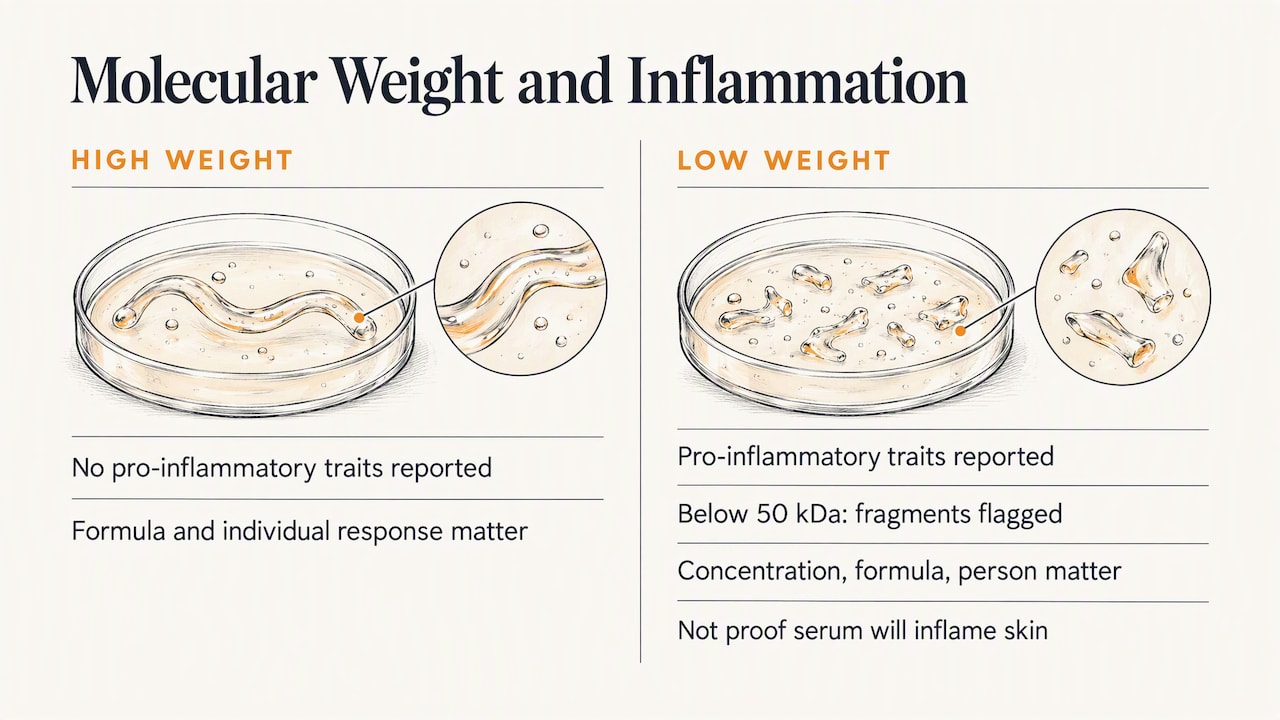
A sensible brief therefore asks for a spread of sizes, not the lowest number a supplier can offer.
Why multi-weight blends are the practical answer
A multi-weight complex combines HMW-HA for instant surface smoothing with smaller fractions for deeper hydration. A clinical evaluation of a multi-weight HA plus antioxidant complex reports improvements in dryness, roughness and fine lines within about two weeks, with hydration measurements changing as early as 30 minutes after application. That is one study of one formulation, so treat it as evidence that the approach works rather than a promise for every blend.
The logic holds up on first principles too:
- The surface film delivers what the customer feels straight away, which drives repeat purchase.
- The smaller fractions deliver hydration beneath the film.
- Spreading the sizes avoids relying on a single, possibly inflammatory, low-weight fraction.
What a blend might look like on a spec sheet
There is no universal ratio. A brief might ask for one high, one medium and one low grade, then leave the proportions to R&D testing against your target texture, skin type and price point. Ask your manufacturer to show the INCI names and the grade or kDa range of each HA used. Most appear on the label as sodium hyaluronate, sometimes alongside hydrolysed or crosslinked variants, so the INCI name alone will not tell you the size.
How to read a supplier’s molecular weight figure
The number on a raw material sheet is less precise than it looks.
- It is an average. HA is polydisperse: one batch contains chains of many sizes. A grade labelled 1,000 kDa is a distribution around that value.
- The method changes the answer. According to the PMC review, viscometry (standard for pharmacopoeia compliance) returns a single average, while techniques such as SEC-MALS describe the distribution more fully, and the same sample can read differently. A 2025 methods review in MDPI Polymers covers how high molecular weight is determined.
- Batches vary. Certificates of analysis typically note that data may vary slightly between lots.
Questions worth putting to any supplier or manufacturer:
- Which method was used to measure the molecular weight?
- What is the stated range, not just the average?
- Is a certificate of analysis supplied for each batch?
- Does the grade stay stable in your base at the pH and preservative system you plan to use?
That last question leads naturally to stability testing, covered below.
Formulation points that decide whether the HA works
Hydrate the powder first
HA can hold up to 1,000 times its weight in water, so dropping powder straight into a finished formula tends to clump. Practitioners sprinkle it slowly into water under high-speed stirring to make a gel base, then add that to the rest of the formula. Adding powder to a formed emulsion leads to uneven dispersion and texture problems. This is a good reason to let a manufacturer with proper mixing equipment handle scale-up rather than copying a bench recipe.
Pair it with an occlusive
HA is primarily a humectant. It does not fill wrinkles the way an injectable does. Harvard Health’s guidance on HA for skin notes that how well it works depends on factors including molecular weight. Advice from practitioners is to apply HA serums to damp skin and follow with an occlusive moisturiser, containing ingredients such as petrolatum or plant oils, to seal hydration in. In very low humidity, an HA product without an occlusive layer can draw water from deeper skin instead, so directions for use on your packaging matter.
Test the finished product
A blend that feels elegant in the lab can drift in viscosity or clarity over months. Stability and packaging compatibility testing are where that shows up. Our own pages on cosmetic stability testing and QC and packaging compatibility testing explain what a lab needs from you.
Our perspective on specifying HA for a private label range
We see the same pattern when brands first come to us with an HA brief: a request for “the smallest molecule” because a competitor’s label says “deep penetration”. We steer the conversation elsewhere.
Our view is that molecular weight is a design decision tied to the product’s purpose. A home-use hydrating serum, a salon treatment ampoule and a formulation prescribed by a doctor ask different things of HA. A salon product might prioritise an immediate, visible finish. A clinic formulation for post-procedure skin might lean on higher weights and keep the lowest fractions out entirely. A home-use essentials line needs a texture people enjoy every day.
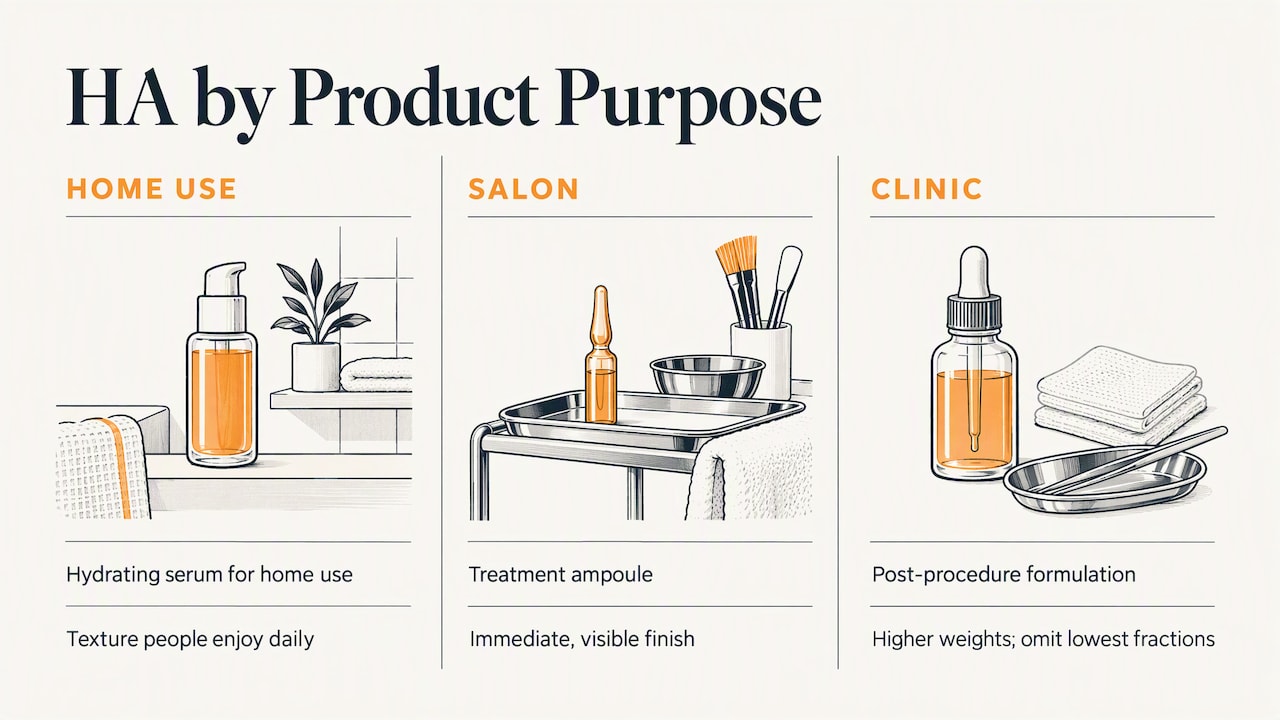
Because we work collaboratively through R&D rather than handing over a catalogue formula, we start from the customer, the claim you want to make and the market trends you are aiming at, then choose the HA grades to match. We also encourage brands to hold their claims to what the evidence supports: hydration, smoothing and a better skin feel, not miracle outcomes.
Our GMP certification from Singapore’s HSA matters here in a very practical way. Consistent batches mean the HA behaves the same in the thousandth unit as in the pilot run. If that interests you, our overview of HSA GMP and skincare manufacturing standards sets out what the standard involves.
— Edmund
Which size for which product
Use this as a starting point for a brief, not a fixed recipe.
| Product type | Priority | Suggested approach |
|---|---|---|
| Daily hydrating serum | Instant feel plus lasting hydration | Multi-weight blend, high and medium grades leading |
| Moisturiser or cream | Seal-in and comfort | HMW film-former plus a smaller fraction; hydrate powder as a gel first |
| Sheet mask or ampoule for salons | Visible plumpness during treatment | Blend with a deeper-acting fraction, tested on your target skin types |
| Sensitive or post-procedure line | Calm, low irritation risk | Favour higher weights; discuss low fractions carefully with a formulator |
| Eye area product | Light texture, fine-line smoothing | Lower-viscosity blend that avoids heavy tackiness |
For salons, see our guides on professional salon skincare manufacturing and the needs of professional skincare for salons. For clinics, we cover aesthetic skincare products for clinics in Singapore.
Singapore rules to plan around
If you sell in Singapore, the HA grade you choose sits inside a regulated product. Cosmetic products fall under the Health Products (Cosmetic Products, ASEAN Cosmetic Directive) Regulations, and every ingredient must be permitted under them. The Health Sciences Authority explains how to notify a cosmetic product before you supply it.
The stakes are real. Under the regulations on Singapore Statutes Online, supplying an un-notified cosmetic product is an offence punishable by a fine of up to $20,000 and/or 12 months’ imprisonment. Custom formulations for patients under a medical practitioner’s care are exempt from this particular notification requirement. The rules were amended again in 2024, effective 1 November 2024, as set out in the Amendment Regulations 2024. Check the current text, or ask the HSA, before you finalise a formula and its claims, because a claim that pushes a product towards a therapeutic purpose changes how it is treated.
Two practical consequences for your HA brief:
- Confirm early that every ingredient in the blend is permitted and that your intended claims are cosmetic ones.
- Keep technical documents, such as certificates of analysis for the HA grades, organised, since you will need them for your own records.
Working with us on an HA-based product
We are an OEM/ODM skincare manufacturer in Singapore. We take a product from concept through design, customised formulation, quality control and packaging, for home-use lines, professional salon ranges and aesthetic or doctor’s formulations. If an HA serum or cream is on your roadmap, bring us your target customer, texture preference and claims, and we will build the formulation with you.
Start with our skincare product development service page, browse the full list of services, or read the seven steps to launch private label cosmetics in Singapore for the typical path from idea to shelf. Choosing between OEM and ODM first? Our comparison of OEM versus ODM skincare manufacturing will help.
A short brief checklist
Before you contact any manufacturer, write down:
- The product format: serum, cream, mask, ampoule.
- The customer and skin type, including whether sensitivity is a concern.
- The claims you want to make, kept to hydration and skin feel.
- The texture you want: light and watery, or cushioned and rich.
- The packaging, since pumps, droppers and sachets affect viscosity and dosing. See our notes on skincare packaging options for Singapore brands.
- Your target launch timing and selling market.
FAQ
What is the best molecular weight for hyaluronic acid?
There is no single best size. For skincare, a multi-weight blend is generally the most sensible choice: high molecular weight HA for surface hydration and feel, with lower fractions for deeper hydration. The right proportions depend on the product type and the skin it is designed for.
Is low molecular weight hyaluronic acid better?
Not automatically. HA below 100 kDa penetrates skin more readily, but research suggests fragments below 50 kDa can act as a pro-inflammatory signal, so the lowest weight is not the safest or most effective choice. Anyone with reactive skin should discuss low-weight serums with a dermatologist.
What does high molecular weight hyaluronic acid mean?
It refers to long HA chains, generally above 700 kDa and often 1 MDa or more. They sit on the skin’s surface, form a moisture-holding film and give a smooth, silky feel. They are useful precisely because they stay on the surface.
How can you tell the molecular weight of the HA in a product?
Usually you cannot from the label, because ingredient lists show the name, such as sodium hyaluronate, not the size. Brands that use several grades sometimes state them, and a manufacturer or raw material supplier can provide the figure and the measurement method on a certificate of analysis. Remember that the figure is an average of many chain sizes.
Sources
- Hyaluronic Acid in Topical Applications: The Various Forms and Biological Effects of a Hero Molecule in the Cosmetics Industry, PMC
- Hyaluronic Acid: The Influence of Molecular Weight on Structural, Physical, Physico-Chemical, and Degradable Properties of Biopolymer, PMC
- Clinical Evaluation of Next-generation, Multi-weight Hyaluronic Acid Plus Antioxidant Complex-based Topical Formulations, PMC
- Designing topical hyaluronic acid technology: Size does matter, eScholarship
- Methods for Determining the High Molecular Weight of Hyaluronic Acid: A Review, MDPI
- Hyaluronic acid for skin: Benefits, how to use it, and side effects, Harvard Health
- Cosmetic products, Health Sciences Authority
- Health Products (Cosmetic Products, ASEAN Cosmetic Directive) Regulations, Singapore Statutes Online
- Health Products (Cosmetic Products, ASEAN Cosmetic Directive) (Amendment) Regulations 2024, Singapore Statutes Online