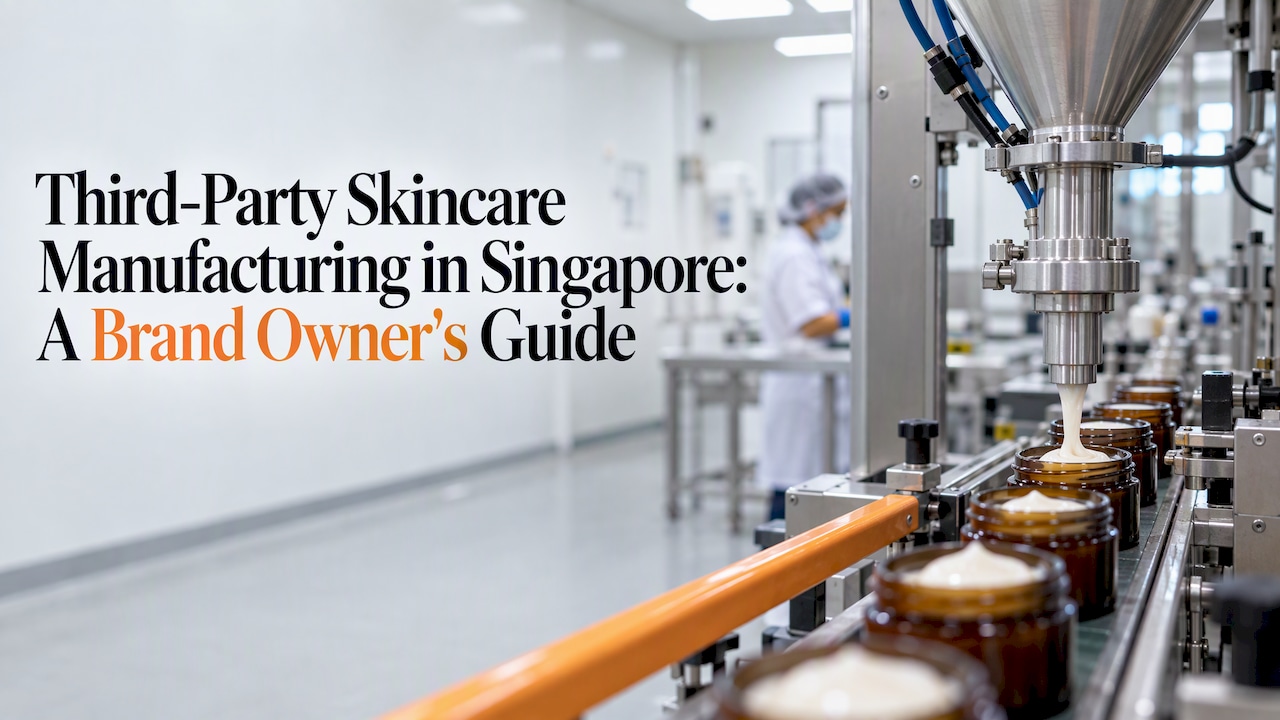
Third-party skincare manufacturing means you hire an outside factory to formulate, produce and often package products that you sell under your own brand. In Singapore, the factory makes the product, but the legal responsibility for it sits with the local company that supplies it. Choosing the right model (white label, ODM or OEM) and the right manufacturer therefore decides your costs, your timeline and your regulatory exposure.
This guide is for entrepreneurs, salon owners and clinic practitioners who want to launch or extend a skincare line. It covers the three manufacturing models, what the Health Sciences Authority (HSA) expects, how to vet a factory, and what to prepare before your first brief.
TL;DR
- Third-party manufacturing comes in three tiers: white label (ready-made formulas), ODM (a factory’s formula, adapted to you) and OEM (fully custom). Cost, minimum order quantity (MOQ) and lead time rise with each tier.
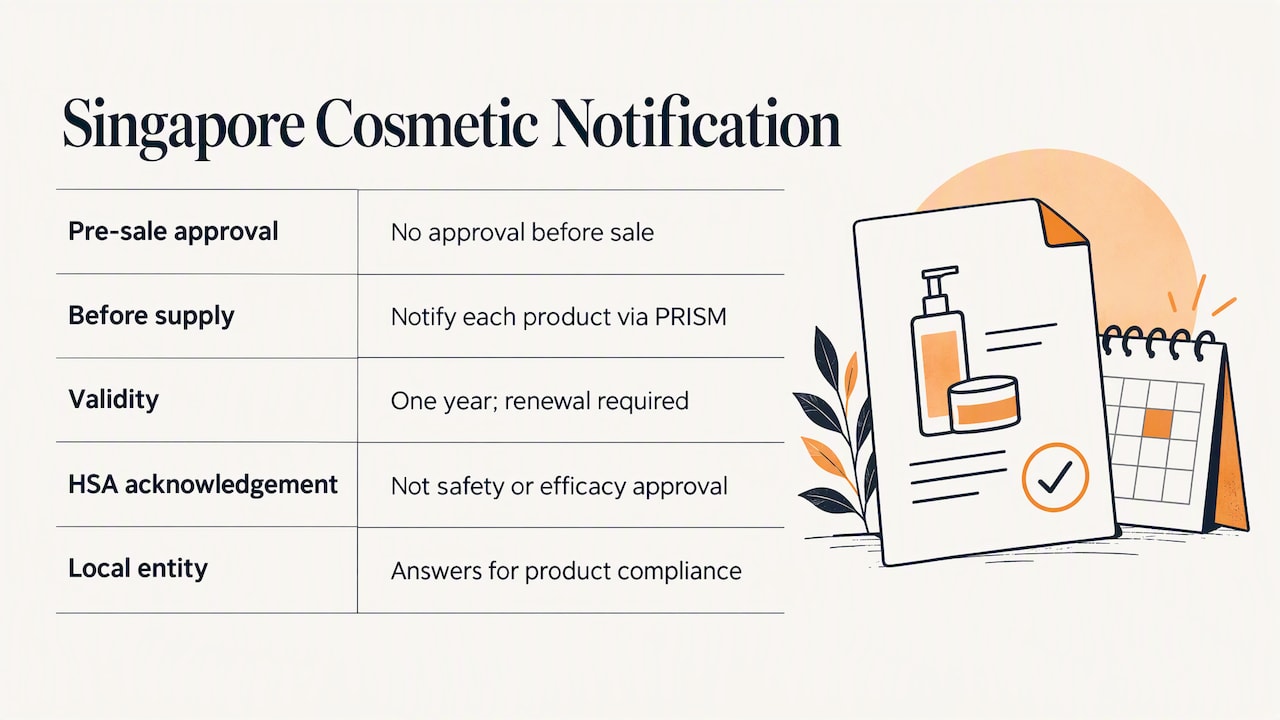
- Singapore has no pre-market approval for cosmetics, but every product must be notified to HSA through PRISM before sale, and the notifying local entity carries the liability.
- GMP certification is voluntary for Singapore manufacturers, yet it is the clearest proof of a working quality system. Ask for the certificate and for batch records.
- Starting with ODM lets you test the market with moderate volumes before you commit to full OEM.
- Prepare your Product Information File (PIF) early. It is the biggest cause of avoidable delay.
Table of Contents
- What third-party skincare manufacturing actually covers
- White label, ODM or OEM: which model fits you
- Who is responsible in Singapore: the rule most newcomers miss
- What to check before you sign with a manufacturer
- A realistic project timeline
- Our perspective: treat the first batch as the start of a relationship
- Working with Harmony Skin Lab
- FAQ
- Sources
What third-party skincare manufacturing actually covers
The phrase is used loosely. In practice, a third-party manufacturer can handle some or all of these stages:
- Formulation and R&D: creating or adapting the formula, then running stability and compatibility checks.
- Production: mixing, filtration, filling and, where needed, sachet or cellophane wrapping.
- Quality control: raw material checks, in-process testing and batch release.
- Packaging and design: bottles, jars, cartons, labels and artwork.
- Distribution support: getting finished goods to your warehouse or salon.
You keep the parts that make the business yours: the brand, the positioning, the customers and the marketing. The factory keeps the equipment, the chemists and the production line. For a start-up, that avoids a large capital outlay. For an established salon or clinic, it turns a treatment philosophy into a product you can retail or use in-room.
White label, ODM or OEM: which model fits you
An Alibaba.com seller guide to skincare configuration for Southeast Asia sets out three tiers for brands entering the Singapore market. Treat its figures as indicative ranges rather than quotes, since every manufacturer prices differently.
| Model | What you get | Typical fee | Typical MOQ | Typical timeline |
|---|---|---|---|---|
| White label | Ready-made formula, your label | $0 to $500 | 100 to 500 units | 2 to 4 weeks |
| ODM | Existing formula, modified to your brief | $1,000 to $5,000 | 1,000 to 5,000 units | 4 to 8 weeks |
| OEM | Fully custom formula built from your concept | $5,000 to $10,000+ | 3,000 to 10,000+ units | 8 to 16 weeks |
Those are the guide’s ranges, and they are not Harmony Skin Lab prices. We do not publish a price list, because cost depends on the formula, the ingredients, the packaging and the volume.
White label: fastest, least distinctive
You pick a formula from the factory’s catalogue and add your branding. It suits a quick pilot. The trade-off is that other brands may sell a very similar product, and you may not own the formula documentation. That matters later, as the section on the Product Information File explains.
ODM: the practical middle
In original design manufacturing, the factory brings a tested base and develops it with you: texture, active ingredients, fragrance, claims. You get a product that feels distinct without paying for a formula built from zero. The Alibaba guide’s analysis of Southeast Asian trends points the same way: many successful brands begin with ODM to gather market feedback, then move to OEM once demand is proven. For a deeper comparison, see our page on OEM versus ODM skincare in Singapore.
OEM: full control, higher commitment
OEM means the formula is built around your concept and, typically, belongs to your brand’s development file. It suits brands with a clear point of difference, such as a particular active, a skin concern or a clinical protocol. The cost is higher MOQs and a longer runway, so cash flow and shelf life need planning. Our overview of how custom skincare formulation works from concept to production walks through the stages.
A simple way to decide
- Testing an idea with limited cash: white label or low-MOQ ODM. Our note on low MOQ skincare manufacturing for new beauty startups explains the options.
- Have a brand story but not a formula: ODM.
- Have a formula concept, a proven customer base or a clinical protocol: OEM.
- Run a salon or clinic: look at a professional line built for treatment rooms, such as professional salon skincare manufacturing or aesthetic skincare products for clinics in Singapore.
Who is responsible in Singapore: the rule most newcomers miss
Singapore does not approve cosmetics before they go on sale. According to the HSA regulatory overview, products must comply with the Health Products Act and the Cosmetic Products regulations, and dealers must notify each product through the PRISM portal before supplying it. The notification is valid for one year and must be renewed, as the HSA notification page states. To submit, the HSA steps include registering a local entity with ACRA, a Corppass account and a CRIS account.
Two consequences follow.
The notification is a record, not an endorsement. An acknowledgement from HSA does not mean the regulator has judged your product safe or effective. The HSA submission guidance describes a duty on manufacturers and importers to notify, and the local responsible entity answers for the product’s compliance.
Outsourcing production does not outsource liability. HSA’s advisory for suppliers of cosmetic products tells suppliers to work with reputable and reliable manufacturers, importers and distributors, because the products directly affect users’ safety. If a batch contains a prohibited or undeclared ingredient, the brand’s local company is the one answering to the regulator. That is why the vetting steps below matter more than the unit price.
If you are selling medical or clinic-only formulations, speak to a regulatory professional or to HSA directly about whether your product still counts as a cosmetic. Claims that go beyond cosmetic effects can change how a product is regulated.
What to check before you sign with a manufacturer
1. GMP status and what it really proves
HSA runs a voluntary GMP certification scheme for cosmetic products made in Singapore, and notes that manufacturers here do not need a manufacturer’s licence. Because it is voluntary, a certificate is a deliberate choice by the factory to be audited. The programme follows the ASEAN Cosmetic Directive and ISO 22716, covering quality systems, personnel training and batch traceability.
Ask to see the certificate, check its validity date, and ask which site and which product categories it covers. For more background, read our seven facts about HSA GMP and skincare manufacturing standards and eight benefits of a GMP skincare manufacturer in Singapore.
2. Raw material transparency
Ask whether the factory will provide a Certificate of Analysis for raw material batches, not just for the finished product. Undeclared contaminants or prohibited substances are the brand’s problem in Singapore, so you want documentation that traces ingredients back to their source.
3. Audit, do not just sample
A good sample proves the factory can make one good batch. It does not prove that batch 20 will match. Visit the site or request an audit, ask for proof of ongoing compliance such as valid ISO 22716 documentation, and request batch records for a comparable product.
4. Documentation you will own
A Product Information File holds ingredient lists in INCI nomenclature, safety assessment, manufacturing specifications, stability data and substantiation for claims. GOL Solution’s registration guide for cosmetics in Singapore stresses that having this file organised before notification means you can answer a data request without delay. It also warns that moving from white label to custom OEM brings a heavier documentation burden, and that a white-label supplier may not transfer the underlying records to you. Ask in writing what documents you receive and whether they are yours.
5. Packaging compatibility
A formula that is stable in a lab jar can separate or discolour in a pump bottle. Ask who runs compatibility and stability testing and what the lab needs from you. Our page on packaging compatibility testing for cosmetics lists what to supply. If packaging is still undecided, eight skincare packaging options for Singapore brands is a useful starting point.
6. Communication and fit
The best-run projects treat the manufacturer as a development partner rather than a vendor. Ask who your day-to-day contact is, how revisions are handled and how many sample rounds are included. Our list of nine questions to ask before choosing a skincare manufacturer and the guide on how to choose an OEM skincare manufacturer give you a ready checklist.
A realistic project timeline
Using the Alibaba guide’s ranges, production alone takes 2 to 4 weeks for white label, 4 to 8 for ODM and 8 to 16 for OEM. These do not include everything. Add time for:
- Brief and concept: defining the target skin concern, texture, claims and price point.
- Sample rounds: usually more than one.
- Packaging lead time: custom bottles and printed cartons often take longer than the formula.
- Notification: there is no approval wait, so preparation, not regulator review, sets the pace. Firms that have their PIF ready face fewer delays, as the GOL Solution guide notes.
Work backwards from your launch date and leave a buffer. A first run that arrives a week before a campaign is a first run you cannot fix.
Our perspective: treat the first batch as the start of a relationship
We are an OEM and ODM skincare manufacturer in Singapore, and the same pattern repeats in the projects we see. Brands that struggle usually did not choose the wrong formula. They chose a factory purely on price, skipped the documentation conversation, and discovered later that they could not prove what was in their own product.
Our advice is to be direct about three things at the start. First, what you are really selling: a skin concern, a treatment, a sensory experience. That drives the formula more than any ingredient list. Second, what volume you can sell through before the product ages on the shelf. Third, who holds the paperwork. We work with clients on research and development so that products fit current market trends and customer needs, and our GMP certification from HSA means production follows a documented quality system. We cover the thinking behind that in how research and development guide OEM skincare production.
If you are unsure, start smaller. A well-built ODM product with honest customer feedback teaches you more than a large OEM run based on guesses.
— Edmund
Working with Harmony Skin Lab
We support private label brands, salons and medical professionals with formulation, quality control, design and packaging, and distribution. Our product lines include home-use essential skincare, professional salon skincare, aesthetic and doctor’s formulations, massage oils, essential oils and natural distillates. See the full list on our services page, browse the product lines, or read about our private label skincare services in Singapore. To discuss a brief, start from our homepage.
FAQ
Is third-party skincare manufacturing the same as private label?
They overlap but are not identical. Third-party manufacturing describes who makes the product. Private label usually means a product sold under your brand, often from a factory’s existing formula, while OEM and ODM describe how much of the formula is designed for you.
Do I need HSA approval before selling skincare in Singapore?
No pre-market approval is required, but you must notify each product through PRISM before supplying it, and renew the notification yearly. The HSA regulatory overview sets out the rules. The notification does not mean HSA has endorsed the product.
Does my manufacturer need GMP certification?
For domestic sale it is not mandatory, as the HSA GMP page makes clear. It is still a strong sign of a controlled process, and it supports export. Ask to see the current certificate rather than accepting a verbal claim.
How much does it cost to start?
It depends on the model. The Alibaba guide cites development fees from $0 to $500 for white label and above $5,000 for OEM, with MOQs rising alongside. Ask each manufacturer for a written quote covering formulation, testing, packaging and minimum order.
Sources
- Skincare Product Configuration Guide: Certification, Packaging and OEM/ODM Options, Alibaba.com Seller Blog
- Regulatory overview of cosmetic products, Health Sciences Authority
- Submit notification and re-notification, Health Sciences Authority
- Submit notification and re-notification (product notification guidance), Health Sciences Authority
- Good Manufacturing Practice certification for cosmetic products, Health Sciences Authority
- Cosmetics Registration Singapore: A Complete Guide for Foreign Brands, GOL Solution