There is no single price for making skincare in Singapore, because a quote is built from five things: the formula, the ingredients, the packaging, the batch size and the testing. One published Singapore launch case reported quotes of S$8 to S$12 per unit at a 500-unit minimum order from contract manufacturers, which is a useful anchor but not a promise for your product. The way to get a number you can trust is to know what goes into the quote and brief a manufacturer on each part. At Harmony Skin Lab we quote per project, because the formulation, packaging and volume differ every time, so this guide shows you how to read and compare a quote.
TL;DR
- Expect a per-unit price that reflects formulation, ingredients, packaging, filling and testing, not just “the liquid in the bottle”.
- Order quantity is the biggest lever: small first runs cost more per unit but limit your stock risk.
- Budget beyond production: company set-up, HSA notification, design, artwork and stock you have yet to sell.
- A single Singapore case study saw S$8 to S$12 per unit at 500 units, with total launch spend of S$14,220. Treat it as one data point, not a rate card.
- Give your manufacturer a clear brief (product type, claims, target price, packaging, volume) and the quote becomes comparable and accurate.
Table of Contents
- What a skincare manufacturing quote is made of
- What drives the price up or down
- A worked example from a Singapore launch
- Costs beyond the factory
- How to get a quote you can compare
- Why working with one manufacturer controls cost
- Talk to us about your project
- FAQ
- Sources
What a skincare manufacturing quote is made of
When a manufacturer gives you one price per unit, it bundles several costs. Asking for them separately, or at least understanding them, is how you spot where the money goes.
Formulation and R&D. A formula is the recipe: which actives, emulsifiers, preservatives and textures, in what percentages. A brand-new formula built around your brief takes development time and trial batches. A ready-made base adjusted to your needs takes less. Harmony Skin Lab offers R&D and customised formulation as part of its manufacturing service, with the aim that the product fits your market and customers. You can read how that stage works in our guide to how research and development guide OEM skincare production.
Raw materials. Ingredients are usually the largest variable. A basic moisturiser built on common emollients and humectants costs far less per kilo than a serum with concentrated actives or botanical extracts. The more premium your claims, the more your formula costs.
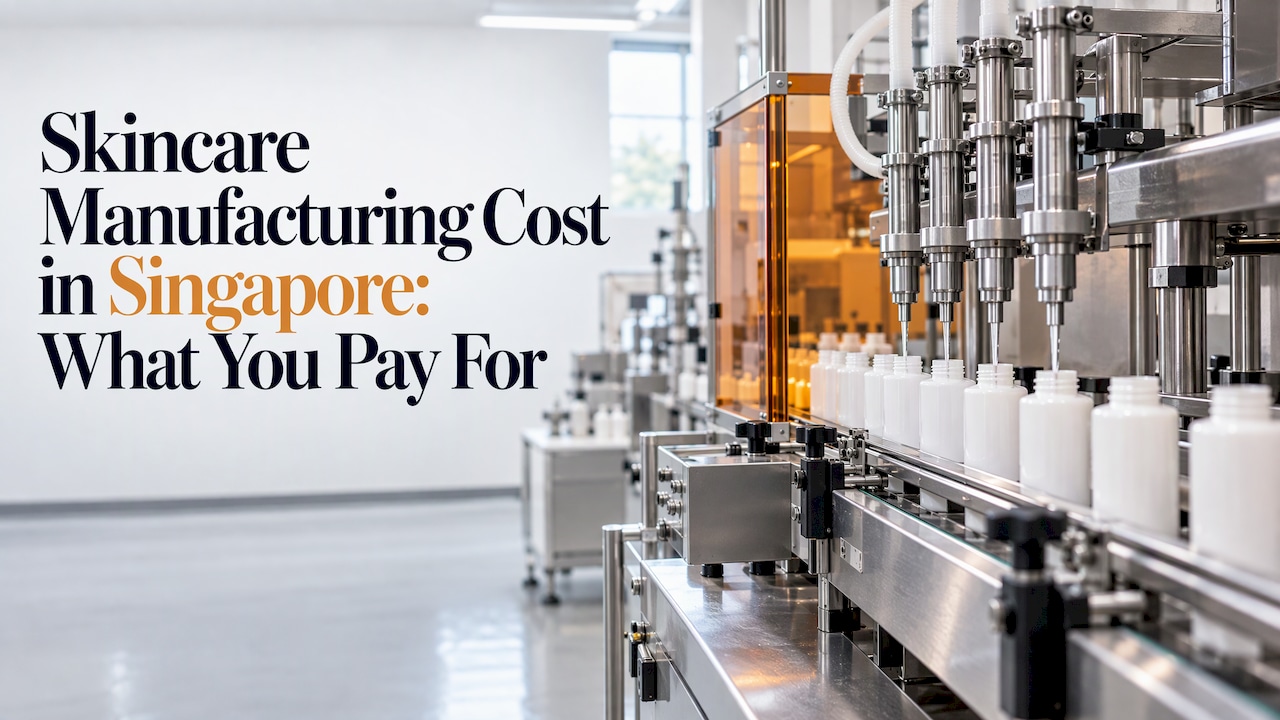
Production and filling. This covers mixing, filtration, filling and capping. Filtration and filling are services we offer directly, including sachet packaging and filling for single-use formats and cosmetic filling for Singapore skincare brands.
Packaging. Bottle, pump, jar, cap, label and outer carton. Packaging can cost as much as the formula in a mid-range product, and a custom mould or special finish raises the minimum quantity you must buy. Our guides to choosing skincare packaging and packaging options for Singapore brands walk through the choices.
Quality control and stability testing. Stability testing checks that the product stays safe and unchanged over time and in different temperatures, and quality control checks each batch. Both are part of what you pay for, and both protect your brand. See stability testing and QC services.
Design and artwork. Label design, printing and carton artwork. If you need a designer, this is a separate line, which we cover under packaging design and printing.
What drives the price up or down
Order quantity
The minimum order quantity (MOQ) is the smallest batch a manufacturer will run. Setting up a production line, cleaning it and testing a batch cost roughly the same whether you make 500 units or 5,000, so the cost per unit falls as volume rises. The trade-off for a new brand is cash tied up in stock. A smaller first run lets you test the market before committing. Our guides on low MOQ manufacturing for new beauty startups and small-batch skincare manufacturing in Singapore explain how to size that first run.
Custom or existing formula
A custom formula (ODM, original design manufacturing, where the manufacturer develops the product with you) costs more up front than relabelling an existing base, but the formula is distinctive. OEM (original equipment manufacturing) means the manufacturer produces to your own specification. Which route suits you depends on how different you need to look from competitors on the shelf. For a comparison of starting routes, see private label skincare options for startup brands.
Product type and positioning
A home-use essential range, a professional salon line and a doctor’s formulation sit at different points on cost. Salon and aesthetic products often use more concentrated actives and larger professional sizes, while home-use ranges are built for retail packaging and shelf appeal. We manufacture all three: home-use essential skincare, professional salon skincare and aesthetic or doctor’s formulations, as well as massage oils, essential oils and natural distillates. For salons, professional salon skincare manufacturing shows what a line involves, and clinics can look at aesthetic skincare for clinics in Singapore.
Packaging complexity
Stock bottles with a printed label are the cheapest route. Custom shapes, metallic finishes, boxes with inserts and multi-component pumps all add cost and lead time. If you are watching the budget, spend on the parts the customer touches and sees most.
A worked example from a Singapore launch
A published case study of a solo founder in Singapore gives a rare set of real numbers. With a S$15,000 budget, she collected quotes from five Southeast Asian contract manufacturers at S$8 to S$12 per unit for 500 units. The manufacturer she chose cost S$5,500 for 500 units, which is S$11 a unit. Company registration and HSA-related legal set-up added S$1,200 and took three weeks. In total she spent S$14,220 and sold 142 of the 500 units in 90 days.
Three lessons stand out, whatever your product:
- The production invoice was well under half of the total spend. The rest went on set-up, design, marketing and everything around the product.
- Unit price is only half of the economics. The same case reports a break-even of about 1,200 units on the S$15,000 investment, which is more than double the first run. Plan the second batch before you place the first.
- Selling stock matters as much as making it. Unsold units are a cost you have already paid.
This is one founder’s launch, with her product and her channel. Your own quote will depend on your formula and packaging, so use these figures to sense-check the order of magnitude, not to set your budget.
Costs beyond the factory
New brands often forget that manufacturing is one line in a launch budget.
A Singapore entity. To notify cosmetics to the Health Sciences Authority (HSA), you need a local entity registered with ACRA, a Corppass account and access to HSA’s PRISM system. The ACRA registration and set-up in the case above cost S$1,200.
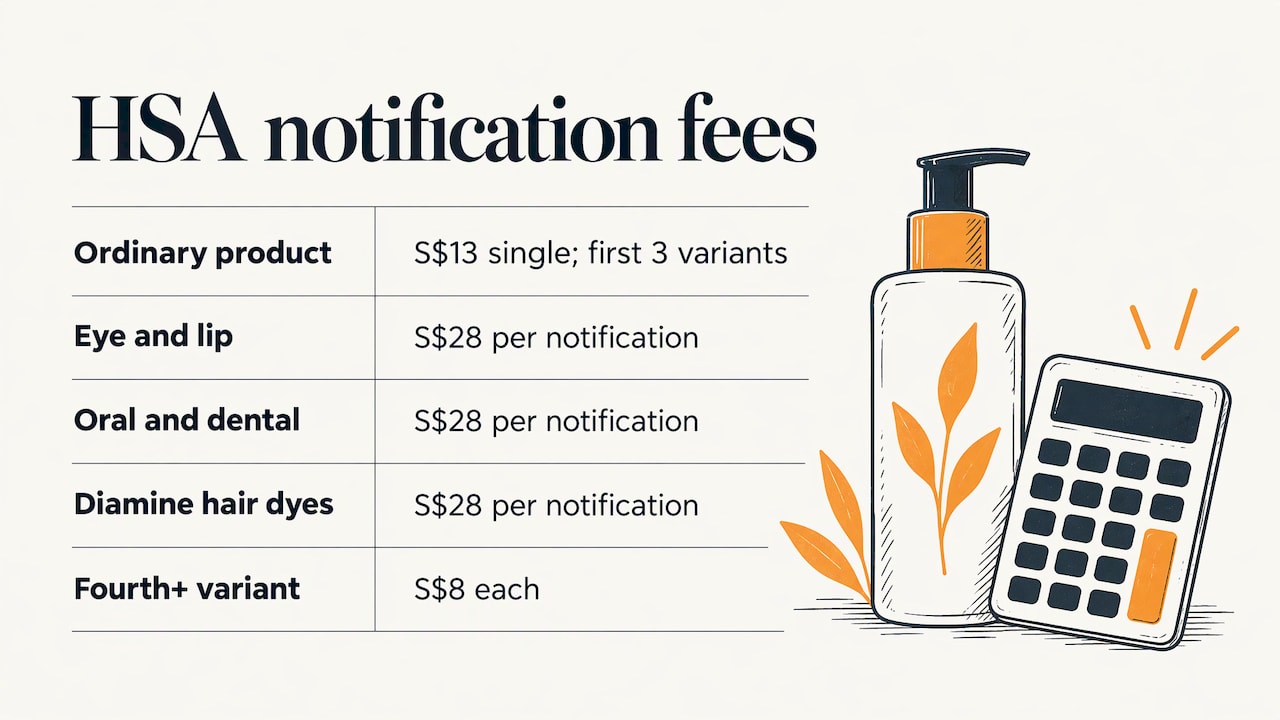
HSA product notification. Singapore does not pre-approve cosmetics, but you must notify each product to HSA before supplying it. Each notification is valid for one year, so you re-notify annually. Published fee schedules put an ordinary product at S$13 for a single product or each of the first three variants, S$28 for eye and lip products, oral and dental care and diamine hair dyes, and S$8 for each variant from the fourth onwards. Check the HSA fee page for the schedule when you file. The fee is small, but the preparation is not: your ingredients and labels must comply with the ASEAN Cosmetic Directive. Our practical guide to HSA cosmetic notification explains the steps.
Design and artwork. Logo, label and box design, if you do not have them ready.
Stock, storage and fulfilment. Cash sits in boxes until you sell. If you need help moving product, we also offer skincare distribution.
Marketing. Photography, samples, advertising and listings. The earlier case treated this as a large share of the budget.
How to get a quote you can compare
Manufacturers can only price what you describe. The more specific your brief, the tighter the quote, and the easier it is to compare two offers on the same basis. Prepare:
- Product type and format: cream, serum, cleanser, oil, sachet; size in millilitres or grams.
- Target customer and price point: retail, salon-professional or clinic use.
- Claims and key ingredients: for example hydrating, soothing or brightening. Claims shape both the formula and what you must be able to support.
- Packaging idea: stock or custom, and whether you need design and printing.
- Quantity: your first-run volume and a realistic second order.
- Timeline and launch date: so the schedule for development, testing and filling is realistic.
- Target cost per unit: a number to build the formula and packaging around.
Then ask what each quote includes: formulation, samples, stability testing, filling, packaging supply, labelling and delivery. Our list of nine questions to ask before choosing a skincare manufacturer covers the rest, and the seven steps to launch private label cosmetics in Singapore show where the quote sits in the whole launch.
Why working with one manufacturer controls cost
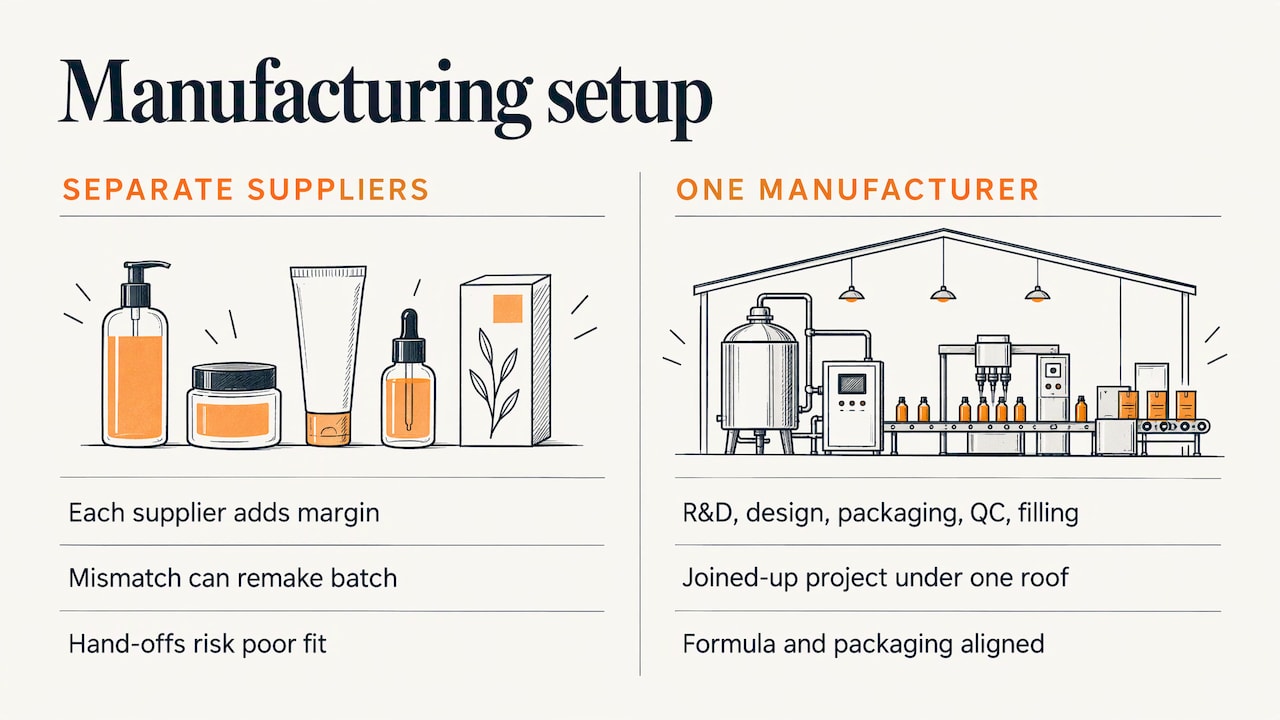
Cost leaks where hand-offs happen. If a formulator, a packaging supplier, a filler and a tester each work separately, each adds margin, and a mismatch (a formula that destabilises in the chosen pump, a label that does not fit the bottle) means a remade batch. Having R&D, design and packaging, quality control and filling under one roof is how we keep a project joined up. You can see the full list in seven end-to-end services in skincare contract manufacturing.
Certification matters for the same reason. Harmony Skin Lab holds GMP (Good Manufacturing Practice) certification from Singapore’s HSA, so your product is made under a documented quality system. More on what that means is in seven facts about HSA GMP and skincare manufacturing standards.
Our view: spend where the customer notices
We work with entrepreneurs, salons and medical professionals, and the first question is almost always “how much per unit?” We would rather start with “what is the product for?”. A salon line, a clinic formulation and a retail moisturiser are different products with different cost structures, and pricing them the same way produces a quote that is wrong for all three.
Our approach is collaborative. We develop the product with you, through research and development that follows market trends and your customers’ needs, then carry it through formulation, quality control and packaging. That joined-up route is designed to keep your budget on what shapes results and perception: a formula that performs, safe ingredients and packaging that suits your brand.
Our advice for a first launch is to decide your volume and positioning early, brief the whole product at once, and plan a second batch before the first is sold.
Edmund
Talk to us about your project
If you already know your product type, rough volume and target customer, we can scope it with you. Harmony Skin Lab manufactures in Singapore across formulation, design and packaging, filling, filtration and distribution, for private label, salon and medical lines. Pricing is project-based and unpublished, so send us your brief through our skincare R&D and manufacturing services page and we will build the quote around it.
FAQ
How much does it cost to manufacture skincare in Singapore?
It depends on the formula, ingredients, packaging and batch size. One published Singapore launch saw quotes of S$8 to S$12 per unit at 500 units. Your own price comes from a quote based on your brief, which we prepare per project.
Is a higher minimum order quantity always cheaper?
Per unit, yes, because setup costs are spread over more units. But a larger run ties up cash and risks unsold stock, so a new brand often does better with a smaller first batch. Our guide to low MOQ manufacturing helps you decide.
Do I have to register my skincare products in Singapore?
Yes. Cosmetics are not pre-approved, but each product must be notified to HSA before it is supplied, and the notification is valid for one year. You need a local entity registered with ACRA to file. See our HSA notification guide.
What should I budget besides production?
Allow for company set-up, HSA notification and renewal, design and artwork, marketing, and the stock you have not yet sold. In the case study above, the factory invoice was S$5,500 of S$14,220 total spend.
Sources
- How a Solo Founder in Singapore Used Claude AI to Launch a D2C Skincare Brand
- HSA: Submit notification and re-notification
- Selling Cosmetics in Singapore: HSA Product Notification Guide