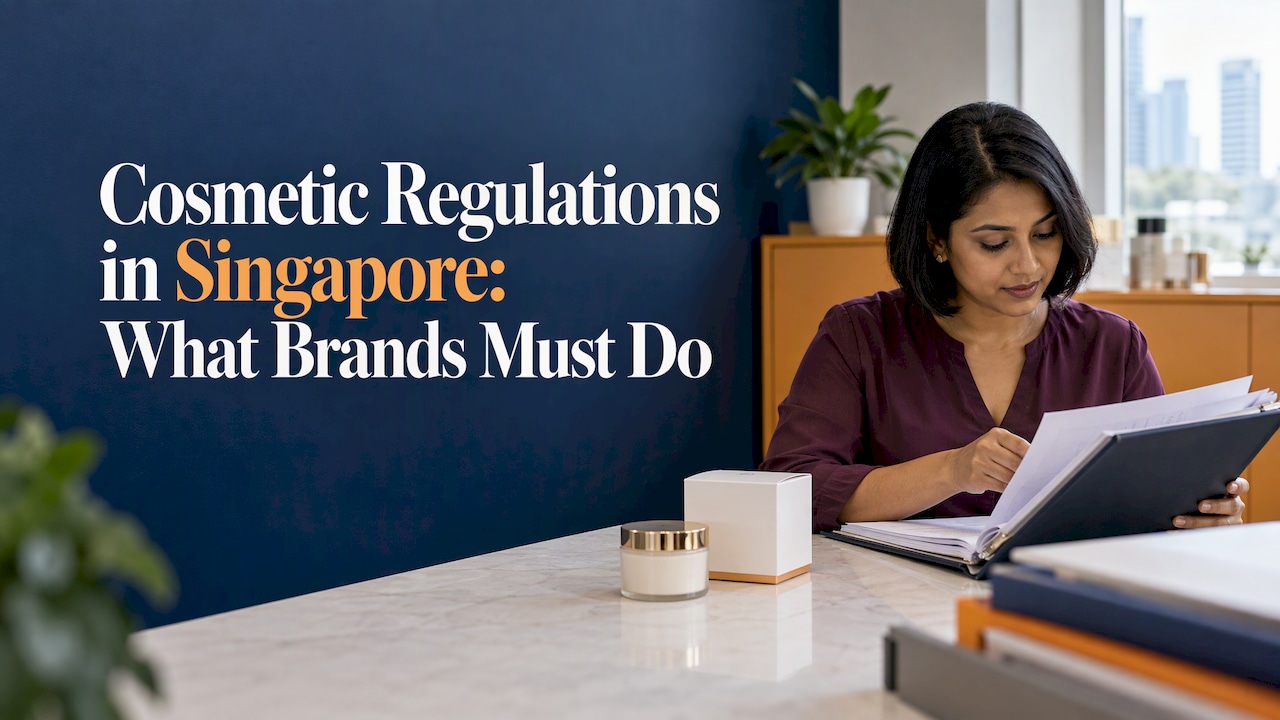
If you want to sell skincare in Singapore, the rule is simple: every cosmetic product must be notified to the Health Sciences Authority (HSA) before you supply it, and the labels, ingredients and records behind it must meet the ASEAN Cosmetic Directive. Notification is not approval, so the safety of the formula remains your responsibility. That is why the safest route is to start with a formulation and manufacturing process built around these rules from day one, which is how we work at Harmony Skin Lab, a GMP-certified OEM/ODM skincare manufacturer in Singapore.
This guide is written for founders, salon owners, clinic owners and private label buyers. It explains what the rules cover, the steps to follow before launch, and where brands most often lose time.
TL;DR
- Cosmetics in Singapore fall under the Health Products Act and its Cosmetic Products regulations, which apply the ASEAN Cosmetic Directive (ACD). HSA is the regulator.
- Each product variant must be notified through HSA’s PRISM system before you supply it. Notification lasts one year and must be renewed.
- Labels must be in English and carry a fixed set of particulars, including a full ingredients list and a local responsible company.
- Supplying without notification can lead to a fine of up to S$20,000, up to 12 months in prison, or both.
- Ingredient annexes are updated regularly (most recently in June 2026), so a formula that was compliant last year needs re-checking.
Table of Contents
- Which rules apply to cosmetics in Singapore
- What counts as a cosmetic
- How notification works
- Labelling requirements
- Ingredients, safety and claims
- Records, adverse effects and Good Manufacturing Practice
- What happens if you supply without notification
- A launch checklist for brand owners
- Our perspective
- Start a compliant range with us
- FAQ
- Sources
Which rules apply to cosmetics in Singapore
Cosmetics are regulated under the Health Products Act and the Health Products (Cosmetic Products, ASEAN Cosmetic Directive) Regulations 2007, which has been amended through 1 December 2025. The ACD is an ASEAN agreement that harmonises cosmetic rules across member states to reduce technical barriers to trade. HSA says Singapore implemented it on 1 January 2008.
In practice this means one set of ingredient lists, labelling rules and safety expectations that is shared across ASEAN, with Singapore-specific steps for notification and enforcement layered on top. For a brand planning to sell in more than one ASEAN market, that shared framework is useful, because a formula built correctly once is a much better starting point for the next country. Our overview of the ASEAN Cosmetic Directive for Singapore brands goes deeper on this.
The regulations carry an exemption worth knowing: they do not apply to cosmetics imported solely for re-export or made in Singapore solely for export. If you plan to sell on the Singapore market at all, even partly, treat the rules as applying to you.
What counts as a cosmetic
HSA defines a cosmetic by what it is for and where it goes. Under its regulatory overview, a cosmetic is a product intended for contact with external parts of the body (skin, hair, nails, lips) or the mouth, used to cleanse, perfume, change appearance, correct odour, protect or keep the body in good condition.
HSA’s classification guide lists examples that may be cosmetics: skin creams, facial masks, makeup, soaps, deodorants, hair care, shaving products, oral-care products, nail-care products and sunbathing products. Massage oils, body care and everyday skincare lines of the kind brands launch under private label sit in this territory.
The boundary matters just as much. HSA’s overview excludes injections, eye drops, tablets, capsules and drinks taken by mouth, and products intended for treatment, such as acne-treatment creams. A product that promises to treat a condition is not a cosmetic, and it cannot be put through cosmetic notification. If you are unsure which side your idea falls on, read our guide to cosmeceutical versus cosmetic before you fix the concept, because the claim you want to make decides the category.
This is also where marketing vocabulary causes trouble. Words such as “clean” or “non-toxic” sell well, but a label has to meet the legal particulars whatever words surround them. For how these terms read to shoppers, see this explainer on clean beauty label meanings.
Clinics have a specific exception. HSA lists products made to a medical practitioner’s specifications and supplied solely by that practitioner to patients among the cases that do not need notification, alongside promotional samples and products used only in research or development trials. If you are a doctor planning a branded range sold beyond your own patients, the exception no longer helps you, and the range should be treated as a notified cosmetic. Our page on aesthetic skincare for clinics in Singapore covers how clinic formulations are approached.
How notification works
Notification is the central step. HSA states that manufacturers and importers must notify each cosmetic product before supplying it in Singapore. This holds even when another company has already notified the same product from the same manufacturer.
The practical sequence looks like this:
- Check the formula and label against the ACD. Ingredients must be allowed, within their limits, and labelled correctly. This is the step where most delays start, so it is best done before a sample is approved, not after.
- Have a local registered entity. The notifier needs an ACRA-registered company in Singapore, plus Corppass (the national digital login for businesses) and a CRIS account (HSA’s company registration for its systems).
- Submit through PRISM. This is HSA’s online portal. Each variant needs its own notification; different pack sizes of the same variant do not.
- Wait for acknowledgement. Once HSA acknowledges the notification, you can begin supplying.
- Re-notify every year. Notification lasts one year, and you must renew it annually if you keep selling.
All of this is set out on HSA’s submission page. For a walkthrough from a brand’s point of view, see our practical guide to HSA cosmetic notification.
A useful variant rule: a shade, a fragrance or a changed formula counts as a different variant, so a range of eight lipstick shades is eight notifications, while the same cream in 30 ml and 50 ml jars is one. Plan your range with that count in mind, because it affects both your launch timeline and your yearly renewal workload.
One point that is easy to misread: HSA describes notification as a way to act quickly if a safety concern arises, not as an approval. Dealers remain directly responsible for the safety of what they sell. Acknowledgement on PRISM is therefore the start of your obligations, not proof that the formula is safe.
Labelling requirements
Labelling is where a private label brand is most visible to the regulator and to customers. HSA’s overview requires the label in English on the outer package, or on the immediate package when there is no outer package. You may add other languages if they are consistent with the English information.
The particulars HSA lists are:
- product name and function, and directions for use unless they are evident from the presentation
- a full list of ingredients
- country of manufacture
- name and address of the local responsible company or person
- net contents
- the manufacturer’s batch number
- manufacturing date or expiry date
- any applicable precautions
Two of these catch new brands out. The local responsible company line means your Singapore entity’s name and address must appear, which has to be settled before artwork is final. The batch number must be traceable to production, so it is a manufacturing decision as well as a design one.
Because label text has to be correct before printing, the order of work matters: finish the formula, confirm the ingredient list, then lock the artwork. Our notes on skincare packaging design and printing in Singapore and packaging options for Singapore brands show how to keep design and compliance moving together.
Ingredients, safety and claims
The ACD controls ingredients through annexes: lists of substances that are banned, restricted or permitted only as colourants, preservatives or UV filters. HSA tells dealers to check the current annexes regularly and make sure products meet current ingredient requirements. It also points to guidance on safety assessment, the Product Information File (PIF, the dossier that documents a product), ASEAN GMP, adverse-event reporting, labelling and claims.
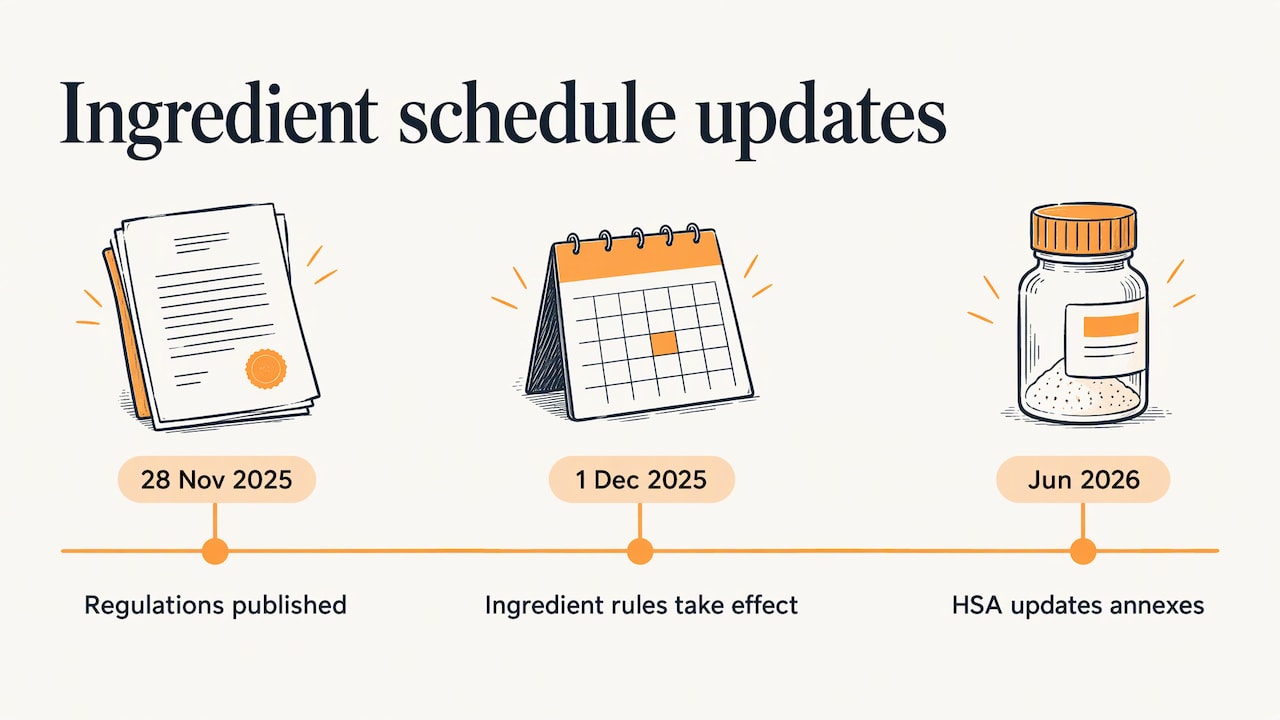
The annexes do change. HSA updated them in June 2026, and it notes that the ASEAN committees that handle amendments meet twice a year. Singapore also amended its ingredient schedules through regulations that were published on 28 November 2025 and took effect on 1 December 2025, covering substances such as octocrylene and formaldehyde release. If you launched a formula years ago, review it against the current annexes before you renew.
For a closer look at how ingredient choices are assessed, our cosmetic ingredient safety guide is the place to continue. If your product ships with a safety data sheet to trade customers, the SDS requirements for cosmetics in Singapore page explains what is expected.
Claims
What you say on the pack is regulated too. A claim such as “brightens” or “hydrates 24 hours” must be backed by evidence you can produce, and a claim that implies treating a disease moves the product out of the cosmetic category altogether. Write claims after the formula and testing, not before, and keep the supporting data with the product file. Our guide to cosmetic claims substantiation shows how to match claim wording to evidence.
Records, adverse effects and Good Manufacturing Practice
The regulations also ask for paperwork after the sale. Under the 2007 Regulations, supply records must include:
- the product name and notification number
- the date of supply
- the recipient’s name and address
- the quantity
- the lot, batch or serial identification
You must keep them for two years after supply.
Adverse effects have fixed deadlines. A report is due within seven days for an effect causing death or life-threatening harm, followed by a detailed report within eight days of the first. Cases involving hospitalisation or persistent or significant disability need a detailed report within 15 days of becoming aware of them. Set up an internal route for complaints from customers, salons and clinics so the clock can be met.
Good Manufacturing Practice (GMP) sits underneath all of this. It governs how a product is made, tested and traced, so that the batch you notified is the batch that reaches the shelf. Choosing a manufacturer with GMP certification from HSA makes your own records and traceability easier to maintain. We explain the standards in 7 facts about HSA GMP and skincare manufacturing.
What happens if you supply without notification
The penalty is concrete. For specified notification offences, such as supplying without the required notification or carrying on after the one-year period lapses, the 2007 Regulations set a maximum penalty on conviction of S$20,000, imprisonment of up to 12 months, or both.
There is an operational risk as well. HSA’s guidance states that firms must stop selling or withdraw a product suspected of posing a health risk, and that HSA carries out risk-based market sampling, testing and monitoring of adverse reactions. A recall after launch costs far more than a delayed launch, because stock, packaging and reputation are all tied up in it.
A launch checklist for brand owners
If you are building a range, work in this order:
- Define the product category. Cosmetic or treatment? Decide this from the claims you want to make.
- Set up the legal entity. Register with ACRA, and arrange Corppass and CRIS, so you can notify.
- Formulate within the annexes. Check each ingredient and its limit against the current ACD annexes.
- Test stability and safety. A product that separates or spoils at month six is a compliance problem as well as a quality one. See cosmetic stability testing.
- Prepare the label. Include every required particular, in English.
- Notify each variant on PRISM. Wait for acknowledgement before any sale.
- Keep records and calendar the renewal. Supply records for two years, notification renewal every year.
If you want the commercial side of this sequence, our 7 steps to launch private label cosmetics in Singapore joins the regulatory steps to formulation, packaging and production.
Our perspective
Most compliance problems we hear about from new brands do not start at notification. They start earlier, when a concept is fixed, a claim is promised to customers and artwork is ordered before anyone has checked the formula against the rules.
That is why we build collaboration into product development. Our R&D, formulation, quality control and packaging work sit under one roof in Singapore, and we hold GMP certification from HSA. When the people who formulate your product also see how it will be labelled and packaged, there are fewer surprises at the point of notification.
Our advice to a founder, a salon or a clinic is the same: decide the category and the claims first, formulate inside the current ACD annexes, and treat the label as part of the formula. Regulations in this field move twice a year, so your manufacturing partner should be one that follows them.
Edmund
Start a compliant range with us
We work with entrepreneurs, businesses, salons and medical professionals who want private label, professional or medical skincare lines. Our services cover R&D and manufacturing, design and packaging, and distribution, and our product lines include home-use essential skincare, professional salon skincare and aesthetic or doctor’s formulations. You can see the full list on our services page.
If you are comparing routes, our guide to OEM versus ODM skincare manufacturing explains how each model affects who owns the formula and how much of the development you direct.
FAQ
Does HSA approve cosmetic products before they are sold?
No. HSA requires notification, not approval. Once your PRISM submission is acknowledged you can supply the product, but dealers remain directly responsible for its safety and for meeting the labelling and ingredient rules.
Do I have to notify every size and every shade?
Every variant needs its own notification, but pack sizes of the same variant do not. A new shade or fragrance counts as a variant, while a larger jar of the same cream does not.
How long does notification last?
Notification is valid for one year. If you continue to supply the product after that, you must re-notify, and supplying after the period lapses is among the offences carrying a maximum penalty of S$20,000, 12 months in prison, or both.
Can I sell an acne-treatment cream as a cosmetic?
No. HSA’s classification excludes products intended for treatment, such as acne-treatment creams, from the cosmetic category. A cosmetic can be described by its appearance and care benefits, so the claims you plan should be checked before you commit to a formula.
Sources
- Health Products (Cosmetic Products, ASEAN Cosmetic Directive) Regulations 2007, Singapore Statutes Online
- Supply records and adverse effect reporting, 2007 Regulations
- Notification offences and penalties, 2007 Regulations
- Amendment Regulations 2025, Singapore Statutes Online
- Regulatory overview of cosmetic products, HSA
- Cosmetic product classification guide, HSA
- Submit notification and re-notification, HSA
- ASEAN Cosmetic Directive, HSA
- How cosmetic products are regulated by HSA