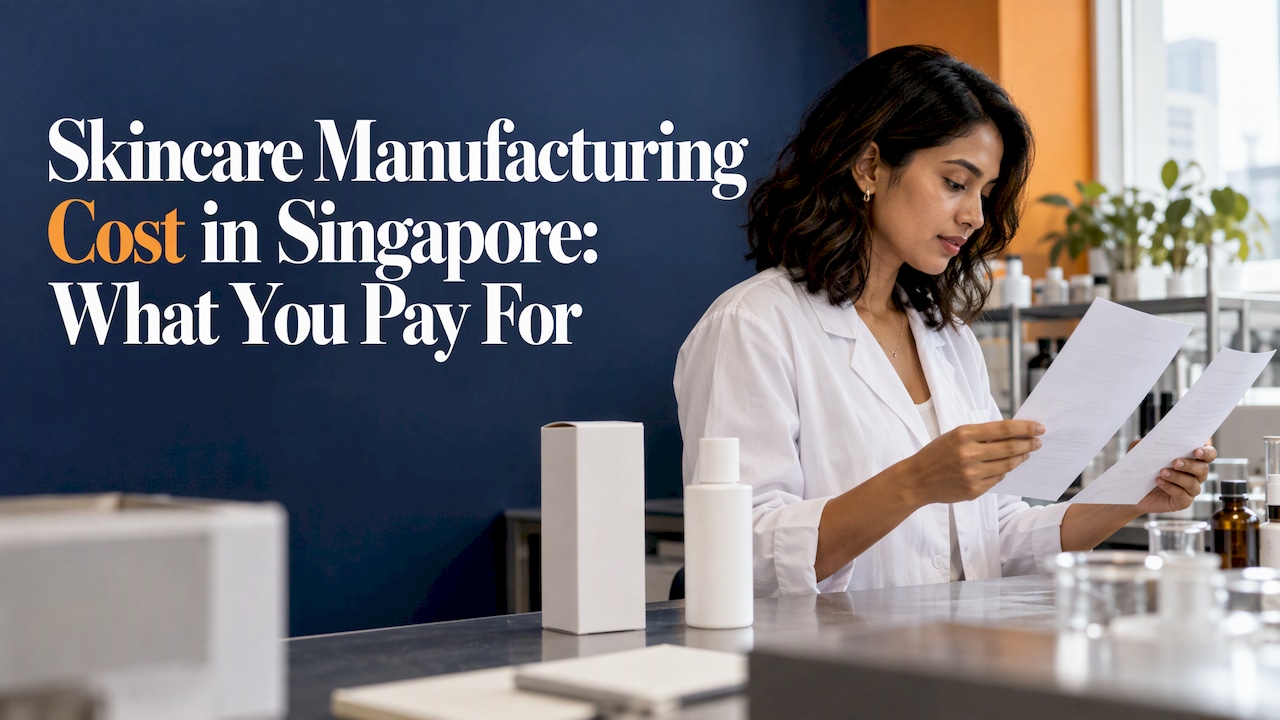
Skincare manufacturing cost is not one number. It is the sum of formulation, raw materials, filling, packaging, testing, regulatory fees and the minimum order quantity (MOQ, the smallest run a factory will accept). The quickest way to a reliable figure is to brief a manufacturer on one product, one pack size and one volume, then compare the quote line by line. At Harmony Skin Lab we publish no price list, because the same cream can cost very different amounts depending on those three choices. What we can give you here is the full map of the costs, the Singapore fees that are fixed and published, and a method for building a budget you can defend.
TL;DR
- Your per-unit cost is driven by five things: formula complexity, ingredient grade, packaging, order volume and testing. Packaging and MOQ often move the total more than the formula does.
- The fixed Singapore costs are small and published: HSA charges SGD 13 or SGD 28 per notification, depending on the product type, renewed every year.
- Development, safety and stability work is paid once per product, then spread across the units in the run. A small run carries more of it per unit.
- Ask every manufacturer to quote the same specification so you compare like with like, and ask what is included before you compare totals.
- A project with one manufacturer covering formulation, filling and packaging is easier to budget than three separate suppliers.
Table of Contents
- What a skincare manufacturing quote actually contains
- How order volume changes your cost per unit
- Singapore regulatory costs you can fix in your budget
- Costs that arrive after the first run
- How to build your own skincare manufacturing budget
- Costs by who you are
- One partner for development, filling and packaging
- Our view on cost
- FAQ
- Sources
What a skincare manufacturing quote actually contains
Most quotes break into two kinds of cost. One-off costs are paid once per product: formulation or adaptation of a base formula, samples, stability and safety work, artwork and packaging tooling. Per-unit costs repeat with every batch: ingredients, filling, the container, the carton, the label and quality checks.
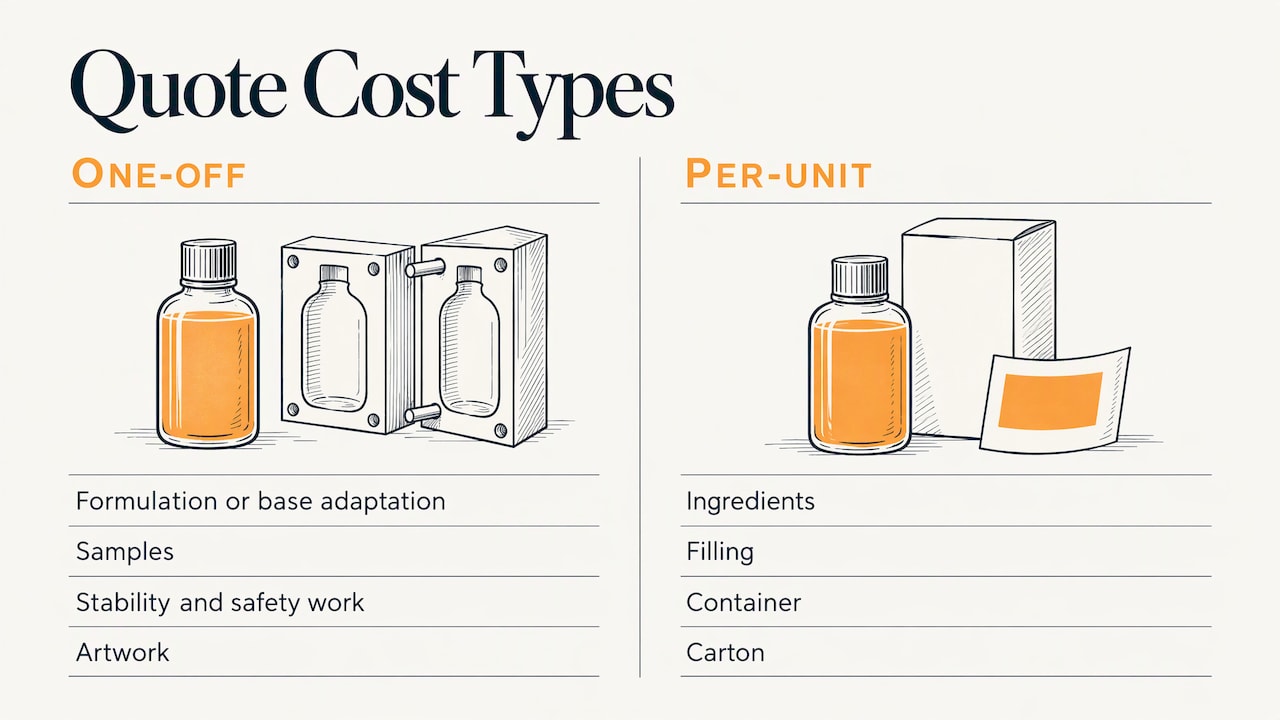
The mistake new brands make is to compare only the per-unit figure. A low per-unit price with a high MOQ means a large cash commitment up front. A higher per-unit price with a low MOQ may leave you with less stock to sell and less money at risk. Judge a quote by the cash you need before the first sale, not by the unit price alone.
Formulation and development
This is the chemist’s time, trial batches and revisions. There are three routes, and they sit at different cost levels:
| Route | What it means | Cost behaviour |
|---|---|---|
| Ready base formula (private label) | You choose from an existing formula and adjust fragrance, texture or claims | Lowest development cost, fastest to market |
| Adapted formula | An existing base is modified with chosen actives or sensory changes | Moderate development cost, some trial rounds |
| Fully custom formula (ODM or OEM development) | A new formula built to your brief | Highest development cost, longest timeline, most distinctive product |
OEM means the manufacturer makes a product to your specification. ODM means the manufacturer also designs the formula. If you want to see how a custom project moves from concept to production, our guide on how custom skincare formulation works walks through the stages, and how to develop a skincare formulation that sells covers the brief itself.
Ingredients
Ingredients are usually the most variable line. A basic moisturiser built on common emollients and humectants sits far below a serum built around concentrated actives, plant extracts or peptides. Grade, purity and supply stability all affect price, and so does the share of the formula that is active rather than base. Natural distillates and essential oils, which many Singapore spa and wellness brands favour, vary with harvest and origin.
Whatever you choose, every ingredient must be permitted under the ASEAN Cosmetic Directive, which HSA says it updated in its prohibited, restricted and permitted ingredient annexes in June 2026. Choosing a banned or restricted ingredient late in development costs you a reformulation, so check the lists early. Our pages on the ASEAN Cosmetic Directive and cosmetic ingredient safety explain what to look for, and ingredient sourcing covers how supply affects cost.
Fragrance is a small line on paper but a complicated one in practice. If you want to see how a scent moves from brief to finished bottle, the perfume manufacturing process shows why fragrance choice affects both timing and cost.
Filling and labour
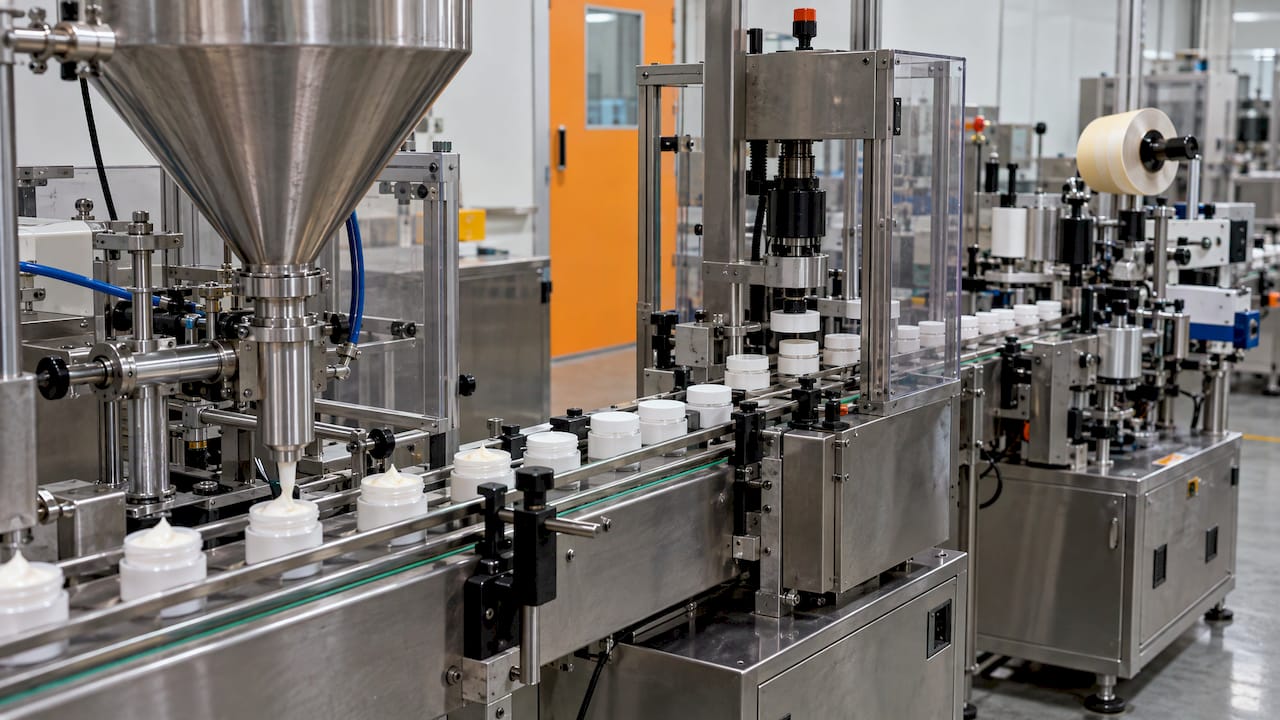
Filling covers the machine time and labour to put product into containers, cap and label them. Viscous creams, thin serums, oils and sachets each need different equipment, so the filling price changes with the format. Small runs cost more per unit here because machines must be set up and cleaned whatever the batch size. If you plan single-use formats, our pages on sachet packaging and filling and cosmetic filling services show what the format involves.
Packaging
Packaging is where many first budgets break. A stock bottle and a plain label cost little. A custom-moulded jar, a metallic finish, a rigid box or an anti-counterfeit feature each add to the per-unit price and to the one-off tooling and artwork bill. Sustainable materials can also change the price. It helps to decide the pack early, because it determines which filling line is used and how much space you need to store it.
Before you commit, read our guides to choosing skincare packaging, the eight packaging options for Singapore brands and sustainable cosmetic packaging. If you want design and print handled together with production, see our packaging design and printing services.
Testing and quality control
Stability testing checks that a product stays safe and looks and feels as intended over its shelf life. Safety assessment and quality control checks on each batch also carry a cost. These are paid per product, not per unit, so a small run carries more of them in each unit sold. They are also the costs that protect you: a product that separates, discolours or spoils in a customer’s bathroom costs far more than the test. Read why stability testing matters in skincare manufacturing before you decide what to cut. If you will ship raw or bulk materials, cosmetic SDS requirements may also apply.
How order volume changes your cost per unit
MOQ is the biggest lever on your cash outlay. Fixed costs (setup, development, testing, artwork) are divided by the number of units, so doubling the run does not double the cost. Here is a worked example with deliberately round, illustrative numbers, not a quote:
- One-off costs for a product: 3,000 (any currency).
- Run of 1,000 units: 3.00 of one-off cost sits in every unit.
- Run of 5,000 units: 0.60 of one-off cost sits in every unit.
The difference is 2.40 per unit before ingredients, filling or packaging are counted. This is why a brand that sells slowly can be better off with a low-MOQ run, even at a higher unit price: less stock sits on the shelf, and less cash is tied up in something that may need reformulating after customer feedback. Our page on low MOQ skincare manufacturing for new beauty startups explains how that route works.
Also allow for some product loss in production. Some product stays in tanks and lines, and some units fail checks, so your usable output is a little below the quantity mixed. Build a margin for this into your costing rather than discovering it on the first invoice.
Singapore regulatory costs you can fix in your budget
The good news is that the compliance fees are published, small and predictable. The main work is preparation, not payment.
Product notification
Cosmetic products supplied in Singapore must comply with the Health Products Act and the ASEAN Cosmetic Directive, as HSA’s regulatory overview explains. Before you launch, you notify HSA of each product through its PRISM portal, after checking that ingredients meet the directive’s annexes and that the label complies. Fees, per HSA’s fee schedule (last updated 4 September 2026):
| Product type | Single product, or each of the first 3 variants | Each 4th and later variant |
|---|---|---|
| Products applied around the eyes or on the lips, oral or dental care, hair dyes containing diamine compounds | SGD 28 | SGD 8 |
| All other cosmetic products | SGD 13 | SGD 8 |
A variant is a version of the same product, such as different shades or fragrances, so grouping them sensibly keeps the fee down. Each notification is valid for one year, and you re-notify annually to keep selling, so treat it as a yearly line in your budget. Our practical guide to HSA cosmetic notification lists the preparation steps.
The responsible person
A locally registered company must be the responsible person placing the product on the Singapore market. It can be an importer, manufacturer, distributor or retailer. If you are a Singapore business launching your own brand, that is usually you, so the obligations below are yours.
GMP certification
Singapore cosmetic manufacturers do not need a manufacturer’s licence; a Good Manufacturing Practice (GMP) certificate is a voluntary step that helps with exporting. HSA’s application fee for a local manufacturer is SGD 4,440, with SGD 220 for each additional certificate that needs no further assessment. That fee is the manufacturer’s to pay, not a line on your quote. It matters to you because it is a way to judge whether a factory runs to a recognised standard. Harmony Skin Lab holds GMP certification from HSA, and our overview of HSA GMP and skincare manufacturing standards explains what it covers. From 30 June 2026, HSA issues GMP certificates as verifiable electronic documents, with no change to fees or requirements.
Costs that arrive after the first run
A first-run budget that stops at the invoice is a budget that runs out. Plan for these:
- Annual re-notification for every product, at the HSA rates above.
- Record keeping. The responsible person must keep supply records for two years, supply safety and technical information when HSA asks, and report adverse events.
- Recall readiness. If a safety concern is found, the responsible person must recall the product. Keeping batch records and stock traceable makes that practical.
- Reorders and storage. Warehousing, and distribution if you do not ship yourself. We also offer skincare products distribution.
- Reformulation and new variants. Customer feedback often leads to a second version, with new testing and notification.
How to build your own skincare manufacturing budget
- Define one hero product. Write down the format (cream, serum, oil, sachet), pack size, key claims and who will use it: home, salon or clinic. A vague brief gets a vague quote.
- Choose your development route. Ready base, adapted or custom, using the table above. This sets your one-off cost and your timeline.
- Set a realistic first volume. Base it on what you can sell in a few months, not on the lowest unit price. Ask for quotes at two volumes to see the curve.
- Specify packaging. Choose the container, closure, label and carton, and say whether they are stock or custom. This is the step where costs most often creep up.
- Ask what is included. Does the quote cover samples, stability testing, safety documentation, filling, labelling and QC? Quotes that exclude these look cheaper and are not.
- Add compliance and ongoing lines. HSA notification per product, annual re-notification, record keeping, and a margin for production loss.
- Compute landed cost per unit. Total all one-off costs divided by units, plus all per-unit costs. Compare it against your target retail price and your margin before you sign.
Our skincare launch roadmap and guide to choosing an OEM skincare manufacturer cover timing and the questions to put to a factory, and nine questions before choosing a skincare manufacturer is a good checklist to take into the first meeting.
Costs by who you are
Entrepreneurs and new brands usually spend most on packaging and the first run, so a low MOQ and a ready or adapted base formula keep cash risk low. Salons need professional-size packs and formulas that work in treatments as well as for retail; see professional salon skincare manufacturing. Clinics and medical professionals carry more development and documentation cost because formulas are specific to a treatment or patient group; our page on aesthetic skincare products for clinics outlines that route.
One partner for development, filling and packaging
Every handover between suppliers adds a margin, a delay and a chance for specifications to drift. We run R&D and manufacturing, design and packaging, and distribution for Singapore skincare brands, with collaboration with you through development. You can browse our product lines, including home-use essential skincare, professional salon skincare and aesthetic or doctor’s formulations. Send us your product brief and volume, and we will scope the project with you.
For a closer look at how we work, see our skincare product development service.
Our view on cost
The cheapest quote is rarely the cheapest product. We have built our approach around the idea that cost is decided in the brief, not at the factory gate. The brands that spend well are the ones that settle format, pack and volume before anyone mixes a batch.
That is why we work with clients on the formula and the packaging together. Research and development, quality control and packaging under one roof mean the formula is designed for the pack it will sit in and the volume you can sell. Our GMP certification from Singapore’s HSA is the standard we work to on every batch, whether it is a home-use cream, a salon line or a doctor’s formulation.
Our advice is to start with one hero product, a realistic first run and a clear budget for compliance. Grow from there, with real customer feedback guiding the next formula.
Edmund
FAQ
How much does it cost to start a skincare line?
The total depends on how many products you launch, whether the formulas are custom, and how much you spend on packaging and marketing. Manufacturing is only one part; compliance, design and selling costs sit on top. The fixed Singapore items, such as HSA notification at SGD 13 or SGD 28 per product, are small beside development, packaging and stock. A single hero product with a ready or adapted formula is the lowest-risk way to begin.
How much does it cost to create a skincare product?
Add the one-off costs (formulation, samples, stability and safety work, artwork) to the per-unit costs (ingredients, filling, packaging, quality control). Divide the one-off total by your run size and add the per-unit total. A ready base formula keeps development low, while a fully custom formula costs more but gives you a product that is yours alone.
Does the HSA charge a fee to sell skincare in Singapore?
Yes. Each product must be notified through PRISM before supply, at SGD 13, or SGD 28 for eye, lip, oral care and certain hair dye products, with SGD 8 for each variant after the third. Notifications last one year and are renewed annually at the same rates.
Why does a small order cost more per unit?
Setup, testing, artwork and development are fixed for a product, so a small run divides them across fewer units. Machine cleaning and changeover also take the same time whatever the batch size. A low-MOQ route reduces how much stock you must buy, which lowers your risk even when the unit price is higher.
Sources
- HSA: Fees and turnaround time
- HSA: Good Manufacturing Practice certification for cosmetic products
- HSA: Regulatory overview of cosmetic products
- HSA: Submit notification and re-notification
- HSA: ASEAN Cosmetic Directive