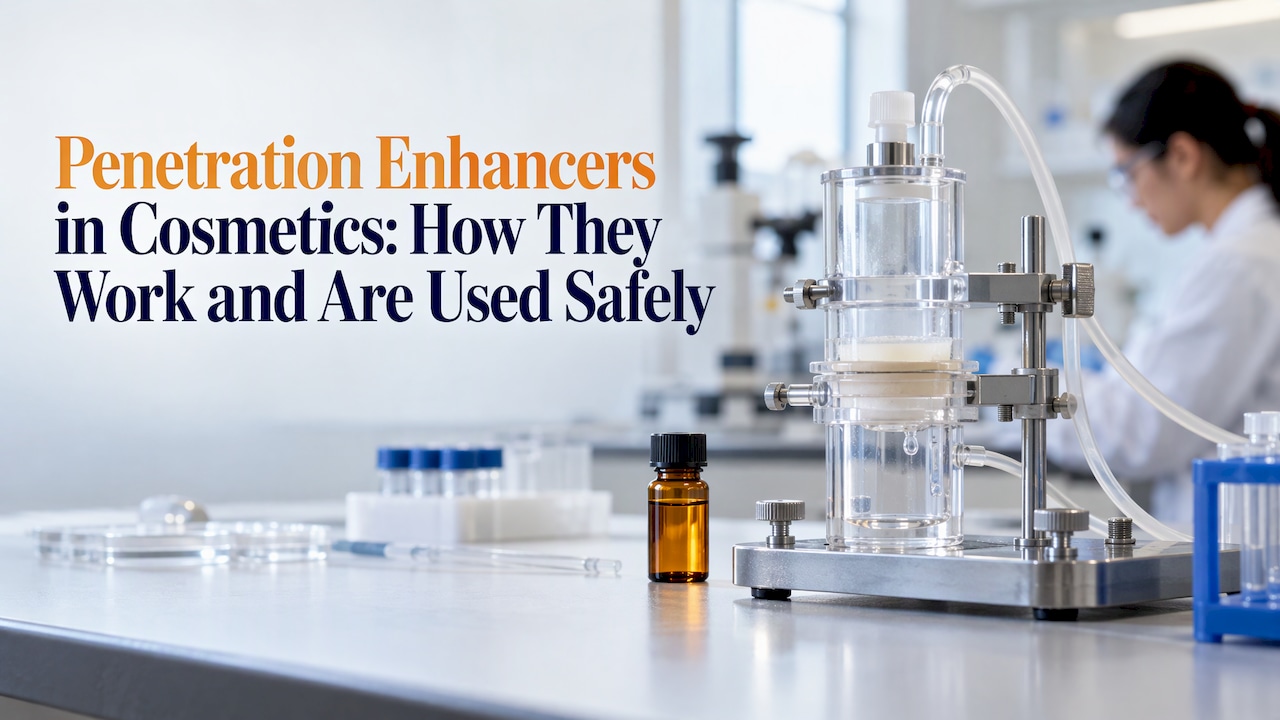
Penetration enhancers are ingredients that temporarily and reversibly make the skin’s outer barrier easier for other ingredients to cross. In cosmetics they sit alongside the active, not in place of it, and the right choice depends on the active’s molecule, the formula around it and the concentration. For a brand owner in Singapore, the practical lesson is that an enhancer is a formulation decision made early in development, together with a formulator who can balance delivery, skin comfort and stability. That is the work we do with clients at Harmony Skin Lab, a GMP-certified OEM/ODM skincare manufacturer based in Singapore.
TL;DR
- Penetration enhancers reversibly loosen the stratum corneum, the skin’s outermost barrier, so actives can pass through more easily. They are not the same as delivery vehicles such as liposomes or emulsions.
- Families include alcohols, glycols, fatty acids, terpenes, pyrrolidones, surfactants and, the safest and most common of all, plain water.
- The same action that helps an active in can irritate if the concentration or contact time is too high, so dose and combination matter more than the ingredient name.
- Whether an enhancer works depends on the active’s size, lipophilicity and solubility, so each pairing has to be developed and checked rather than assumed.
- In Singapore, every cosmetic product must be notified to the Health Sciences Authority (HSA) before it is supplied, whatever is in the formula.
Table of Contents
- What penetration enhancers are
- How enhancers change the skin barrier
- The main families of chemical enhancers
- Physical and formulation approaches
- Why the same enhancer does not suit every active
- Using enhancers safely: dose, contact time and combinations
- Singapore: what the rules mean for an enhanced-delivery product
- Working with a manufacturer on enhanced-delivery formulas
- Our view on enhancers
- FAQ
- Sources
What penetration enhancers are
The skin is built to keep things out. Most of that work is done by the stratum corneum, a thin layer of flattened cells held together by ordered lipids. A review of vehicles and cosmetic moisturisers describes penetration enhancers as excipients that disrupt the structure of this layer to help active compounds pass, by reducing the barrier’s resistance in a reversible way.
Two points help to keep the term clear.
An enhancer changes the barrier. A vehicle carries the active. Liposomes, gels and emulsions deliver an ingredient by encapsulating or transporting it. An enhancer works on the skin side of the equation. Many finished products use both, which is why a formulator thinks about the whole system and not one ingredient.
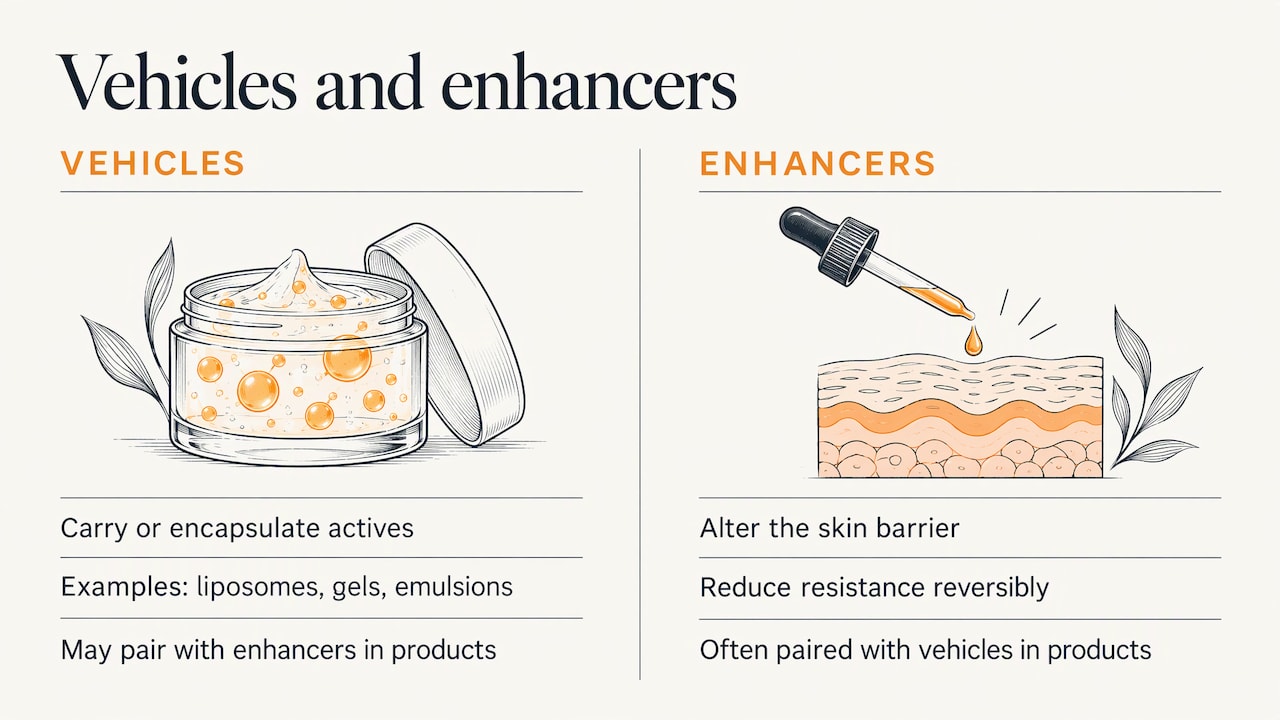
Enhancers are usually inactive in their own right. A 2018 review of chemical enhancers describes them as pharmacologically inactive compounds that partition into the skin and interact with its components, and are generally regarded as safe. Their job is to change how much of the active gets in, not to act on the skin themselves.
There is also a physical side. Methods such as ultrasound, radio frequency and iontophoresis can enhance penetration without any chemistry, and this is why you will hear the term used for devices as well as ingredients. This article concentrates on what goes into the bottle or jar.
How enhancers change the skin barrier
Researchers group the mechanisms in a few ways. The 2021 review names three main routes:
- Disrupting the highly ordered lipid structure of the stratum corneum.
- Interacting with those lipids.
- Improving how well the active partitions into the stratum corneum.
A 2025 review of penetration enhancers adds modification of keratin conformation and lipid extraction to the list. An academic overview of transdermal delivery in cosmetics describes four ways an enhancer can act: increasing the fluidity of skin lipids, removing intercellular lipids, increasing the thermodynamic activity of the active in its vehicle, and exfoliating cell membranes.
In plain terms, an enhancer does one or more of these things:
- It makes the lipid layers more fluid, so molecules move through more easily.
- It pulls some lipid out of the barrier, opening gaps.
- It helps the active dissolve into the skin layer instead of staying on the surface.
- It raises the active’s tendency to leave the formula and enter the skin.
In a landmark study of 102 chemical enhancers using infrared spectroscopy, Karande and colleagues found that enhancers disturb the barrier through lipid extraction or fluidisation, and that irritation tracked with the denaturation of stratum corneum proteins. That finding matters to formulators because it gives a way to look at potency and skin comfort separately.
The main families of chemical enhancers
The same academic overview lists more than 350 chemicals shown to increase skin permeability. Among them are terpenes, sulfoxides, laurocapram, pyrrolidones, fatty acids, fatty alcohols, glycols, surfactants and urea. It also describes water as the safest and most common penetration enhancer, which is a useful reminder that a well-hydrated stratum corneum is itself part of delivery.
A 2025 review on dermal absorption of cosmeceuticals lists the common chemical enhancers as alcohols, alkyl ethers, fatty acid derivatives, amides, sulfoxides, pyrrolidones, azepanones, terpenes, hyaluronic acid derivatives and various surfactants, including sodium dodecyl sulfate.
| Family | Examples | How it generally acts | Formulation point |
|---|---|---|---|
| Water | Hydration of the stratum corneum | Swells and softens the barrier | The safest and most common enhancer, according to the academic overview |
| Alcohols and glycols | Ethanol, propylene glycol | Solvent action, change in the active’s solubility in the skin | Also affect texture, feel and preservation |
| Fatty acids and alcohols | Oleic acid | Fluidise skin lipids | Reported to raise permeation up to 30-fold in one review |
| Terpenes | Plant-derived terpenes | Disrupt lipid packing | Of interest for botanical lines |
| Pyrrolidones and sulfoxides | Pyrrolidone derivatives, DMSO | Improve partitioning, solvent effects | Choice depends on regional ingredient rules |
| Surfactants | Sodium dodecyl sulfate and others | Extract lipids, alter proteins | Concentration control is essential |
The figure in the table comes from a 2025 review in the Journal of Dermatology and Dermatologic Surgery, which reports that chemical enhancers such as oleic acid increased permeation up to 30-fold, while microneedles and dermarollers improved delivery 3 to 15 times. The same review says an ideal cosmetic enhancer should be pharmacologically inert, non-irritant, compatible with other ingredients, and chemically reproducible, with good solvent properties for the active.
That list is a useful brief. It describes what a formulator is trying to find: an enhancer that does its job and then disappears into the background of the formula.
Physical and formulation approaches
Not every improvement in delivery comes from a chemical enhancer. A cosmetic chemist has other levers:
- Hydration and occlusion. Water is the simplest enhancer, and occlusive ingredients help hold it in the skin.
- Vehicle design. Emulsions, gels and liposomal systems change how the active is presented to the skin. Your choice of emulsifier shapes this, and our guide to emulsifier selection for skincare walks through the decision.
- Physical methods. Microneedling, ultrasound and iontophoresis suit professional settings, such as clinics and salons, rather than a home-use cream.
A 2024 study using confocal Raman imaging, published in Molecular Pharmaceutics, found water to be the safest enhancer. It found that oleic acid, sodium dodecyl sulfate and low molecular weight protamine disrupted the ordered structure of keratin, while azone and liposomes had less effect on keratin. Different enhancers leave different fingerprints on the barrier, which is one reason a formulation is built around a specific active and not a generic list.
Why the same enhancer does not suit every active
A common mistake is to treat an enhancer as a universal booster. It is not. The 2018 review of chemical enhancers explains that how an active interacts with skin depends mainly on its molecular weight, log P (a measure of how oil- or water-loving it is), melting point and solubility parameter. It describes a “push-pull” effect: the push comes from the difference in solubility between the active and the enhancer, and the pull comes from the enhancer changing the stratum corneum so the active dissolves into it more readily or is dragged through as the enhancer diffuses.
Karande’s team found that the fluidising potential of an enhancer correlated closely with its hydrophobicity (log P, r² = 0.86), while its irritation potential correlated with the ratio of two solubility parameters (r² = 0.78). In practice that means:
- A small, moderately lipophilic active may cross the barrier with little help, and an aggressive enhancer would add irritation risk for no gain.
- A larger or more polar active may need a considered system, and no single enhancer will suit every molecule.
- Depth matters. An active meant to act on the surface needs no enhancer, while one meant for deeper layers needs the right balance of enhancer and vehicle.
This is the core reason enhancer selection belongs inside product development and not at the end of it. We explain how that process unfolds in our overview of how skincare research and development supports launches.
Using enhancers safely: dose, contact time and combinations
Because enhancers work by changing the barrier, concentration and contact time are the main safety variables. The 2021 review notes that care must be taken to select them and use them at the optimal concentration, to avoid unwanted systemic absorption and skin irritation. The 2025 dermal absorption review adds that chemical enhancers can irritate or be toxic when the concentration is too high or the contact time is too long, and that surfactants may cause allergic contact dermatitis.
The same review points to ways formulators are reducing that risk: high-throughput screening, combinations of enhancers, and biodegradable enhancers that improve permeation while lowering irritation. Karande’s work also found that potency and irritation were not tightly linked for some enhancer classes, which leaves room to design effective and gentle systems.
For a brand, a safe use approach looks like this:
- Keep the enhancer level as low as the active allows. More is not better.
- Match the format to the use. A leave-on home-use serum, a rinse-off salon cleanser and a clinic-applied treatment have very different exposure times.
- Check compatibility. An enhancer can change how other ingredients, preservatives and packaging behave. Our guides to cosmetic compatibility testing and stability testing cover what is examined.
- Support the claims. If a product promises better delivery or visible results, the evidence has to match the promise. See skincare efficacy testing methods.
- Note who should take care. People with sensitive or compromised skin, or a known contact allergy to an ingredient, should patch test any new leave-on product and stop using it if redness or stinging appears. Anyone with a skin condition should ask a doctor or dermatologist before using a product containing strong enhancers.
PEG-based emulsifiers and solubilisers show how ingredient-by-ingredient safety is assessed. A 2015 safety evaluation of PEG compounds found that PEG-40 and PEG-60 hydrogenated castor oils were recommended as safe in cosmetics at up to 100% concentration and that PEG-20 glyceryl triisostearate is considered safe, while it recommended further study of PEG/PPG-17/6 copolymer. The point is that safety conclusions are specific to each ingredient, not to a whole class.
Singapore: what the rules mean for an enhanced-delivery product
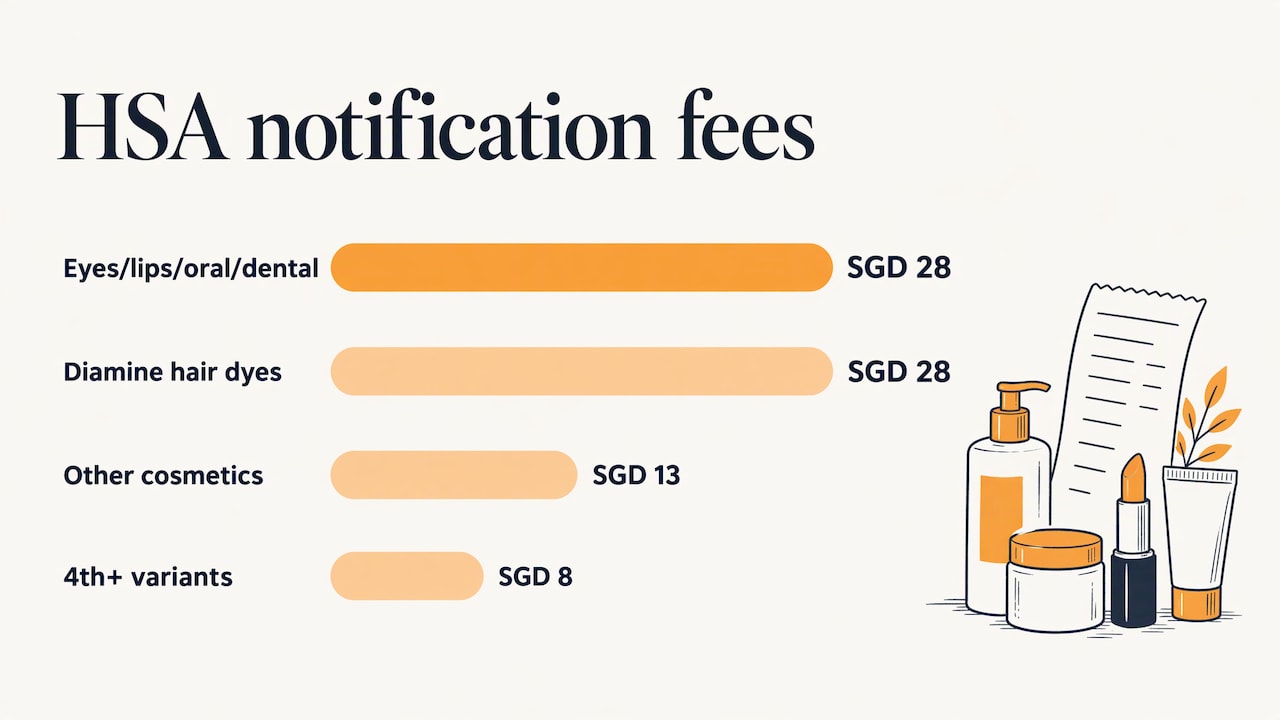
A penetration enhancer is an ingredient decision, but a Singapore launch is also a regulatory one. Cosmetics are notified to HSA before they are supplied, and notification and re-notification carry fees. According to HSA’s fee schedule, notification costs SGD 28 for products applied around the eyes or on the lips, oral or dental care products, and hair dyes containing diamine compounds (a single product or each of the first three variants). For other cosmetic products it costs SGD 13 for a single product or each of the first three variants. Each fourth and later variant costs SGD 8. The same fees apply to notification and re-notification.
Three practical consequences follow for a brand using an enhancer:
- Ingredients must be permitted. Singapore follows the ASEAN Cosmetic Directive’s lists of restricted and prohibited substances, so an enhancer that is common elsewhere needs to be checked against those lists during formulation.
- Documentation follows the formula. The responsible person keeps product information, including safety and efficacy support, so the choice of enhancer and its level should be recorded as you develop.
- Claims shape the category. The more a product promises about reaching deeper layers or acting like a medicine, the more carefully the claim needs to be positioned. Confirm requirements with HSA for your specific product.
HSA also issues a GMP certificate for local cosmetic manufacturers, which is relevant if you want your product made under a recognised quality system in Singapore.
Working with a manufacturer on enhanced-delivery formulas
If you are building a brand, your question is rarely “which enhancer is best?” It is “which formula delivers the result I want to promise, feels good on the skin and passes the checks?” That is a development project.
Harmony Skin Lab is a Singapore-based OEM/ODM skincare manufacturer with GMP certification from HSA. Our skincare R&D and manufacturing services cover product design, customised formulation, quality control and packaging, and we work with clients on formulations for home use, professional salons and medical or aesthetic settings. If you are weighing a ready-made base against a bespoke formula, private label versus custom formulation explains how to choose, and how custom skincare formulation works follows a project from concept to production.
To discuss your own formula, start with our skincare product development service.
Brands for clinics can also look at our page on aesthetic skincare products for clinics in Singapore, and salon owners at professional salon skincare manufacturing.
Our view on enhancers
We think of a penetration enhancer as one decision inside a whole formula, never as a feature to bolt on. Delivery, skin comfort, stability and packaging all pull on each other, and the best results come when they are developed together.
That is why we put collaboration first. We sit down with a client to understand the customer, the market and the claim, then use rigorous R&D to build a formula that serves them. High-quality, safe ingredients and state-of-the-art technology matter most at exactly this point, where a small change in concentration changes how a product feels and performs.
Our GMP certification from Singapore’s HSA reflects the standard we hold ourselves to when a formula moves from the lab to production. Whether the product is a home-use essential, a salon line or a doctor’s formulation, we want it to be unique, effective and safe for the people who will use it.
Edmund
FAQ
Are penetration enhancers the same as active ingredients?
No. An enhancer is generally an inactive compound that changes how easily the active crosses the skin barrier, as described in a review of chemical enhancers. The active is what delivers the cosmetic benefit. The two are chosen together so the enhancer suits the active’s size and solubility.
What is the safest penetration enhancer?
An academic review of transdermal delivery in cosmetics describes water as the safest and most common penetration enhancer. Other families, such as fatty acids, glycols and surfactants, are used at controlled levels, because irritation depends on concentration and contact time.
Can penetration enhancers irritate the skin?
At excessive concentrations or long contact times they can, and surfactants may cause allergic contact dermatitis, according to a 2025 review. Well-formulated products keep enhancers at suitable levels and are checked for compatibility. If you notice redness or stinging from a new product, stop using it, and see a doctor if it persists.
Do I need a penetration enhancer in my skincare product?
Only if your active needs help to reach its target layer. Some actives work on the surface or cross the barrier readily. A formulator weighs the molecule, the claim and the format before deciding, which is why this belongs in the development brief.
Do penetration enhancers change how I register a cosmetic in Singapore?
The notification route is the same: products are notified to HSA, with fees set by HSA. The enhancer must be permitted under the ASEAN ingredient lists, and your claims need to be supported by the product information you hold.
Sources
- Vehicles for Drug Delivery and Cosmetic Moisturizers (PMC, 2021)
- Chemical Enhancer: A Simplistic Way to Modulate Barrier Function (PMC, 2018)
- Design principles of chemical penetration enhancers for transdermal drug delivery (PMC, 2005)
- Research progress of penetration enhancers in transdermal delivery (PMC, 2025)
- Transdermal delivery systems in cosmetics (Biomedical Dermatology, 2020)
- Enhancing Dermal Absorption of Cosmeceuticals (PMC, 2025)
- Permeation enhancers for enhanced topical delivery (Journal of Dermatology and Dermatologic Surgery, 2025)
- Effect of Penetration Enhancer on the Structure of Stratum Corneum (Molecular Pharmaceutics, 2024)
- Safety Evaluation of Polyethylene Glycol (PEG) Compounds (PMC, 2015)
- HSA: Cosmetic products fees and turnaround time