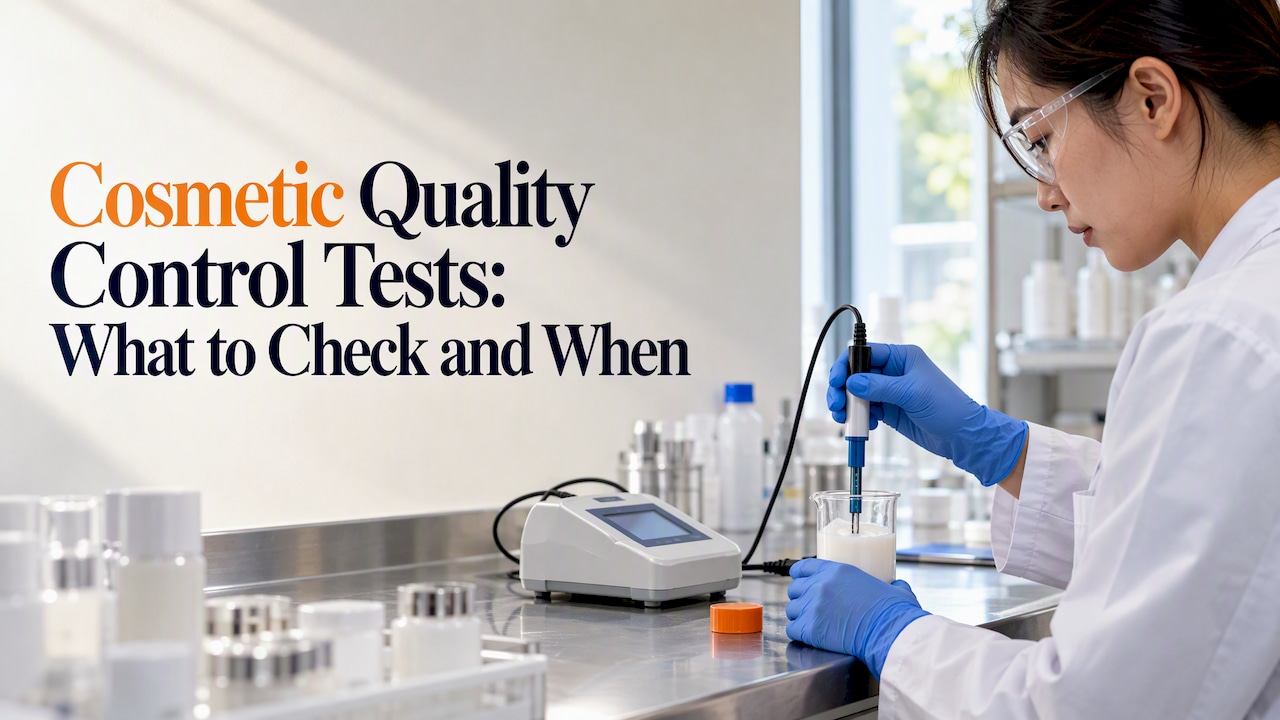
Cosmetic quality control is a sequence of checks at three points: incoming raw materials, samples taken during production, and the finished batch before release. Those checks look at identity, physical and chemical properties, microbial contamination and unwanted contaminants, and they are backed by stability studies and batch records. For a Singapore brand, the tests also sit inside the ASEAN Cosmetic Directive and good manufacturing practice (GMP) rules. This guide explains each test, when it happens, and what paperwork you should ask to see before you sell.
TL;DR
- Quality control (QC) detects a problem in a batch; quality assurance (QA) is the system that stops problems happening in the first place. You need both.
- Test at three checkpoints: raw materials on arrival, samples in process, and the finished batch before release.
- Core tests cover identity, appearance, pH and viscosity, microbial limits, preservative efficacy, stability and packaging compatibility. Which ones you need depends on the formula, pack and claims.
- In Singapore, the ASEAN Cosmetic Directive applies, notification is usually required before sale, and supply records must be kept for two years.
- Before release, ask for specifications, QC records and the batch manufacturing record, not just a one-page certificate.
Table of Contents
- QC versus QA: the difference that matters to a brand owner
- The three checkpoints where cosmetic QC happens
- The tests themselves: what each one tells you
- When to test during development and manufacture
- How to choose tests for your product
- What Singapore brands need to know
- What to review before you release a batch
- Our perspective
- Work with a manufacturer that builds testing into the project
- FAQ
- Sources
QC versus QA: the difference that matters to a brand owner
The two terms are often used as if they were one. They are not. A standards-body explanation from the US National Institute of Standards and Technology puts it neatly: QA gives confidence that requirements are met, while QC is an operational check of a method or process. The same document frames the perspective difference: QA aims to prevent nonconforming products, whereas QC aims to detect one if it occurs.
In skincare terms:
- Quality assurance is the system: approved suppliers, written specifications, trained staff, cleaning procedures, change control, document review and audits.
- Quality control is the testing: sampling a drum of glycerin, measuring the pH of a cream mid-batch, running a microbial count on the finished lotion.
Why this matters when you commission a product: a manufacturer can test thoroughly and still produce inconsistent batches if the system around the tests is weak. Equally, a good system with no testing leaves you blind. When you compare manufacturers, ask about both.
The ASEAN Good Manufacturing Practice guidelines define the scope of QC clearly. Quality control covers sampling, inspection and testing of starting materials, in-process and intermediate materials, bulk product and finished product. Where applicable it also includes environmental monitoring, batch-document review, retained samples and stability studies. That list is a useful checklist in its own right.
The three checkpoints where cosmetic QC happens
Testing is not one event at the end. The US FDA’s cosmetic GMP guidance describes a pattern in which raw materials, in-process samples and finished products are tested or examined to verify identity and compliance. In practice that gives three checkpoints.
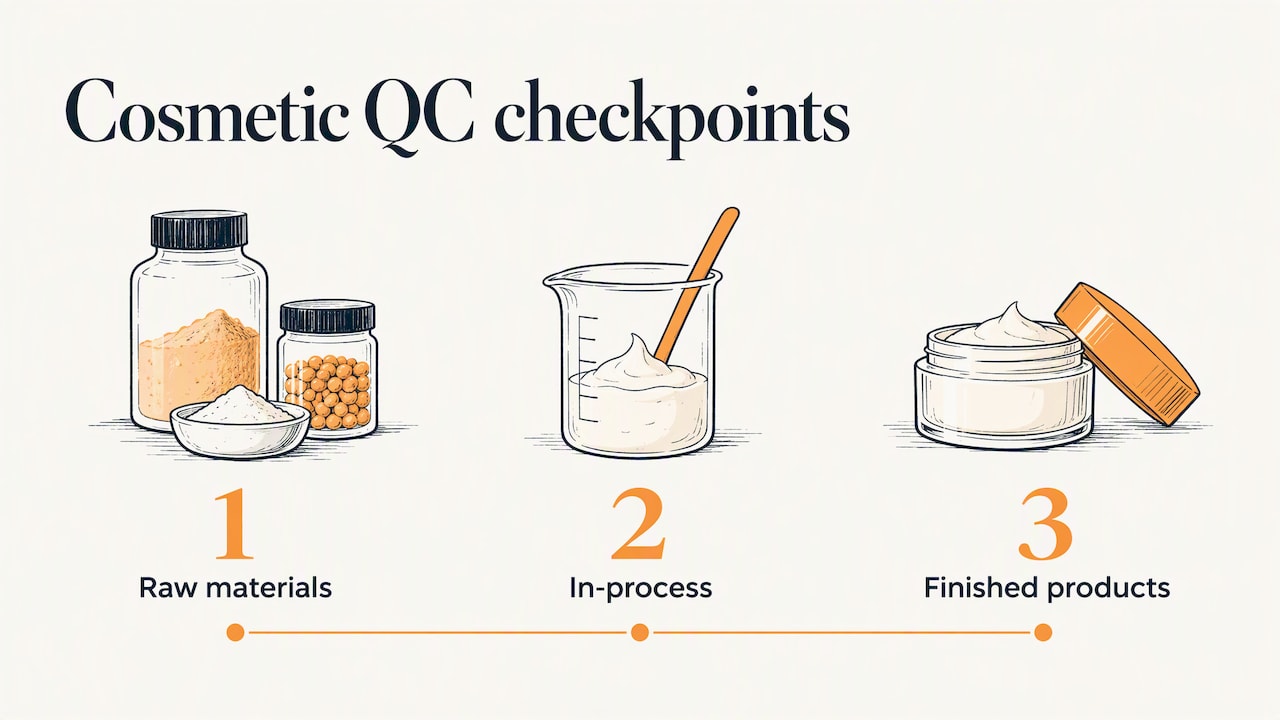
1. Incoming raw materials and packaging
Every ingredient that enters the factory should be quarantined until it has been checked and released. Typical checks:
- Identity: is it what the label and supplier document say it is?
- Appearance, odour and colour against the approved specification.
- Physical and chemical properties such as pH, density or refractive index, depending on the material.
- Microbial quality, especially for water-rich or natural-origin materials such as plant extracts and hydrosols.
- Contaminants, including heavy metals, where the material or its source makes that relevant.
Water deserves its own mention. The FDA guidance calls for regular testing of water used as an ingredient, because water is the most common route for microbial contamination in creams, toners and gels.
Packaging gets checked too: dimensions, closures, print and labelling accuracy, and whether the pack material suits the formula. Our guide to skincare packaging options for Singapore brands covers the choices that affect these checks.
2. In-process checks during production
While a batch is being made, samples are taken at defined steps. These catch errors while they can still be corrected, which is far cheaper than discarding a finished batch. Common in-process checks include:
- Weight or volume of key ingredients charged to the tank.
- Temperature at heating, emulsifying and cooling stages.
- Appearance and homogeneity of the emulsion or solution.
- pH and viscosity at the bulk stage, before filling.
- Clarity after filtration, for products such as toners, serums and oils.
If the bulk fails here, it can sometimes be adjusted and retested under a documented procedure. That decision belongs in the batch record, not in someone’s memory.
3. Finished product before release
The final batch is tested against its specification before it is released for sale. This is where microbial testing and final physical checks are normally confirmed, and where packed and labelled units are examined for fill level, leaks, coding and label correctness. The FDA guidance also calls for retaining reserve samples of approved raw-material and finished-product batches for retesting. Retained samples are what let you investigate a complaint months after launch.
The tests themselves: what each one tells you
The table below summarises the tests brand owners meet most often. Not every product needs every test; selection is covered in the next section.
| Test | What it checks | Typical stage |
|---|---|---|
| Identity and appearance | Material or product matches the specification in look, colour, odour | Raw material, bulk, finished |
| pH | Acidity or alkalinity suits the formula and skin use | Raw material, bulk, finished |
| Viscosity and density | Texture and fill consistency from batch to batch | Bulk, finished |
| Microbial count | Bacteria, yeast and mould within acceptable limits | Water, raw materials, finished |
| Preservative efficacy (challenge test) | The preservative system can cope with contamination | Development, then on formula changes |
| Stability | Product stays acceptable over its shelf life | Development, then ongoing |
| Packaging compatibility | Formula does not damage the pack, and the pack does not alter the formula | Development |
| Contaminant screening | Heavy metals and prohibited substances absent or within limits | Raw material, finished |
Microbiological testing and the preservative challenge
Microbial testing asks whether a batch is clean. The preservative efficacy test, usually called the challenge test, asks a different question: if bacteria or fungi get into the product (and in real use, they will), will the preservative system keep them in check? A product can pass a microbial count on day one and still fail a challenge test, which is why both appear on good test plans. We explain the methods in more detail in our guide to cosmetic microbiological testing.
Stability testing
Stability testing shows how a product behaves over time and under stress: heat, cold, light and repeated temperature cycling. The Brazilian health regulator’s stability guide states that companies are responsible for assessing stability before products reach consumers, and that stability is fundamental to quality and safety. The same guide notes that parameters such as organoleptic properties, physical-chemical values (pH, viscosity, density) and microbiological evaluation should be defined by the formulator according to the product’s characteristics.
For a Singapore brand, heat and humidity make this more than a formality. A lotion that behaves in an air-conditioned lab may separate in a warehouse or a shop window. Read more in why stability testing matters in skincare manufacturing and our guide to cosmetic stability testing for products that last.
Packaging compatibility
A formula is only as stable as the container it sits in. Essential-oil blends can soften some plastics; low-pH products can affect metal parts; a pump may clog with a thick balm. Compatibility testing keeps the formula in its intended pack through accelerated conditions and checks for leakage, discolouration, odour change and closure performance.
Contaminant and prohibited-substance screening
Some checks are about what must not be there. Singapore’s Health Sciences Authority (HSA) runs a cosmetics laboratory that screens for prohibited colorants, Western drug adulterants, phthalates, retinoic acids, UV filters and toxic heavy metals. That list is a fair indication of what regulators look for in the market, and therefore of what a careful brand should confirm on its own products. HSA also lists the ASEAN Guidelines on Limits of Contaminants for Cosmetics, last updated in October 2019.
When to test during development and manufacture
Timing is where many first-time brands go wrong. They treat testing as a gate at the end instead of a thread through the whole project. A sensible sequence for a new skincare product looks like this.
- Formulation stage. Choose ingredients and a preservative system with the pack, claims and target market in mind. Run early screening: pH, viscosity, appearance, and a first accelerated stability check on a lab sample.
- Prototype stage. Run the challenge test and a fuller stability programme on the near-final formula in its real packaging. Changing the preservative or a key ingredient after this point means repeating the work.
- Pilot or first production batch. Confirm that the factory-scale product matches the lab sample. Test the finished batch against its specification and keep retained samples.
- Routine production. Every batch goes through the three checkpoints. Stability samples from selected batches are kept on a continuing schedule.
- After any change. A new supplier, a changed ingredient grade, a new pack or a new site should trigger a documented review of which tests to repeat.
Our article on how custom skincare formulation works from concept to production shows where these stages fall in a full project, and the skincare launch roadmap places them against your launch timeline.
How to choose tests for your product
There is no single mandatory list that fits every cosmetic. The right set depends on four things.
- Formula type. Water-based creams, gels and toners carry the highest microbial risk and need robust preservation and challenge testing. Anhydrous oils and balms carry less, but still need stability and oxidation checks. Hydrosols and plant waters need careful microbial control.
- Packaging. An airless pump, a jar and a sachet expose the formula differently. Jars invite finger contamination, so preservation matters more. Sachets need seal and fill checks.
- Intended use. Products for leave-on use on the face, for use around the eyes, or for professional or medical-supervised settings justify more scrutiny than a rinse-off body product.
- Claims. A claim such as “for sensitive skin” or “reduces blemishes” needs evidence behind it. The more specific the claim, the more specific the supporting testing should be.
For a salon or clinic line, the same logic applies with extra care over contact with broken or reactive skin. If you are formulating for medical use, work with a qualified doctor or pharmacist on the claims and safety review alongside the manufacturer’s testing.
What Singapore brands need to know
Four points frame the local rules. Always confirm the current position with HSA, as requirements change.
The ASEAN Cosmetic Directive applies. It was implemented in Singapore on 1 January 2008 and harmonises requirements across the region, covering safety assessments, product information files, GMP and ingredient restrictions. Our summary, ASEAN Cosmetic Directive: what Singapore brands must know, walks through each part.
Notification comes before sale. HSA says notification usually must be submitted before a cosmetic product is sold in Singapore. Products supplied solely as advertising or promotional samples, or solely for research and development testing or trial use, are not covered by that requirement. See our practical guide to HSA cosmetic notification.
Labels must meet local rules. Key information has to appear in English, including ingredients, batch number, country of manufacture and the name and address of the local responsible company. The batch number is also what ties a unit on a shelf back to its QC records.
Supply records are a legal requirement. Under the Health Products (Cosmetic Products, ASEAN Cosmetic Directive) Regulations, supply records must include the product name and notification number, supply date, recipient details, quantity and a product identification or batch mark. Those records must be retained for two years after supply.
For how GMP fits in, see GMP in cosmetics: what it means and what Singapore expects and 7 facts about HSA GMP and skincare manufacturing standards.
What to review before you release a batch
A certificate with a row of ticks is not enough. Based on the ASEAN GMP guidelines, the documents worth reviewing before release are:
- Approved specifications for raw materials and packaging materials, and for bulk and finished products.
- QC records showing what was tested and whether each material or batch was released or rejected.
- The Batch Manufacturing Record for your batch, showing the formula, process and dates, equipment or line used, cleaning, line clearance, sampling, any investigations, and the examination of packed and labelled product.
The guidelines also say finished-product specifications should include a product description, physical properties, and chemical or microbiological assays with acceptance limits where necessary, plus storage or safety conditions where needed. If the specification has no acceptance limits, a passing result means little.
When you read a test report, ask:
- Does the report name your batch number and the date of testing?
- Are the acceptance limits stated, not just “pass”?
- Was the sample taken from the finished, packed product or only from bulk?
- Were any results out of specification, and what happened next?
- Are retained samples held for this batch?
The same discipline applies in other regulated product categories where a lot-specific certificate of analysis is expected; a certificate of analysis checklist shows how a batch-level document can be read line by line, and the habit transfers well to cosmetic QC reports.
Our perspective
We see the same pattern with new brand owners. They ask for a price per unit and a launch date, and only later ask what testing sits behind the product. We would rather the conversation ran the other way round, because testing decisions made at formulation stage cost almost nothing, while the same decisions made after a failed batch cost a launch window.
As a GMP-certified OEM/ODM skincare manufacturer in Singapore, we work with clients on product design, customised formulation, quality control and packaging in one collaboration. That matters for QC because the formulator, the production team and the packaging team see the same data. A stability result can change a pack choice; a packaging decision can change a preservative; a market trend can change a claim, and each of those changes should trigger a testing review. We design our R&D process to keep those links visible, so that a home-use line, a professional salon range or an aesthetic formulation is tested for how it will actually be used.
Our advice: define the specification before the first production run, test in the real pack, keep retained samples, and read the batch record, not just the summary.
— Edmund
Work with a manufacturer that builds testing into the project
If you are planning a private label, salon or medical-grade skincare line, we can take the project from formulation through quality control and packaging. See our R&D, manufacturing and packaging services, or read how our stability testing and QC services in Singapore are structured.
To discuss your product, start from our homepage and get in touch with your formula brief, pack idea and target market.
FAQ
Is cosmetic quality control the same as quality assurance?
No. Quality assurance is the system that aims to prevent nonconforming products, and quality control is the testing that detects a problem if one occurs. A brand needs both, because testing alone cannot fix a weak process.
Which tests should every skincare batch pass?
There is no single universal list, but most water-containing products are checked for appearance, pH, viscosity and microbial limits before release. Preservative efficacy and stability are normally established during development and then monitored. Your manufacturer should set these in a written specification for your formula and pack.
How long must I keep records in Singapore?
Singapore’s cosmetic regulations require supply records to be retained for two years after supply. Those records include the product name and notification number, supply date, recipient details, quantity and a batch mark. Check the current regulations or ask HSA if your situation is unusual.
Do I need to test samples I only use for product development?
HSA says notification is not required for products supplied solely as samples for advertising or promotion, or solely for research and development testing or trial use. That is a notification point, though, not a reason to skip safety and stability checks. Anything you put on a person’s skin should be assessed first.
Can I rely on a supplier’s certificate instead of testing?
A supplier certificate is a useful input, but GMP guidance still expects the manufacturer to verify identity and compliance of incoming materials through its own sampling and testing. Ask your manufacturer how it verifies supplier documents.
Sources
- NIST: Quality Assurance vs. Quality Control
- ASEAN Guidelines for Cosmetic Good Manufacturing Practice
- US FDA: Good Manufacturing Practice Guidelines/Inspection Checklist for Cosmetics
- ANVISA: Cosmetics Stability Guide
- HSA: Cosmetics analysis
- HSA: ASEAN Cosmetic Directive
- HSA: Regulatory overview of cosmetic products
- HSA: How cosmetic products are regulated
- Singapore Statutes Online: Health Products (Cosmetic Products, ASEAN Cosmetic Directive) Regulations