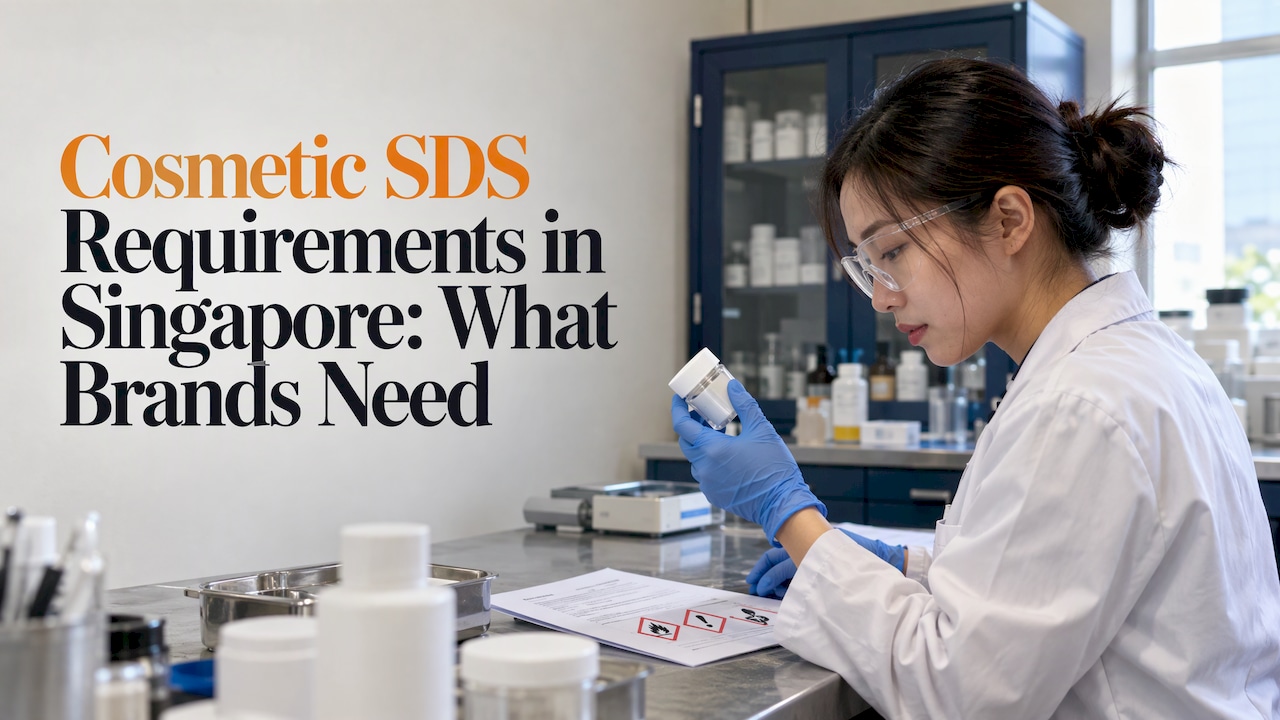
A finished cosmetic sold to consumers in Singapore is not normally required to carry a safety data sheet (SDS). The documents that matter for it are HSA notification, a compliant label and a Product Information File. An SDS still becomes a legal requirement when a workplace handles the product or its raw materials, for example in a factory, a salon back room or a warehouse. It also applies when hazardous ingredients are supplied in bulk. This guide shows where that line sits, what an SDS contains, and how it differs from a certificate of analysis (CoA).
TL;DR
- Cosmetics are a special case: a consumer pack sold at retail is exempted from SDS duties under the WSH rules, but raw materials, bulk lots and products used at work are not.
- Where an SDS is needed, Singapore expects the GHS format of 16 sections, prepared to SS 586 Part 3.
- A CoA is a different document. It reports test results for one batch, while an SDS describes hazards and handling for the product as a whole.
- For the finished product, your core paperwork is HSA notification, label compliance and the ASEAN Product Information File (PIF).
- Ask your manufacturer for the SDS, CoA and PIF inputs for every material and batch before you sign off on a launch.
Table of Contents
- Do cosmetics need an SDS in Singapore?
- Who is responsible for the SDS
- The 16 sections of a GHS safety data sheet
- What a CoA is, and how it differs from an SDS
- The paperwork a Singapore cosmetic brand needs
- A practical document checklist for your manufacturer
- Worked examples
- Our perspective
- Plan your product with the documents built in
- FAQ
- Sources
Do cosmetics need an SDS in Singapore?
The short answer is: it depends on where the product is in its life. Singapore has no rule that says “every cosmetic needs an SDS”. It has a workplace chemical rule that applies to hazardous substances, and a cosmetic regime run by HSA. They overlap in a few places.
The workplace rule. Under the WSH (General Provisions) Regulations, a seller, or an agent who arranged the sale for workplace use, must give the buyer an SDS with accurate and adequate information. An occupier who uses, handles or stores a hazardous substance at work must obtain the SDS, assess it, take precautions and make it available to people who may be exposed. Regulation 43 sets these duties out, and giving inaccurate, inadequate or misleading information in an SDS is an offence.
The consumer exemption. The Singapore GHS booklet notes that hazardous substances in a consumer package intended for retail sale are exempt from SDS requirements under those regulations. That is why a bottle of face serum on a shelf does not need one.
Where cosmetics are still in scope. SS 586-3:2022 says cosmetics are outside GHS at the point of intentional intake by the consumer. They are covered where workers can be exposed at work and where there is potential exposure during transportation. In practice that means:
- Raw materials and intermediates. Solvents, active concentrates, essential oils, preservatives and pigments that are classified as hazardous each need an SDS from their supplier.
- Bulk product. A drum of finished lotion moving between a factory and a filling line is a workplace and transport situation, not a retail pack.
- Salon and clinic supply. Professional-size products used by staff all day are handled at work. If the formulation is classified as hazardous, expect an SDS request from the premises.
- Borderline products. Items that are not clearly cosmetics, or that contain classified ingredients above the cut-off, may need one.
The rule of thumb in the booklet is that there is no exemption for chemicals unless they are classified as non-hazardous and contain no hazardous ingredient above the SS 586 cut-off limits. If your formula and its ingredients fall below those limits, there may be nothing to classify. Your formulator should confirm this on paper rather than leave it assumed.
Who is responsible for the SDS
Chemical manufacturers and suppliers must provide a GHS SDS with accurate and sufficient information, in GHS format. MOM’s guidance goes a step further for imports: it says overseas SDSs must be prepared in line with Singapore’s requirements for local use. An SDS written for another market is not automatically enough.
MOM also states that you must prepare an SDS for every substance or product classified as hazardous under GHS, prepared under SS 586 Part 3 where the cut-off for the hazardous ingredient is met.
For a brand owner, this splits into three jobs:
- Collect an SDS for each hazardous raw material from its supplier.
- Check that those SDSs are current and written to Singapore requirements if the material is imported.
- Issue an SDS for your own bulk product if it is classified as hazardous and goes to workplaces.
SS 586 Parts 2 and 3 were revised in 2022 to align with the 7th edition of GHS. An SDS dated before that revision is worth having reviewed.
The 16 sections of a GHS safety data sheet
Singapore’s GHS booklet sets out 16 information items in a fixed sequence. For a cosmetic ingredient or bulk product, here is what each one tells you.
| No. | Section | What a cosmetics buyer looks for |
|---|---|---|
| 1 | Identification | Product name, supplier details, recommended use, emergency contact |
| 2 | Hazards identification | GHS classification, signal word, hazard statements |
| 3 | Composition/information on ingredients | Hazardous components and their concentration ranges |
| 4 | First aid measures | What to do after skin or eye contact, inhalation or ingestion |
| 5 | Fire fighting measures | Suitable extinguishing media, hazards from combustion |
| 6 | Accidental release measures | Spill containment and clean-up |
| 7 | Handling and storage | Safe handling, storage temperature, incompatibilities |
| 8 | Exposure controls/personal protection | Ventilation, gloves, eye protection |
| 9 | Physical and chemical properties | Appearance, pH, flash point, solubility |
| 10 | Stability and reactivity | Conditions and materials to avoid |
| 11 | Toxicological information | Skin and eye irritation, sensitisation, other health data |
| 12 | Ecological information | Effects on water and wildlife |
| 13 | Disposal considerations | How to dispose of residues and packaging |
| 14 | Transport information | UN number, transport class, packing group |
| 15 | Regulatory information | Regulations that apply to the material |
| 16 | Other information | Revision date, abbreviations, references |
Two habits save time. First, read section 2 and section 3 together: the classification should match the ingredients listed. Second, check the revision date in section 16. A sheet that has not been touched for years is a prompt to ask the supplier for an update.
If you want a worked example of how a document checklist is laid out for a lab-supplied material, this lot-specific COA checklist shows the kind of batch detail buyers expect to see alongside an SDS.
What a CoA is, and how it differs from an SDS
A certificate of analysis answers a different question. The SDS asks, “how do I handle this safely?” The CoA asks, “did this batch meet its specification?”
A cosmetics CoA typically lists product information such as name, batch number, production and expiry date, then test items, methods, results and a compliance determination. Typical test items include appearance, odour, pH, heavy metals and microbial limits, with the issuer’s signature or stamp at the end.
| Safety data sheet | Certificate of analysis | |
|---|---|---|
| Main purpose | Hazard and safe-handling information | Proof that a batch met its specification |
| Scope | The product or material in general | One specific batch or lot |
| Format | Fixed 16-section GHS layout | Set by the issuer, usually a table of tests and results |
| Legal basis in Singapore | WSH (General Provisions) Regulations, SS 586 Part 3 | No standalone CoA rule for cosmetics; supports the quality data in the PIF |
| Who asks for it | Workplaces, transporters, safety officers | Brand owners, QC teams, auditors, retailers |
| Changes when | Classification, formulation or regulation changes | Every new batch |
A CoA does not replace an SDS, and an SDS does not prove batch quality. You need to be able to produce both when the situation calls for them.
The paperwork a Singapore cosmetic brand needs
For the finished consumer product, the regulatory core sits with HSA rather than MOM.
Notification. Cosmetic products are regulated under the Health Products (Cosmetic Products, ASEAN Cosmetic Directive) Regulations 2007. The responsible person must notify HSA through the PRISM portal before supply, with re-notification every 12 months, according to an HSA presentation. Our guide to HSA cosmetic notification walks through the steps.
Safety responsibility. The ASEAN Cosmetic Directive has applied in Singapore since 1 January 2008. Dealers are legally responsible for product safety and for meeting requirements on labelling and on prohibited or restricted ingredients. HSA lists documents on ingredients, labelling, GMP, safety assessment, adverse-event reporting and Product Information Files. More on this in our ASEAN Cosmetic Directive explainer.
Labelling. HSA requires a full ingredient list in descending order of weight, plus usage instructions unless they are obvious from the name or presentation. Under the regulations, ingredients below 1% may follow in any order, and colourants may come last. An expiry date is needed when durability is under 30 months.
Records and information on request. The same HSA presentation says the responsible person must supply safety and technical information to HSA on request. It also says supply records (product name, notification number, date, recipient, quantity and identification mark) must be kept for at least 2 years after supply.
The Product Information File. The ASEAN PIF guidelines suggest four parts: administrative documents and product summary; raw material quality data; finished product quality data; and safety and efficacy data. This is where your SDS and CoA material becomes useful. Part II holds raw-material specifications and test methods, and for fragrance the supplier details and an IFRA compliance certificate. Part III covers finished-product specifications, microbiological criteria and chemical purity of ingredients.
So the SDS and CoA are not the regulatory finish line, but they feed the file you must be able to produce.
A practical document checklist for your manufacturer
When you brief a contract manufacturer, ask for these items by name:
- SDS for each hazardous raw material, current, and in Singapore format if imported.
- A written statement of whether your finished formula or bulk product is classified as hazardous under SS 586, and if so an SDS for it.
- CoA per batch of finished product, with test items, methods, limits and measured results.
- Raw-material specifications and CoAs for key ingredients, to support PIF Part II.
- Fragrance documents, including the IFRA certificate and supplier details.
- Microbiological and stability data to support PIF Part III. See our note on stability testing and QC.
- Batch and supply records that let you trace a unit back to its lot.
- Manufacturing standards evidence, such as GMP. Our pages on GMP in cosmetics and HSA GMP facts explain what Singapore expects.
If you are still choosing a partner, nine questions to ask a skincare manufacturer is a useful place to build your shortlist. For ingredient suppliers, our ingredient sourcing guide covers what to request at the purchasing stage.
Worked examples
A serum brand selling online only. The finished 30 ml bottles are consumer packs for retail. No SDS is required for them. The brand still needs HSA notification, a compliant label and a PIF. Its manufacturer holds SDSs for the hazardous raw materials used in production.
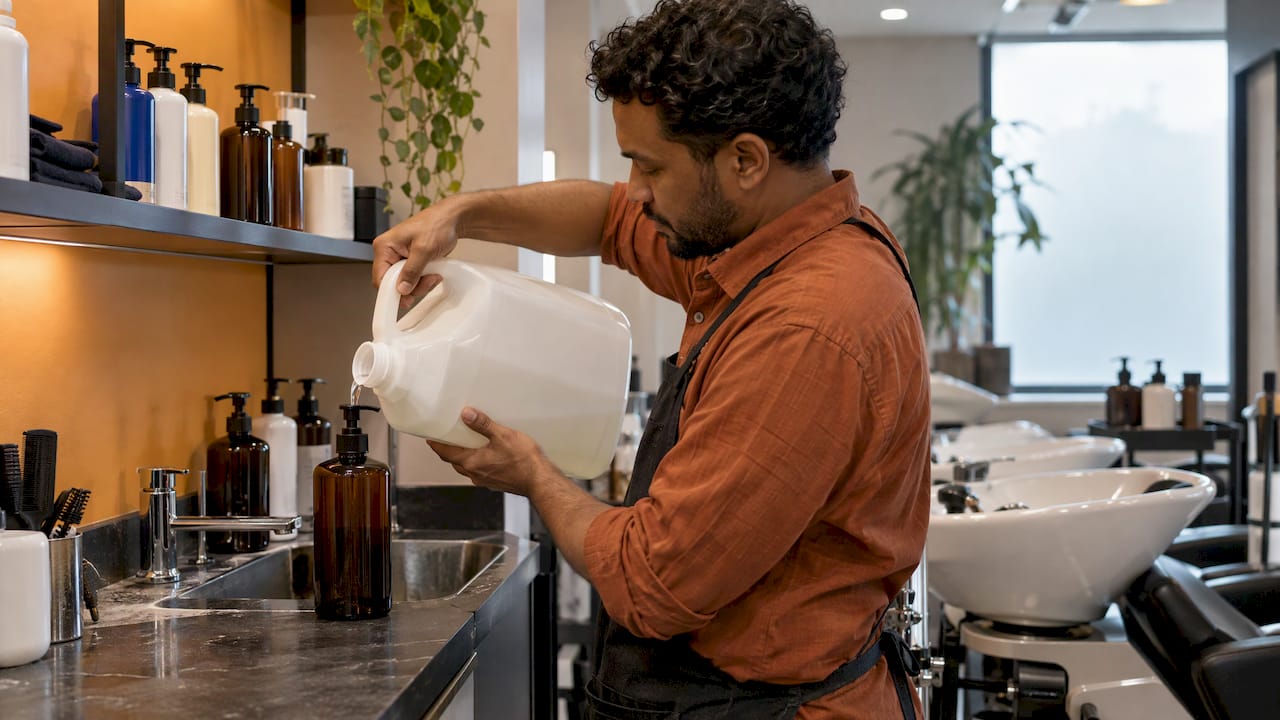
A salon chain buying 5-litre refills. Staff handle the product daily, so this is workplace use. If the formula is classified as hazardous above the SS 586 cut-offs, the chain’s safety officer will expect an SDS from the seller. If it is not classified, a written statement saying so is the cleaner reply.
A brand importing a pre-mixed bulk from overseas. The overseas SDS may follow another country’s rules. MOM’s position is that SDSs must meet Singapore requirements for local use, so the sheet should be reviewed and, where needed, reissued.
Our perspective
We see the same confusion at the start of most projects: founders either assume a finished serum needs a 16-section SDS, or assume documents are only a regulatory formality. Neither is quite right.
Our view is that documentation is part of the formulation, not an afterthought. As an OEM/ODM manufacturer in Singapore with GMP certification from HSA, we develop products with the paperwork in mind. The formulation, raw-material records, quality control and packaging run through one collaborative process, so the files you need later are built as the product is built.
That is why we work closely with clients from the first brief. When we select ingredients, we are thinking about their safety information and how they will be handled on the line, in the salon and in the clinic. Whether the end use is home care, professional salon or doctor’s formulation, we aim to give you a product that is safe and a file you can stand behind.
Edmund
Plan your product with the documents built in
If you are launching a private label, salon or clinic line, we can take the product from design and R&D through manufacturing, quality control and packaging. Our team can talk you through which documents your product will need and when, so nothing is a surprise at notification. See our skincare R&D and manufacturing services, or read how end-to-end contract manufacturing works.
Browse our product lines for home-use, salon and aesthetic formulations, or start with the seven steps to launch private label cosmetics in Singapore.
FAQ
Is a safety data sheet mandatory for cosmetics in Singapore?
Not for a finished product in a consumer pack sold at retail, which is exempt under the WSH rules. It is mandatory where a hazardous substance, including a hazardous cosmetic raw material or bulk product, is supplied for workplace use. Confirm your own product’s position with your formulator or a qualified safety professional.
What must a cosmetic SDS contain?
It must follow the GHS format of 16 sections, from identification and hazards through to regulatory and other information. In Singapore it is prepared under SS 586 Part 3. The information must be accurate and adequate, because misleading SDS content is an offence under the WSH regulations.
What is a CoA for cosmetics?
A certificate of analysis reports test results for one batch against its specification. It usually shows batch number, dates, tests such as pH, heavy metals and microbial limits, methods, results and a sign-off. It is a quality record, not a hazard document.
Does a CoA replace an SDS?
No. The CoA proves a batch met its specification, while the SDS explains hazards and safe handling for the product in general. Where both apply, you need both.
Do I need an SDS for HSA notification?
HSA notification is made through PRISM and rests on the ASEAN Cosmetic Directive requirements, such as labelling, ingredients and the PIF. Keep your safety and technical information ready, since HSA can ask for it. Raw-material SDSs and CoAs commonly support that file.
Sources
- Regulation 43, WSH (General Provisions) Regulations 2006, laws.sg
- Globally Harmonised System of Classification and Labelling, Singapore GHS booklet
- MOM: overseas SDS in Singapore format
- MOM: are chemical compounds exempted from SDS
- UL: Singapore adopts GHS 7th edition
- HSA: ASEAN Cosmetic Directive
- HSA: Regulatory overview of cosmetic products
- HSA presentation: Cosmetic Products Regulation in Singapore
- Health Products (Cosmetic Products, ASEAN Cosmetic Directive) Regulations, Singapore Statutes Online
- ASEAN Guidelines for Product Information File
- Key compliance documents in the cosmetics industry: MSDS, CoA and TDS