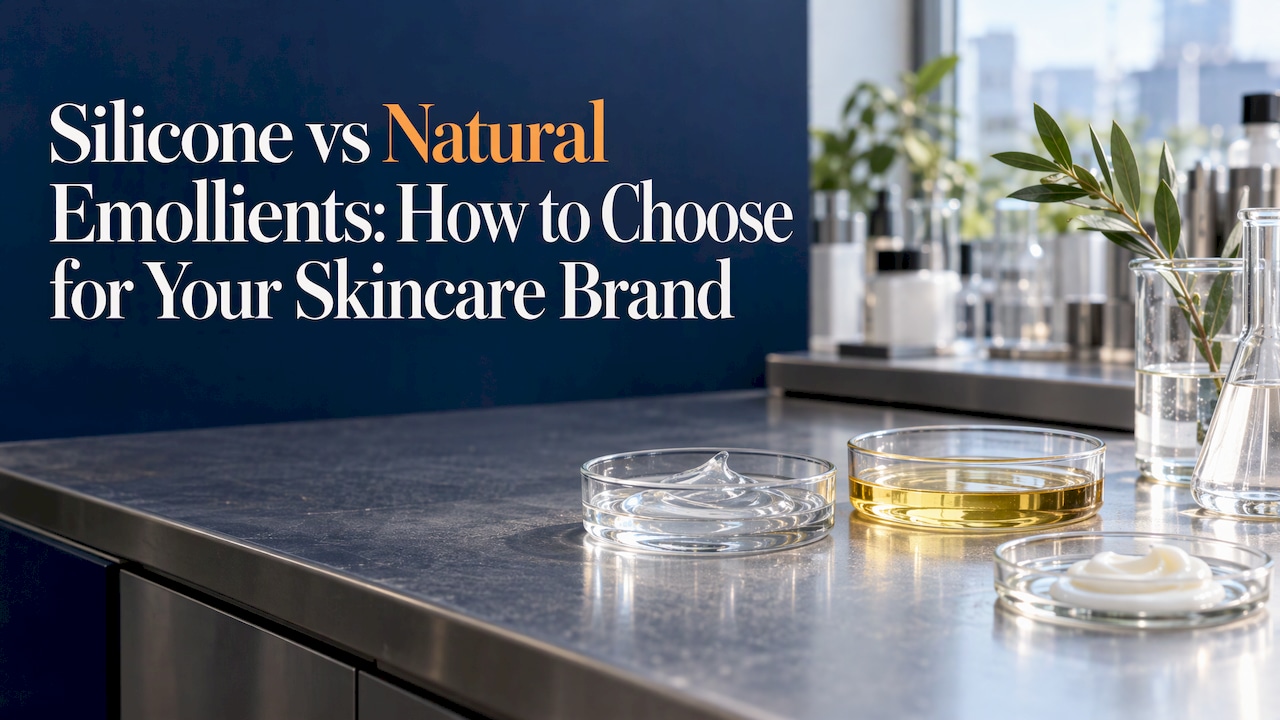
Neither is simply better. Silicones such as dimethicone give a light, silky, very stable feel at low doses. Natural emollients can match much of that feel, but only when the whole formula is rebuilt around them, with the right antioxidant system and stability testing. For a brand owner, the real decision is what your customer expects on the skin, in a humid climate, and on the label. That brief should be settled with your formulator before the first sample is made.
This guide is for brands, salons and clinics planning a private label or custom line. It covers what each emollient family does, how they compare on feel and stability, how to replace silicones without losing texture, and what to check for a fragrance-free claim in Singapore.
TL;DR
- Dimethicone is an emollient and also forms a light, breathable protective film. It is valued for spreadability, a non-greasy finish and long shelf life.
- Natural emollients can reproduce the sensory profile of silicones, but a one-for-one swap rarely works. The oil phase, texturisers and stabilisers usually need to be redesigned together.
- Plant oils and esters oxidise more readily than silicones, so a natural-led formula needs an antioxidant system and accelerated stability testing before scale-up.
- A fragrance-free claim starts with the formula brief, not the label. Singapore rules let a perfume composition be listed under a single term, so check every raw material, not just the ingredients you added on purpose.
- Choose by customer: oily or acne-prone, sensitive, salon treatment or clinic use each point to a different emollient system.
Table of Contents
- What emollients actually do in a formula
- Silicone vs natural emollients: the comparison that matters
- How to formulate without silicones
- Choosing by customer and product type
- Fragrance-free formulation and what to check
- Singapore regulatory points for both routes
- Our perspective
- Take your emollient brief to a formulator
- FAQ
- Sources
What emollients actually do in a formula
An emollient smooths and softens skin by filling the gaps between skin flakes with oil droplets. That is different from a moisturiser. A moisturiser combines occlusive, humectant and emollient properties: the occlusive forms a film that slows water loss through the skin (transepidermal water loss, or TEWL), the humectant draws water in, and the emollient gives the smooth feel.
The same source notes that glycerin alone can raise TEWL by 29 percent, which is why humectants are paired with occlusives or emollients. In practice, the emollient choice shapes how the whole product feels, but it works as part of a system.
Where silicones fit
Yes, dimethicone is an emollient. An ingredient reference describes it as giving a protective but breathable barrier, better spreading, less whitening during rub-in and a soft, lubricious feel. A 2023 dermatology review describes it as an occlusive, emollient and artificial barrier that forms a thin, non-greasy layer. The same review found dimethicone and glycerin were the most common ingredients across 52 online acne moisturisers, which is why silicone-based facial moisturisers suit oily skin.
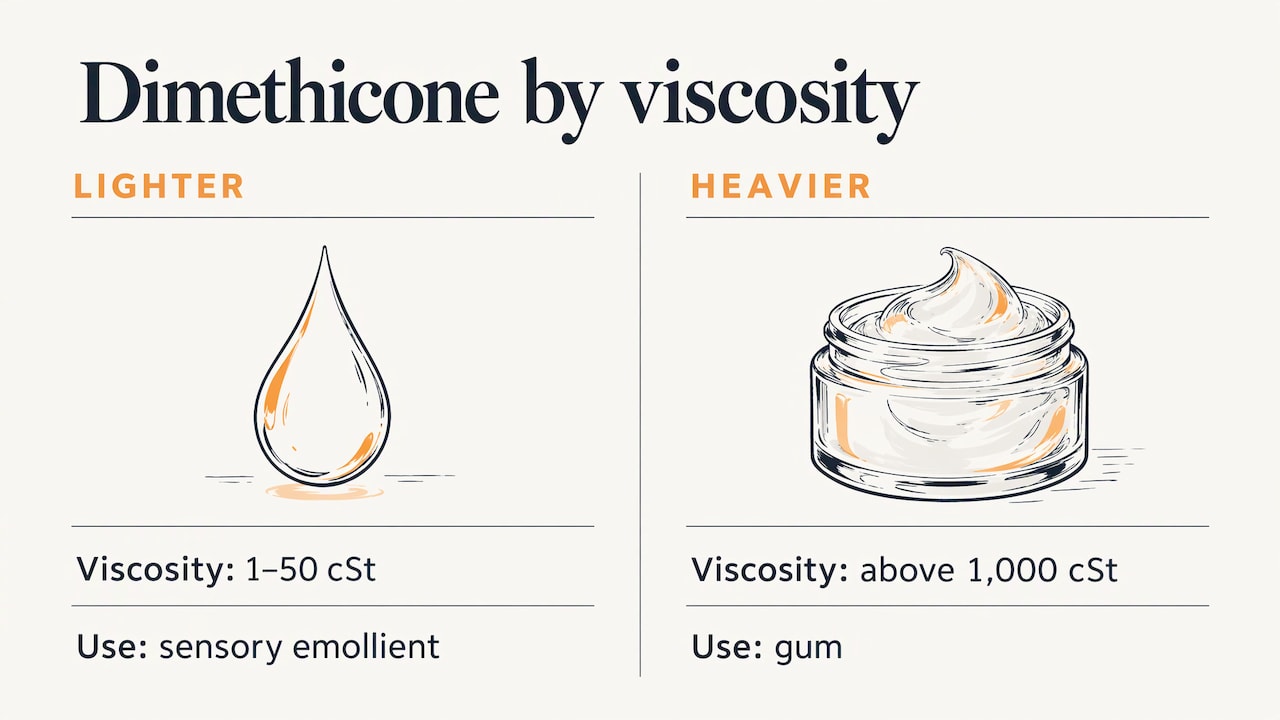
Two more properties matter to a manufacturer. A 2008 formulation review states that silicones are efficient at small dosages, well tolerated and have practically unlimited shelf life, because atmospheric oxygen, water and microbes do not degrade them in any significant way. And weight matters: a technical article on silicone alternatives explains that lighter dimethicones (1 to 50 cSt) are used as sensory emollients, while heavier ones above 1,000 cSt act as gums. So ‘silicone’ is a family of materials, not one ingredient.
Where natural emollients fit
Natural emollients cover plant oils, butters, esters made from plant fatty acids, and newer nature-derived emollients designed to behave like silicones. They appeal to brands whose customers read the ingredients list and want a plant-based story, and to brands with biodegradability goals. A 2025 characterisation of one natural-based emollient reported a surface tension of 22.53 mN/m, a viscosity of 86 cP, and reduced water loss from hair by 7.5% w/w, with topical toxicity tests passed. A low surface tension is the property that gives silicones their easy spread, so figures like these show why modern natural emollients are taken seriously.
Silicone vs natural emollients: the comparison that matters
| Criterion | Silicone (e.g. dimethicone) | Natural and nature-derived emollients |
|---|---|---|
| Skin feel | Silky, light, non-greasy, easy spread | Ranges from light esters to rich butters; the blend decides |
| Whitening on rub-in | Low | Needs formula adjustment, such as waxes or biopolymer particles |
| Oxidative stability | Inert to oxygen | Unsaturated oils and esters need antioxidants |
| Shelf life planning | Straightforward | Depends on the antioxidant system and stability results |
| Brand story | Performance-led | Plant-based, biodegradable positioning |
| Formulation effort | Low dose, one ingredient does many jobs | A combination of emollients is usually needed |
What the sensory data says
A 2022 Italian study compared silicone-based and silicone-free emulsions. Silicone emulsions scored higher for silkiness, freshness and softness, and lower for greasiness. Droplet size and uniformity were unchanged after a month, the emulsions were stable at room temperature and at 40°C, and TEWL readings were comparable to a negative control, meaning they were not occlusive in a way that blocked the skin. For a brand, this explains why silicone is still the benchmark for the elegant, quick-absorbing feel that facial products are judged on.
It also sets the target for a natural formula: match the silkiness, freshness and low greasiness, not just the ingredient list.
Why a straight swap fails
The same BASF-authored article is blunt that replacing dimethicone is not trivial. Its performance comes from low surface energy and high molecular weight, so formulators must combine emollients of different polarity, spreading value, viscosity and sensory character. It also states that an exact 1:1 chemical replacement is currently not possible. The practical lesson for a brand owner: ask for a formula designed without silicone, not a silicone formula with one line changed.
How to formulate without silicones
A good silicone-free brief has four parts.
- Define the target feel. Pick a reference product your customers already like. Describe it in sensory words: slip, cushion, after-feel, residue, whitening. Your formulator can then match it against measurable properties.
- Build an emollient blend, not a single swap. A sustainability study in the Journal of Cosmetic Science reported that a natural-based emollient mixture predicted by a screening tool matched the sensory profile of dimethicone 5 cSt in a benchmark day-care face cream that typically contains 10% of that dimethicone. The blend, not one hero oil, did the work.
- Fix the whitening. The same paper reports that mono- and diglyceride-based waxes and calcium-chloride-crosslinked alginate particles can counter the whitening that appears when dimethicone is removed.
- Rebuild the texture system. A 2024 study reformulated three commercial oil-in-water emulsions using plant-based emollients and a biodegradable elastomer instead of silicone oils, swapping texturisers for ingredients such as starch and maltodextrin and acrylic modifiers for gums such as xanthan and carrageenan. The authors concluded that rheology and texture analysis can guide ingredient selection without compromising the sensory experience, while accepting that perfect replication of the original formula may not be achievable.
That last point is worth planning for. A silicone-free version of a product will feel close, not identical, and your sign-off on samples should say what ‘close enough’ means for your customers.
The emulsifier is the other big lever, because it governs how the new oil phase behaves. Our guide to emulsifier selection for skincare walks through that choice.
Stability is where natural formulas are won or lost
Vegetable oils and esters rich in unsaturated fatty acids are more prone to oxidative degradation than silicones, which are chemically inert to oxygen. The recommended approach is to pair bio-based emollients with an antioxidant system and run accelerated stability testing before scale-up. In Singapore’s warm, humid conditions that is not optional polish: it decides whether the product still smells, looks and feels right months after it ships.
Preservation matters too, since natural-led formulas still need a system that passes testing; see our note on natural preservatives in cosmetics. For the testing itself, read why stability testing matters in skincare manufacturing and the overview of cosmetic stability testing.
Butters and the feel of rich natural emollients
If your line leans on butters for body products or salon treatments, melt point and texture change how the product spreads and sets. A comparison of shea butter versus cocoa butter texture and melt point is a useful way to see why two ‘natural’ emollients can behave so differently in the same base.
Choosing by customer and product type
The right emollient system follows who will use the product and where.
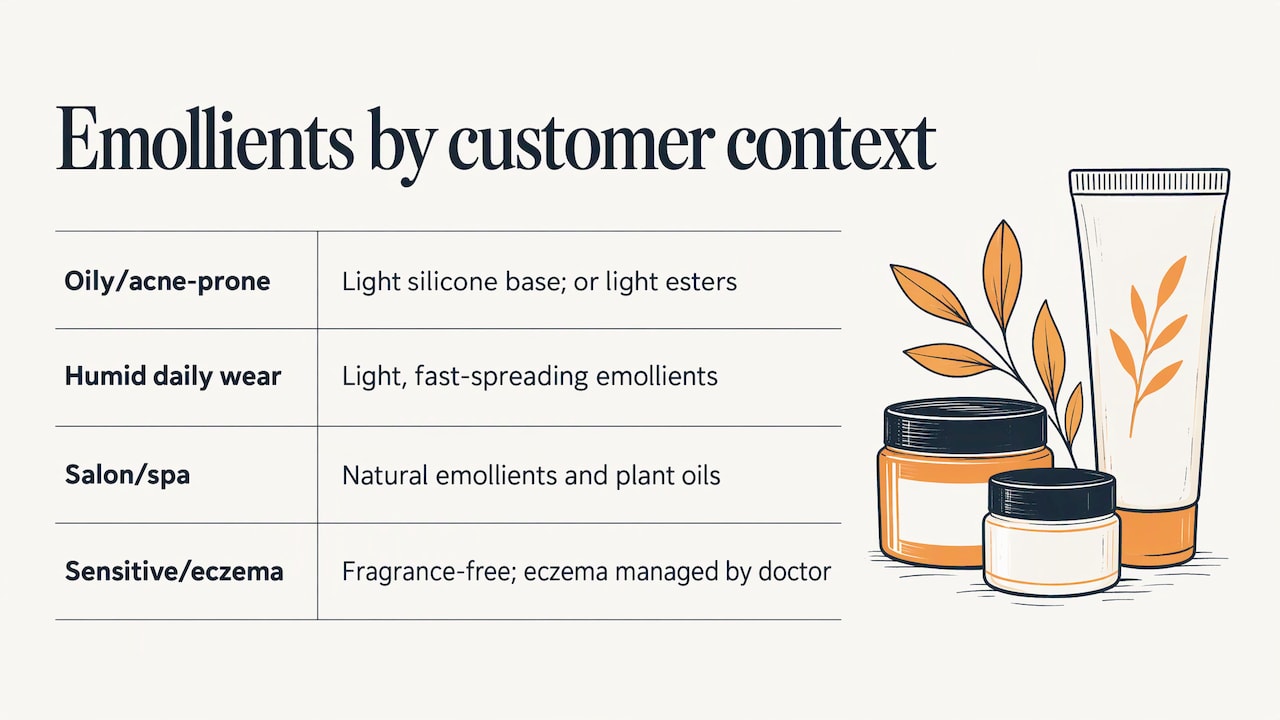
Oily and acne-prone skin. Dimethicone-based moisturisers are described in the literature as noncomedogenic, hypoallergenic and able to cut TEWL without a greasy feel, and a 2014 acne-moisturiser study notes its synergy with antiacne medications can improve compliance and tolerability. For a clinic or aesthetic line working alongside acne treatment, that makes a lightweight silicone-containing base a strong option. A silicone-free alternative needs light esters and sensory testing on the target skin type.
Humid-climate daily wear. Singapore customers often want a fresh, fast-absorbing finish. The silkiness and freshness scores in the 2022 comparison are the reference for that. A natural-led base here should be built around light, fast-spreading emollients rather than rich butters.
Salon and spa use. Treatment products that are massaged in, such as oils and balms, are where natural emollients and plant oils shine, because slip and aroma are part of the service. Our professional salon skincare manufacturing and private label massage oil pages cover those lines.
Sensitive skin and eczema-prone customers. Fragrance-free emollients are the usual starting point, and a skin condition such as eczema should be managed with a doctor or dermatologist, not a cosmetic claim. Cosmetic compatibility checks help here; see our guide to cosmetic compatibility testing.
Fragrance-free formulation and what to check
Fragrance-free is a formulation decision first. Plan for it at the brief stage so the base is built to smell neutral, and so you are not masking raw-material odour later. This matters more for natural emollients, since plant oils carry their own scent and can change as they age.
For your label, Singapore’s cosmetic labelling rules under the Health Products Act regulations require ingredients to be listed in descending order by weight, with those under 1% allowed in any order. A perfume or aromatic composition may be declared as ‘perfume’, ‘fragrance’ or ‘aroma’. That single-term allowance is why a fragrance-free claim needs checking at the raw-material level: confirm with each supplier that no scent component is included in any ingredient before you print the claim.
A practical checklist:
- Ask for a written declaration from every raw-material supplier on fragrance and scent-masking content.
- Record the scent of the finished product at the start and across the stability study, so oxidation of natural oils is caught early.
- Keep the claim wording on the pack consistent with the ingredient list.
- Review the full label with our guide on how to label cosmetic products for market.
Singapore regulatory points for both routes
Silicone or natural, the regulatory framework is the same. Under the Health Products Act regulations, a cosmetic product must be notified to the Health Sciences Authority (HSA) before it is supplied, and re-notified after one year from the most recent notification. Substances on the Part I list are barred, except in trace amounts that are technically unavoidable under good manufacturing practice, or where used in line with that Part’s conditions. Check the current text on the official page before you finalise a formula.
One silicone-specific point: the EU has restricted the cyclic silicones D4, D5 and D6 as substances of very high persistence and bioaccumulation. If you plan to sell in the EU as well as Singapore, ask your formulator to confirm which silicones are in the base and whether they are acceptable in every target market.
Our perspective
We do not start with a side. We start with the customer you want to win and the feel they expect, then pick the emollient system that delivers it.
Silicones are excellent at what they do, and a well-made silicone-containing formula remains a sound choice for many lines. A silicone-free formula is just as achievable when it is designed as a whole: a blend of emollients, a texture system, an antioxidant system and a stability plan, all developed together with the client.
That is how we work. We collaborate with brand owners from the first brief, and our R&D, quality control and packaging services sit under one roof in Singapore, with GMP certification from HSA. The point is that you can test a concept, refine the feel and move to a market-ready product without handing the project between several suppliers.
If you tell us the skin type, the climate, the price tier and the story you want on the pack, we can tell you which route fits.
Edmund
Take your emollient brief to a formulator
If you are planning a private label, salon, home-use or aesthetic line, we develop the formula with you: R&D, customised formulation, quality control and packaging for OEM and ODM projects. Bring your target feel, your customer and your claims, and we will work through the emollient choice with you. See our R&D and manufacturing services, or compare OEM and ODM routes if you are still deciding how to start.
FAQ
Is dimethicone an emollient?
Yes. Dimethicone softens and smooths skin like other emollients, and it also forms a thin, breathable protective layer. Reference sources describe it as improving spreading, reducing whitening and giving a soft, lubricious feel. That combination is why it appears so often in facial moisturisers.
Are emollients and moisturisers the same thing?
Not exactly. A moisturiser usually combines three kinds of ingredient: an occlusive that slows water loss, a humectant that draws water in, and an emollient that smooths the skin surface. The emollient is one part of the moisturiser. Formulators balance all three, which is why changing the emollient often means adjusting the rest of the formula.
Can a natural emollient replace silicone in a face cream?
It can come close when the formula is rebuilt around it. Published work shows blends of natural emollients matching the sensory profile of dimethicone 5 cSt in a day-care cream, with waxes or biopolymer particles used to reduce whitening. Expect a close match rather than an identical one, and confirm it with sensory and stability testing.
What are the best natural emollients to consider?
That depends on the product. Light esters and nature-derived silicone alternatives suit fast-absorbing facial products, while plant oils and butters suit body, massage and salon products. Compare them on viscosity, spreading, polarity and oxidative stability rather than on name alone, and test the combination in your base.
How do I support a fragrance-free claim?
Start with a formula designed to be neutral, then collect written declarations from every raw-material supplier that no scent component is present. Singapore labelling rules allow a perfume composition to be listed as a single term, so supplier confirmation matters. Track the scent through stability testing and keep the pack wording consistent with the ingredient list.
Sources
- Dimethicone, Cosmetic Ingredients Guide
- Silicone in dermatology: an update, Journal of Cutaneous and Aesthetic Surgery
- Moisturizers for Acne: What are their Constituents?, JCAD
- A comparison between silicone-free and silicone-based emulsions, PMC
- Silicone alternatives, Journal of Cosmetic Science
- Eco-Designing Cosmetic Products, MDPI Cosmetics
- A Novel, Multifunctional, Natural-Based Emollient, MDPI Cosmetics
- Sustainability Special Issue, Journal of Cosmetic Science Vol 76 No 1
- Bio-based emollients for cosmetics: performance vs stability
- Fats and oils in cosmetics: Mother Nature versus petrochemistry
- Health Products (Cosmetic Products) Regulations, Singapore Statutes Online
- Shea butter vs cocoa butter: texture, melt point and skin benefits