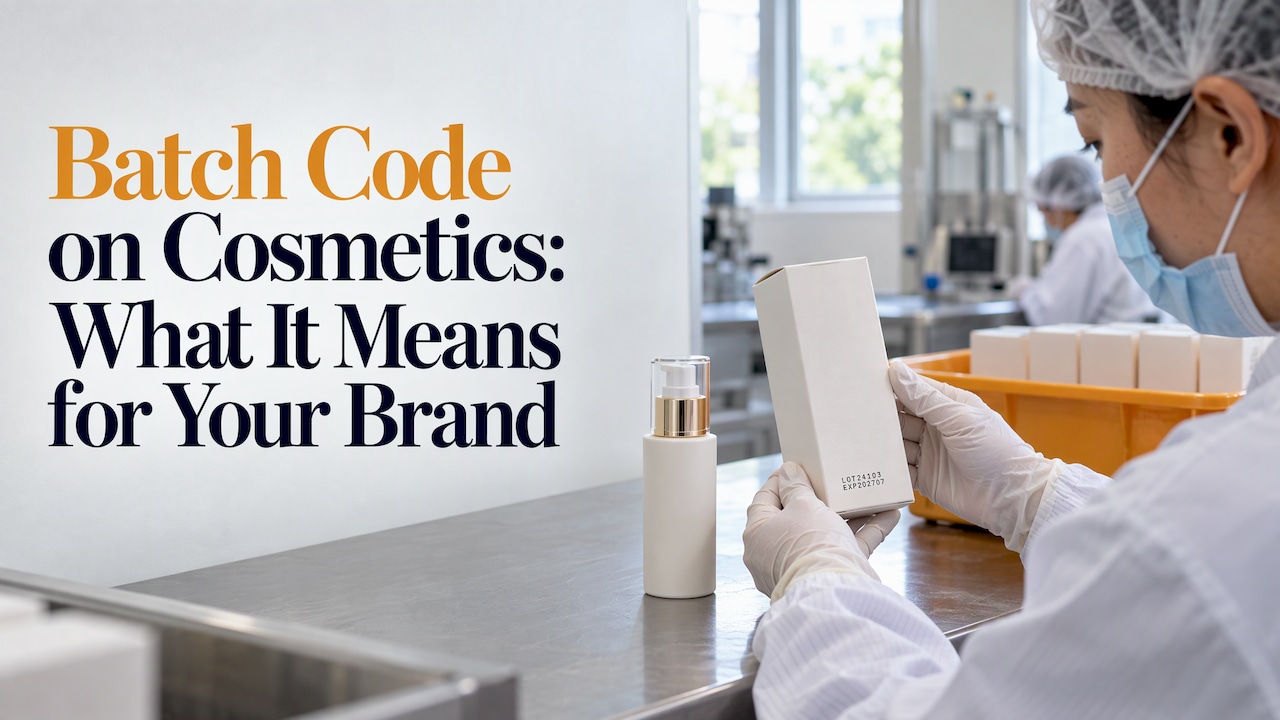
A batch code is a short run of letters and numbers that identifies one production run of a cosmetic product. In Singapore it is a legal label requirement, not a design choice. The manufacturer’s batch number must appear on the outer packaging of every cosmetic supplied here, according to the Health Sciences Authority (HSA) regulatory overview. For a brand owner, the code does three jobs: it keeps you compliant, it lets you trace and recall a run, and it is what shoppers type into decoder websites to judge how old your product is. Plan it before packaging artwork is approved, not after.
This guide is written for founders, salons and clinics launching their own skincare lines. It covers what the code is, what Singapore requires, what customers will and will not learn from it, and how to build batch coding into a launch.
TL;DR
- A batch code identifies a production run. It is not a barcode and it is not an expiry date.
- HSA requires the manufacturer’s batch number on the outer packaging (or the immediate packaging if there is no outer pack) of every cosmetic supplied in Singapore.
- You also need a manufacturing date or an expiry date, depending on shelf life: an expiry date is mandatory where minimum durability is under 30 months.
- There is no universal code format, so shoppers’ decoders only estimate. Print the real dates in plain text so nobody has to guess.
- Settle coding, dates and traceability with your manufacturer at the design stage, together with the packaging.
Table of Contents
- What a cosmetic batch code is
- What Singapore requires on your label
- What shoppers can and cannot learn from the code
- How brands use batch codes behind the scenes
- Planning batch coding at launch: a practical sequence
- A worked example
- Why the manufacturer matters here
- Perspective
- Launch your line with batch coding built in
- FAQ
- Sources
What a cosmetic batch code is
A batch (or lot) code marks all units made in the same production run. If a customer reports a reaction, a smell or a separated formula, the code tells you which run to investigate. It is usually a short stamp of a few characters, often found on the base of a bottle or jar, the crimped end of a tube or the flap of the outer box, and often embossed or ink-jetted rather than printed as part of the design (Skincarisma).
It is easy to confuse with three other markings:
| Marking | What it identifies | Changes between runs? |
|---|---|---|
| Batch code | One production run | Yes |
| Barcode (EAN/UPC) | The retail product, shade and size | No, identical on every unit |
| Expiry date or “best before” | Date until which the product is intended to stay fit for use | Usually, if printed per run |
| PAO symbol (open jar, e.g. 12M) | Months of use after opening | No, set per formula |
The distinction matters because a batch code encodes, at most, when the product was made. Batch code guidance from a decoder site notes that some manufacturers build a month and year into the code while others use an internal sequence with no date at all. Neither is wrong. That is why a customer who reads your code with a free tool may get a precise date, a rough estimate or nothing.
What Singapore requires on your label
Singapore regulates cosmetics through HSA under the ASEAN Cosmetic Directive framework. Three requirements bear directly on batch coding.
1. A batch number on the pack. HSA lists the manufacturer’s batch number among the mandatory label details, in English, on the outer packaging or on the immediate packaging when there is no outer pack (HSA regulatory overview). The Health Products (Cosmetic Products, ASEAN Cosmetic Directive) Regulations 2007 word it as the batch number given by the person who manufactured the product to the batch of which it forms a part (Singapore Statutes Online, regulation 7(1)).
2. A date. HSA states that the manufacturing or expiry date must be expressed clearly as day (if applicable), month and year. An expiry date, preceded by “expiry date” or “best before”, is mandatory for cosmetics whose minimum durability is less than 30 months (HSA regulatory overview). The 2007 Regulations require a manufacturing date unless an expiry date is already specified.
3. The rest of the label. HSA’s April 2026 announcement on how cosmetics are regulated adds that labels must carry ingredients, the country of manufacture, the Singapore name and address of the company placing the product on the market, and any precautionary warnings. It also says firms must notify products before sale, report serious adverse events and withdraw products suspected of posing a health risk. A recall is only workable if you can tell which units are affected, and that is the batch code’s job.
The regulations are amended from time to time. The Amendment Regulations 2025 came into operation on 1 December 2025 and amend the Third Schedule of the 2007 Regulations. Check the current text on Singapore Statutes Online and HSA’s site before you finalise artwork.
One older rule is worth knowing if you make small formats such as sachets, minis or sample tubes. Under the earlier Medicines (Cosmetic Products) (Labelling) Regulations 1996, the batch reference could not be moved to a leaflet even when the container was too small for full labelling (S270-1996). Treat that as a reminder to plan space for the code on the smallest unit you sell, and confirm today’s position with HSA.
What shoppers can and cannot learn from the code
Your customers, and any reseller or marketplace buyer, will check your code. Searches for “batch code cosmetics” lead mostly to free decoder tools where a user picks a brand, types the code and receives an estimated production date. Knowing how they work helps you design a code that does not mislead.
Decoders estimate, they do not certify
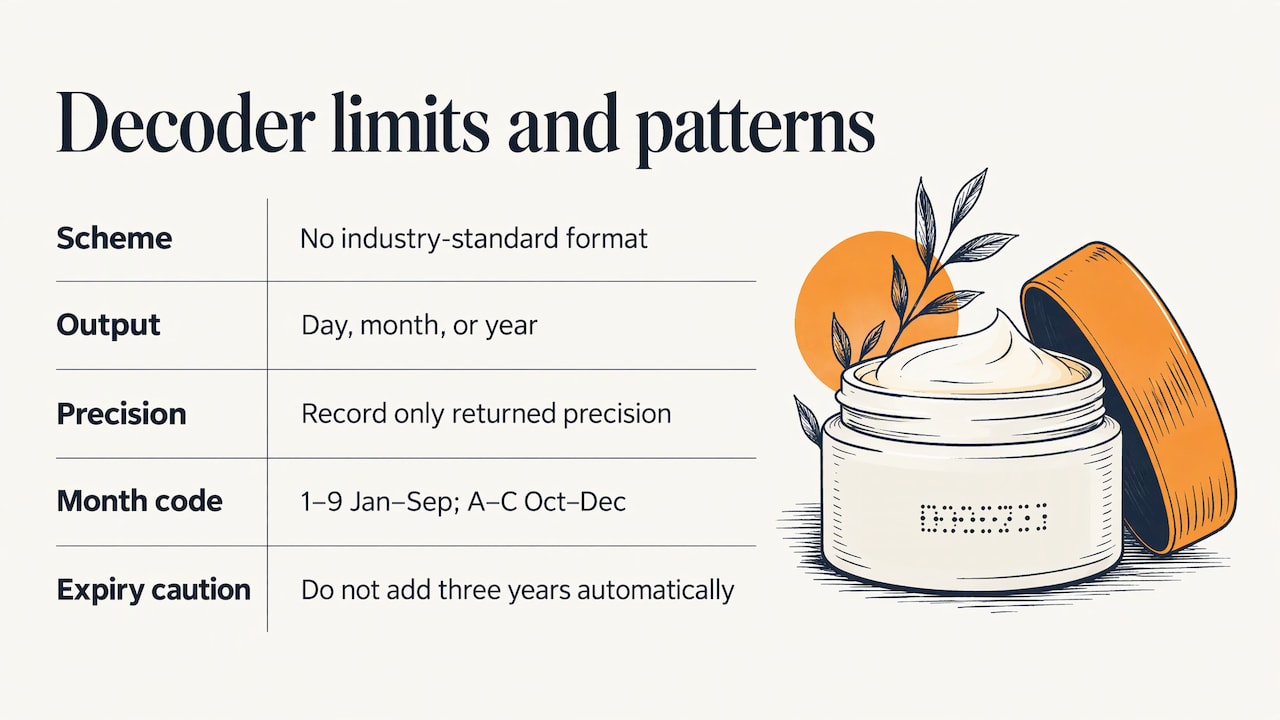
As one decoder explains, there is no industry-standard format: each manufacturer picks its own scheme and rarely publishes it, so tools reverse-engineer rules from codes with known dates (Lotly). A decoder may return a day, a month or only a year. Another tool advises recording only the precision the result actually carries and not converting a production estimate into an expiry date by automatically adding three years (CosmeticBatchTool).
The common three-character pattern, where the second character gives the month (1 to 9 for January to September, A to C for October to December) and the third the year, is one example of how a company might do it (MakeupDr). It is a pattern, not a rule.
A code does not prove authenticity or safety
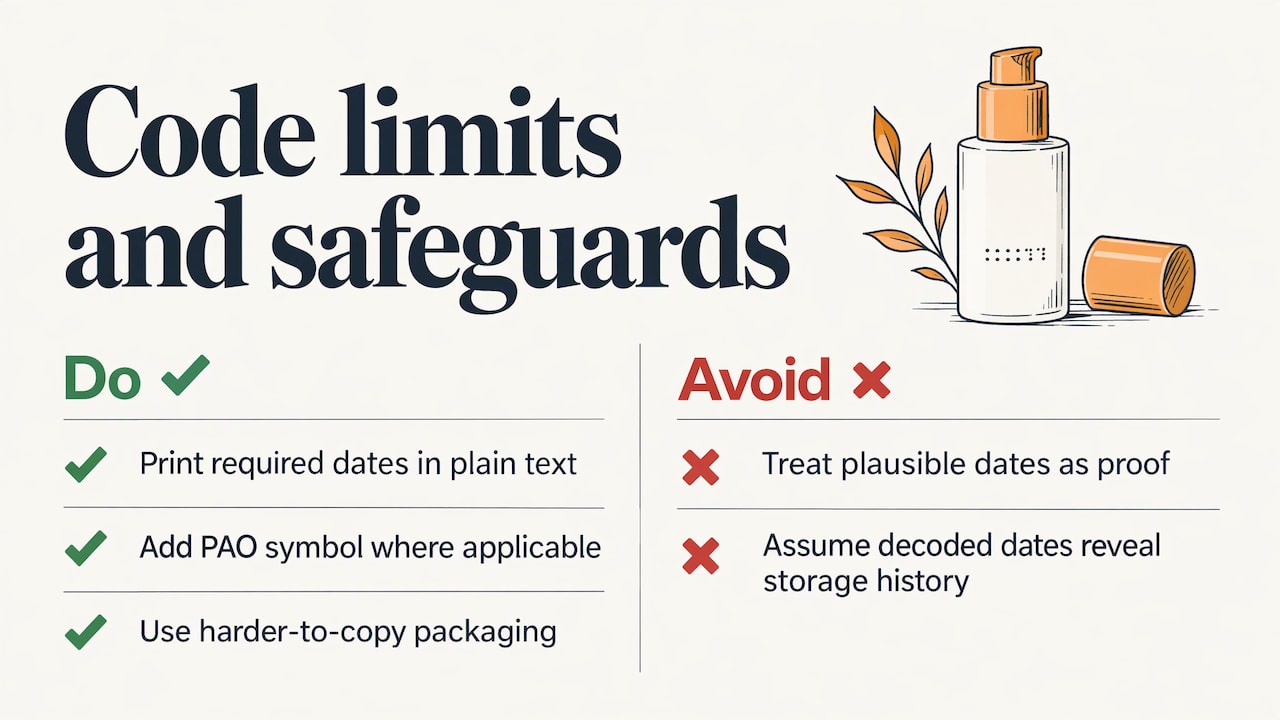
Counterfeiters can copy a visible code from a genuine package, so a plausible date is only one clue (Skincarisma). A decoded date also says nothing about storage, heat, sunlight or opening history, which is why products such as sunscreens, strong actives and eye products deserve a more conservative decision once they have aged (CosmeticBatchCheck).
For your brand, the lesson is practical. Your customers will judge freshness from a code they cannot fully read. Remove the doubt by printing the dates the law asks for in plain text, adding the PAO symbol where it applies, and using packaging features that make copying harder. Our guide to anti-counterfeit packaging for skincare brands covers the options.
How brands use batch codes behind the scenes
Outside the label, the batch code is the reference that ties together everything recorded about a run: the formula version, the raw material lots, the filling date and the quality control results. When a customer reports an unusual smell, colour, separation or texture, a packaging fault or a recall is announced, the code is how you find the affected run, since recalls are usually announced by batch or lot (Ozera Labs).
That has consequences for a new brand:
- Keep a batch log. For each code, note the production date, the quantity, the destination (your own store, a distributor, a salon) and the date of the release decision.
- Keep retained information, not just retained stock. Customer complaints should always quote the code, so train front-of-house staff and customer service to ask for it.
- Align with HSA duties. Because you must be able to withdraw a product suspected of posing a health risk, a batch you cannot trace to its customers is a compliance problem as well as a commercial one.
Planning batch coding at launch: a practical sequence
1. Decide who assigns the code
The regulation speaks of the number given by the person who manufactured the product. Agree with your manufacturer at the start how codes are issued, so that the number on your pack matches the number in the production record. If you appoint more than one filler, or add a sachet or sample format, settle one scheme across all of them.
2. Choose a readable scheme
A scheme that your own team can read in seconds is worth more than a clever one. Many brands include the year and month of manufacture plus a run number. Whatever you choose, write it down once, because staff changes and a recall that needs a quick answer will test it.
3. Set the date approach from shelf life
The 30-month threshold decides whether an expiry date is mandatory (HSA). Shelf life comes from the formula and its stability data, so this decision belongs with your formulation and testing, not with the packaging designer. Our overview of stability testing and QC explains what supports a durability claim.
4. Reserve space and method on the pack
Embossing, laser coding and ink-jet each suit different materials. Glass, tubes, sachets and folding cartons behave differently, and the code must stay legible through handling. Reserve a clear zone on the artwork early. Our note on skincare packaging options for Singapore brands compares formats, and the filling services page shows how filling fits in.
5. Check the code against your notification and label
Before sale, your product must be notified to HSA, and the label you sell must match the rules. Our HSA cosmetic notification guide and the ASEAN Cosmetic Directive overview walk through the process.
6. Test the code in the real world
Once the first batch is filled, inspect finished units for legibility on every format and every channel, from the carton to the unit inside it. Fix any smudging or placement problem before the second run, not after a complaint.
A worked example
Imagine a salon launching a 50 ml hydrating serum and a 10 ml sample sachet. The team agrees a code made of year, month and a two-digit run number, and shows it on the carton, the bottle base and the sachet. The serum’s formula has a shelf life of 24 months, so under the HSA rule an expiry date is required, written with month and year in the prescribed manner. The salon logs the run number against every shipment to its three treatment rooms and to online customers. When a client later reports redness, staff ask for the code, find the run in minutes and can see exactly which other units went out with it. None of that depends on a shopper’s decoder app.
Why the manufacturer matters here
Batch coding is only as good as the process behind it. Production records, quality control checks and the release decision all hang on the code, so a manufacturer’s way of working matters more than the stamp itself. Harmony Skin Lab holds GMP certification from Singapore’s HSA, and you can read what that standard covers in our piece on HSA GMP and skincare manufacturing standards. If you are comparing options, nine questions to ask before choosing a skincare manufacturer is a useful checklist, and our guide on how to choose an OEM skincare manufacturer goes further.
Perspective
We meet many first-time founders who treat the batch code as a small print detail that the printer will sort out. We see it differently. It is the thread that connects your formula, your quality control and your customer, and it should be agreed while the product is still being designed.
That is why our work covers product design, customised formulation, quality control and packaging under one roof. When the people who develop the formula and the people who handle packaging are in the same conversation, decisions about shelf life, dates and where the code sits on the pack are made once, together, and fit your market trends and your customers’ needs.
Our advice to brands in Singapore: do not rely on how a third-party decoder reads your code. Print the dates plainly, keep a clean batch log, and work with a manufacturer whose GMP certification from HSA means records are part of the routine.
Edmund
Launch your line with batch coding built in
Harmony Skin Lab is a Singapore OEM/ODM skincare manufacturer. We take private label, salon and clinic lines from idea to finished product, with R&D, customised formulation, quality control, design and packaging in one project. You can see the full list on our services page and the ranges we make on our products page. To start a project, begin from our homepage.

If you are mapping the whole journey, our skincare launch roadmap and the seven steps to launch private label cosmetics in Singapore put batch coding in context.
FAQ
Where is the batch code on a cosmetic product?
Usually on the base of a bottle or jar, the crimped end of a tube, or the flap or base of the outer box. It is often embossed or ink-jetted, and looks separate from the printed design. Under HSA rules, the code must be on the outer packaging, or on the immediate packaging if there is no outer pack.
Is a batch code the same as an expiry date?
No. A batch code identifies the production run and may or may not contain a date. An expiry date, where required, is printed separately with the words “expiry date” or “best before”. In Singapore it is mandatory for cosmetics whose minimum durability is under 30 months, and the open-jar PAO symbol covers use after opening.
Do I need a batch code if my product is made in small quantities?
Yes. HSA requires the manufacturer’s batch number on cosmetics supplied in Singapore regardless of the size of the run. Small runs are easy to manage when the code scheme is simple and each code is logged against what was produced and where it was sent.
Can a batch code prove my product is genuine?
Not by itself. Counterfeiters can copy a code from a real pack, so shoppers should also look at packaging and the seller. Brands can support authenticity with packaging features and by selling through their own channels and authorised retailers.
Can customers work out my product’s age from the code?
Only sometimes. Each manufacturer chooses its own format, so decoders return estimates of varying precision or no result. Printing the manufacturing or expiry date in plain text on the pack removes the guesswork.
Sources
- HSA: Regulatory overview of cosmetic products
- HSA: How cosmetic products are regulated by HSA
- Singapore Statutes Online: Health Products (Cosmetic Products, ASEAN Cosmetic Directive) Regulations 2007
- Singapore Statutes Online: Amendment Regulations 2025
- Singapore Statutes Online: Medicines (Cosmetic Products) (Labelling) Regulations 1996
- Skincarisma: Batch code checker
- Skincarisma: How to spot counterfeit cosmetics
- Batch Code Lookup: What is a batch code
- Lotly: Cosmetic batch code checker
- CosmeticBatchTool: Batch code basics
- MakeupDr: How to read cosmetic batch codes
- CosmeticBatchCheck: What is a cosmetic batch code
- Ozera Labs: What a skincare batch code means