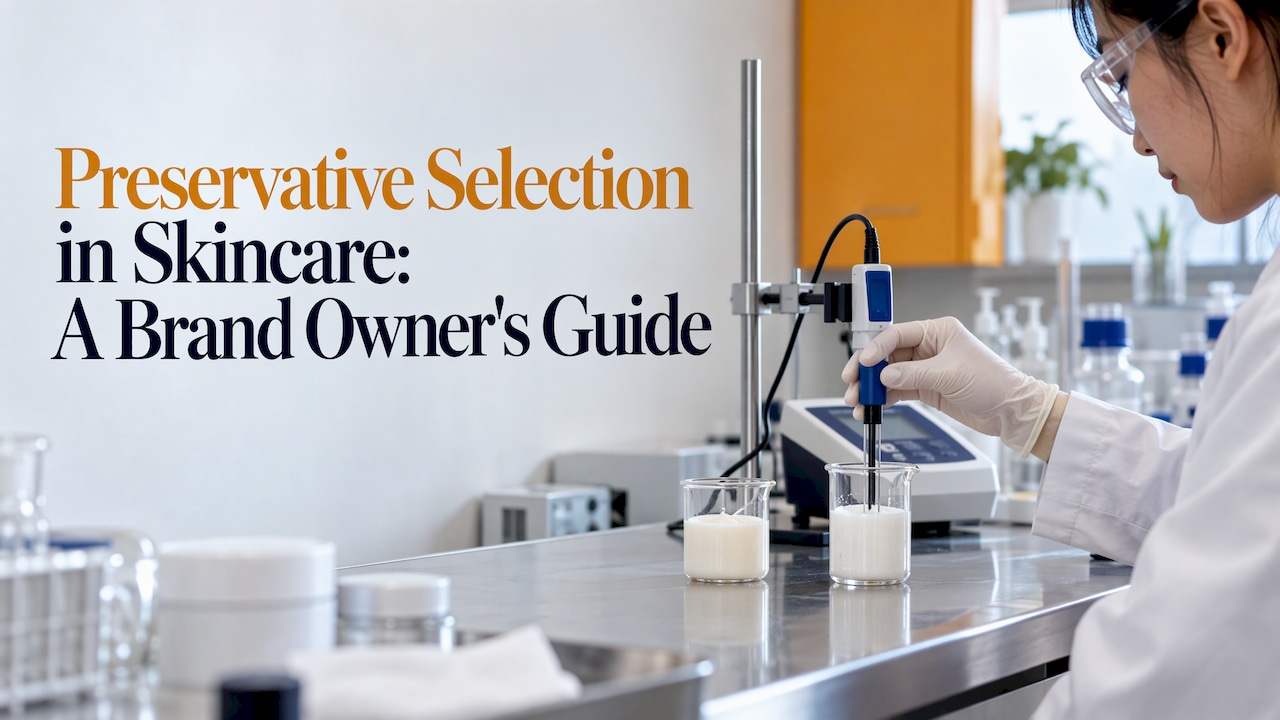
The right preservative for your skincare product is the one that suits that exact formula, its pH, its packaging and the skin it will touch, and that is proven by a challenge test and listed in Annex VI of the ASEAN Cosmetic Directive. There is no universal best choice. Selection is a formulation decision made together with your manufacturer before the first pilot batch, which is why we at Harmony Skin Lab treat it as part of R&D and not as a last-minute additive.
This guide is for brand owners, salon groups and clinics who are commissioning a private label or custom range in Singapore. It explains what a preservative system must do, how the main classes behave, what the rules say, and how to check the result.
TL;DR
- Choose a preservative system by formula: water content, pH, surfactants, oils, packaging, intended skin and shelf life all change what works.
- In Singapore a preservative must appear in Annex VI of the ASEAN Cosmetic Directive and stay within its limit. The annex is revised regularly, so confirm the live version with HSA.
- Most robust systems combine two or more complementary ingredients at lower individual levels, not one strong ingredient.
- A 28-day challenge test on your own formula, in its own packaging, is how you confirm the system works.
- Raise preservation at brief stage with your manufacturer. Changing it after the formula is fixed usually means re-testing.
Table of Contents
- What a preservative system has to do
- The factors that drive selection
- Comparing the common preservative classes
- Singapore rules: what you must follow
- Proving the system works
- A selection routine for your brief
- Our perspective
- Taking the next step with Harmony Skin Lab
- FAQ
- Sources
What a preservative system has to do
Any product containing water, and many that contain only traces of it, can support bacteria, yeast and mould. A preservative system stops that growth during manufacture, on the shelf and while your customer dips fingers into the jar for months.
“Broad spectrum” means the system works against several groups at once: gram-positive bacteria, gram-negative bacteria, yeasts and moulds. One ingredient may be strong against bacteria and weak against mould, so coverage is the first filter. A contaminated cream can do more than spoil: applied to skin it can cause irritation or infection, which is a safety and a brand-reputation problem.
Academic reviews list what an ideal preservative would offer: broad activity at low concentration across the pH range of cosmetics, stability, compatibility with ingredients and packaging, safety for workers and consumers, regulatory compliance and cost-effectiveness. The same review in the Society of Cosmetic Chemists library notes that no single preservative has met all of these criteria. That is the practical reason systems are built from combinations.
The factors that drive selection
The Cosmetics & Toiletries guidance by Betty Croshaw puts the starting point simply: selection depends on the physical and chemical nature of the product, how it will be used (normal or broken skin, infants, around the eyes), the type of container and the desired shelf life. Here is how each plays out.
pH
Many preservatives only work in a certain pH window. Halla and colleagues’ 2018 review notes that parabens become ineffective in alkaline formulations because they dissociate, and that bronopol decomposes slowly at high pH. Organic acid preservatives such as benzoates and sorbates also depend on a lower pH to work. So a toner at pH 4.5 and a body wash at pH 7 need different answers.
Oil and water phases
In an oil-in-water emulsion, an oil-loving preservative can migrate into the oil phase and leave the water phase, where microbes live, under-protected. The same review describes this for parabens. An optimised system, as Eric Abrutyn of TPC2 Advisors writes, needs activity at the right pH and solubility in both phases, while accounting for the water content and the nutrients that natural ingredients and proteins supply to microbes.
Other ingredients in the formula
Preservatives interact with the rest of the recipe. According to the same review, formaldehyde is inactivated by surfactants and nonionic proteins, nonionic surfactants alter paraben activity, and talc reduces the antimicrobial activity of more than 90% of methylparaben. On the positive side, EDTA acts synergistically with several preservatives by disrupting the bacterial lipid layer so they penetrate better.
This is why swapping one ingredient late in development, a new botanical extract or a different emulsifier, can quietly undermine a system that looked fine.
Packaging and customer
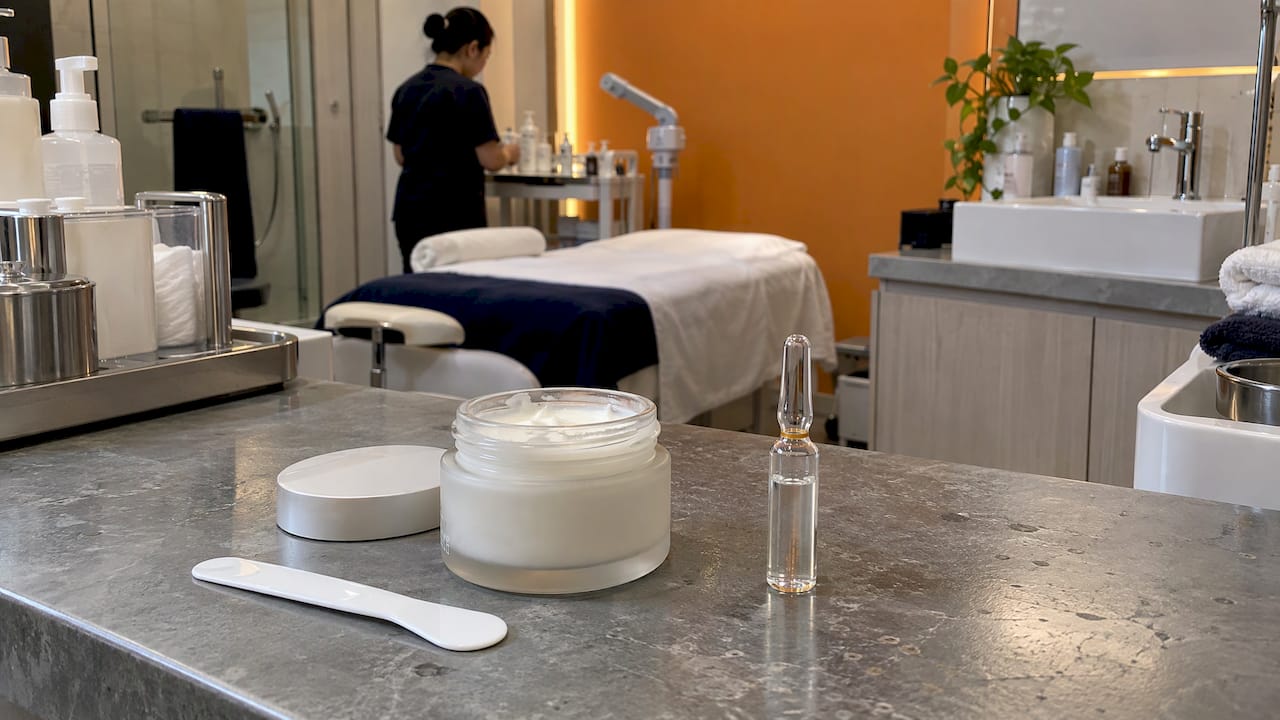
A jar opened daily is exposed to far more contamination than an airless pump. A salon backbar product decanted into spatulas faces different risk from a sealed ampoule. A formulation for sensitive or post-procedure skin, which clinics often request, should be designed with the lowest effective preservative load. Packaging choice and preservative choice should therefore be settled together. Our guide on skincare packaging options for Singapore brands covers the packaging side.
Comparing the common preservative classes
The table below is a simplified orientation, not a recipe. Real concentrations depend on the formula and the legal limits in force.
| Class | Typical strengths | Main formulation considerations |
|---|---|---|
| Parabens | Long record of use, broad coverage against bacteria and fungi | Best in acidic to mildly acidic systems; can partition into oil; lose activity in alkaline products |
| Phenoxyethanol | Broad-spectrum, widely used, stable across a wide pH range | Often paired with other ingredients to strengthen fungal coverage; capped at a maximum level |
| Benzoates and sorbates | Familiar, lower-irritation organic acids | Need a lower pH to be effective |
| Benzyl alcohol | Useful supporting preservative | An allergen listed in labelling rules; eye-irritant at higher levels |
| Formaldehyde releasers | Strong coverage historically | Labelling above a threshold, tightening regulation, and inactivated by some surfactants |
What the safety reviews say
An Society of Cosmetic Chemists review from 2021 reports that the Cosmetic Ingredient Review Expert Panel concluded in 2019 that 20 paraben-related ingredients, including methylparaben, ethylparaben, propylparaben and butylparaben, are safe in cosmetics under present practices of use. It also reports that phenoxyethanol is considered safe at a maximum of 1% by the EU Scientific Committee on Consumer Safety, and describes it as one of the best-tolerated preservatives. The same review records benzyl alcohol as an allergen that caused reactions in 1.2% to 15% of eczema patients in the data it cites, which is why it needs care in products for reactive skin.
What about “natural” preservation?
Brands often ask for a naturally derived system. The practical question is the same as for any other: does it protect this formula against bacteria, yeast and mould, within Annex VI where it is a listed preservative? Plant-based and nature-identical ingredients can be part of a system, but the water content and the nutrients in natural ingredients raise the growth potential of the formula, so these products often need more preservation planning, not less. Raise your natural positioning at brief stage so the formula can be built around it. If you are weighing ingredient claims for your range, this overview of ingredients to avoid in skincare shows how consumers read ingredient lists, which helps you decide how to position your preservative choices.
Why systems beat single ingredients
A single preservative dosed high enough to cover bacteria, yeast and mould would be harsh on skin in most formulas. Combining complementary ingredients lets each work at a lower level. The same logic sits behind Abrutyn’s advice that the optimum concentration must preserve the product without sensitising skin, and that robust protection starts with formulation strategy, including understanding each raw material’s interaction and using preserved surfactants, rather than simply adding a preservative at the end.
Singapore rules: what you must follow
If you will supply in Singapore, preservative choice is a legal matter as well as a technical one.
- Only listed preservatives. Under the Health Products (Cosmetic Products – ASEAN Cosmetic Directive) Regulations 2007, a cosmetic product may not contain a preservative unless it is listed in Part IV of the Third Schedule, stays within its specified limit and meets the other conditions attached to it.
- Annex VI is the list. The Health Sciences Authority (HSA) states that the ASEAN Cosmetic Directive has applied in Singapore since 1 January 2008, that Annex VI is the list of preservatives allowed and that dealers carry legal responsibility for product safety, labelling and ingredient compliance. HSA’s page showed Annex VI as updated in June 2026.
- Notify before supply. Supply requires prior notification, with a further notification needed to continue supplying after one year. Our practical guide to HSA cosmetic notification walks through it.
- Label correctly. Formaldehyde-releasing preservatives must carry a “contains formaldehyde” statement when the finished product exceeds 0.05% formaldehyde, as set out in the ASEAN Annex VI release of 15 December 2023.
The annex changes, so your formula must keep up
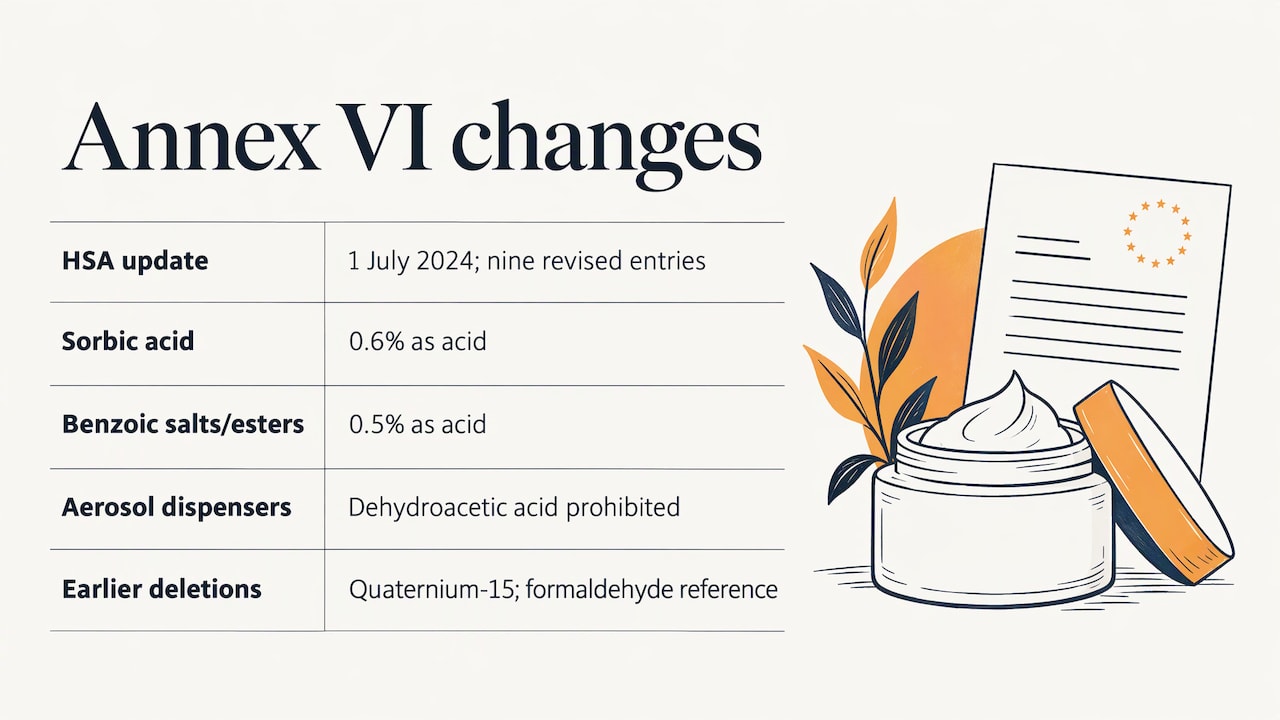
Annex VI is not static. On 1 July 2024 HSA issued updated annexes with nine revised preservative entries, as reported by ChemLinked. Examples include sorbic acid and its salts at 0.6% (as acid), benzoic acid salts and esters at 0.5% (as acid), and a prohibition on dehydroacetic acid in aerosol dispensers. Earlier, ASEAN member states agreed to remove quaternium-15 from Annex VI after it was banned and to delete the reference to formaldehyde as a permitted preservative.
The lesson for a brand owner: a formula approved two years ago should be re-checked against the current annex whenever you reorder, relaunch or renew your notification. Read the live annex on the HSA page for current limits, not a summary from a past year. For the wider picture, see our pages on the ASEAN Cosmetic Directive and cosmetic regulations in Singapore.
Proving the system works
A preservative that looks right on paper can still fail in your formula. The accepted way to find out is the challenge test, also called a preservative efficacy test. The Halla review describes it: the product is inoculated with known amounts of bacteria, yeasts and moulds, held at room temperature for 28 days in its original packaging, and the reduction in microbes is measured against official acceptance criteria.
The same review recommends validating efficacy at three points:
- On freshly prepared product.
- After storage in the container.
- In the first production batch before packaging.
That third point is where scale-up surprises show up, because mixing times, temperatures and raw-material lots differ from the lab bench. For a deeper explanation, read what 28 days of challenge testing reveals, our overview of cosmetic microbiological testing and why stability testing matters.
A selection routine for your brief
When you commission a formula, work through these questions with your manufacturer:
- Format and water content. Is it an emulsion, a gel, a toner, an oil-based balm or a powder? Water-rich formats need the most robust protection.
- Target pH. Fix the skin-compatible pH range first, then select preservatives that work inside it.
- Key ingredients. List actives, botanicals, proteins and surfactants. Each can feed microbes or interfere with a preservative.
- User and use. Sensitive skin, post-procedure skin, around the eyes, children’s products and daily-use salon products set the tolerance bar.
- Packaging. Jar, tube, airless pump or sachet determines contamination risk and how much protection must come from the formula.
- Claims and positioning. “Free-from” or natural claims should be decided now, since they narrow the options.
- Markets. If you plan to export beyond Singapore, say so, because other markets keep their own preservative lists.
- Testing plan. Agree the challenge test and stability checks before pilot approval, not after.
A brand that arrives with answers to these eight points shortens development and avoids reformulating after sample approval.
Our perspective
We see preservation as a design decision, not an ingredient you add at the end. The strongest launches we help shape begin with a conversation about the customer, the format and the packaging, and only then move to the preservative system.
Our approach is collaborative: we develop with you through R&D, customised formulation, quality control and packaging, so the preservative system, the container and the claims on your label are planned as one. Our facility holds GMP certification from Singapore’s HSA, and we use high-quality, safe ingredients with modern manufacturing technology.
Whether your range is home-use essentials, a professional salon line or an aesthetic formulation for a doctor’s practice, the aim is the same: a product that stays safe and pleasant from the first use to the last, and that meets Singapore’s rules.
Edmund
Taking the next step with Harmony Skin Lab
If you are planning a private label, salon or medical skincare line, our team can take preservation from brief to production alongside formulation, quality control and packaging. Our skincare R&D and manufacturing services cover product design, customised formulation and packaging for home-use, professional salon and aesthetic or doctor’s formulations. You can also read how custom skincare formulation works from concept to production.
Bring your target customer, format and packaging idea, and we will start from there.
FAQ
Which preservative is best for skincare products?
No single preservative is best for every product. The right choice depends on the formula’s water content, pH, ingredients and packaging, and it must be listed in Annex VI of the ASEAN Cosmetic Directive. Many effective systems combine two or more ingredients so that each is used at a lower level.
What does broad spectrum mean for a cosmetic preservative?
It means the preservative or system is effective against gram-positive bacteria, gram-negative bacteria, yeast and mould. Each group can spoil a product or harm the user, so a system needs coverage of all four, which is then confirmed by a challenge test.
Can a skincare product be sold in Singapore with any preservative?
No. Under the 2007 regulations, a preservative must be on the permitted list, within its stated limit and compliant with any conditions attached. The product must also be notified to HSA before supply, and notified again to continue supplying after one year.
How long does a challenge test take?
The standard approach described in the scientific literature runs for 28 days, with the product in its original packaging. Plan for this in your launch timeline and repeat it on the first production batch, not only on the lab sample.
Sources
- Cosmetics Preservation: A Review on Present Strategies (Halla et al., 2018)
- The Evolution of Cosmetic Preservation (Society of Cosmetic Chemists)
- Preservation of Personal Care and Cosmetic Products (Society of Cosmetic Chemists)
- Betty Croshaw, Cosmetics & Toiletries, Vol. 28 No. 1
- Optimizing Formula Preservation (Cosmetics & Toiletries)
- Health Products (Cosmetic Products – ASEAN Cosmetic Directive) Regulations 2007
- ASEAN Cosmetic Directive (Health Sciences Authority)
- ASEAN Annex VI release, 15 December 2023
- Updates to ACD ingredient annexes (ChemLinked)
- FDA Circular No. 2024-005 on 38th ASEAN Cosmetic Committee updates
- Ingredients to avoid in skincare: 2026 guide