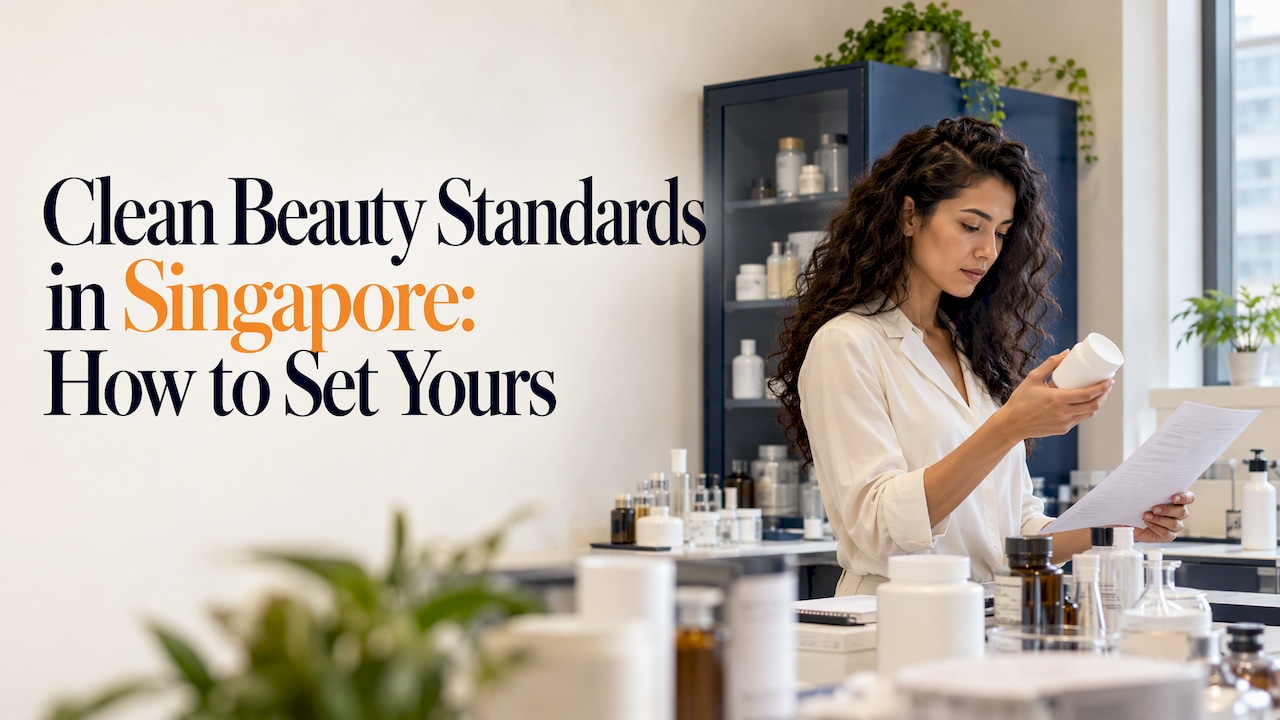
If you are launching a skincare line in Singapore, the first thing to know about clean beauty standards is that you write them yourself. Neither the Health Sciences Authority (HSA) nor any other Singapore body defines “clean”. What the law does fix is the safety floor: banned and restricted ingredients, notification, labelling and claims. A credible clean standard is a written ingredient policy that sits above that floor, is built into the formula from day one, and can be backed with documents. At Harmony Skin Lab, a GMP-certified OEM/ODM manufacturer in Singapore, we develop formulations with brand owners on exactly this basis.
TL;DR
- “Clean” has no legal definition in Singapore. Retailers and brands each set their own criteria, so your standard has to be written down and defensible.
- The legal floor is the ASEAN Cosmetic Directive rules enforced by HSA: prohibited and restricted substances, notification before sale, English labels with a full ingredient list.
- Any “clean”, “natural” or “safe” claim must be substantiated if HSA or the advertising code asks for evidence.
- Decide your exclusions per ingredient and per concentration, not by whether an ingredient is natural or synthetic.
- Build the standard into the formulation and manufacturing brief early, so it is tested, documented and repeatable.
Table of Contents
- What “clean” means, and what it does not
- The legal floor under any clean standard
- Writing your own clean standard
- Claims: how to say “clean” without creating a problem
- Where the manufacturer fits in
- Our view on clean beauty standards
- Taking your standard into production
- FAQ
- Sources
What “clean” means, and what it does not
Ask five brands and you will get five definitions. A 2026 paper in Surgical & Cosmetic Dermatology describes clean beauty as products considered safe, transparent and free of controversial ingredients such as parabens, sulfates, phthalates, petrolatum and synthetic fragrances. Vogue Singapore reports that the core idea is avoiding synthetic ingredients most likely to trigger allergies, while some brands go further and mean fully natural-origin formulas, or add sustainability and vegan credentials.
That range is the opportunity. Because the term is open, a brand that states precisely what it excludes, why, and how it checks, stands out from one that simply prints “clean” on the box.
Two neighbouring terms are worth separating, because customers mix them up:
- Natural: mostly minimally processed plant, mineral or animal raw materials. The Brazilian paper above puts synthetic content in natural cosmetics at generally no more than 5%.
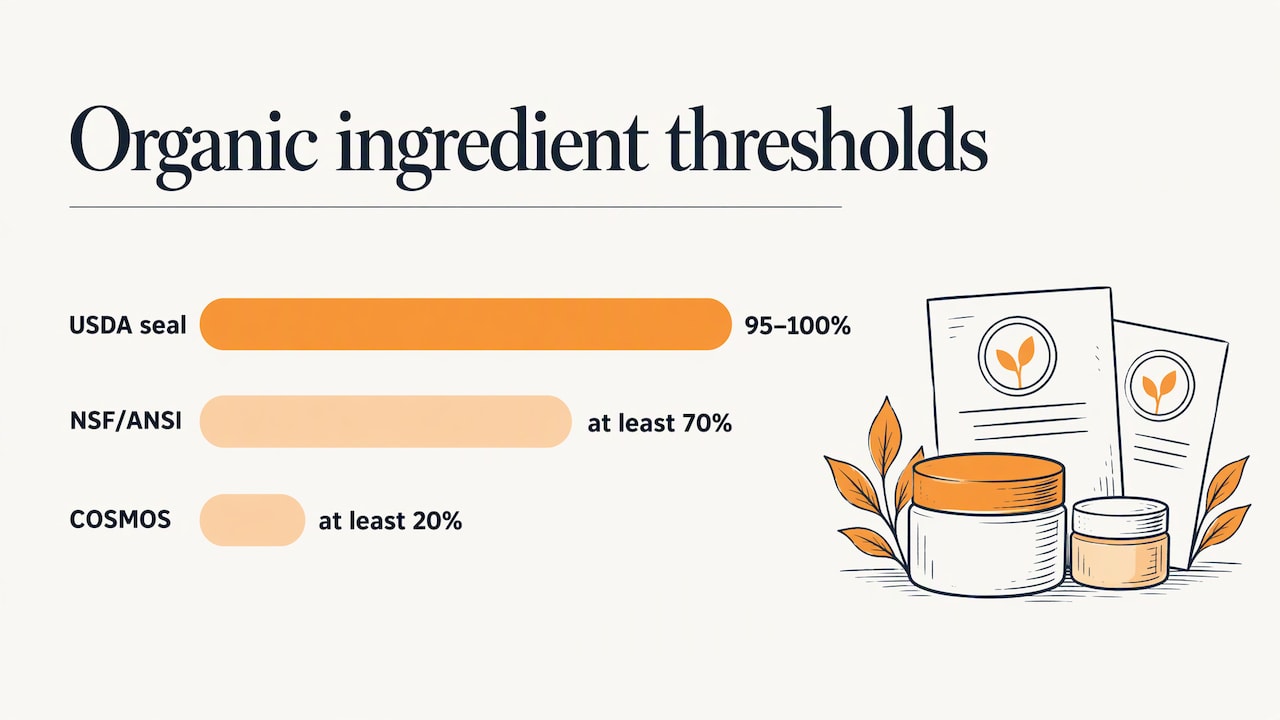
- Organic: a certification-driven term. In the US, according to a Journal of Drugs in Dermatology review, the USDA seal needs 95 to 100% certified organic agricultural ingredients, NSF/ANSI certification at least 70%, and COSMOS at least 20%. If you want to say organic, you need to say which scheme and meet its threshold.
A product can be one of these without being the others. Choose which promise you are making, then make only that one.
The legal floor under any clean standard
Your clean standard is a layer on top of Singapore’s cosmetic rules, never a substitute for them. HSA states that cosmetics supplied in Singapore must comply with the Health Products Act and the Cosmetic Products ASEAN Cosmetic Directive Regulations 2007. In practice that means:
- Notification before sale. A product notification is usually submitted through HSA’s PRISM system before the product is supplied, with re-notification after one year. Our guide to HSA cosmetic notification walks through the process.
- Banned and restricted substances. According to the CMS Expert Guide on Beauty in Singapore, the Third Schedule lists prohibited substances, restricted substances with maximum concentrations and label warnings, and allowed lists of colourants, preservatives and UV filters. HSA’s ASEAN Cosmetic Directive page lists the annexes, including the ASEAN Guidelines for Cosmetic Good Manufacturing Practices. See also our summary of the ASEAN Cosmetic Directive.
- A Singapore responsible company. The CMS guide explains that this is the person in Singapore who causes the product to be available for sale.
- English labels with defined content. Per HSA, the label needs the product name and function, usage instructions, a full ingredient list in descending order of weight (ingredients under 1% may follow in any order, and perfume may be declared as “fragrance”), country of manufacture, the responsible company’s name and address, contents, batch number, manufacturing or expiry date where required, and any directive warnings.
One point trips up new brands. HSA’s May 2026 consumer announcement says that wording such as “Endorsed by” or “Approved by HSA” is a red flag, because notification is not an approval. Do not describe your clean product as HSA-approved. For the wider picture, read our overview of cosmetic regulations in Singapore.
Writing your own clean standard
A usable standard is short, specific and testable. Here is a process that works for a new line, a salon range or a clinic formulation.
1. Pick the promise
Decide what clean means for your customer. Is it fragrance-free for sensitive skin? Free of a named list of ingredients? Naturally derived? Vegan? Write one sentence for each promise. If you cannot explain it in a sentence on the label or product page, narrow it.
2. List exclusions by ingredient, with a reason
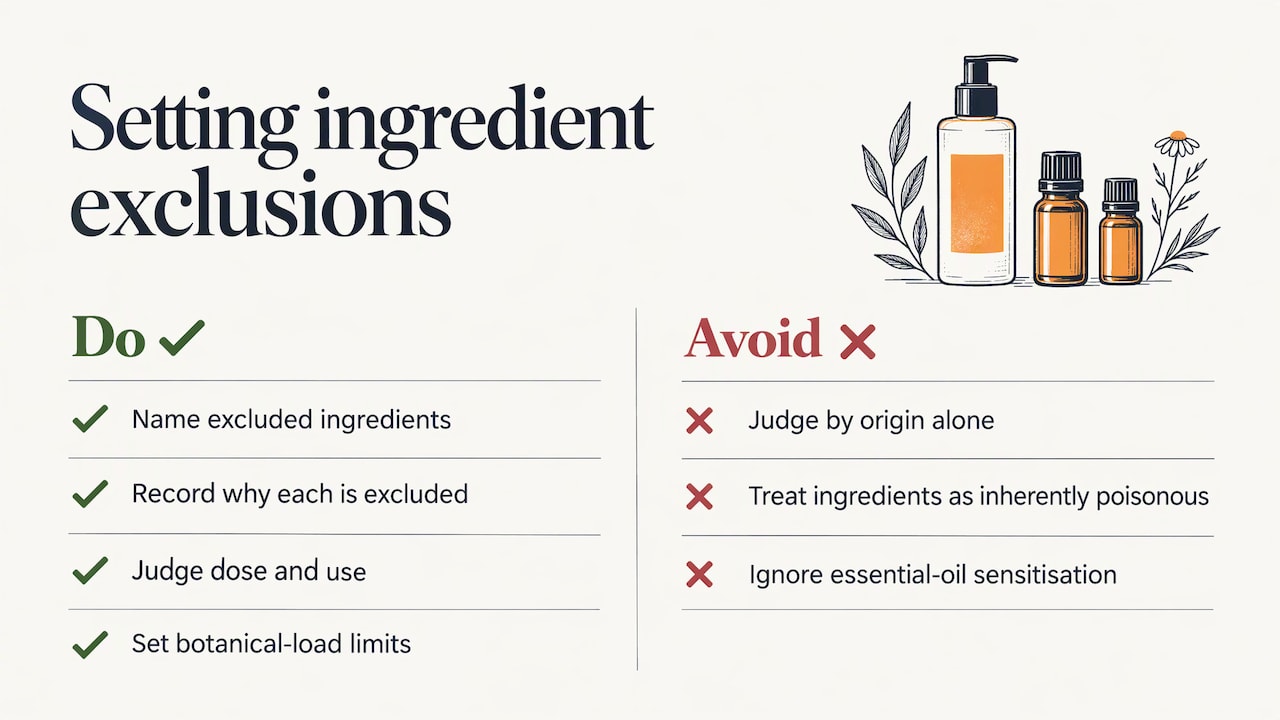
Name the ingredients you will not use, for example parabens, certain sulphates or synthetic fragrance, and record why. Define them as your own list, so a customer or a reviewer can see exactly what is meant.
Judge by dose and use, not just origin. Dr Tabitha Lee of NUS told Vogue Singapore that an ingredient alone is not inherently poisonous, because how much is present decides whether it is harmful. The same logic applies to natural ingredients. Essential oils are a good example for Singapore’s climate and skin types: Dr Low Chai Ling, a Singapore aesthetic physician, notes that essential oils are potent skin sensitisers, with citrus-derived ones phototoxic and tea tree oil able to cause contact dermatitis. A sound standard therefore sets limits on botanical load, not only on synthetics.
3. Check every ingredient against the regulated lists
HSA’s July 2024 advisory, as summarised by CMS, directs suppliers to source from reputable manufacturers, review composition against the ACD Regulations, and use laboratory testing to confirm that prohibited and restricted substances are absent or within limits. Our guide to cosmetic ingredient safety covers how brands apply this, and ingredient sourcing for cosmetics covers supplier documents.
4. Decide your disclosure
The label must carry the full ingredient list in any case. Going beyond it is a brand decision: explaining each ingredient’s role, or naming the fragrance components, builds the transparency clean customers look for. Keep every statement consistent with what is in the bottle.
5. Put it in writing and keep the evidence
Hold the ingredient policy, supplier specifications, test reports and batch records together. You will want them for claims, for any HSA query and for your own quality control.
Claims: how to say “clean” without creating a problem
HSA’s overview states that cosmetic advertisements cannot claim to modify a physiological process or prevent or treat disease, and that claims must align with the ASEAN Cosmetic Claim Guideline and be fully substantiated on request under the Singapore Code of Advertising Practices. Dentons Rodyk’s guide adds that claims should be justified by scientific data or evidence and/or by the formulation itself.
The practical rules:
| If you want to say | What to be ready to show |
|---|---|
| “Free from X” | Formula and supplier specifications showing X is not used, plus relevant test results |
| “Dermatologically tested” | The test report itself |
| “Hypoallergenic” | Evidence of reduced allergy risk |
| “Clean” | A written definition on the page, with the exclusion list it refers to |
| “Natural” | The percentage of natural-origin content and how you calculate it |
The lowest-risk habit is to define the word where you use it. “Clean” followed by “formulated without [your list]” tells the customer something checkable, and tells a regulator the same.
Note also that claims about therapeutic benefit are off limits for cosmetics. Medical and aesthetic clinic ranges need particular care here: the formulation can be tailored to a clinic’s needs, but the wording still has to stay within the cosmetic definition.
Where the manufacturer fits in
A clean standard lives or dies in formulation and production. Every exclusion changes the preservative system, the texture, the stability and the shelf life, so the standard has to be settled with the formulator rather than handed over at the end. Our pieces on how custom skincare formulation works and how to develop a formulation that sells show that sequence.
Questions worth settling with your manufacturer before you commit:
- Is the facility GMP-certified, and by whom? Ours holds GMP certification from Singapore’s HSA. Our seven facts on HSA GMP explains what that means for your product.
- Will the R&D team build to your exclusion list and document it?
- How are shelf life and labelling handled? See cosmetic shelf life.
- Does packaging suit the formula? Our packaging options for Singapore brands compares them.
- What happens if something goes wrong? Read cosmetic product recall in Singapore.
Our longer checklist, nine questions before choosing a skincare manufacturer, covers the rest. If you are weighing a ready-made base against a bespoke formula, private label versus custom formulation sets out the trade-off. A custom formulation is the route that lets a clean standard be yours rather than inherited.
Our view on clean beauty standards
We start every clean conversation with one question: what exactly will your customer be able to check? A word on a label cannot be checked. An exclusion list, a concentration limit and a test report can.
Singapore gives brands a clear legal floor through HSA and the ASEAN Cosmetic Directive, and then leaves the word “clean” to the brand. We see that as freedom. It lets a salon range for humid-weather skin, a home-use essential line and a doctor’s formulation each carry a standard that fits its own customer.
That is why we work collaboratively with clients through R&D, formulation, quality control and packaging, under our HSA GMP certification. The standard is agreed early, built into the formula, and documented so it holds from the first batch to the fiftieth.
Choose natural ingredients where they perform, and synthetic ones where they are safer or more stable. Judge both by dose, quality and evidence. That is how a clean claim earns trust.
Edmund
Taking your standard into production
If you already have a clean brief, or only a customer and a hunch, our team can turn it into a formulation, a quality plan and finished packaging. We design and manufacture for home-use essential skincare, professional salon skincare and aesthetic or doctor’s formulations, and our services cover R&D and manufacturing, design and packaging, and distribution. Start with our skincare product development service, or see everything we offer on our services page.
Salon owners can see how a range is specified in professional salon skincare products manufacturing, and clinics in aesthetic skincare products for clinics in Singapore.
FAQ
Is there an official clean beauty standard in Singapore?
No. HSA regulates cosmetic safety, notification, labelling and advertising, but its rules do not define “clean”. Brands and retailers set their own criteria, which is why a written definition of your own matters.
Does clean beauty mean natural?
Not necessarily. Vogue Singapore notes that some brands mean natural-origin formulas, while others focus on avoiding specific synthetic irritants. Natural, organic and clean are separate promises, and each needs its own definition.
What must a clean skincare label show in Singapore?
Per HSA, an English label with the product name and function, usage instructions, the full ingredient list in descending order of weight, country of manufacture, the responsible company’s name and address, contents, batch number, dates where required, and any directive warnings.
Can I say my product is HSA approved?
No. HSA’s consumer announcement says cosmetic notification is not an approval, and wording such as “Approved by HSA” should raise a red flag. State accurately that the product is notified, if you need to say anything.
How do I back up a clean claim?
Hold the evidence: formulation records, supplier specifications and test reports for each statement. Define the word on the page, for example “formulated without” followed by your list, so the claim is specific and checkable.
Sources
- HSA: Regulatory overview of cosmetic products
- HSA: ASEAN Cosmetic Directive
- HSA: Staying safe while looking good with cosmetic products
- CMS Expert Guide on Beauty in Singapore
- Dentons Rodyk: Guide to retail success, the sale of cosmetic products in Singapore
- Surgical & Cosmetic Dermatology: Clean beauty definitions
- Journal of Drugs in Dermatology: A Guide to Informed Skincare
- Vogue Singapore: Is clean beauty the best option for everyone?
- Dr Low Chai Ling: Clean Beauty Trend, What the Science Actually Says