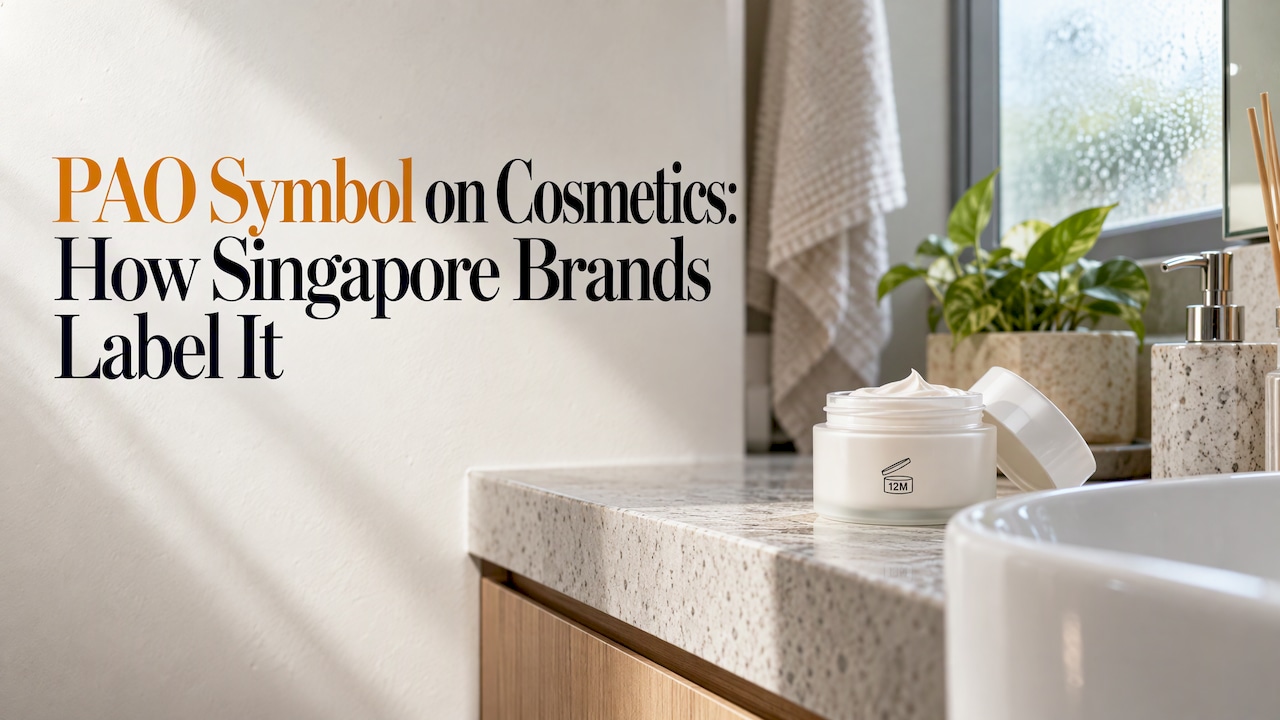
The PAO symbol is a small open jar with a number and the letter M inside or beside it, such as 6M or 12M. PAO stands for Period After Opening: how many months a cosmetic stays suitable to use once the seal is broken. For a brand owner in Singapore, the harder question is not what the jar looks like but what number goes in it, where it sits next to the expiry or manufacturing date the law requires, and what evidence backs it. That number is your responsibility as the brand, so it should come out of formulation, stability and microbiological work done before artwork is approved. It is not something you pick from a chart. At Harmony Skin Lab we develop and manufacture skincare for private label, salon and medical lines in Singapore, so this is how we would brief any new brand.
TL;DR
- PAO means Period After Opening. The open-jar symbol with a number and M (for months) tells the user how long the product stays suitable once opened.
- In Singapore, PAO does not replace the expiry or manufacturing date. ASEAN’s scientific body decided that PAO may be added on top of the required date labelling, not used instead of it.
- An expiry date is mandatory when a product’s expected durability is under 30 months. Otherwise a manufacturing date must appear unless an expiry date is given.
- The person who places the product on the market carries full responsibility for the PAO figure, so it needs to rest on formulation and test data.
- Print the period in months only, in English-language context, legibly, and on both the primary and secondary packaging.
Table of Contents
- What the open-jar symbol actually tells the user
- PAO and the expiry date in Singapore
- Who sets the number, and on what evidence
- When no PAO symbol is needed
- Printing the symbol: a practical label checklist
- Helping your customers read the symbol
- Building PAO into your launch with Harmony Skin Lab
- FAQ
- Sources
What the open-jar symbol actually tells the user
PAO is the minimum period after opening during which a cosmetic can be used without harm to the consumer. The industry guidelines written for the open-jar symbol define it in those terms. The symbol itself comes from Europe: the European Commission adopted the open-jar symbol on 5 September 2003, to be displayed from 11 March 2005 on products with durability over 30 months, with an indication in months or years of how long the product stays suitable after opening.
Two things follow from that definition, and both matter when you design a label.
First, PAO is about the product after the user has started using it. Air, fingers, water and skin contact all introduce microbes and cause oxidation. The unopened shelf life is a different matter, covered by the expiry or manufacturing date.
Second, the clock starts at first opening, not at purchase. In Singapore, CNA Lifestyle explains with a Nanyang Polytechnic lecturer that the printed expiry date applies to unopened products. Once opened, consumers should follow the PAO: the jar icon with a number and M, where 6M means six months and 12M means twelve months after opening.
Reading the common values
The number printed with the jar is simply a count of months. Typical labels you will see on shelves run from 3M through 6M, 9M, 12M, 18M, 24M and beyond. The period is not a universal property of a product type. A water-rich cleanser, a lip balm and an anhydrous massage oil are different formulations, and each needs its own figure from its own data. When a customer asks what 12M means on your serum, the answer is: use it within twelve months of first opening it.
PAO and the expiry date in Singapore
This is where brand owners most often go wrong, so it is worth being precise. Singapore regulates cosmetics under the ASEAN Cosmetic Directive, which has applied in Singapore since 1 January 2008 and harmonises requirements across ASEAN. The Health Sciences Authority (HSA), Singapore’s regulator for health products, lists the label particulars that must appear. They include product name and function, use instructions, ingredients, country of manufacture, the responsible company’s name and address, contents, batch number, manufacturing or expiry date, and special precautions. The information must be in English, and an expiry date is mandatory for products with minimum durability under 30 months.
The underlying rule is in the Health Products (Cosmetic Products – ASEAN Cosmetic Directive) Regulations: where expected durability is under 30 months, an expiry date is required. Otherwise the manufacturing date must appear unless an expiry date is specified. A Singapore law firm’s retail guide confirms the same 30-month threshold.
On the PAO question specifically, at its 10th meeting on 19 November 2008 in Singapore, the ASEAN Cosmetic Scientific Body decided that PAO labelling should not be accepted in place of the manufacturing or expiry date labelling the Directive requires. PAO labelling on top of the current requirements is permitted.
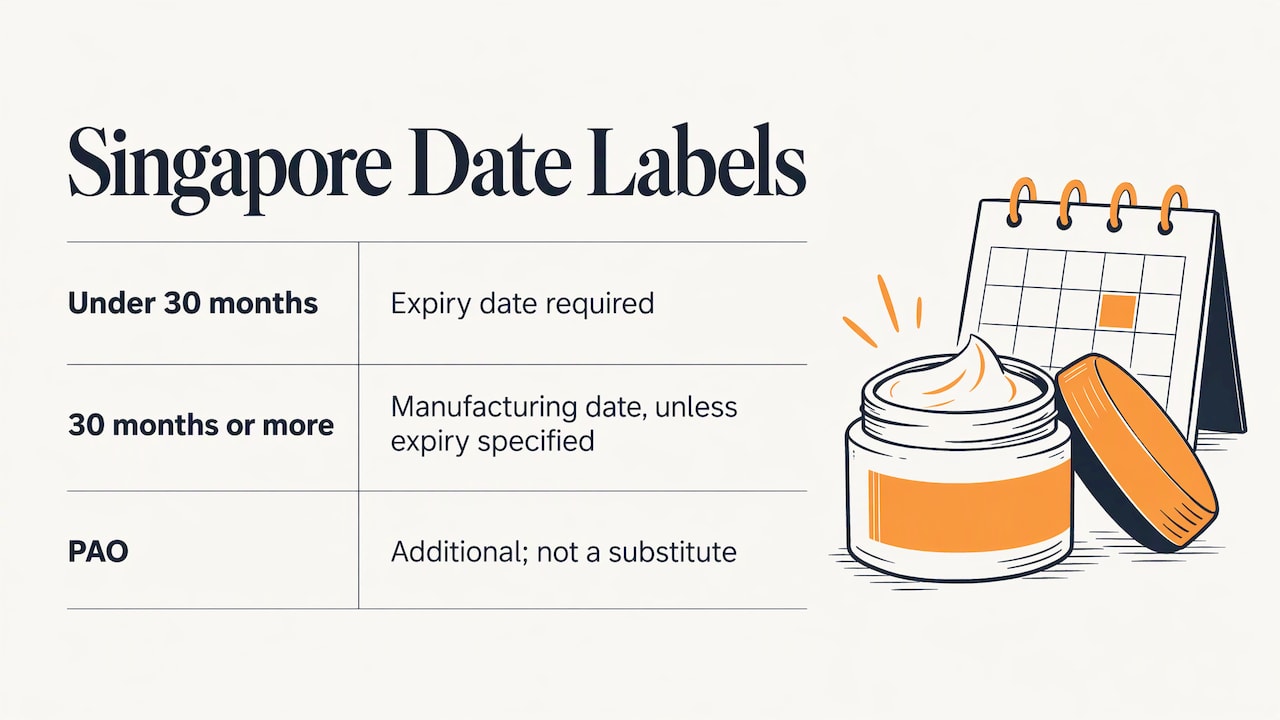
In practice that gives you a simple rule: the date comes first, the jar is an addition. If you export to the EU or serve tourists and cross-border buyers who expect the symbol, adding it is a reasonable choice. Singapore’s own requirement is met by the date.
How the 30-month line works
The ASEAN labelling requirements state that the date must be in clear terms, month and year or day, month and year, preceded by “expiry date” or “best before”. Particulars must be easily legible, clearly comprehensible and indelible.
In the European system the 30-month line also decides whether the jar appears: the Commission’s announcement ties the symbol to products with durability over 30 months, while shorter-life products carry a date instead. Singapore’s line is the same figure but does a different job, because here it decides whether an expiry date is compulsory.
A worked example, for illustration only. Suppose a brand develops a vitamin C serum with a stability-supported unopened durability of 24 months and wants to add a 6M open-jar mark:
- Expected durability is under 30 months, so an expiry date is mandatory in Singapore.
- The batch number and the date go on the label.
- The brand may add the jar with 6M as an extra, if its data supports six months after opening.
Now take a stable, water-free body oil with an expected durability of 36 months. It needs a manufacturing date unless an expiry date is specified, and the brand can choose to add a PAO figure such as 24M, again only if supported.
Who sets the number, and on what evidence
The industry guidelines are blunt on this point: full responsibility for the PAO on a label lies with the person who places the product on the market. That person must assess both whether a PAO is needed and the specific period. If you launch a private label line, that person is you, whoever fills the bottles.
Copying a figure from a competitor’s jar or a stock-vector chart is therefore the weak point in many launches. A 12M printed on a product that cannot support it is your liability. A cautious 6M on a product that could have supported 12M costs you in perception and in customer behaviour, because users discard product earlier.
The figure should come from the formulation and the data around it:
- The formula itself. Water content, preservative system, pH and ingredients that oxidise all shape how a product behaves once opened. Our guide to cosmetic ingredient safety for Singapore brands covers how ingredient choices tie into safety.
- Stability work. Testing shows how a formula holds up over time in its pack. Read why stability testing matters in skincare manufacturing and the practical overview of cosmetic stability testing for products that last.
- Microbiological testing. The open-jar claim is ultimately about microbial safety in use. Our guide to cosmetic microbiological testing explains what the tests are for.
- The pack. A pump bottle, a tube, a jar you dip fingers into and a single-use sachet expose the product very differently. The same formula can justify different periods in different containers, which is why packaging belongs in the same conversation as the formula.
The broader view of how shelf life is set and labelled is in Cosmetic Shelf Life: How Singapore Brands Set and Label It.
When no PAO symbol is needed
The open jar is not a universal requirement. Under the European approach that the symbol comes from, it applies to products with durability over 30 months. Products with a shorter durability carry a date. Under the same framework, items such as single-use products and packs that cannot be opened do not use it. For a brand range in Singapore, this means some of your lines may carry only a date, and that is correct:
- Sachets and single-use ampoules: used once, so there is no after-opening period to state. If you are planning these, see sachet packaging for skincare.
- Short-life products with an expiry date: the date is the compulsory element here.
- Anhydrous products, such as some massage oils: these may be formulated to resist microbial growth, but the decision on whether a PAO is relevant still belongs to the responsible person and the data.
Printing the symbol: a practical label checklist
Once the figure is settled, the label work is mostly detail. The checklist below draws on the Singapore regulations and the industry guidelines.
- Express the period in months. The guidelines recommend the number plus M, for example 12M, for consistency across markets.
- Place it inside or beside the jar. There is no specific size requirement as long as it is easily legible.
- Print it on both primary and secondary packaging. That means the bottle or jar and the carton around it.
- Keep English as the base language. Singapore requires label information in English, and other languages may be added. Numbers, letters and symbols must be legible, permanent, indelible and prominent, and any symbol or code used must be explained on the label, according to regulations 7(5) to 7(7) of the Singapore regulations. A short line near the jar, such as “Use within 12 months of opening”, takes care of the explanation requirement.
- Keep the date and batch number. The expiry or manufacturing date and batch number stay on the label whatever PAO you add.
- Plan for small packs. Where full details will not fit, HSA allows leaflets, pamphlets or display panels, but the product name and batch number must still appear on the immediate container.
Because artwork changes are costly after printing, settle the PAO figure before packaging is ordered. Our overview of how to choose skincare packaging for your brand and the list of skincare packaging options for Singapore brands show how pack format affects label space.
For the wider framework around labels, see Cosmetic Regulations in Singapore: What Brands Must Do and the ASEAN Cosmetic Directive guide for Singapore brands.
Helping your customers read the symbol
Salons and clinics that buy your products will be asked about the jar by clients, and ordinary consumers often confuse PAO with the expiry date. Three messages are worth putting in your product leaflets and staff training:
- The expiry date is for the unopened product. After opening, the PAO applies.
- Count from the day the product is first opened. Writing the opening date on the pack helps.
- Changes in smell, colour or texture mean it is time to stop using the product, whatever the jar says. Consumer-facing guidance on recognising when skincare has gone bad covers the signs of spoilage.
Salons and clinics should also store professional-size products closed, away from heat and sunlight, and use clean spatulas rather than fingers for jars. That protects the period you have printed.
Our view: the number is a product decision
We see the PAO symbol as the last line of a story that starts in the lab, not a graphic added at the end. At Harmony Skin Lab we work with clients on product design, customised formulation, quality control and packaging, and we are GMP certified by Singapore’s HSA. That combination matters here, because the period you print depends on the formula, the pack and the quality system that produces every batch.
Our approach is collaborative. We would rather settle the formula, the pack format and the label claims together at the start of a project than discover during artwork that the pack and the number do not match. For home-use essentials, professional salon lines and aesthetic or doctor’s formulations, the questions are the same: how will the user open and handle this product, and what do we need to know to state a period with confidence?
Our advice to every brand is to treat PAO as part of the development brief, next to texture, fragrance and price point.
Edmund
Building PAO into your launch with Harmony Skin Lab
If you are planning a private label range, a salon line or a medical-grade formulation, we can take the work from concept through R&D, manufacturing and packaging, so that the label you print reflects the product you made. Our services cover skincare R&D and manufacturing, design and packaging, and distribution, and our product lines include home-use essential skincare, professional salon skincare and aesthetic or doctor’s formulations. See our services for the full range.
If you are still weighing the route, the guides on private label versus custom formulation and the skincare launch roadmap set out the stages, and our list of nine questions to ask a skincare manufacturer helps you prepare a brief.
FAQ
What does PAO stand for on cosmetics?
PAO stands for Period After Opening. It is the time a cosmetic can be used without harm after it has first been opened, shown as an open-jar icon with a number and the letter M for months.
What does 12M mean on a skincare product?
It means use the product within 12 months of first opening it. The count starts when the seal is broken, not on the purchase date, and it is separate from the printed expiry date, which applies to the unopened product.
Is a PAO symbol compulsory in Singapore?
Not as a stand-alone requirement. Singapore requires an expiry date for products with an expected durability under 30 months, and otherwise a manufacturing date unless an expiry date is given. PAO may be added on top of these, but it cannot take their place.
Who decides the PAO period for my product?
The person who places the product on the market is fully responsible for it. That means you, as the brand owner, so the figure should be supported by your formulation, stability and microbiological data.
Where should the PAO symbol go on the packaging?
Print it inside or next to the open jar, as a number followed by M, legibly, and on both the primary pack and the outer carton. Keep the date and batch number on the label as well.
Sources
- Guidelines for compliance with the Period After Opening (Colipa/ACSB)
- European Commission press release on the use-by symbol for cosmetics, 2003
- CNA Lifestyle: expired toiletries and period after opening
- HSA: regulatory overview of cosmetic products
- HSA: ASEAN Cosmetic Directive
- Singapore Statutes Online: Health Products (Cosmetic Products – ASEAN Cosmetic Directive) Regulations
- Summary report on the 10th meeting of the ASEAN Cosmetic Scientific Body
- ASEAN Appendix II: Cosmetic labelling requirements
- Dentons Rodyk: guide to the sale of cosmetic products in Singapore