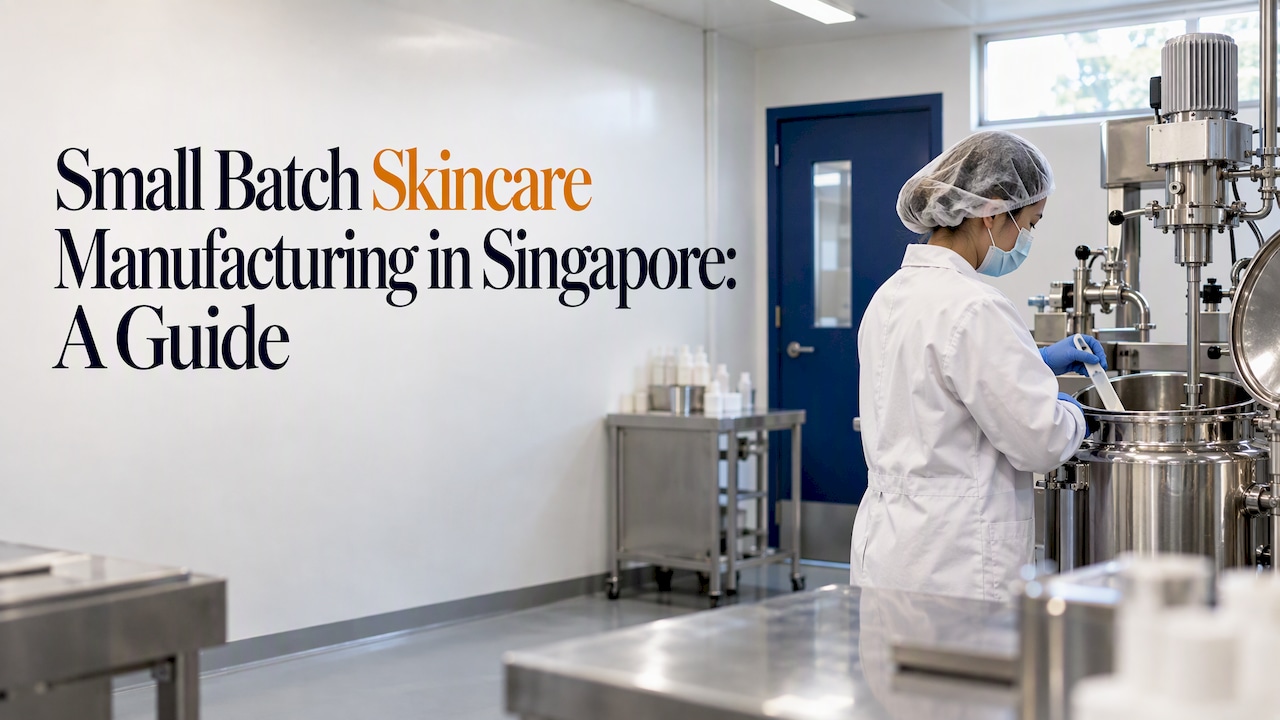
Small batch skincare manufacturing means a contract manufacturer formulates, makes and packs your products in limited runs, so you can launch or refresh a line without funding a large factory order. In Singapore, the practical route is to work with a GMP-certified OEM/ODM partner, settle the formula and packaging in sampling, and handle HSA notification before anything is sold. This guide covers how the process runs, what drives minimum order quantities and cost, and what to check before you sign.
TL;DR
- Small batches let you test a product with real customers, salon clients or patients before committing to volume.
- The usual path is brief, formulation, samples, stability and quality checks, production, filling and packaging, then notification.
- MOQ, lead time and cost depend on formula complexity, packaging, testing and batch size. Ask for a written quote built on your brief.
- Every cosmetic variant sold in Singapore needs HSA notification through PRISM, and your manufacturer’s GMP documents support it.
- Choose a partner on certification, formulation depth, packaging capability and how well they collaborate, not on price alone.
Table of Contents
- What small batch skincare manufacturing involves
- Who small batch production suits
- What you can make in small batches
- How the process runs, step by step
- Singapore rules you must plan for
- Minimum order quantities, lead times and cost factors
- How to assess a small batch manufacturer
- Our perspective
- Start your small batch project with us
- FAQ
- Sources
What small batch skincare manufacturing involves
In a conventional factory model, you commit to thousands of units of one formula. In a small batch model, the manufacturer produces a smaller quantity in a controlled run, which suits brands that are still learning what their customers will buy.
The work itself is the same as any skincare production: choosing ingredients, building a stable formula, mixing under hygienic conditions, filling, labelling and packing. What changes is the scale, and with it the planning. Smaller runs mean you can launch several products at once, adjust a texture or fragrance after feedback, and keep less stock on the shelf.
Two contract models exist:
- OEM (original equipment manufacturing): you bring the concept or formula, and the manufacturer makes it to your specification.
- ODM (original design manufacturing): the manufacturer develops the formula with you, often from its own R&D base, and you sell it under your brand.
Most first-time brands end up with some blend of the two: a developed base adjusted to their positioning. Our own Singapore skincare OEM manufacturing page explains how we frame that work.
Who small batch production suits
Small runs work best when you need flexibility more than the lowest possible unit cost.
- Entrepreneurs launching a first brand. You can put a hero cleanser, serum and moisturiser on the market and learn from sales before scaling. Our note on low MOQ skincare manufacturing for beauty startups goes deeper on this.
- Salons and spas. A professional range for treatment rooms and retail shelves, with the salon’s name on it. See professional salon skincare manufacturing and our list of what salon products need to deliver.
- Clinics and medical professionals. Practitioners who want a post-treatment or aesthetic range matched to their protocols. Read about aesthetic skincare products for clinics in Singapore.
- Established brands. Limited editions, seasonal launches or a new market test, without disturbing the main production schedule.
What you can make in small batches
The product forms that suit small runs are the usual skincare formats: cleansers, toners, serums, lotions, creams, masks, and oil-based products. Our product lines cover home-use essential skincare, professional salon skincare, aesthetic and doctor’s formulations, massage oils, essential oils and natural distillates, all listed on our products page.
Formulation options broadly fall into two routes:
- Ready or adapted formulation. You start from a tested base and adjust the active profile, texture, scent and claims. This is quicker and usually the lower-risk way to begin.
- Custom formulation. The formula is built around your brief: target skin concerns, ingredient philosophy, sensory feel and price point. It takes longer because it needs more development rounds. Our guide to how custom skincare formulation works walks through it, and developing a formulation that sells covers the commercial side.
Write your brief around the customer rather than the ingredient list. “Lightweight daily moisturiser for oily, humid-climate skin, fragrance-free, under a set retail price” gives a formulator far more to work with than “a good moisturiser with niacinamide”.
How the process runs, step by step
1. Brief and feasibility
You describe the product, the customer, the claims you want to make, the packaging idea and a target cost. A good manufacturer pushes back where a claim, texture or budget do not fit together. This is the cheapest stage to change your mind.
2. Formulation and sampling
The R&D team builds a prototype and sends samples. Expect several rounds: texture, spreadability, absorption, scent and finish are all adjusted. Collaboration matters most here, because your feedback decides how many rounds you need. We explain how research supports launches in how skincare R&D supports launches and how R&D guides OEM production.
3. Stability and quality checks
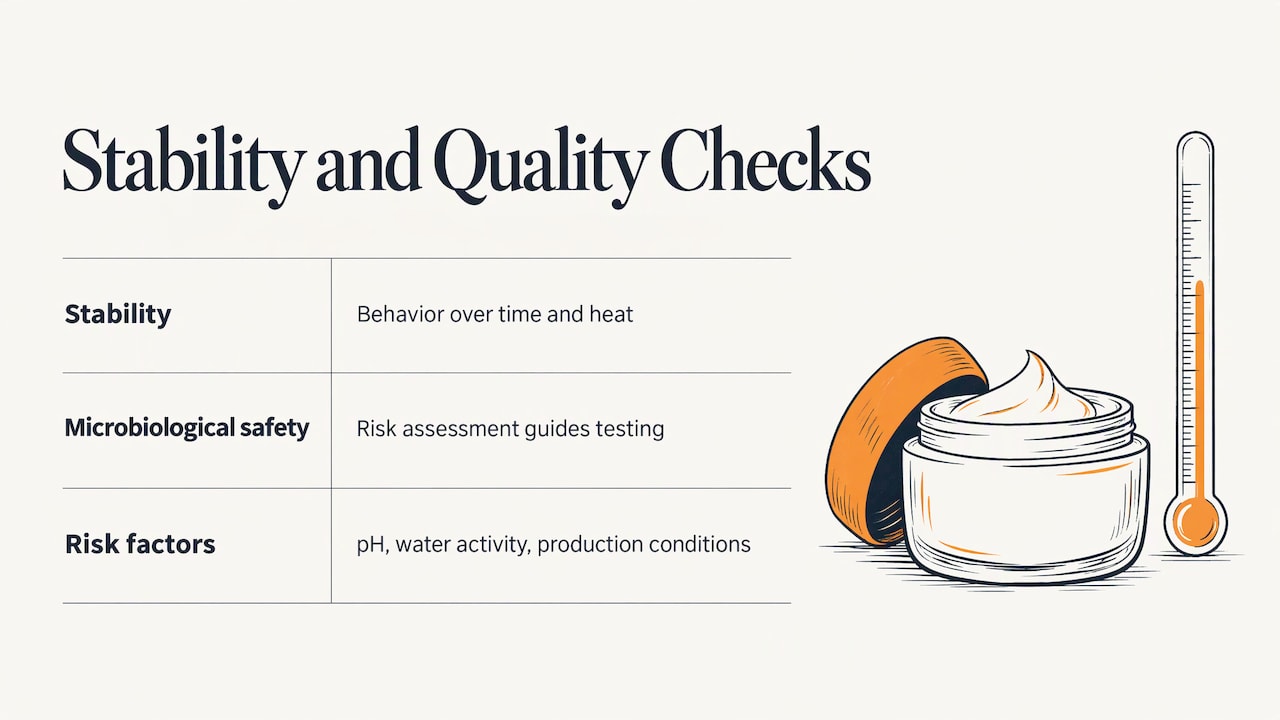
Before a formula goes into production, it should be checked for how it behaves over time and under heat, plus microbiological safety. Singapore’s standard SS ISO 29621:2017 gives guidance on microbiological risk assessment for cosmetics, helping decide whether a product needs microbiological testing, based on factors such as pH, water activity and production conditions. Details on what we cover are on our stability testing and QC services page.
4. Packaging selection and design
Packaging often decides lead time more than the formula does. Bottles, jars, tubes, sachets, boxes and labels each have their own sourcing time, and compatibility with the formula must be checked. Start with how to choose skincare packaging, compare packaging options for Singapore brands, and see our packaging design and printing services.
5. Production, filling and packing
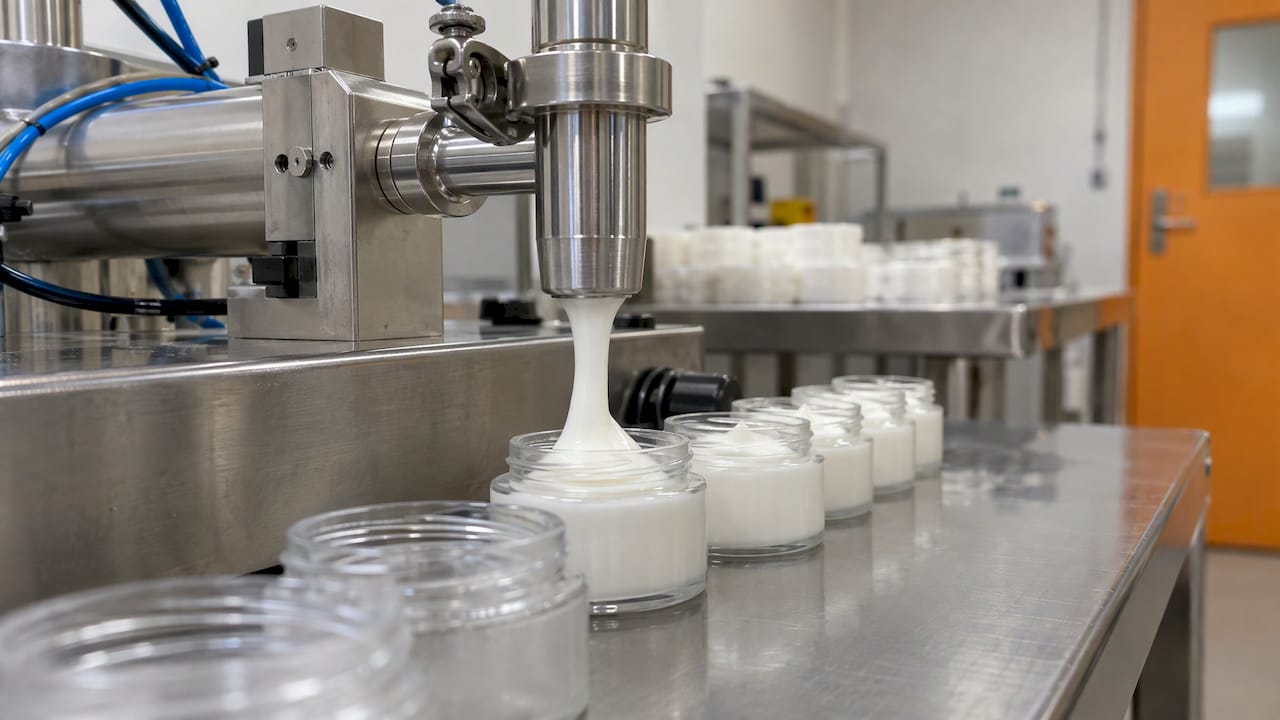
Once you approve the pre-production sample, the batch is made, filled and packed. Filling is a distinct step with its own equipment and hygiene needs; see cosmetic filling services for Singapore skincare brands.
6. Notification and launch
The product must be notified to the regulator before you supply it. The next section covers this.
Singapore rules you must plan for
Singapore regulates cosmetics through a notification system rather than pre-market approval. The Health Sciences Authority says cosmetic products usually need notification through PRISM before sale, that ingredients should comply with the ASEAN Cosmetic Directive, and that labelling requirements must be met. After notification, the company is responsible for reporting serious adverse effects and product defects.
A few practical points that catch new brands out:
- Each variant counts. HSA states that a notification is needed for every different variant of a product, such as different shades or scents. If you plan three fragrances of one body oil, plan three notifications.
- You need local setup. To use PRISM you need a local entity registered with ACRA and a Corppass account, among other registrations listed on the same HSA page. Check the current requirements there before you start.
- Labels follow rules. HSA’s overview lists the label contents: English text, product name and function, ingredient list, country of manufacture, the responsible company’s name and address, contents by weight or volume, batch number, and a manufacturing or expiry date. An expiry date is mandatory where minimum durability is under 30 months. Your manufacturer’s batch numbering feeds directly into this.
Our separate practical guide to HSA cosmetic notification covers the steps in more detail.
Minimum order quantities, lead times and cost factors
We do not publish fixed MOQs or prices, because they depend on the project. What matters is knowing which factors move them, so you can compare quotes properly.
| Factor | Why it affects MOQ, cost or timing |
|---|---|
| Formula complexity | Active-rich or multi-phase formulas need more development rounds and more careful production |
| Product type | Emulsions, serums and oils each need different equipment and clean-down between batches |
| Packaging | Stock packaging is quicker and cheaper at low volumes; custom moulds or printing raise both volume and lead time |
| Testing scope | Stability and microbiological checks add time but protect the product and your brand |
| Number of variants | Each scent, shade or size adds notification, labelling and filling work |
| Filling format | Bottles, tubes and sachets have different setup requirements |
| Artwork and labelling | Approvals and printing slow launches when artwork changes late |
To get a quote you can compare, give each manufacturer the same brief: product list, target quantities per product, packaging preferences, claims, target retail price and your launch window. Ask what is included, such as samples, testing, filling and labelling, and what is charged separately.
A sensible planning habit is to treat the first batch as an investment in information. Order enough to sell through in a defined test period, not enough to feel safe.
How to assess a small batch manufacturer
Use criteria you can verify.
- GMP certification. In Singapore, a manufacturer’s GMP certificate is a document needed to support product notification, and good practice follows internationally recognised guidance such as ISO 22716. Ask to see the certificate and confirm its scope covers the product type you want. Our explainers on GMP in cosmetics, HSA GMP standards and the benefits of a GMP manufacturer give the background.
- Full ingredient disclosure. You need complete ingredient lists for labels, notification and your own safety file.
- Formulation capability. Is there an in-house R&D team, or only a catalogue of stock formulas?
- Packaging and filling under one roof. Fewer handovers mean fewer delays and fewer finger-pointing moments.
- Experience with your channel. A salon range, a clinic range and an e-commerce line have different needs.
- Communication. How fast do they answer a technical question, and do they explain trade-offs plainly?
The nine questions to ask before choosing a skincare manufacturer works well as a call checklist.
Our perspective
Most brands that come to us worry first about price per unit. We understand why, but the costliest mistakes we see are made earlier: a vague brief, claims that the formula cannot support, or packaging chosen before anyone has tested it with the formula.
That is why we put collaboration at the centre of how we work. Our R&D team works from your customer and your market, then develops, samples and adjusts with you. We are GMP certified by Singapore’s HSA, and we design the process so formulation, quality control and packaging are handled together rather than passed between separate suppliers.
Small batches suit this way of working. They let you launch a focused range, learn from real use in homes, salons and clinics, and refine before you scale. Our lines cover home-use skincare, professional salon products and aesthetic or doctor’s formulations, so the same team can grow with you as your range does.
Edmund
Start your small batch project with us
We are a Singapore OEM/ODM skincare manufacturer offering R&D and manufacturing, design and packaging, filling and distribution support. If you have a product idea, a salon range in mind or a clinic formulation to develop, bring the brief and we will help you shape it into something you can produce and sell.
See everything we offer on our services page, or visit Harmony Skin Lab to start a conversation about your first run.
FAQ
Do I need my own company in Singapore to sell skincare here?
To notify products through PRISM, HSA’s guidance asks for a local entity registered with ACRA, plus Corppass and other registrations. Check the HSA submission page for the current list before you plan your launch.
Is a small batch product less safe or lower quality than a large run?
No. Batch size does not change the standard: the same hygiene, ingredient checks and quality controls should apply. What you should verify is the manufacturer’s GMP certification and testing approach, not the size of the run.
Do I need to notify each scent or shade separately?
Yes. HSA requires notification for every different variant of a cosmetic product, including different shades or scents. Build the number of variants into your timeline and budget from the start.
What should I send a manufacturer to get an accurate quote?
Send a short brief with the product type, target customer, preferred texture and key ingredients, claims, packaging idea, quantities per product and target retail price. The more specific the brief, the more reliable the quote and timeline.
Sources
- HSA: Regulatory overview of cosmetic products
- HSA: Submit notification and re-notification
- SS ISO 29621:2017, microbiological risk assessment for cosmetics (preview)