Bulk skincare is the formula only: cream, serum or oil in large containers, not yet filled, packed or labelled. Finished skincare is the product ready for the shelf: filled, sealed, labelled and checked. For most new brands, salons and clinics in Singapore, the finished route is the better start, because one manufacturer owns the formula, the filling and the final checks, so nothing falls between suppliers. Bulk suits a business that already runs its own filling and quality systems.
This guide explains what each term means, what contract filling covers, what to compare before you commit, and which model fits which kind of business.
TL;DR
- Bulk means the formula in large containers, with filling, packaging and labelling still to be done. Finished means a product ready to sell.
- Contract filling is the stage where bulk is put into its final packs, such as jars, tubes, bottles or sachets, under controlled conditions.
- Every gap between formulation, filling and packing is a place where responsibility can blur. A single manufacturer closes those gaps.
- In Singapore, a cosmetic product usually has to be notified to HSA before it is sold, whichever route you pick.
- New brands, salon lines and clinic formulations usually do best with a finished, end-to-end route.
Table of Contents
- What bulk and finished skincare actually mean
- What contract filling involves
- Bulk vs finished: side-by-side
- What to compare before you decide
- What a brand supplies when commissioning filling and finishing
- Singapore rules that apply to both routes
- Which model fits which business
- How to choose a manufacturer for the finished route
- Our perspective
- From bulk idea to finished product with Harmony Skin Lab
- FAQ
- Sources
What bulk and finished skincare actually mean
The two terms describe how far along the product is when it reaches you.
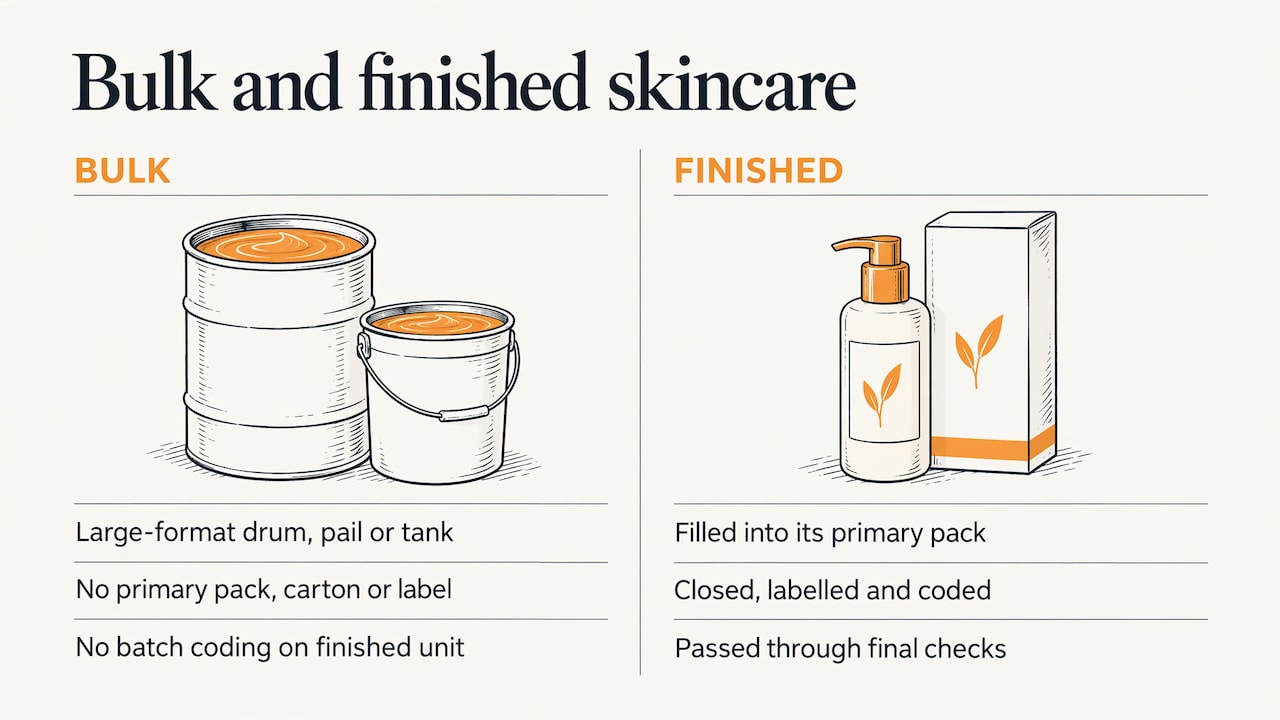
Bulk skincare is the formulated product in its large-format state: a drum, pail or tank of cream, lotion, serum or oil. It has been made, but it has not become a product a customer can buy. There is no primary pack, no carton, no label and no batch coding on a finished unit.
Finished skincare is the same formula after every remaining step: it is filled into its primary pack, closed or sealed, labelled, coded, placed in secondary packaging where used, and passed through final checks. HSA’s regulatory overview deals with the cosmetic product as supplied, which is the finished item a consumer or a salon client actually receives.
The difference matters because the steps between the two are where most of the work, cost and risk sit. A formula that is stable and pleasant in a drum can still behave differently once it meets a pump, a tube or a sachet film.
The stages between bulk and finished
Thinking in stages makes the comparison clearer:
- Formulation and development: the recipe, the ingredient choices, the texture, the stability work.
- Bulk manufacture: making the formula at production scale.
- Filtration or polishing, where the product type needs it, so the bulk is clear or uniform before it is filled.
- Filling: transferring bulk into the primary pack.
- Packaging and labelling: closures, cartons, wrapping, labels, batch codes.
- Final checks and release: the product is checked before it ships.
- Distribution, if the manufacturer also supplies the market.
A bulk purchase stops after stage 2 or 3. A finished purchase runs to stage 6 or 7.
What contract filling involves
Contract filling means a manufacturer fills your product into its final packs for you. Searches for “contract filling cosmetics” usually come from a business that has a formula, or bulk, and needs it turned into sellable units.
In practice, the work covers:
- Receiving and preparing the bulk, including any filtration so the product flows cleanly through filling equipment.
- Filling to the declared net content, into jars, bottles, tubes, sachets or other formats.
- Closing and sealing, so the product is protected and tamper-evident where required.
- Labelling and coding, so each unit carries the batch information needed to trace it.
- Secondary packing, such as cellophane wrapping or cartons.
Harmony Skin Lab lists several of these stages as services in its services range: product filtration, sachet packaging and filling, cellophane product wrapping, and design and packaging services, alongside R&D and manufacturing. For brands that want single-serve formats, the page on sachet packaging and filling in Singapore goes into that format in detail.
Why filling is not a small step
Filling looks mechanical, but it is where a product’s formula meets its container. Viscosity decides which filling equipment works. Preservative systems and packaging materials have to suit each other. The pack must hold the declared amount, and the label must match what is inside. When the formula, the filler and the packer are three different businesses, each can reasonably say a problem belongs to someone else. When one manufacturer holds all three, the question “whose problem is this?” has one answer.
Bulk vs finished: side-by-side
| Question | Bulk | Finished |
|---|---|---|
| What you receive | Formula in large containers | Filled, labelled, ready-to-sell units |
| Work left for you | Filling, packaging, labelling, final checks | Brand approval and sales |
| Number of suppliers | Often several (formula, filler, packer) | Can be one |
| Equipment you need | Filling and packing capability, or contractors | None |
| Quality responsibility | Split across each stage | Held by the manufacturer through to release |
| Typical fit | Established operators with their own lines | New brands, salons, clinics, growing labels |
| Time to shelf | Longer, because each handover adds a step | Shorter, because stages run in one place |
The table shows why finished is the usual answer for the readers of this guide. A business launching a brand is paid for selling, not for running a filling line.
What to compare before you decide
Whichever route you consider, put the same questions to every quotation. Harmony Skin Lab does not publish prices, so figures come from a project quotation based on your brief.
Cost: compare the whole route, not the unit price
A bulk price per kilogram looks low because it excludes everything that comes after. To compare fairly, add the cost of filling, primary packs, closures, labels, cartons, wastage during filling, quality checks, storage and the time you spend coordinating suppliers. A finished quotation that covers all of this is easier to read than a bulk price with five add-ons.
Minimum order quantities
Minimum order quantities, or MOQs, are the smallest run a manufacturer will accept. They differ between formula, filling and packaging, and the pack is often the constraint, because printed components are bought in set volumes. Ask for the MOQ at each stage so that you see the real minimum. Harmony Skin Lab explains its thinking in its guide to low MOQ skincare manufacturing for new beauty startups.
Lead time
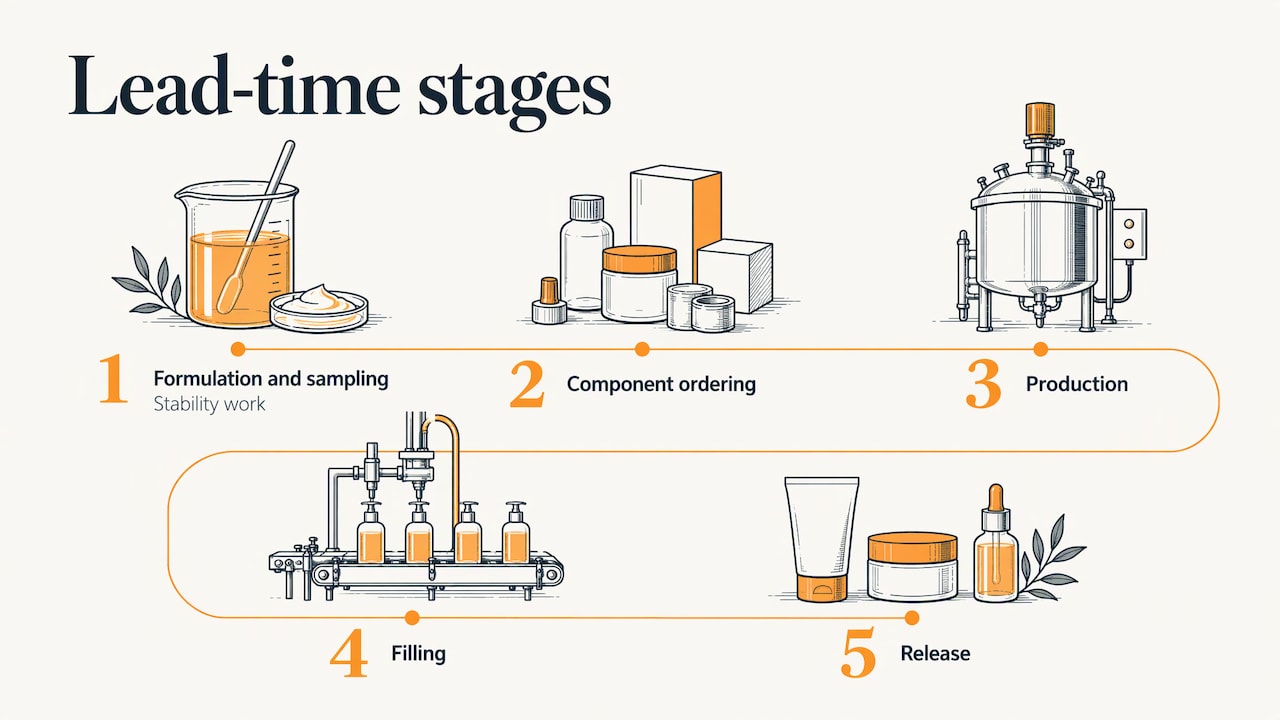
Lead time is the sum of formulation, sampling, stability work, component ordering, production, filling and release. In a bulk-plus-contractors set-up, each handover can wait in a queue. In a single-site route, the stages can be planned together. The skincare launch roadmap sets out the sequence from concept to market.
Quality control and traceability
Ask who checks the product at each stage, and who signs it off before it leaves. Harmony Skin Lab holds GMP certification from Singapore’s HSA, and its offering includes quality control. Good Manufacturing Practice, or GMP, is the set of production and hygiene controls a manufacturer follows so that each batch is made and checked consistently. Our article on HSA GMP and skincare manufacturing standards explains what that means in practice.
Packaging compatibility
A formula and its pack must be chosen together. Pumps suit some textures and not others; oils behave differently from emulsions; single-use sachets need a film and seal that suit the formula. The guide on how to choose skincare packaging and the overview of skincare packaging options for Singapore brands help you narrow this down before you brief a manufacturer.
What a brand supplies when commissioning filling and finishing
A smooth project depends on a clear brief. Prepare these before the first conversation:
- The formula or the concept. Either your own formula, or a product idea to be developed.
- Target market and positioning: home use, salon, or clinic, and the skin concerns and textures you want.
- Pack format and volume: jar, tube, bottle, sachet, and the fill size for each.
- Artwork and label content, including the claims you intend to make.
- Expected first-run volume and reorder pattern.
- Your notification plan, since the product will need to be notified before sale (more below).
If you are still at the idea stage, the guide to how to start a private label skincare brand walks through the early decisions.
Singapore rules that apply to both routes
The route you choose does not change the regulatory expectation: the product that reaches customers has to comply.
- Cosmetic products supplied in Singapore must comply with the Health Products (Cosmetic Products – ASEAN Cosmetic Directive) Regulations 2007, as set out on HSA’s regulatory overview of cosmetic products.
- A cosmetic product notification usually needs to be submitted before the product can be sold in Singapore, according to the same HSA page.
- Ingredient safety is part of this picture. Our Singapore guide to cosmetic ingredient safety covers it for brands.
For the practical side, see our guides to HSA cosmetic notification and the ASEAN Cosmetic Directive. If you work with a safety data sheet for a raw material or product, the page on cosmetic SDS requirements in Singapore explains what brands need.
One practical point: a product is notified as the product that will be sold. That is one more reason to settle the formula, the pack and the label together, rather than in separate stages with separate suppliers.
Which model fits which business
A new skincare brand
You need a product that looks, feels and performs like a finished brand, without building a factory. The finished route, with formulation, filling and packaging handled together, puts the least on your desk. Decide first whether you want a ready-made base with your branding or a formula built for you; the guide to private label vs custom formulation helps with that choice, and the list of private label options for startup brands shows what is available.
A salon or spa product line
Salons need consistency across a treatment room and a retail shelf, often in both professional and take-home sizes. A finished line with matching formulas and packs keeps the experience the same from treatment to home care. Read what professional skincare products for salons need and the page on professional salon skincare manufacturing.
A clinic or medical professional
A doctor’s formulation is defined by its specification, so control over every stage matters more here than anywhere else. Developing the formula and finishing it with one manufacturer keeps the specification intact from development to the final unit. See aesthetic skincare products for clinics in Singapore.
An established brand that already fills its own products
If you already own filling and packing capacity and a quality system, you know the stages above well. Your decision is about capacity, and the same comparison applies: add up the full cost and lead time of each stage, then compare it with a finished quotation.
How to choose a manufacturer for the finished route
A good manufacturer answers these questions plainly:
- Which stages do you run on your own site, from formulation to final release?
- What certification do you hold, and what does it cover?
- How do you work with the brand on formulation and trends?
- What does the brief need to contain for you to quote?
- What are the MOQs at each stage?
The guides on choosing a private label skincare manufacturer and nine questions before choosing a skincare manufacturer expand each point.
Our perspective
We built Harmony Skin Lab around a simple idea: a skincare product is one thing, not a series of handovers. Formula, filling, packaging and checks belong together, because that is how the product reaches your customer in the condition you intended.
That is why we work with clients on the idea first. Our R&D, our attention to current market trends and our quality control all feed one finished product. As a GMP-certified manufacturer, with certification from Singapore’s HSA, we hold ourselves to that standard from the first sample to the last unit.
For a brand, a salon or a clinic, the finished route means your time goes into your customers and your brand, not into coordinating suppliers. That is the result we aim for on every project.
Edmund
From bulk idea to finished product with Harmony Skin Lab
Harmony Skin Lab is an OEM/ODM skincare manufacturer in Singapore. Our services cover R&D and manufacturing, design and packaging, distribution, product filtration, sachet packaging and filling, and cellophane wrapping. Our product lines include home-use essential skincare, professional salon skincare and aesthetic or doctor’s formulations. See the full services and product lines, or start with our product development service.
Tell us your product, your pack format and your market, and we can talk through the route from formula to finished unit.
FAQ
Is bulk skincare cheaper than finished skincare?
The price per kilogram of bulk is lower because it leaves out filling, packs, labels, cartons and checks. Once you add those, plus wastage and coordination time, the gap narrows. Compare full landed cost per finished unit rather than the bulk price alone.
What is contract filling in cosmetics?
Contract filling means a manufacturer fills your formula into its final packs, such as jars, bottles, tubes or sachets, then seals, labels and packs it. It can also include filtration of the bulk beforehand and wrapping afterwards. It turns bulk into units ready for sale.
Do I need to notify HSA if I buy finished products?
In Singapore, a cosmetic product usually needs a notification to HSA before it is sold, as described on HSA’s regulatory overview. This applies to the product being supplied, so plan it with your manufacturer during development. Our HSA notification guide covers the practical steps.
Which option suits a new skincare brand?
A finished, end-to-end route usually suits a new brand best, because formulation, filling, packaging and checks come from one manufacturer. You focus on brand, positioning and sales. Start from a clear brief covering the product, pack, market and expected volume.