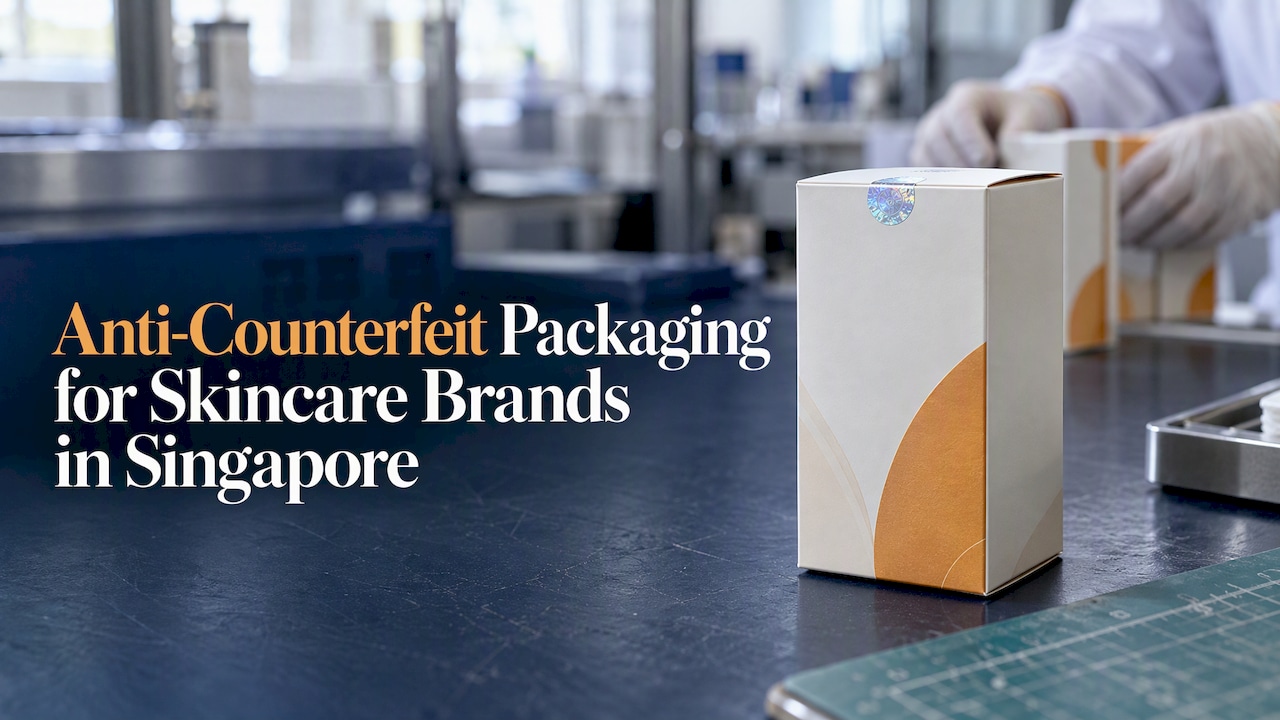
Good anti-counterfeit packaging for skincare is a layered system, not a single hologram or QR code. It combines a tamper-evident seal, a unique code buyers can check on a phone, and a hidden feature your own team can inspect. It also has to sit inside Singapore’s cosmetic labelling rules. The best time to design it is during formulation and artwork, before the first production run.
This guide is for brand owners, salons and clinics planning a private label or professional line. It explains which features do which job, how to choose between them, and what to settle with your manufacturer before you approve packaging.
TL;DR
- Choose the job first: consumer checking, refill prevention, investigator authentication or supply-chain tracing. Each needs a different feature.
- For most premium skincare, a tamper-evident seal on the closure plus a serialised, phone-verifiable code is a sound starting point.
- Security features must not cover mandatory label information such as batch number, ingredients and the responsible company.
- Packaging security does not replace trademark registration, batch records or evidence management.
- Agree the security design during formulation and artwork, not after production.
Table of Contents
- What anti-counterfeit packaging actually does
- Why skincare needs more than brand protection
- The main feature types, and what each one is good for
- A practical configuration for premium skincare
- Fit the security design to Singapore’s cosmetic rules
- Packaging security and the law work together
- Our perspective: design security in, not on
- Questions to settle before you approve packaging
- Working with us on packaging and production
- FAQ
- Sources
What anti-counterfeit packaging actually does
Counterfeiters want two things: to copy your look, and to reuse your genuine packaging with something else inside. Anti-counterfeit packaging answers both. It makes the pack harder to copy, shows when it has been opened, and gives you a way to prove a unit is genuine.
The European Union Intellectual Property Office (EUIPO) groups 46 anti-counterfeiting technologies into five areas: electronic, marking, mechanical, chemical/physical and digital-media. Its examples include RFID, NFC, security holograms, UV-sensitive inks, tamper-evident seals, DNA coding, laser engraving and digital watermarks. Most are designed for one of three functions: authentication, tracking and tracing, or anti-tampering. EUIPO’s own technology guide makes the point that a brand should choose the function it needs before choosing the feature.
That is why a QR code alone is not a strategy. A static QR code can be photographed and reprinted on a fake in seconds. It only becomes protection when each code is unique and your verification page can tell a buyer what a valid, already-scanned or suspicious result means.
Why skincare needs more than brand protection
For skincare, the concern goes beyond lost sales. Product goes on skin, and a jar or pump can be opened, sampled, decanted, refilled and closed again. A peer-reviewed review of anticounterfeit packaging technologies frames the issue as one of safety as well as brand value: counterfeit or adulterated contents can harm users, so packaging has to preserve product integrity.
That matters most for the lines we see at the professional end of the market:
- Salon retail and back-bar products, where decanting and refilling are tempting.
- Aesthetic and doctor’s formulations, where the clinic’s reputation sits behind every unit.
- Premium home-use serums and creams, which are the usual targets for lookalikes sold online.
Treat tamper evidence as a product-protection control, not as decoration.
The main feature types, and what each one is good for
The same review describes overt features such as holograms, special inks and visible barcodes, covert features such as hidden markers, tamper-evident films and breakable closures, and electronic identification such as RFID. Here is how they compare for a skincare brand.
| Feature | Who it helps | Strength | Limit |
|---|---|---|---|
| Tamper-evident seal or breakable closure | Buyer | Shows the pack was opened; deters refilling | Does not prove the contents are genuine |
| Hologram or optically variable device | Buyer, retailer | Quick visual check, hard to copy well | Cheap imitations can fool casual buyers |
| Serialised QR or smart label | Buyer, brand | Unit-level verification, scan data | Needs a maintained verification page and database |
| Covert marking (hidden inks, glue coding) | Investigator | Hard to spot, strong evidence | Needs a special reader; not for ordinary shoppers |
| RFID or NFC tag | Brand, distributor | Tracing through the supply chain | Higher unit cost, more integration work |
| Security film | Brand | Protects printed data from alteration | Placement must prevent lifting or copying |
Overt features for buyers
Overt features work when the action is familiar and quick. TOPPAN’s Illumigram hologram, for example, is built so that authenticity can be checked with a smartphone flashlight, which removes any need for specialist knowledge. The lesson is general: if checking takes effort, buyers will not do it.
Covert features for investigators
The strongest feature is not always the most visible one. EUIPO describes glue coding as a unique pattern of polymer bubbles, recorded in a restricted database, with a matching probability of one in several billion. Verification needs a special reader, so it suits controlled inspection, such as a dispute with a distributor, rather than a shopper at a counter.
Covert identifiers only work if each unique pattern is captured in a secure reference database. Decide who owns that database and who holds the reader before you pay for the feature.
Tamper evidence for refill and substitution
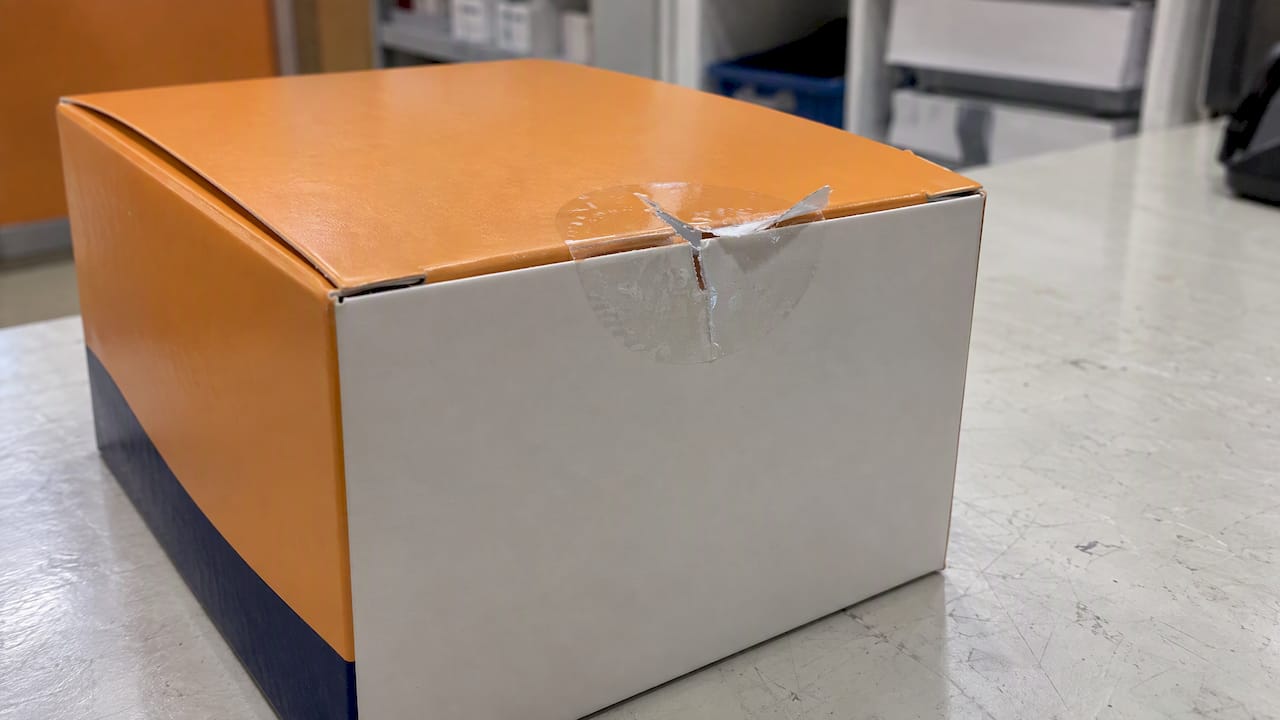
A seal across the carton flap, jar lid or pump closure gives visible proof that a unit has been opened. Film wrappers, voidable films, solvent-sensitive papers and breakable caps all work on this principle. For airless pumps and jars, ask your packaging supplier which closure style leaves clear evidence without making the pack hard for the end user to open.
A practical configuration for premium skincare
For a serum, cream or professional treatment product, a sensible baseline is:
- A tamper-evident seal across the closure or carton opening.
- A unique serialised code on each unit, checked by smartphone.
- Optionally, a non-repeatable visual feature such as a holographic pattern.
- A covert marker on high-value or high-risk lines, for your own inspections.
This mirrors what a 2021 Covectra case study describes for a luxury skincare brand: a serialised QR code combined with a non-repeatable 3D holographic pattern. These are examples, not a Singapore regulatory requirement. Availability, minimum order quantities, artwork integration and data-hosting terms all need confirming during packaging quotation.
Plan the verification response
The printed feature is half the system. Write down what the buyer sees after a scan:
- Valid, first scan: confirm the product name, batch and a short reassurance.
- Valid, scanned many times: warn that the pack may have been reused, and say how to contact you.
- Not recognised: tell the buyer not to use the product and give a reporting channel.
Without these messages, a code is only a decoration.
Fit the security design to Singapore’s cosmetic rules
Singapore regulates cosmetics under the Health Products (Cosmetic Products, ASEAN Cosmetic Directive) Regulations 2007. The responsible company must notify the Health Sciences Authority (HSA) before supply, and official guidance states that supply records are kept for at least two years after supply. HSA’s overview of cosmetic product regulation sets out the stages, including checking ingredients against the ASEAN Cosmetic Directive annexes and checking labelling before notification.
The labelling rules matter for packaging security. The regulations list details such as product name and function, use, ingredients, country of manufacture, net contents, batch number, the responsible company’s name and address, and manufacturing or expiry information where applicable. Check the current text before finalising artwork.
Three practical consequences follow:
- Do not obscure mandatory information. A hologram or security label must not sit over the batch number or ingredient list.
- Keep codes consistent. The batch coding, responsible company details and your serialisation data should all describe the same production run.
- Keep records that support traceability. Serial data and batch records are useful evidence if a unit is questioned. If you distribute across the region, supply chain optimisation across Southeast Asia is worth planning alongside your packaging, so that records follow the product.
Because Singapore places responsibility on the company putting the cosmetic on the market, an OEM or ODM project should agree anti-counterfeit packaging during formulation, artwork and batch-release planning. Added afterwards, features tend to collide with label space and batch coding.
Packaging security and the law work together
Packaging features give you evidence. Legal rights give you the means to act on it. Singapore has working border enforcement: in one reported High Court decision, Singapore Customs detained, inspected and seized containers holding goods bearing infringing trade marks under the Trade Marks Act border provisions. The case concerned counterfeit branded goods transhipped through Singapore, and outcomes depend on the facts.
So keep a file for each product: registered trade mark records, packaging specifications, batch data and authentication evidence. Security features do not replace trademark registration. If you want a lawyer’s view on enforcement or a specific dispute, speak to an intellectual property lawyer in Singapore.
Our perspective: design security in, not on
We manufacture OEM and ODM skincare in Singapore, and the pattern we see is consistent. Brands usually think about counterfeiting after a lookalike appears. By then the label is approved, the carton is printed and the closure is fixed, so the options are narrow and costly.
Our view is that security belongs in the same conversation as the formula and the pack. A closure that shows tampering has to suit the product’s viscosity and the dispenser. A code needs label space that does not collide with the batch number and ingredients. A hologram needs to survive the filling line. These are manufacturing questions as much as marketing ones, and they are cheaper to answer early.
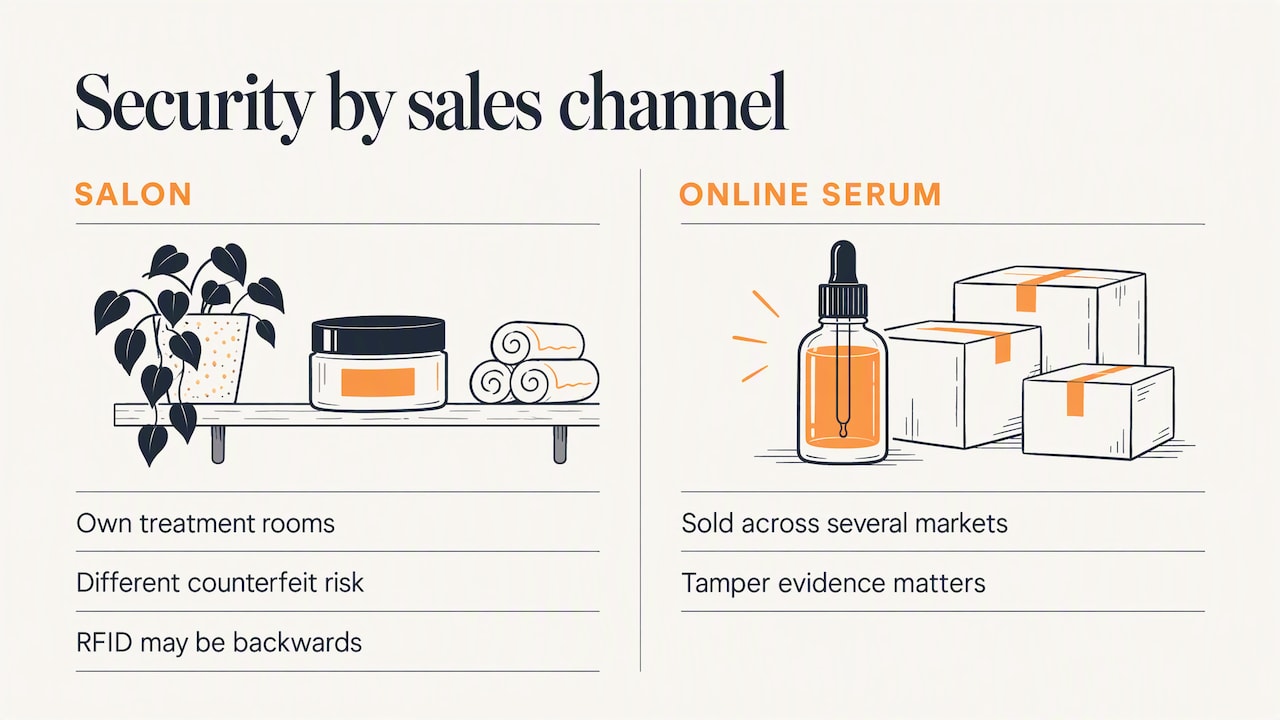
We also push clients to be honest about the threat. A salon line sold only through your own treatment rooms faces a different risk from a serum sold online across several markets. Spending on RFID for the first and ignoring tamper evidence on the second would be backwards. Start with the realistic risk, then pick the lightest layer that covers it.
— Edmund
Questions to settle before you approve packaging
Use this list with your manufacturer and packaging printer:
- Which function matters most: consumer checking, refill prevention, investigation or tracing?
- Where will each feature sit, and does it leave the mandatory label details fully legible?
- What are the minimum order quantities for security labels or holograms, and do they suit a first batch?
- Who hosts the verification page and the serial database, and on what terms?
- How will batch numbers, serial numbers and the responsible company’s details be kept consistent across production runs?
- Does the closure still work for the end user, and does it hold up through stability testing and transport?
- How will you record evidence of genuine product for each batch?
Our guides on choosing skincare packaging and packaging options for Singapore brands cover closures, materials and formats in more detail. If you are earlier in the process, the seven steps to launch private label cosmetics in Singapore show where packaging decisions fall in the timeline.
Working with us on packaging and production
Harmony Skin Lab is a GMP-certified OEM/ODM skincare manufacturer in Singapore. We handle product design, customised formulation, quality control and packaging solutions, so security features can be agreed alongside the formula and the artwork rather than bolted on. We work with private label brands, salons and clinics, including professional salon skincare and aesthetic formulations for clinics.
If you are planning a launch and want packaging security considered from the start, see our design and packaging services or get in touch through our main site. Pricing is project-based and not published, so describe your product and volumes when you contact us.
FAQ
What is the cheapest effective anti-counterfeit feature for skincare?
A tamper-evident seal on the closure or carton is usually the simplest first layer, because it shows whether a pack has been opened. It does not prove the contents are genuine, so many brands add a unique serialised code later. Costs vary by supplier and volume, so ask for quotes during packaging design.
Is a QR code enough to protect my products?
Not on its own. A code that is identical on every unit can be copied onto fakes. Each unit needs a unique code, and your verification page must explain what valid, repeated and unrecognised scans mean.
Does Singapore require anti-counterfeit features on cosmetics?
The cosmetic regulations we reviewed do not require them. They do require notification to HSA before supply, specified label details such as the batch number and responsible company, and retained supply records. Any security feature you add must leave those details clear.
Can anti-counterfeit packaging be added to a small first batch?
Often, but minimum order quantities for holograms and smart labels differ by supplier. Seals and serialised labels are generally easier to start with than RFID. Confirm quantities, artwork integration and data-hosting terms before you commit.
Sources
- EUIPO: anti-counterfeiting and anti-piracy technology guide announcement
- EUIPO: Anti-Counterfeiting Technology Guide (PDF)
- Anticounterfeit packaging technologies, PMC
- EUIPO: Glue Coding
- TOPPAN Illumigram
- Covectra and Aprisa case study
- Health Products (Cosmetic Products, ASEAN Cosmetic Directive) Regulations 2007
- HSA: regulatory overview of cosmetic products
- Singapore High Court decision, 2017 SGHC 305