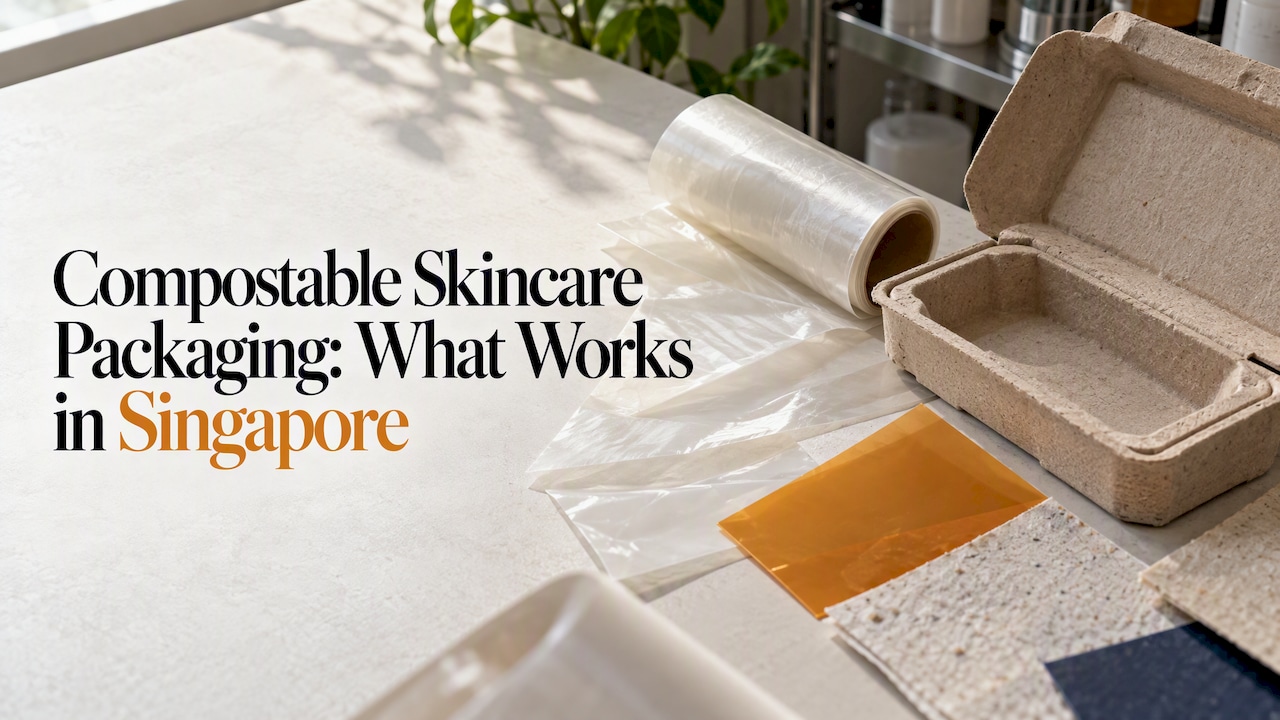
Compostable skincare packaging can work, but only when the material, the formula and the disposal route fit together. In Singapore the last part is the weak link: most household waste is incinerated, so a compostable label does not guarantee a compostable outcome. This guide is for brand owners, salons and clinics deciding whether to switch, and it covers what the term means, where the materials hold up, what to test and how to make claims you can defend.
TL;DR
- “Compostable” is a tested standard, not a synonym for “biodegradable” or “bio-based”. Ask for the certificate, not the brochure line.
- Singapore sends plastic waste to recycling or incineration, not landfill, so compostable packaging has limited end-of-life benefit here unless a dedicated organic route exists.
- Water-based and liquid formulas are the hardest case: some compostable materials let moisture through, so test the filled pack over time.
- Dry, low-moisture and secondary packaging (cartons, paper wraps, pulp trays) is the easiest place to start.
- Choose the claim carefully: “recyclable”, “refillable” or “reduced packaging” is often easier to prove than “compostable”.
Table of Contents
- What “compostable” actually means
- The Singapore reality: where does the pack go?
- Which materials can be compostable, and where they struggle
- Match the pack to the product
- Test before you commit
- Certifications and claims: say only what you can prove
- Our perspective
- Working with a manufacturer on sustainable packs
- A sensible order of work
- FAQ
- Sources
What “compostable” actually means
Three words get mixed up in skincare marketing, and they describe different things.
Biodegradable means a material can be broken down by microorganisms. It says nothing about how long that takes or what is left behind.
Compostable is narrower. It is a subset of biodegradable materials that must meet a specific standard, such as BS EN 13432:2000, for breaking down under defined conditions. Packaging guidance from Pact Collective draws exactly this line: a general biodegradable claim may not mean the pack breaks down in a managed composting environment.
Bio-based describes the raw material, not the end of life. A UK industry paper on sustainable packaging notes that bio-based plastics come from renewable biological sources but are not necessarily biodegradable or compostable. A jar made from sugarcane-derived polyethylene is bio-based and still behaves like ordinary plastic.
Two further distinctions matter when you brief a supplier:
- Industrial versus home compostable. Industrial composting needs controlled, higher temperatures. Home compostable is a stricter claim that is rarely relevant in a Singapore flat.
- Recyclable versus compostable. A pack cannot usually be both. If your main route is recycling, a compostable material in the same stream can cause problems.
The Singapore reality: where does the pack go?
This is the part most overseas guides skip, and it changes the answer.
Singapore’s government has stated that plastic waste here is either recycled or incinerated, not directly landfilled. In a written parliamentary reply on biodegradable plastics, the environment ministry said the environmental benefits of biodegradable plastics do not apply in Singapore’s context, and that they could interfere with recycling when mixed with conventional plastics.
The National Environment Agency’s annual report describes a system that relies heavily on incineration. For compostable packaging, that means the benefit appears only if the pack can be separated and sent to a dedicated organic treatment facility. A bin in a Tampines block does not do that.
The same caution applies abroad. Pact Collective says industrial composting programmes that accept packaging reach only a small fraction of users, and that much compostable packaging may end up in landfill.
What does this mean for a skincare brand?
- Do not promise a disposal outcome you cannot control. “Compost me” printed on a pack that a customer puts in a general bin is a claim that fails in practice.
- Look at the whole footprint. Weight, material volume, refills and shipping often matter more than the end-of-life label.
- Consider who handles the pack. A salon, spa or clinic that collects empties can arrange a take-back route. A retail customer cannot.
There is one more complication specific to cosmetics. The UK paper observes that packaging contaminated with cosmetic residue can be unsuitable for standard recycling, which raises a possible future role for biological treatment, provided both the pack and the leftover formula are compatible with the organic system. That is a direction of travel, not something you can rely on in Singapore today.
Which materials can be compostable, and where they struggle
Compostable options for skincare fall into a few families.
| Material family | Typical use | Strength | Watch-out |
|---|---|---|---|
| Moulded pulp and paper fibre (bagasse, recycled paper, bamboo) | Outer cartons, trays, inserts | Low-risk for secondary packaging, good print and shelf presence | Not a barrier for creams or liquids on its own |
| Cellulose films | Wraps, sachet outer layers | Naturally derived, can be transparent | Can be hydrophilic, so needs modification for water-based products |
| PLA and other starch-based bioplastics | Tubs, sleeves, some bottles | Familiar to converters | Usually needs industrial composting, limited heat and oil resistance |
| PHA | Emerging rigid and film packaging | EU-funded research reported good gas and moisture barrier properties | Cost and supply, so confirm availability for your volume |
| Compostable pouches | Refill and single-use pouches | Light, low material use | Moisture and evaporation risk with liquid formulas |
The barrier problem is the one to take seriously. The UK paper points out that cellulose and other naturally derived materials can be hydrophilic, and that any modification or added barrier layer should itself be assessed for compostability. A coating that solves leakage but fails the compostability test defeats the purpose.
On the more promising side, the EU’s Oli-PHA project, as reported on CORDIS, found that PHAs have good gas and moisture barrier and thermo-mechanical properties, and tested compounds for both industrial and home compostability. It is research-stage evidence, so treat it as a sign of where materials are heading, not a guarantee for a specific jar you can order today.
Why liquids are the hard case
A brand that publishes its own refill-pouch trials reports that compostable pouches can lose product through evaporation or leakage. Its 2023 update projected double-digit percentage losses after a few months, and suggests weighing filled pouches over time to catch the problem. Another refill company argues that fill-to-order is the only realistic way to use compostables with liquids, because the pack is not asked to store the product for long.
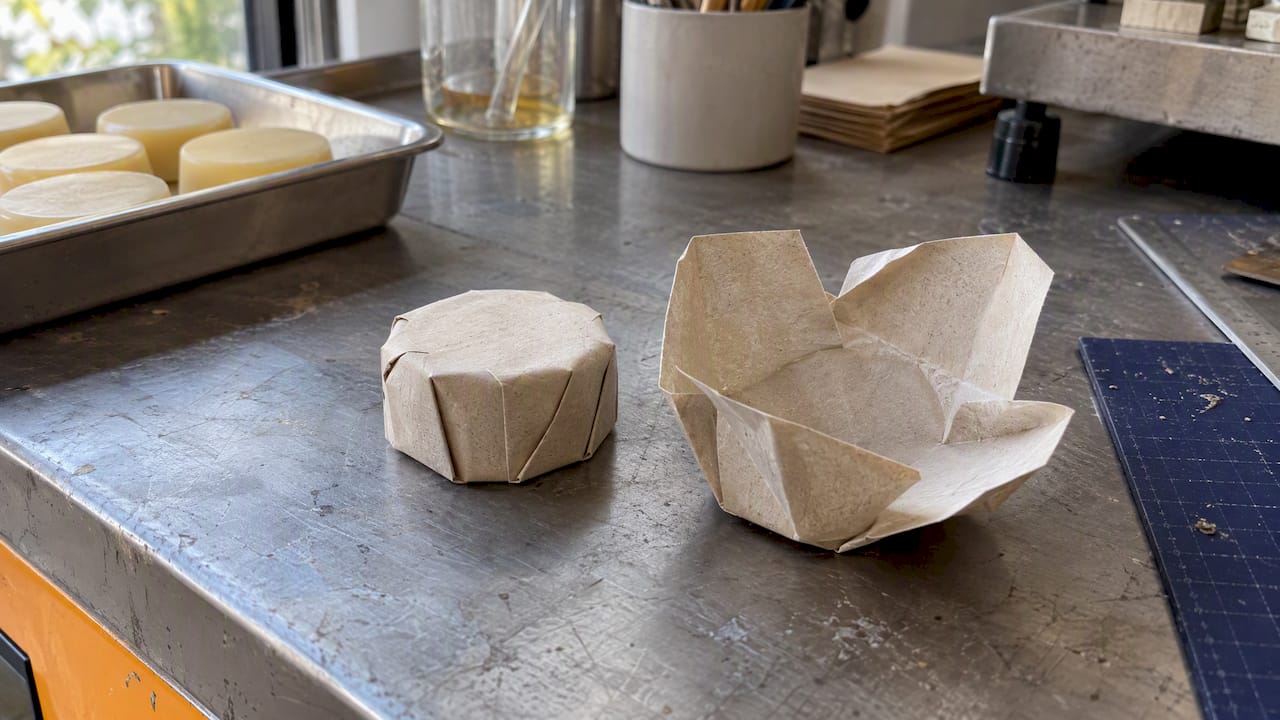
Take that as a design principle: the shorter the contact time between formula and compostable material, the safer you are. Single-use sachets, dry powders, balms in a paper-based wrap and fill-at-point-of-sale models suit compostable materials better than a serum sitting on a shelf for 24 months.
Match the pack to the product
Here is a practical way to sort a range.
Low risk: start here
- Outer cartons and shipping boxes in moulded pulp or paper
- Inserts, leaflets and tamper bands
- Dry or anhydrous products, such as powders and solid balms, in paper-based primary packs
Medium risk: test carefully
- Oil-based products, including massage oils and essential oils. Oils can attack some bioplastics, so confirm resistance with your actual formula.
- Single-use sachets, where shelf life is short and the volume is small
High risk: usually not worth forcing
- Water-based serums, toners and lotions with a long shelf-life claim
- Products with actives that are sensitive to oxygen or moisture ingress
- Pump dispensers, where compostable materials in the mechanism rarely hold up
For these, a recyclable mono-material pack, glass or a refillable design may deliver more environmental benefit than a compostable one that does not protect the formula. Our guide on skincare packaging options for Singapore brands compares the main choices side by side, and how to choose skincare packaging for your brand walks through the decision from the product’s point of view.
Test before you commit
A compostable pack that fails halfway through shelf life costs more than the plastic it replaced: returns, reformulated batches and lost trust. Compatibility and stability testing is how you avoid that.
What to check
- Weight loss. Fill the real pack with the real formula, seal it and weigh it at intervals under controlled conditions. A steady drop points to evaporation or permeation.
- Visual and physical change. Look for swelling, softening, delamination, staining, odour change and seal failure.
- Formula change. Check pH, viscosity, colour, fragrance and preservative performance against a control stored in glass or the standard pack.
- Migration and adsorption. Components of the pack can migrate into the product, and actives or preservatives can be adsorbed into the pack. Chinese industry standards such as T/CHCIA 045-2025 set out procedures for extraction, migration and adsorption tests, which is useful as a reference for what a thorough protocol covers.
- Transport simulation. Heat, humidity and vibration through the tropical supply chain, including a hot warehouse in Singapore or a container to a neighbouring market.
We explain what labs need from you in packaging compatibility testing for cosmetics, and the broader logic in why stability testing matters in skincare manufacturing. A shelf-life claim should rest on tests run in the final pack, not on a result from a different container.
Certifications and claims: say only what you can prove
For compostability, ask the supplier for a certificate that names the standard, the conditions (industrial or home) and the exact material, including any coating, ink and adhesive. A certificate for a base film does not cover a printed, laminated version.
In Singapore, a Singapore Standard for plastics suitable for organic recycling specifies requirements for such plastics and is intended as a basis for labelling and claims. If you plan to print a compostability mark, this is the local reference to discuss with your packaging supplier.
On the wider packaging side, Technical Reference 109:2023 is voluntary guidance on sustainable packaging practices such as reduction, collection for reuse or recycling and recycled content, including how to communicate proper disposal to consumers. Its framework lines up with the government’s packaging reporting scheme.
That scheme is the Mandatory Packaging Reporting requirement, under which producers of packaged products must submit packaging data and 3R plans to NEA. The published criteria include an annual turnover above S$10 million, so most start-ups are outside it today. Brands that expect to grow into it are wise to track packaging weights and materials from the first run.
A short checklist for your claims:
- Use “compostable” only with the standard and the conditions named.
- Do not use “biodegradable” alone as a selling point.
- State the disposal instruction in plain words, and make sure it is realistic for a customer in Singapore.
- Keep supplier certificates and test reports on file.
- Cosmetic product labelling is a separate topic: see our note on the ASEAN Cosmetic Directive for what Singapore brands must know.
Our perspective
We make skincare for private label, salon and medical clients, so we see packaging fail in the lab as often as we see it succeed on a render. Our view is simple: the formula comes first, and the pack must keep it safe and stable for its full shelf life.
That is why we rarely advise a client to put a water-based serum into a compostable pouch simply because it photographs well. We would rather start with the secondary packaging, where a switch to paper or pulp is easy and visible, and move to primary packs only after compatibility results are in. Where the product is oil-based, a sachet or a short shelf-life format, there is often a sensible path.
We also push clients to be honest about Singapore’s disposal reality. A customer who puts a “compostable” sachet in the general bin has not been helped by the label. A refill, a reduced-material pack or a take-back arrangement at a salon can be the more credible green story.
Our approach is collaborative: we look at your target market, your positioning and your formula, then work through the packaging options with testing at each step.
— Edmund
Working with a manufacturer on sustainable packs
If you are planning a skincare line and want to include a lower-impact pack, bring the decision to us early. We are a GMP-certified OEM/ODM skincare manufacturer in Singapore, and our services cover R&D and formulation, design and packaging, and quality control. We can discuss compatibility checks, sachet formats and filling options alongside the formula, so that the pack and the product are developed together.
See our design and packaging services, or start with sachet packaging and filling services in Singapore if a single-use format suits your range. If you are still mapping out the project, our skincare launch roadmap shows how packaging decisions fit into the timeline.
A sensible order of work
- Define the product and shelf life. The more water and the longer the shelf life, the fewer compostable options you have.
- Choose your claim. Compostable, recyclable, refillable or reduced packaging? Pick the one you can prove and your customers can act on.
- Shortlist materials with certificates. Ask for the standard, conditions and full structure, including inks and coatings.
- Run compatibility and stability tests in the final pack. See our stability testing and QC services.
- Plan disposal. Write instructions your customers can follow in Singapore, and consider a take-back for professional channels.
- Record packaging data. Weights and materials per SKU will help if reporting rules reach you later.
FAQ
Is compostable skincare packaging better for the environment in Singapore?
Not automatically. Singapore’s government says plastic waste here is recycled or incinerated rather than landfilled, so the usual landfill benefit does not apply. Compostable packaging only adds value if it reaches a suitable organic treatment route, so lower material use, refills and recyclability should be weighed too.
What is the difference between compostable and biodegradable cosmetic packaging?
Biodegradable means microorganisms can break a material down, with no guaranteed time or conditions. Compostable means it meets a defined standard, such as BS EN 13432, for breaking down under specified composting conditions. Only the second is a claim you can back with a certificate.
Can I put a water-based serum in a compostable pouch?
It is risky. Naturally derived materials can be hydrophilic and may need a barrier that must also be assessed for compostability, and one brand’s 2023 refill tests showed double-digit product loss over a few months. Test the filled pack for weight loss and formula changes before launch, or choose a short-life, fill-to-order format.
Which parts of a skincare pack are easiest to make compostable?
Outer cartons, inserts, trays and paper-based wraps are the easiest, because they never touch the formula. Primary packs for oils, balms and single-use sachets can follow once compatibility tests are done. Pumps and long-life water-based formulas are usually the hardest.
Do I have to report my packaging in Singapore?
The Mandatory Packaging Reporting scheme applies to producers that meet NEA’s criteria, which include an annual turnover above S$10 million. Smaller brands are not covered at present, but you should check NEA’s page for the current rules and keep records of your packaging materials and weights.
Sources
- Guide: Sourcing smart packaging and materials, Pact Collective
- Sustainable packaging paper, UK industry body
- Written reply on biodegradable plastics, Ministry of Sustainability and the Environment
- NEA annual report FY2022/2023
- Oli-PHA project reporting, CORDIS
- Compostable refill pouches update, 2023
- Compostable refill pouches, fill-to-order system
- T/CHCIA 045-2025 cosmetics and packaging compatibility standard
- Singapore Standard on plastics suitable for organic recycling
- Technical Reference 109:2023, sustainable packaging
- Mandatory Packaging Reporting, NEA