A good vitamin C serum comes down to three decisions made early: which form of vitamin C you use, the pH you formulate at, and how you keep the active from oxidising in the bottle and on the shelf. Get these right and the serum performs. Get them wrong and you ship an orange liquid that has lost much of its active before the customer opens it.
This guide is written for brand owners, salon groups and clinic practitioners in Singapore who are briefing a manufacturer on a vitamin C product. It explains the trade-offs in plain terms, so you can ask better questions and judge the answers.
TL;DR
- L-ascorbic acid is the most potent form but the least stable. Derivatives such as sodium ascorbyl phosphate trade some potency for much better stability and gentler pH.
- The long-held rule is pH 2.5 to 3.0 for L-ascorbic acid. Recent work shows a stabilised 12% serum can perform at pH 6, so the old rule is no longer the only route.
- Shelf-life stability and in-use stability are different problems. Packaging, dosing format and customer instructions matter as much as the formula.
- In Singapore the manufacturer or supplier carries the burden of proof for safety, because HSA notification is not an approval.
Table of Contents
- Choosing the form of vitamin C
- Why pH decides so much
- Keeping vitamin C stable
- Testing before you launch
- Singapore regulation: what you need to know
- Our perspective on vitamin C development
- Working with Harmony Skin Lab on a vitamin C range
- What to put in your brief
- FAQ
- Sources
Choosing the form of vitamin C
The first formulation decision is the molecule. Every other choice (pH, packaging, price, target skin) follows from it.
L-ascorbic acid (L-AA) is the form with the deepest evidence behind it. A 2025 review of vitamin C and its derivatives describes it as the most potent form but highly unstable. It is also the form that needs the most engineering.
Sodium ascorbyl phosphate (SAP) and magnesium ascorbyl phosphate (MAP) are phosphate derivatives. The same review reports that they offer far better oxidative stability, suit sensitive skin and can be formulated near neutral pH (around 7.0). The catch is that the skin has to convert them enzymatically into active L-AA, so they are not a like-for-like swap. The review notes SAP stays stable at pH 7.0 and is used at roughly 0.01% to 3%. An older stability study of ascorbyl palmitate, SAP and MAP also compared how these derivatives behave in finished topical formulations.
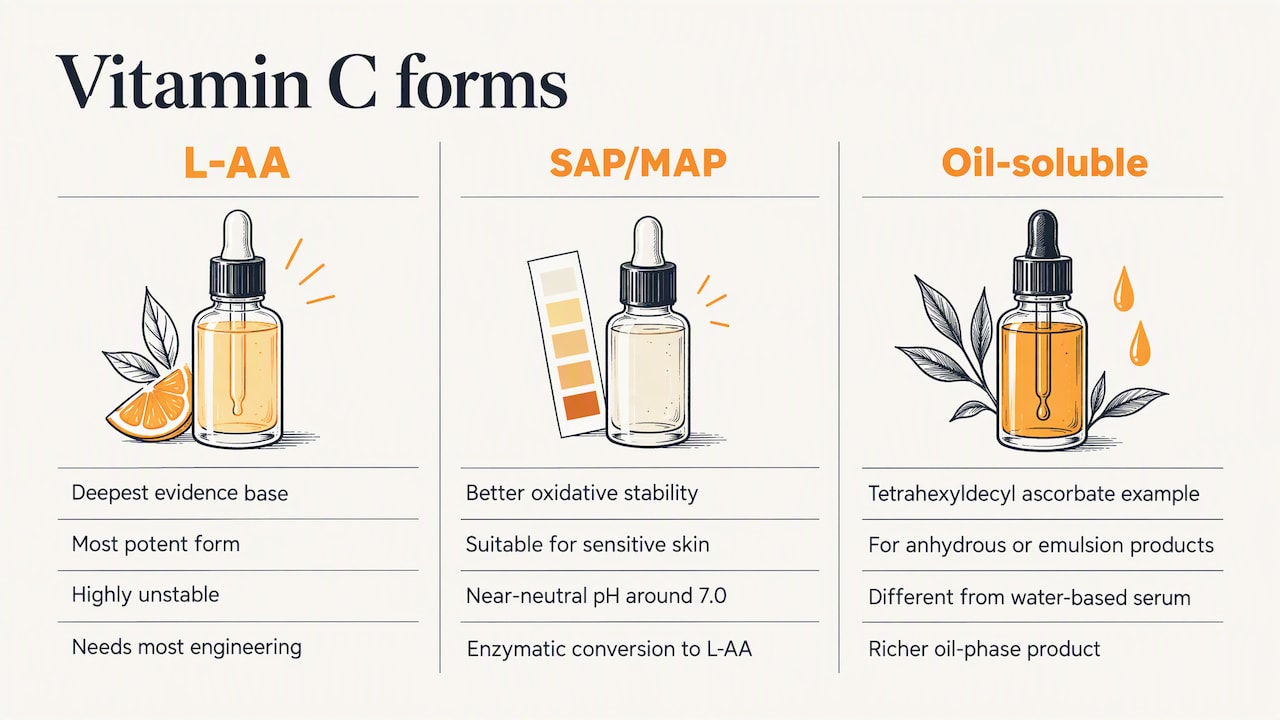
Oil-soluble derivatives such as tetrahexyldecyl ascorbate suit anhydrous or emulsion-based products. They are a different product architecture from a water-based serum, so decide early whether you want a light serum or a richer, oil-phase product.
L-ascorbic acid versus sodium ascorbyl phosphate
| Criterion | L-ascorbic acid | Sodium ascorbyl phosphate |
|---|---|---|
| Potency | Active form, directly available | Needs conversion in skin |
| Stability in water | Poor, oxidises quickly | Considerably better |
| Typical pH | Acidic (2.5 to 3.0 in conventional serums) | Can be near neutral |
| Skin feel | Can sting on sensitive or compromised skin | Generally gentler |
| Formulation effort | High: chelators, antioxidants, packaging | Moderate |
| Best for | Brands positioning on potency | Sensitive-skin, daily-use or entry-level ranges |
Neither is simply better. A clinic range aimed at post-procedure skin and a salon brightening treatment have different needs, and a manufacturer should ask about your customer before it quotes a formula.
Why pH decides so much
For L-ascorbic acid, pH does two jobs that pull in opposite directions. A 2026 review on shelf-life stability calls pH both a prerequisite for chemical stability and absorption and a potential cause of irritation and barrier damage.
The conventional position, reflected in a PubMed paper on stabilising vitamin C, is that L-AA needs a pH below 3.5, with 2.5 to 3.0 the industry norm, to balance bioavailability and stability. That is why most classic serums are quite acidic and why they can sting.
Can you formulate above pH 3?
The same paper describes a stabilised 12% vitamin C serum at a pH close to that of skin. Its companion study ran an in vivo trial of that pH 6 serum with eighty women across phototypes I to VI, looking at signs of photoageing. The authors report that stabilisation technology can now deliver performance without the very low pH that may compromise the skin barrier over time.
Two cautions for a brand owner:
- This is one stabilisation approach from one research group. It does not mean any L-AA serum adjusted to pH 6 will survive. Without the stabilisation system it will oxidise quickly.
- A stabilised higher-pH serum still needs your own stability data, in your own packaging, before you make claims.
For a sense of what a consumer brightening serum looks like on shelf today, you can look at this skin tone brightener from a professional retail range, then compare how its positioning differs from a high-potency acidic serum.
Keeping vitamin C stable
L-ascorbic acid degrades with light, heat, air and water. In a water-based serum, oxidation starts as soon as the active dissolves. Manufacturers manage this in layers.
In the formula
- Chelating agent. Trace metals such as iron and copper catalyse oxidation. A chelator like disodium EDTA binds them.
- Antioxidant partners. The well-known combination pairs L-AA with vitamin E and ferulic acid, which regenerate and protect each other. Published guides on this framework use 15% L-AA with 1% vitamin E and 0.5% ferulic acid, and the pairing is a starting point for development, not a finished specification.
- Water control. Water-free or powder-and-liquid dual-chamber systems keep the active apart from water until use.
- pH strategy. Either keep the acidic window, or use a stabilised complex at higher pH as above.
In the process
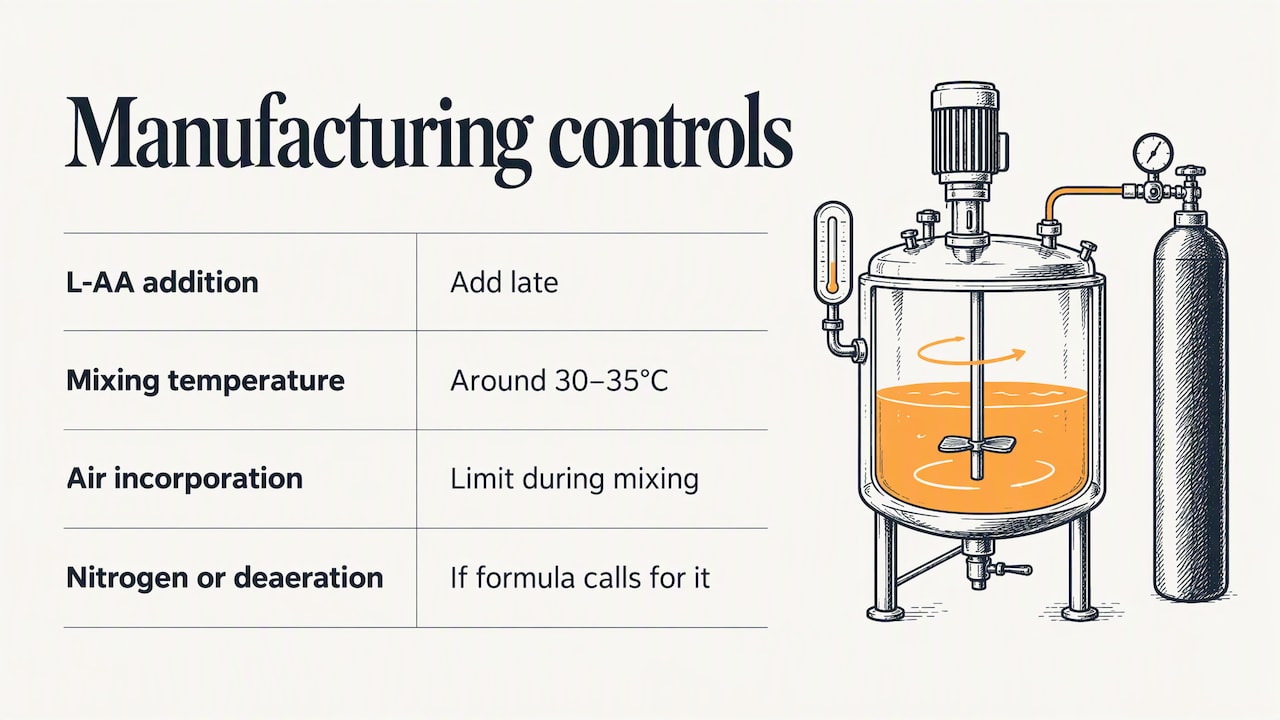
Temperature control during manufacture is one of the most practical levers. Formulation guides commonly advise adding L-AA late and keeping the batch cool, with figures of around 30 to 35°C quoted for mixing stages. Your manufacturer should be able to tell you its own validated limits, how it limits air incorporation during mixing, and how it handles nitrogen blanketing or deaeration if the formula calls for it.
Shelf-life versus in-use stability
The same 2026 review draws a distinction that many brief documents miss. Anhydrous and dual-chamber systems can pause degradation in storage. Once the product meets air, water and skin, degradation is rapid and current science has not fully solved it.
Practical consequences:
- Choose airless pumps, opaque or dark containers and small fill sizes, so the customer finishes the product quickly. Our guide to skincare packaging options for Singapore brands covers the formats.
- Consider single-use sachets for professional or sampling formats. See sachet packaging for skincare.
- Print storage and use-by guidance on the pack and teach your sales staff to repeat it.
- Ask for packaging compatibility testing, because acidic, oxidation-prone actives can interact with pumps, droppers and liners.
One point on climate. Singapore is hot and humid year-round, so shipping, warehousing and bathroom storage all stress a vitamin C product more than a temperate market would. Build that into your stability protocol rather than hoping for the best.
Testing before you launch
A vitamin C serum should never go to market on a lab-bench impression. A sensible programme includes:
- Accelerated and real-time stability at several temperatures, tracking assay of the active, colour, odour and pH over time.
- Packaging-specific testing, since the same formula behaves differently in a clear dropper and an airless pump.
- Challenge testing for preservation, particularly in water-rich formulas at lower pH.
- Skin compatibility checks appropriate to the claim and target user.
We explain why this matters in why stability testing matters in skincare manufacturing, and describe the service on our cosmetic stability testing and QC page.
Singapore regulation: what you need to know
Cosmetics in Singapore follow the ASEAN Cosmetic Directive, and a product must be notified to the Health Sciences Authority before it is supplied. The HSA’s notification guidance states that notifications are submitted through PRISM and are valid for one year. It also states that notification is not HSA approval or endorsement.
That last point matters for formulation. HSA’s page on how cosmetic products are regulated makes clear that the responsibility for safety, quality and ingredient compliance sits with the manufacturer or supplier. For a vitamin C serum, that means documenting the ingredient choices, concentration, pH rationale and stability data behind every claim you make. If you are unsure which route is right for your brand, our 7 facts about HSA GMP and skincare manufacturing standards is a good starting point.
Claims need care too. “Brightening” and “antioxidant” are very different statements from anything that sounds like treating a condition. Agree wording with your manufacturer before artwork is printed.
Our perspective on vitamin C development
We see the same pattern in briefs: a client asks for “a 20% vitamin C serum” because a bigger number feels more premium. We would rather start with the person who will use the product.
A salon applying a serum in a controlled treatment room can use a different format from a customer who will keep a bottle on a bathroom shelf for three months. A clinic with post-procedure clients may be better served by a gentler derivative or a stabilised higher-pH system than by the most acidic option. Concentration is only one input. pH, stabilisation, packaging and in-use behaviour decide whether the percentage on the label means anything by the time the customer applies it.
Our approach is collaborative. We research the market with you, develop the formula, test it in the pack you intend to use, and work within GMP certification from Singapore’s HSA. We would rather tell you early that a design is hard to stabilise than discover it in a failed stability run.
— Edmund
Working with Harmony Skin Lab on a vitamin C range
If you are planning a brightening or antioxidant serum, we can take it from concept through formulation, R&D, quality control and packaging. We make products for home use, professional salons and aesthetic or doctor’s formulations. Browse our services and product lines, or read how our skincare product development service works. For salon and clinic ranges, see professional salon skincare manufacturing and aesthetic skincare for clinics in Singapore. When you are ready to brief us, start from our skincare launch roadmap.
What to put in your brief
A clear brief saves weeks. Include:
- Target user and channel: home use, salon or clinic.
- Preferred form of vitamin C, or the outcome you want if you are open to advice.
- Texture and finish: watery serum, gel, light emulsion.
- Packaging idea, including whether single-dose formats are an option.
- Claims you plan to make, so the formula and testing support them.
- Target market: Singapore only, or other ASEAN countries as well.
- Volumes and timeline, so the plan fits your first order.
If you are choosing between OEM and ODM routes, see cosmetic OEM versus ODM services compared. For the full launch sequence, see 7 steps to launch private label cosmetics in Singapore.
FAQ
What pH should a vitamin C serum have?
For a conventional L-ascorbic acid serum, the accepted range is 2.5 to 3.0, and effective penetration generally needs a pH below 3.5. Stabilised systems have been shown to work at pH 6 in a published 12% serum. Derivatives such as sodium ascorbyl phosphate can sit near neutral pH.
Is sodium ascorbyl phosphate better than L-ascorbic acid?
It is more stable and gentler, but it is not a direct replacement. The skin must convert it into active L-ascorbic acid, so potency and mechanism differ. The better choice depends on your customer’s skin, your positioning and your packaging.
Why does vitamin C serum turn orange or brown?
The colour change is a sign of oxidation. Light, heat, air, water and trace metals drive it, which is why stabilisers, chelating agents and protective packaging are used. A serum that darkens has lost some of its active.
Do I need HSA approval to sell a vitamin C serum in Singapore?
No. Cosmetic products must be notified to HSA before supply, but notification is not approval. You remain responsible for proving the product is safe and compliant with the ASEAN Cosmetic Directive.
Sources
- Topical Vitamin C and Its Derivatives in Cosmetic Science: Stability, Efficacy, and Formulation Strategies
- Mastering the formulation of an unstable vitamin C: a new approach (PubMed)
- In vivo efficacy of a stabilised vitamin C serum at pH 6 (PubMed)
- The Challenges of Shelf Life Stability in Vitamin C Cosmetics and pH-Dependent stability strategies
- Stability of vitamin C derivatives in topical formulations (Europe PMC)
- HSA: cosmetic product notification
- HSA: how cosmetic products are regulated
- HIDEHERE Vita Elixir Skin Tone Brightener