
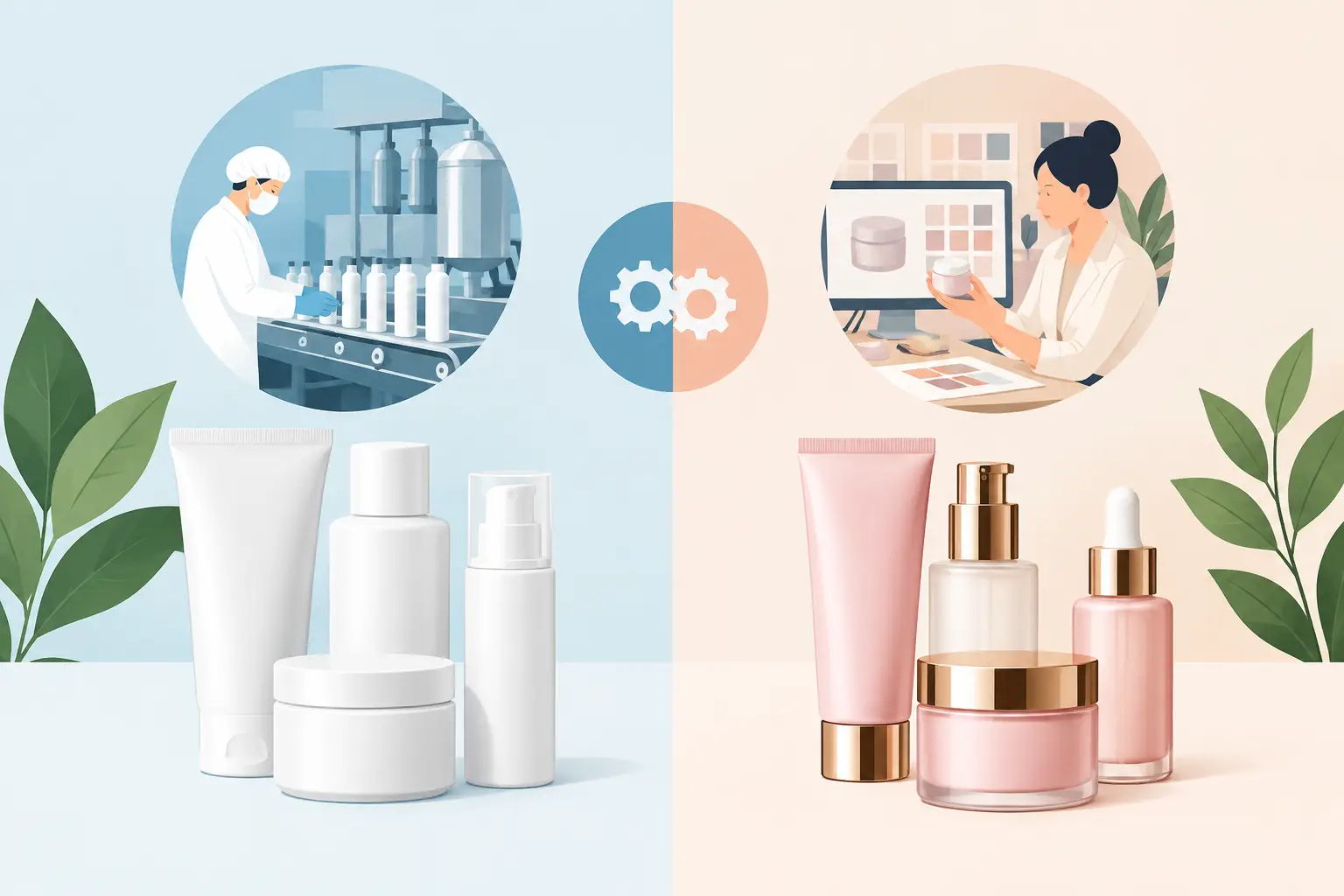
A serum can look ready for launch long before the manufacturing choices behind it are ready. When comparing cosmetic OEM versus ODM services, the real decision is not simply whether to create a custom product or choose an existing one. It is about how much control your brand needs, how quickly you need to enter the market, and where a manufacturing partner can add the most value.
For skincare founders, salons, clinics, distributors, and established beauty businesses, both models can produce premium, market-ready products. The better route depends on your product strategy, available development time, target price point, claims direction, and long-term plans for differentiation.
What Cosmetic OEM Services Mean for Your Brand
OEM stands for original equipment manufacturer. In cosmetics, OEM services generally mean a manufacturer produces a product under your brand based on a formula, specification, or product direction that belongs to your business or is developed specifically for it.
The level of customization can vary. A brand may arrive with a completed formula and need a qualified facility to scale it safely. More commonly, the brand brings a product brief: perhaps a fragrance-free brightening moisturizer for sensitive skin, a professional-use peeling gel, or a lightweight SPF-adjacent daily moisturizer without making sun-protection claims. The manufacturer’s R&D team then develops, tests, refines, and produces the formula around that brief.
OEM is often the right choice when the product itself is central to your competitive advantage. You may need a distinctive sensory profile, a particular active-ingredient story, compatibility with a clinical or salon protocol, or exclusions that align with your clean-beauty positioning. This path creates more room to shape texture, performance, scent, color, viscosity, packaging fit, and consumer experience.
That control requires time and commitment. A custom formula needs laboratory development, sample reviews, stability support, packaging compatibility checks, production scale-up, and documented quality processes. If your brief changes after testing, the timeline can extend. That is not a drawback when handled deliberately – it is part of building a product that can credibly carry your name.
What Cosmetic ODM Services Mean for Your Brand
ODM stands for original design manufacturer. With cosmetic ODM services, the manufacturing partner provides product concepts and established formulations that can be selected, adapted within defined parameters, branded, and brought to market more efficiently.
An ODM range may include products such as cleansers, toners, moisturizers, masks, scalp care, body care, or targeted serums developed around relevant market demand. Your brand can usually make choices around packaging, label design, fragrance where appropriate, product format, and commercial positioning. Depending on the manufacturer and formula, limited modifications may also be possible.
ODM is well suited to a brand testing a new category, responding to a clear market opportunity, or assembling a cohesive first collection without a lengthy formulation-development cycle. A salon that wants a professional retail range or a distributor entering a new territory may benefit from the speed and lower technical burden of an ODM starting point.
The trade-off is differentiation. If the base formula is part of a manufacturer’s broader offering, your brand may have less exclusivity and less freedom to make substantial changes. Strong packaging, a clear customer proposition, reliable product quality, and a focused go-to-market plan still matter greatly, but the formula may not be uniquely yours.
Cosmetic OEM Versus ODM Services: The Key Differences
The most practical distinction is this: OEM starts with your product requirements and builds toward a tailored outcome, while ODM starts with a manufacturer’s existing development platform and moves toward a branded launch.
OEM generally gives your business greater influence over ingredient selection, product claims support, sensory performance, and future formula evolution. It is a strategic fit for brands that want a recognizable product signature or need products developed for a precise professional, aesthetic, or consumer use case. It may involve more development investment and a longer route to final production.
ODM generally shortens the route from selection to commercialization. Because the formula architecture has already been developed, the work can focus on selecting the right product, confirming packaging, preparing labels, and completing production requirements. It can be commercially sensible for brands that prioritize speed, want to validate demand, or do not require a fully original formula at the outset.
Terminology is not always used consistently across the industry. One manufacturer may describe a lightly modified stock formula as OEM, while another may classify it as ODM. Rather than relying on the label alone, ask clear questions: Who owns the formula? Can it be sold to other brands? What customization is possible? What testing has been completed? What is included in the quoted scope?
Choose OEM When Formula Strategy Drives Growth
An OEM route is worth considering when your product concept cannot be adequately met by a ready-developed option. This is common for clinic-led brands seeking a product aligned with a treatment philosophy, brands with strict ingredient restrictions, and premium skincare businesses where texture and visible user experience support the brand’s price position.
It is also appropriate when you want to create a platform for future expansion. A well-developed hero serum, for example, can establish a recognizable formulation language that later informs a cleanser, cream, mask, or professional back-bar product. The investment is not only in one SKU. It is in a product standard your customers can recognize.
However, custom development should begin with a disciplined brief, not an overly long ingredient wish list. Active ingredients can affect stability, color, odor, viscosity, preservative performance, and packaging compatibility. A capable R&D partner will help prioritize what the product must achieve for the end user and identify where technical compromises may be necessary.
Choose ODM When Speed and Focus Matter Most
ODM is a practical choice when your business needs a proven starting point and wants to concentrate resources on branding, channel development, retail education, and customer acquisition. For an entrepreneur building a first range, a well-chosen ODM product can provide a more manageable entry into the market.
It can also support faster category expansion. An established brand may have a clear opportunity to add body care or hair care without diverting substantial time from the core skincare line. In that case, an ODM product can fill a commercial gap while the business reserves custom R&D for future hero products.
Speed should not mean reduced scrutiny. Review the formula’s ingredient profile, product positioning, packaging suitability, documentation requirements, manufacturing standards, and quality controls. Confirm that the final label accurately reflects the product and is suitable for each intended sales market. A fast launch still needs a responsible foundation.
Manufacturing Quality Is Not Optional in Either Model
Whether you select OEM or ODM, the product must be developed and produced with consistent quality controls. Formula performance in the laboratory is only one part of the equation. A product must also remain stable through production, filling, storage, shipping, and normal consumer use.
This is why an end-to-end manufacturing partner matters. The ability to coordinate formulation development, raw-material sourcing, batch scale-up, filtration, filling, packaging, printing, labeling, and final inspection reduces avoidable handoffs. It also makes it easier to identify potential issues before they become costly production delays.
For brands selling into demanding channels, GMP-certified manufacturing is a meaningful safeguard. At Harmony Skin Lab, Singapore Health Sciences Authority GMP certification, dedicated R&D support, formulation simulation capabilities, and detailed quality processes support clients from early concept work through finished packaged goods. The goal is not merely to make a product, but to make one that is reliable, commercially appropriate, and ready to represent the brand well.
Questions to Settle Before You Request a Quote
A productive manufacturer conversation begins with the business case behind the product. Share your target customer, intended channel, desired retail position, anticipated launch timing, target order volume, and the product qualities that are genuinely non-negotiable.
You should also establish whether formula exclusivity is required, which markets you intend to sell in, what packaging format best suits the formula, and whether you need support beyond bulk manufacturing. A partner that can manage packaging design, labeling, filling, sachet formats, wrapping, and distribution can simplify the operational path, especially for lean brand teams.
Do not assume that a lower initial price creates the lower total cost. An ODM product may reduce development expense and shorten time to revenue. An OEM product may demand more upfront work but deliver a stronger point of difference and more long-term brand equity. The right comparison considers the full commercial picture.
The best choice is the one that gives your brand enough speed to act and enough distinction to grow. Start with the customer promise you want your product to keep, then choose the development path and manufacturing partner that can protect that promise at every stage.