A skincare product does not prove itself on launch day. It proves itself weeks and months later, after transport, storage, repeated opening, and daily use in real conditions. A cream that feels elegant at first fill can still fail if it separates, discolours, develops an off-odour, or loses preservative protection over time.
That is why stability testing sits near the centre of serious skincare manufacturing. It helps brands move beyond a promising formula and toward a product that stays safe, effective-looking, and commercially dependable across its intended shelf life. In Singapore, where heat and humidity are part of ordinary life, this matters even more.
What skincare stability testing actually checks
Stability testing is not one single test with one universal answer. Official guidance reflects that reality. FDA guidance places shelf-life determination with the manufacturer, while ISO/TR 18811 treats cosmetic stability as protocol-driven and product-specific. In practice, that means that a gel cleanser, a vitamin serum, a massage oil, and a professional-use mask should not all be assessed in exactly the same way.
A well-planned stability programme looks at how a product behaves across time and under selected storage conditions. The aim is simple: confirm that the formula remains safe, usable, and consistent enough for market release. That includes physical, chemical, microbiological, and packaging-related checks.
When a product goes through stability review, teams are usually watching for visible and measurable shifts like these:
- Colour change
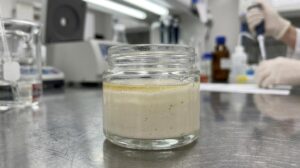
- Phase separation
- Viscosity drift
- pH movement
- Off-odour
- Sedimentation or crystallisation
- Leakage or cap failure
Some changes are obvious. Others are subtle, yet commercially serious. A serum that darkens slightly may still be usable, but the market may read it as oxidised or old. A lotion that becomes slightly thinner may still dispense, but consumers may no longer trust it. Stability testing helps catch those issues before they turn into returns, complaints, or reformulation costs after launch.
Shelf-life determination depends on real product behaviour
One common misunderstanding is that shelf life is a label exercise. It is not. Even where regulations do not require a specific cosmetic expiration date on pack, the responsibility to determine shelf life and substantiate product safety still sits with the manufacturer or brand owner.
That is why stability testing matters commercially as much as technically. It gives evidence for decisions like how long a product can remain in marketable condition, whether it should carry a period-after-opening symbol, what storage advice is sensible, and whether the pack and formula can withstand routine distribution conditions.
FDA guidance notes that some companies test samples under different temperature and humidity conditions to see how safety and usability are affected. That principle is highly relevant in Singapore and the wider region, where products may move through warm warehouses, delivery vehicles, clinic backrooms, salon shelves, and bathroom cabinets before the last use.
Here is a practical way to think about the scope of stability work:
| Stability area | What is assessed | Why it matters |
|---|---|---|
| Physical stability | Appearance, texture, viscosity, phase integrity | Protects user experience and brand confidence |
| Chemical stability | pH, oxidation risk, active ingredient behaviour | Supports product integrity over time |
| Microbiological stability | Preservative performance and contamination control | Helps keep the product safe in storage and use |
| Packaging compatibility | Container interaction, leakage, dispensing, seal quality | Confirms the pack protects the formula properly |
| In-use robustness | Performance after repeated opening and consumer handling | Reflects real market conditions |
Shelf-life work is strongest when it is linked to the actual product concept. A lightweight toner in a bottle has a different risk profile from a rich cream in a jar. A home-use item differs from a professional cabin product that may be opened frequently during treatment sessions. Good stability planning respects those differences instead of flattening them into a generic checklist.
Microbial safety and preservative performance in skincare
Stability is often discussed in terms of texture or colour, yet microbiological safety is just as important. A product can look acceptable and still become unsafe if preservation is weak or contamination enters the formula during storage and use.
FDA guidance on cosmetic microbiological safety is direct on this point. Cosmetic products can become harmful if contaminated with pathogenic bacteria or fungi, and companies are responsible for keeping products free from harmful microorganisms. Guidance also points to major risk pathways: ineffective preservation systems, packaging that does not protect the product adequately, and poor storage or shipping conditions.
For brands, this means stability testing should never be reduced to “Does the cream still look nice?” It should also ask whether the product remains protected under reasonably foreseeable conditions of storage and consumer use.
Some product types and commercial formats need especially close attention:
- High-water formulas: creams, gels, masks, and lotions usually need careful preservation review.
- Jar packaging: repeated finger contact can increase in-use contamination risk.
- Professional-use packs: frequent opening and decanting may change the exposure profile.
- Long shipping routes: sustained heat can stress both formula and preservative system.
This is where retained samples, batch monitoring, and preservation-focused testing become very useful. A product may pass a bench-top assessment early in development, yet show weaknesses later when scale-up, filling, and real handling are introduced. Stability work helps connect formulation theory with commercial reality.
Packaging compatibility and skincare usage risks
Packaging is not just a branding surface. It is part of the product protection system.
A formula can be well designed and still run into problems if the pack is unsuitable. Pumps can clog. Droppers can expose the formula to excess air. Caps can loosen in transport. That risk tends to rise when volume spikes, and SVDirect’s look at peak-season fulfillment describes how heavier handling, denser packing, and faster warehouse throughput can expose weak packaging choices long before the product reaches the end user. A bottle may not create an adequate barrier. Even a small mismatch between pack and product can reduce stability or make contamination more likely.
This is one reason official guidance highlights packaging protection as part of cosmetic safety. If a container does not shield the formula properly, microbial and physical failures become more likely. In-use performance matters too. A consumer will not separate “formula quality” from “packaging quality”. If the pump splutters or the tube leaks, the whole product is judged poorly.
Packaging compatibility review may include points like these:
- Barrier performance: whether the pack limits air, moisture, or external contamination effectively.
- Dispensing behaviour: whether pumps, droppers, sachets, or tubes deliver the product consistently.
- Material interaction: whether the formula affects the container, or the container affects the formula.
- Transport resilience: whether seals, caps, and closures remain reliable after handling and shipment.
For new brands, this is a valuable reminder. A premium formulation deserves packaging that supports its stability profile, not packaging selected only for aesthetics or cost. For salons and clinics, the same principle applies to cabin-use formats, where high-frequency handling changes the risk picture.
Building a product-specific stability protocol for skincare manufacturing
ISO guidance is especially useful here because it does not pretend there is a single standard condition that fits every cosmetic product. The manufacturer must specify and justify the stability protocol. That approach is sensible. Products vary widely, and so do their intended users, packaging systems, distribution pathways, and storage environments.
A thoughtful protocol often starts with product identity. Is it an emulsion, an anhydrous oil, a water-based serum, or a clay mask? Does it contain sensitive actives, botanical ingredients, fragrance, or pigments? Is it sold in a jar, airless pump, sachet, or treatment-room bulk pack? Will it sit in retail, move through e-commerce fulfilment, or be used mainly by professionals?
These decisions help determine what to test, what conditions to select, what intervals to monitor, and what acceptance criteria make sense.
Key protocol design factors usually include:
- Formula profile: water content, pH range, oil phase, actives, and ingredient sensitivity.
- Packaging system: jar, bottle, tube, pump, dropper, sachet, or cabin-use container.
- Storage pathway: warehouse storage, courier handling, retail display, and home bathroom conditions.
- Usage pattern: daily home application, clinic treatment use, travel handling, or frequent reopening.
This is also where scale matters. A promising lab sample can behave differently once it moves into pilot or production batches. Mixing energy, heating and cooling behaviour, filling, quality control, and raw material variation can all influence stability. Testing should support scale-up decisions, not sit apart from them.
Why stability testing matters for skincare start-ups and growing brands
It is easy to assume that only large multinational brands need structured stability testing. In reality, smaller and growing brands often benefit the most from it because early-stage mistakes are costlier to absorb.
A failed batch does not only affect inventory. It can affect launch timing, retailer confidence, clinic relationships, and customer retention. If a first release disappoints, the brand may spend months rebuilding trust. Stability testing reduces that risk by identifying weak points before a product reaches market.
For start-ups working with low MOQ manufacturing, the temptation is sometimes to move quickly and keep pre-launch checks light. Speed has value, but speed without evidence can become expensive. A stable product gives a young brand something powerful: confidence that the formula can survive real-world handling while still representing the brand properly.
This matters equally for professional salons and aesthetic clinics. Products used in treatment settings often carry stronger expectations around consistency, hygiene, and repeat performance. A texture shift or preservation concern in that environment is not a small issue. It can affect service quality and client confidence very quickly.
How OEM/ODM skincare partners support stability testing
For many brands, the practical challenge is not deciding whether stability testing matters. The challenge is building it into product development without slowing everything down unnecessarily.
That is where an experienced OEM/ODM manufacturing partner can add structure. When formulation, packaging review, scale-up, filling, quality control, and stability planning are coordinated together, teams can identify risks earlier and avoid rework later. It becomes easier to connect the intended market position of the product with its technical requirements.
A GMP-certified skincare manufacturer in Singapore may support this through end-to-end development services that include concept work, customised formulation, R&D, production planning, quality control, packaging and label coordination, and product stability testing. For brands with limited internal technical resources, that joined-up process can make decision-making much clearer.
Harmony Skin Lab operates in this space, supporting skincare and personal care brands, salons, and clinics with OEM/ODM development, low MOQ production, customised formulations, quality control, packaging support, and stability-related work within a GMP-certified setup. That kind of integrated model is useful because stability is rarely an isolated question. It sits beside formulation choices, packaging fit, filling method, and the route to market.
A product that remains safe and dependable over time is not a matter of luck. It is the result of disciplined testing, sound manufacturing practice, and product decisions made with commercial reality in mind. That is what gives a skincare launch a stronger footing, whether the plan is a boutique private label line, a clinic-exclusive treatment product, or a broader retail range.