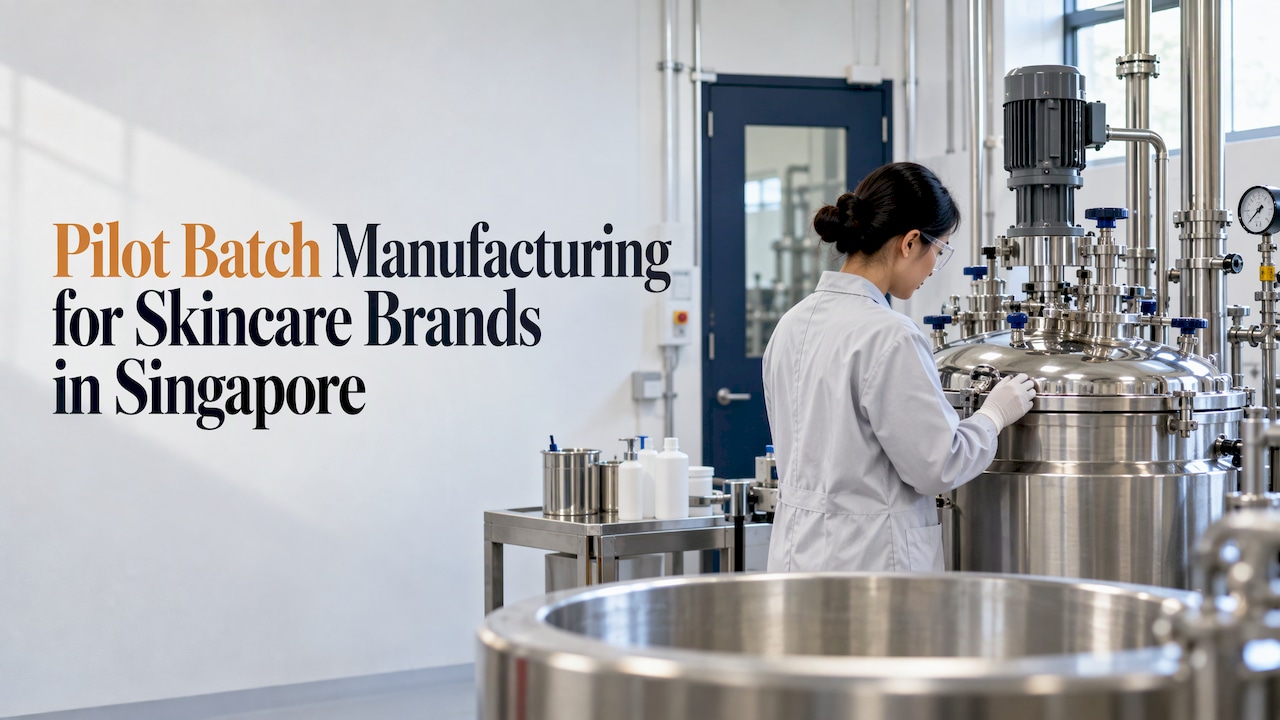
A pilot batch is a small production run made with the process, equipment, ingredients and packaging you intend to use commercially. It sits between the lab sample and your first full production run. Its job is to show that the formula you approved on the bench still behaves the same way when it is made in a real vessel, filled into real packs and written up in real batch records. If you are launching a private label range, a salon line or a medical formulation, the most reliable way to run it is with a manufacturer that handles formulation, quality control and packaging under one roof. That is how we work at Harmony Skin Lab, a GMP-certified skincare manufacturer in Singapore.
TL;DR
- A pilot batch is the dress rehearsal for commercial production: same formula, same process logic, same packaging, smaller volume.
- Its output is not just product. It is a proven process, a draft batch record, stability and compatibility data, and a decision on whether to scale.
- Most scale-up problems appear at this stage, which is exactly why you run it before committing to a large order.
- In Singapore, cosmetics must be notified to HSA before supply, and labels must carry specific details, including the batch number. Plan both before the pilot, not after.
- Working with one manufacturer from formulation to filling keeps the pilot results connected to the final product.
Table of Contents
- What a pilot batch is, and what it is not
- Why the formula behaves differently at scale
- How to plan and run a pilot batch
- What the pilot batch should prove: quality and records
- Tests to run on pilot units
- Singapore rules to settle before and around the pilot
- Reading the results: is the product ready for commercial production?
- Who needs a pilot batch most
- Work with a manufacturer who runs the pilot with you
- Our view: the pilot is where a brand is really made
- FAQ
- Sources
What a pilot batch is, and what it is not
Skincare products move through three stages of scale.
The lab sample. A chemist makes a small amount on the bench to prove the formula: the texture, the feel, the active levels, the preservative system. It tells you the formula can work. It does not tell you how it will be made at volume.
The pilot batch. The same formula is made on equipment that behaves like the production plant, in a larger quantity. Pharmaceutical writing describes a pilot plant as an intermediate facility between laboratory and commercial production, used to develop processes and formulations. Cosmetics borrow the same logic. The size is usually set by what you need: enough units for stability studies, safety testing, packaging trials and customer or practitioner feedback.
The commercial batch. The full tank, made to an approved process and recorded in an approved batch manufacturing record. This is the batch you sell.
A pilot batch is therefore not a sample run to hand out at a trade show, and it is not a cheaper way to start selling without testing. Pilot units can sometimes be sold, but only if they were made to the same controlled standards and have passed the same checks. Treat the pilot as evidence gathering first.
Why the formula behaves differently at scale
The ingredients do not change between the bench and the plant, but the physical conditions do. A large vessel heats and cools more slowly relative to its volume than a beaker does. Mixing speeds and shear that worked in a small container cannot be copied directly into a large tank. Ingredients are added over minutes instead of seconds, and emulsions can respond to that.
The practical results are familiar to anyone who has scaled a product:
- A cream that was glossy and stable in the lab comes out thinner or grainier.
- An emulsion separates after a few weeks because the droplet size was different.
- A colour, fragrance or viscosity drifts between the first and last unit filled.
- A pump or tube that suited the lab sample clogs, leaks or reacts with the formula.
None of these means the formula is bad. They mean the process has not yet been defined for the real equipment. Finding that out on a pilot batch costs a small amount of material. Finding it out on a full production run costs the whole run.
How to plan and run a pilot batch
Here is the sequence we would follow with a brand owner, with what each step takes and where it tends to go wrong.
1. Lock the formula and the claims
Before scaling, the formula should be stable enough on the bench and the intended claims defined: hydrating, soothing, for professional use, for home use. Changing a raw material mid-pilot invalidates the data you are collecting. This is where collaborative development matters. Our R&D and formulation work is built around what the brand wants the product to do and who will use it, so the formula arriving at the pilot already reflects the market it is aimed at. If you are still at this stage, our guide on how to develop a skincare formulation covers it in detail.
2. Choose the batch size by what you need to learn
Do not pick the size by price alone. Work backwards from the quantity you need: units for stability testing in each pack type, units for safety and efficacy checks, retained samples, and a small allowance for loss in the vessel and filling lines. Too small and the batch does not behave like production. Too large and you have committed money to a formula that may still need adjusting.
3. Use production-like equipment and real materials
A pilot made on equipment unlike the production line proves little. The point is to learn the real heating, mixing, cooling and filling times. Raw materials should come from the same specification and supplier you will use commercially, not leftover lab stock. Our manufacturing is done in-house in Singapore, so the pilot and the commercial run can follow the same process rather than being handed between different facilities.
4. Write the process down as you go
The pilot is where the process becomes a document. Record the order of addition, temperatures, mixing speeds and times, hold times, and the in-process checks such as pH and viscosity. This becomes the draft batch manufacturing record that the first commercial batch will follow. Where it goes wrong: teams rely on the chemist’s memory, and a month later nobody can reproduce what was done.
5. Fill into the final packaging
Pack the pilot units in the pack you will sell, not a stand-in jar. Packaging affects stability, dosing, shelf appearance and shipping. Our design and packaging services mean the pack, the label and the filling are developed alongside the formula. For choosing formats, see how to choose skincare packaging and the packaging options for Singapore brands.
6. Test, review and adjust
Test the pilot units against your specification (next section), review the results with the people who made the batch, and decide what to change. Expect at least one adjustment. That is a normal outcome, not a failure.
7. Decide: scale, repeat or revise
If the pilot passes, the draft record is refined and the commercial run follows. If it does not, change one thing at a time and repeat a smaller trial. Section on readiness below sets out how to judge this.
What the pilot batch should prove: quality and records
Singapore follows the ASEAN approach to cosmetic good manufacturing practice. The ASEAN Guidelines for Cosmetic Good Manufacturing Practice set out expectations that map directly onto a pilot batch:
- Starting materials are approved before use.
- Manufacturing follows written procedures.
- In-process controls are recorded.
- Bulk product is labelled until quality control approves it.
- Cross-contamination is controlled, and wet products are protected from microbial contamination.
- Quality control covers sampling and testing of materials and finished products, review of batch documentation, retention of samples and stability studies.
In plain terms: a pilot batch made without batch documentation and retained samples is a pilot batch you cannot learn from properly. When your manufacturer already works to these practices, the records you need come as part of the process and not as an afterthought. Our GMP certification is from Singapore’s HSA, which is relevant if you plan to export (more on that below).
Tests to run on pilot units
The exact programme depends on the product type, but most skincare pilot batches are checked on four fronts.
Physical and chemical checks. Appearance, colour, odour, pH, viscosity and, for emulsions, how uniform the mixture is from the start to the end of filling. Differences between the top, middle and bottom of the vessel point to mixing or hold-time problems.
Microbiological safety. Water-containing products are vulnerable to contamination, so the preservative system and the hygiene of the process both get tested.
Stability. Does the product stay the same over its intended shelf life and in the conditions it will meet in transit and storage, including Singapore’s heat and humidity? Our article on cosmetic stability testing explains the usual approach. For scented products, the same thinking applies to the fragrance component, and fragrance stability testing methods and conditions show how heat, light and time are used to judge whether a scent will hold.
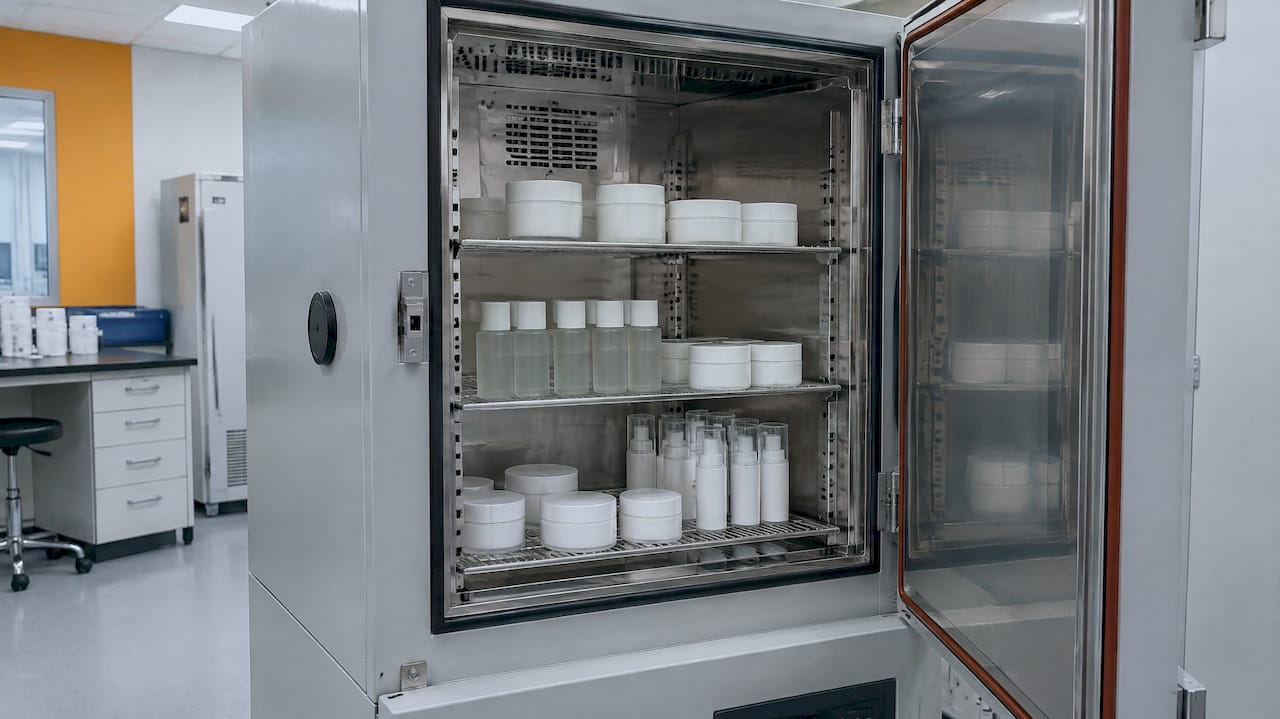
Packaging compatibility. The formula can interact with the pack: absorbing into plastic, softening seals, staining, or changing in pH. The pilot units in final packaging are what this test needs. See what is checked in our guide to packaging compatibility testing.
If your product will be sold with a safety report, the formulation, stability and packaging data from the pilot feed directly into it. Ingredient choices matter here too: our cosmetic ingredient safety guide explains how to check them against the rules.
Singapore rules to settle before and around the pilot
The pilot does not need a licence of its own, but the product it leads to is regulated, and some decisions are best made while the pilot is running.
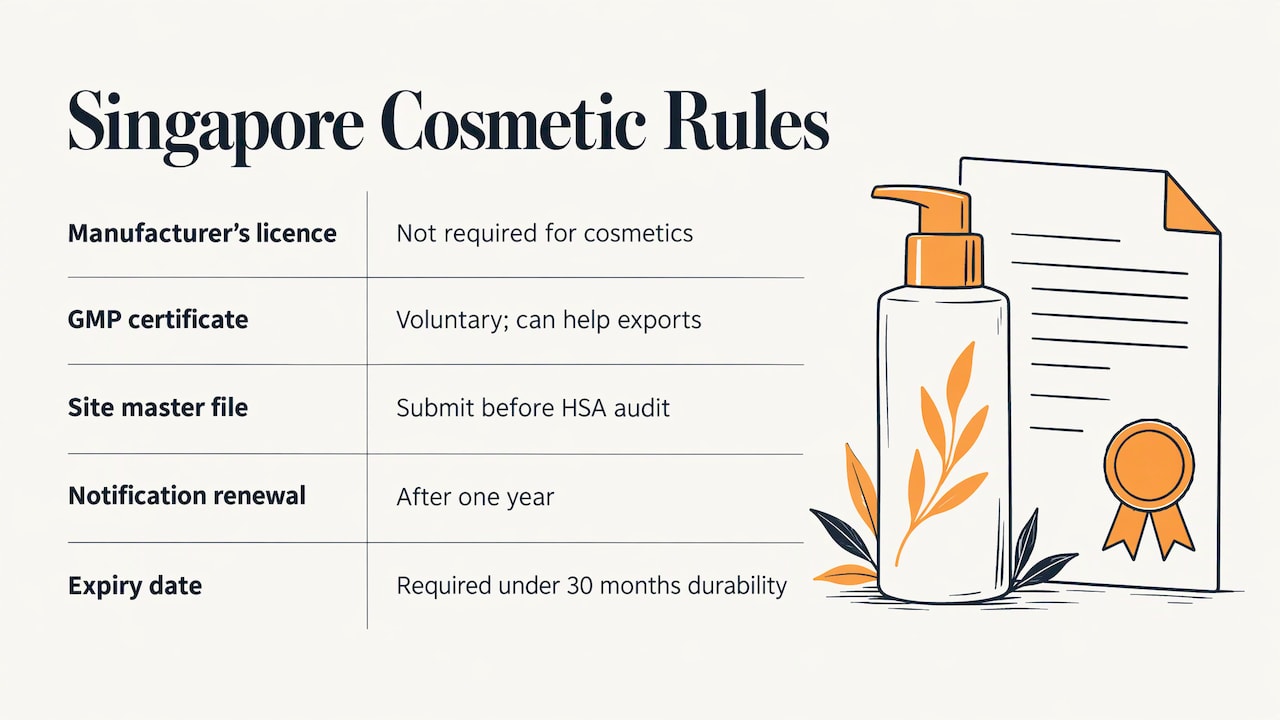
No manufacturer’s licence, but a voluntary GMP certificate. According to HSA’s guidance on GMP certification, cosmetic manufacturers in Singapore do not need a manufacturer’s licence, but they can apply for a voluntary GMP certificate to help with exports. HSA audits against its guidelines for cosmetic manufacturers, and a site master file must be prepared and submitted before the audit. Choosing a manufacturer that already holds this certification means your pilot is made in a facility that has been audited. We explain the standards in 7 facts about HSA GMP and skincare manufacturing.
Product notification. HSA’s regulatory overview states that cosmetics supplied in Singapore must comply with the Health Products Act and the Health Products (Cosmetic Products – ASEAN Cosmetic Directive) Regulations 2007. Before notifying, companies check ingredients against the ASEAN Cosmetic Directive annexes and the labelling rules, then apply for a CRIS account and notify through PRISM. HSA also notes that notification must be renewed after one year, and cancelled if the product is no longer sold. The final formula and label should be settled by the end of the pilot so that what you notify matches what you sell. Our HSA cosmetic notification guide walks through it.
Ingredient lists. HSA’s ASEAN Cosmetic Directive page, last updated on 30 June 2026, lists the prohibited, restricted and permitted ingredient annexes, labelling requirements, GMP and safety assessment guidelines, and Product Information File guidelines. Check your pilot formula against the current annexes, not an older copy. Our ASEAN Cosmetic Directive overview is a plain-English starting point.
Labels. Under the Health Products (Cosmetic Products – ASEAN Cosmetic Directive) Regulations 2007, labels must state the product name, function, instructions, full ingredient list, metric weight or volume, batch number, and the name and Singapore address of the person responsible for placing the product on the market. They must also show the country of manufacture and any special precautions, and an expiry date where the expected durability is under 30 months. The batch number is worth noting: your pilot is the first time your batch numbering system gets used, so set it up now.
Rules move. The Regulations have been amended several times in recent years, so check the current version at each stage rather than relying on what a previous launch needed. For safety data sheets on products supplied to trade customers, see cosmetic SDS requirements in Singapore.
Reading the results: is the product ready for commercial production?
A pilot batch gives you a decision, and the decision is clearer when you set criteria before you start. A practical readiness checklist:
- Consistency. Samples from the start, middle and end of the batch match each other and the approved standard.
- Reproducibility. The process was recorded well enough that another operator could repeat it and get the same result.
- Stability on track. Early stability results show no separation, colour change, odour change or pH drift in the final pack.
- Packaging works. No leakage, clogging, absorption or interaction, and the filling speed and fill weight are within tolerance.
- Regulatory fit. The ingredient list passes the annex check, the label carries every required detail, and the notification can be submitted for exactly this formula.
- Commercial fit. The cost per unit at scale still supports your pricing, and the lead times suit your launch plan.
If one point fails, find which variable caused it. Issues such as heating, cooling or mixing time differences are common at this stage and are usually traceable. Make one change, run a small repeat, and compare. Only move to a full run when every item above is a yes. Our cosmetic product scale-up process article continues from this point, and the skincare launch roadmap places the pilot in the full launch timeline.
Who needs a pilot batch most
New private label brands. You have a formula idea and no production history. The pilot is how you turn the idea into something you can reorder identically twelve months later.
Salons and professional lines. Practitioners use your product on clients, so consistency from bottle to bottle matters. A pilot batch lets staff test the product in treatments before the full run is made.
Medical and aesthetic formulations. Where a doctor specifies the formulation, documentation and repeatability carry extra weight. The pilot batch record is the start of that paper trail.
Established brands changing a formula or pack. A new fragrance, a new preservative system or a new jar is a change worth testing at pilot scale before it reaches the shelf.
Work with a manufacturer who runs the pilot with you
If you are planning a pilot batch in Singapore, we can take it from formulation through to filled, packed units. Harmony Skin Lab is a GMP-certified OEM and ODM manufacturer, covering R&D, custom formulation, quality control and packaging for home-use, professional salon and aesthetic or doctor’s formulation lines. Our approach is to develop the product with you, so the pilot reflects your market and your customers. You can see the full range on our services page, or read about our skincare product development service.
To discuss a pilot batch for your own line, start from our website and tell us about the product, the market and the pack you have in mind.
Our view: the pilot is where a brand is really made
Brands often treat the pilot batch as a formality between the approved sample and the big order. We see it the other way round. The lab sample shows what is possible. The pilot shows what is repeatable, and repeatable is what customers actually buy.
That is why we prefer to do formulation, production and packaging in one collaboration. When the people who developed the formula also make the pilot, fill it and run quality control, any difference between the sample and the plant is understood quickly, and nobody is guessing across a handover. The batch record that comes out of the pilot becomes the instruction for every batch after.
Our R&D is built around what the brand’s customers need and what the market is asking for, and our GMP certification from Singapore’s HSA means the work is done to an audited standard. For a private label founder, a salon owner or a doctor with a formulation in mind, that combination means a pilot that leads somewhere: a product you can reorder, notify and sell with confidence.
Edmund
FAQ
How big should a skincare pilot batch be?
Size it by what you need to learn, not by a fixed number. Count the units for stability testing in each pack type, safety and practitioner trials, retained samples and filling losses, then confirm with your manufacturer which vessel suits that quantity. It must be large enough to behave like production equipment.
Can I sell products from a pilot batch?
Only if they were made under the same controlled conditions as commercial product, have passed the required checks and carry a compliant label, and the product has been notified to HSA. Until you have those, treat the units as test material for stability, packaging and feedback.
Do I need HSA approval to run a pilot batch in Singapore?
Cosmetic manufacturers do not need a manufacturer’s licence, but the product you place on the market must be notified to HSA through its system and meet the ingredient and labelling rules. A voluntary GMP certificate is available to support exports. Settle your formula and label during the pilot so the notification matches.
What is the difference between a pilot batch and a lab sample?
A lab sample is made by hand in a small quantity to prove the formula works. A pilot batch is made with production-like equipment and recorded procedures, in the final packaging, so you can test whether the formula and the process hold up at larger volume.
How long does a pilot batch take?
The making itself is quick, but the learning takes time because stability and compatibility results need weeks of observation. Plan the pilot as a phase in your launch roadmap, and ask your manufacturer for a timeline that covers production, testing and any repeat run.
Sources
- Good Manufacturing Practice certification for cosmetic products, HSA
- Regulatory overview of cosmetic products, HSA
- ASEAN Cosmetic Directive, HSA
- ASEAN Guidelines for Cosmetic Good Manufacturing Practice
- Health Products (Cosmetic Products – ASEAN Cosmetic Directive) Regulations 2007, Singapore Statutes Online