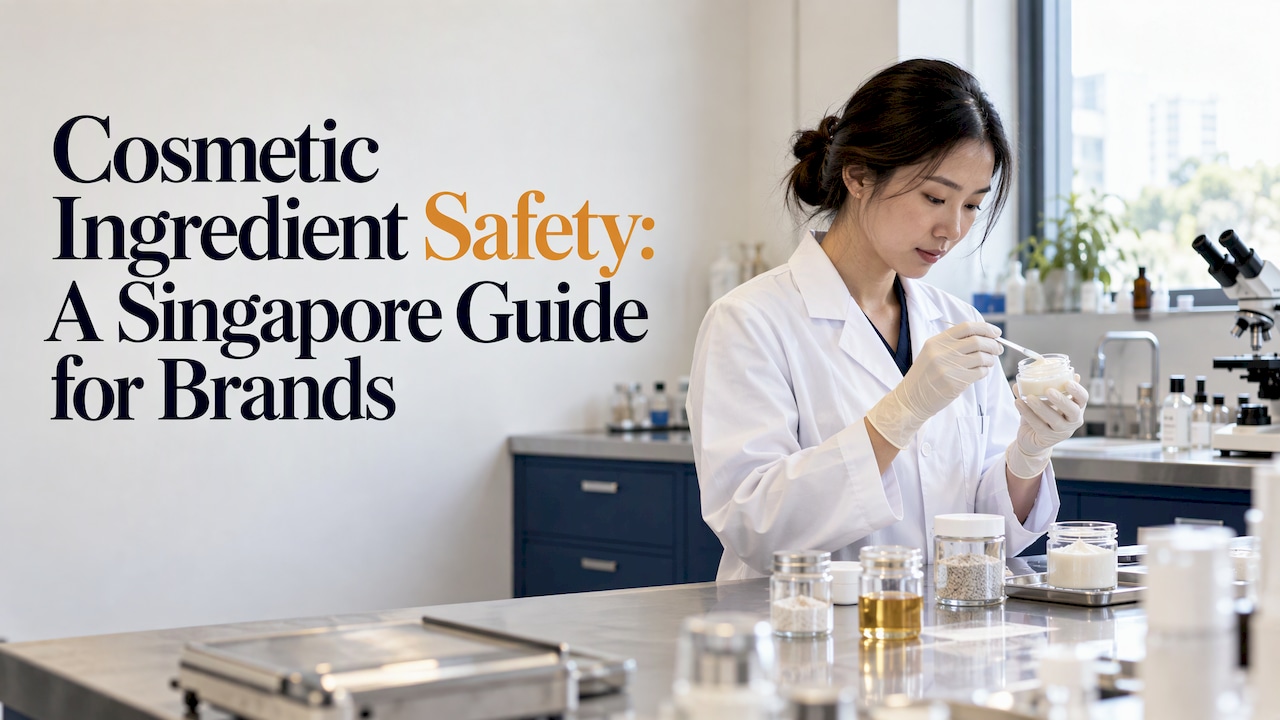
Cosmetic ingredient safety means showing that every ingredient is permitted, used within its limits and safe in the finished product, under normal or reasonably foreseeable use. In Singapore, that duty sits with the business that supplies the product. This guide shows what that involves, from assessment to notification to record keeping, so you can launch a skincare line with confidence.
TL;DR
- Safety is judged on the finished product, not on a single ingredient in isolation: concentration, product type, how often it is used and how it interacts all matter.
- Singapore regulates cosmetics under the Health Products Act and the ASEAN Cosmetic Directive rules, and notification with HSA is usually required before sale.
- Notification is not approval. HSA does not evaluate the product before supply, so your own safety evidence carries the weight.
- Keep supply records for two years, monitor adverse events and be ready to recall.
- Involve a formulator and a safety assessor from the first brief, not after the formula is fixed.
Table of Contents
- What cosmetic ingredient safety means in Singapore
- Hazard and risk are not the same thing
- How to assess an ingredient in the finished formula
- Evidence that helps identify irritation, allergy and contamination
- Botanical and plant-derived ingredients
- Singapore and ASEAN rules that govern ingredients
- Records and controls to keep before and after launch
- Judging safety claims from other markets
- Our perspective
- Work with a manufacturer that builds safety in
- FAQ
- Sources
What cosmetic ingredient safety means in Singapore
Cosmetic products supplied in Singapore must comply with the Health Products Act and the Health Products (Cosmetic Products, ASEAN Cosmetic Directive) Regulations 2007, as the Health Sciences Authority (HSA) sets out in its regulatory overview. The same page explains what counts as a cosmetic: a product intended for contact with external body parts to clean, perfume, change appearance, correct body odour, or protect or keep them in good condition. Injections, oral products and products intended for treatment fall outside that definition.
That definition matters for ingredient choices. If you describe a cream as treating a condition, you are no longer talking about a cosmetic. Ingredient safety therefore starts with a clear statement of what the product is for.
The ASEAN approach adds a second principle. According to an academic review of the ASEAN framework, cosmetic safety is assessed for the finished product under normal or reasonably foreseeable conditions of use. An ingredient is not simply “safe” or “unsafe”. It is safe or unsafe at a given level, in a given product, used in a given way.
Why a “safe ingredient” list is not enough
Public ingredient rating tools and “toxic” lists are popular with consumers, and many brands feel pressure to answer them. They are a starting point for questions, but they do not replace a safety assessment under the rules that apply where you sell. Many of those lists were built for other markets and say little about concentration in your formula. When a customer asks about an ingredient, the strongest reply is the reasoning behind your assessment for the product on the shelf.
Hazard and risk are not the same thing
Much confusion about ingredient safety comes from mixing up these two words. Cosmetics Europe describes hazard as the intrinsic property of a substance, thing or situation to cause harm, and risk as the likelihood that harm will occur. A risk assessment decides whether a hazard presents an unacceptable risk.
A practical way to hold this in mind:
| Question | Hazard view | Risk view |
|---|---|---|
| What is asked? | Can this substance cause harm at all? | How likely is harm in this product, at this level, for this user? |
| What matters? | Intrinsic properties | Concentration, frequency, route, skin area, product type |
| Typical outcome | A flag or a classification | A decision: use, restrict, reformulate |
Many everyday substances have a hazard under some conditions. What a safety assessor asks is whether the exposure from your product reaches a level where that hazard becomes a real concern.
How to assess an ingredient in the finished formula
The ASEAN-based assessment process, as summarised in the academic review, looks at identity and hazard data together with concentration, product type, leave-on or rinse-off status, daily use, route of exposure and margin of exposure. Then it assesses the complete formula, including impurities, vehicle effects, ingredient interactions and any change in how deeply an ingredient penetrates the skin.
In practice, a business can work through it in this order:
- Confirm identity. Know exactly what each raw material is, from which supplier, with what specification.
- Check legal status. The ASEAN safety assessment guidelines say the assessor must determine whether ingredients comply with legal concentration and prohibition requirements.
- Set the exposure. A rinse-off cleanser and a leave-on eye cream use the same ingredient very differently.
- Review the endpoints. Are the toxicological endpoints relevant, and is the data sufficient?
- Look at the whole formula. The same guidelines ask whether toxicologically relevant interactions or altered penetration are likely.
- Decide on extra testing. New ingredients, new combinations or new processes may call for additional testing, according to the academic review.
Start with collaboration, not a late sign-off
The ASEAN guidance states that formulation development should involve close collaboration between the formulator and the safety assessor from the start. That is more efficient than finishing a formula and then discovering that an ingredient needs a lower level or a different preservative system. It is also why we involve our R&D team early in client projects. If you want to see how that stage works, read how custom skincare formulation works from concept to production.
Evidence that helps identify irritation, allergy and contamination
The ASEAN botanical safety guidance lists the kinds of evidence a safety file draws on:
- reliable data on ingredient identity, purity and impurities;
- botanical characterisation;
- batch consistency;
- relevant contamination checks;
- endpoint data for irritation, sensitisation, phototoxicity, genotoxicity and systemic toxicity.
The same guidance prefers validated in-vitro approaches where they are available, and says additional testing may be needed when information is inadequate.
Allergy and irritation
Skin allergy is among the main concerns in any assessment. Cosmetics Europe notes that safety assessments include an evaluation of the risk of skin allergies caused by the ingredients. For a brand, that means asking, for each ingredient, what is known about sensitisation and at what level, and recording the answer. Fragrance components and botanical extracts deserve particular attention because they are mixtures.
Contamination
An ingredient can be safe by design and still carry a problem, such as an impurity from the supply chain. That is why identity, purity and batch data sit at the top of the evidence list. HSA also has an active role after launch: its cosmetics laboratory tests cosmetics for prohibited or restricted substances, including toxic and carcinogenic ones, as part of post-market surveillance in Singapore. Products on the market can be tested, so your documentation should match what is in the bottle.
Stability is part of safety
A formula that separates, changes pH or loses preservative effectiveness can become a safety problem over its shelf life. Our page on cosmetic stability testing and QC services in Singapore covers how we approach that side of quality control.
Botanical and plant-derived ingredients
Plant ingredients are popular in essential oils, massage oils and natural distillates, and they need their own care. The ASEAN botanical guidance recommends characterising botanical identity, plant part, physical properties, traditional-use history, preparation method, extraction solvents and chemical consistency across at least two batches where applicable.
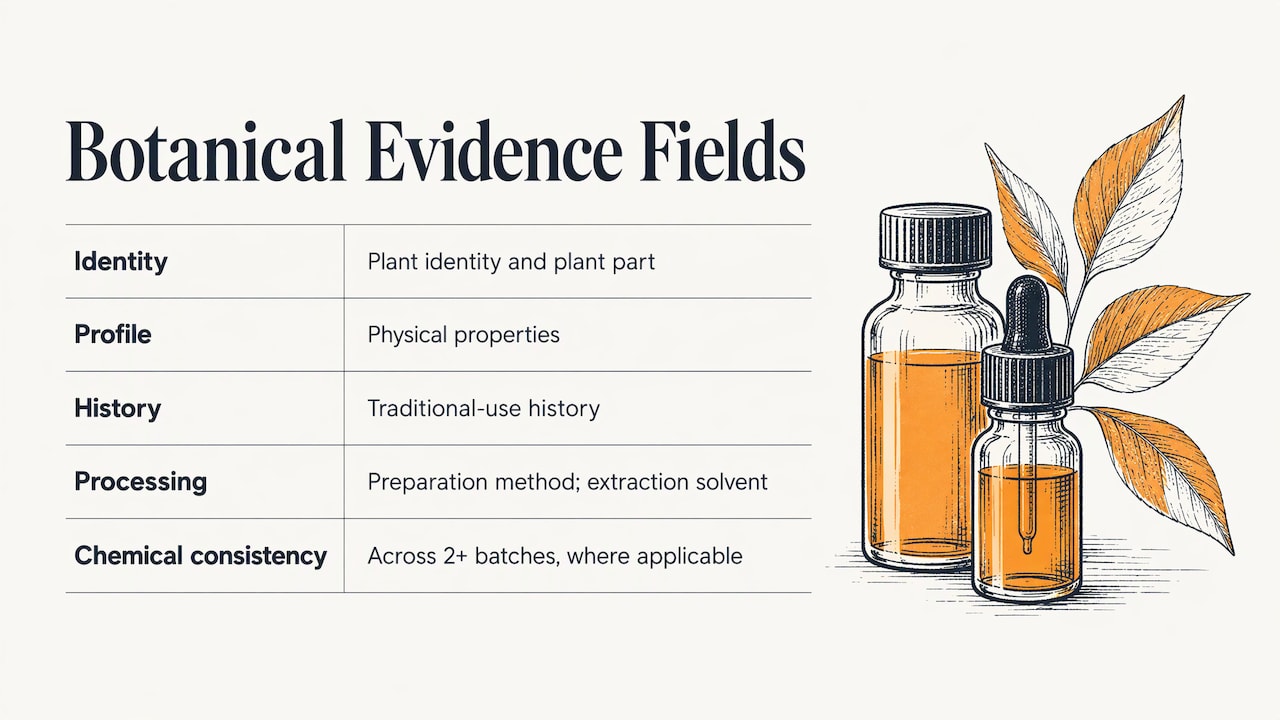
The reason is simple: two batches of the same plant extract can differ with the harvest, the plant part and the solvent. Batch documentation is what lets you show that the material you assessed is the material you use. A certificate of analysis checklist for ingredient batches shows the sort of lot-level detail worth asking suppliers to provide for any raw material.
Singapore and ASEAN rules that govern ingredients
HSA’s ASEAN Cosmetic Directive page says the ACD materials cover prohibited, restricted and permitted ingredients, labelling, GMP, safety assessment, adverse-event reporting, the Product Information File and contaminant-limit guidance. The page, updated on 30 June 2026, says Singapore implemented the ACD on 1 January 2008 and that cosmetic dealers must comply with the aligned national regulations. It also advises checking the ACD annexes regularly so that products stay compliant. Ingredient lists change, so a formula that complied at launch deserves a review at each renewal.
On prohibited substances, the Singapore Regulations allow a listed prohibited substance only in trace amounts, where it is technically unavoidable under good manufacturing practice, or where the applicable schedule conditions are met. This is one reason manufacturing controls and ingredient safety cannot be separated. For more on the framework, see our guide to what Singapore brands must know about the ASEAN Cosmetic Directive.
Notification before sale
HSA states that a cosmetic product notification usually must be submitted before sale in Singapore. Exceptions cover promotional samples, research or development testing, and certain practitioner-supplied products. According to HSA’s notification guidance, the process runs through PRISM after local entity, Corppass and CRIS registration, and sale may begin once the acknowledgement is generated.
Two points are easy to miss:
- Notification is not approval. HSA says it does not evaluate the product before supply, so the acknowledgement is not a certificate of safety. Your safety assessment is what stands behind the product.
- It must be renewed. Each notification is valid for one year, and annual re-notification is required to continue marketing the product, per the HSA regulatory overview.
Our practical guide to HSA cosmetic notification walks through the steps in more detail.
Records and controls to keep before and after launch
HSA requires sellers to keep cosmetic-product supply records for two years and to provide safety and technical information when asked. It also requires companies to monitor and report adverse events and recalls, and to recall products when safety concerns are identified (HSA notification guidance).
A sensible launch file includes:
- the full formula with each ingredient’s concentration and supplier specification;
- the safety assessment for the finished product, with the reasoning for each ingredient;
- batch records and any contamination or stability results;
- label artwork checked against ingredient and labelling rules;
- a written process for logging consumer complaints and adverse events;
- supply records covering the two-year period.
Good manufacturing practice ties these together, because records mean little if production is not controlled. We explain what that involves in GMP in cosmetics: what it means and what Singapore expects.
Judging safety claims from other markets
A consumer may quote a rating from a US database or a decision from another region. Treat these as prompts to check, not as verdicts. The questions to ask are:
- Does the assessment cover the same concentration and product type as yours?
- Is the rule it relies on part of the Singapore and ASEAN framework?
- Is the source a regulator, a recognised expert panel or a campaign list?
If the answer shows a real gap, discuss it with your formulator and safety assessor. If not, you can explain calmly that your product is assessed under the rules that apply in Singapore.
Our perspective
In our experience, the strongest cosmetic safety work happens before the first sample is made. We bring formulation, quality control and packaging into the same conversation, because an ingredient that is fine in a beaker can behave differently in a finished, filled and stored product.
That is why we work closely with each client from the brief. We look at the target market, the product type and how people will use it, and then build the formula around ingredients we can document. Our GMP certification from Singapore’s HSA is a commitment to controlled, traceable production, and our R&D process is designed to turn an idea into a product that is safe and commercially viable.
Whether the line is for home use, a salon or a doctor’s formulation, we think the best protection for your brand is a clear paper trail and a manufacturer that treats safety as part of product design.
Edmund
Work with a manufacturer that builds safety in
If you are planning a private label, salon or clinic line, we can help you move from concept to a market-ready product. Our R&D, design, packaging and manufacturing services cover formulation, quality control and packaging under one roof.
For a view of the full journey, see our skincare launch roadmap, or browse our product lines to see what we already make.
FAQ
Does HSA notification prove a cosmetic product is safe?
No. HSA states that notification is not approval or certification, because it does not evaluate the product before supply. The business supplying the product remains responsible for safety, and must be able to provide safety and technical information on request.
What is the difference between hazard and risk for a cosmetic ingredient?
Hazard is the intrinsic ability of a substance to cause harm. Risk is the likelihood that harm will occur in real use. An assessor weighs concentration, frequency, product type and route of exposure to decide whether a hazard becomes an unacceptable risk.
How often must a cosmetic product be notified in Singapore?
Each notification is valid for one year, so annual re-notification is needed to keep marketing the product. It is a good moment to check your formula against the current ACD annexes.
How long should I keep supply records?
HSA requires cosmetic-product supply records to be kept for two years. You should also be able to produce safety and technical information when HSA asks for it.
Sources
- Regulatory overview of cosmetic products, HSA
- ASEAN Cosmetic Directive, HSA
- Submit notification and re-notification, HSA
- Cosmetics, HSA applied sciences
- Health Products (Cosmetic Products, ASEAN Cosmetic Directive) Regulations 2007
- Ensuring the safety of cosmetics, Cosmetics Europe
- ASEAN safety assessment academic review
- ASEAN guidelines for safety assessment of cosmetic products, Annex I Part 6
- ASEAN botanical safety assessment guidance
- Certificate of analysis checklist for ingredient batches