

Niacinamide is one of the most flexible actives in skincare. It works with hyaluronic acid, ceramides, retinol, salicylic acid and azelaic acid. The one pairing that causes debate is vitamin C, and in a modern, well-formulated routine it is usually fine too. If your skin stings or flushes, the fix is simple: spread the two across morning and evening.
Below, we cover each pairing, the correct layering order, what the pH argument really means, and what it tells brand owners who want to put several actives into one product.
TL;DR
- Niacinamide pairs well with hyaluronic acid, ceramides, retinoids, salicylic acid and azelaic acid.
- Niacinamide and vitamin C can be used together. Apply the thinner, more watery product first, and move one to the evening if your skin reacts.
- Most “incompatibility” comes from mismatched pH or from very high heat in old experiments, not from everyday layering.
- Using several exfoliants in one routine is a bigger irritation risk than niacinamide itself, so alternate nights.
- For brands, compatibility is decided in the formula: pH, stability and preservative system matter more than a warning on the label.
Table of Contents
- Why niacinamide has a reputation for being fussy
- Niacinamide and vitamin C: can you use them together?
- How to layer niacinamide with other actives
- Compatibility at a glance
- Niacinamide with retinol, acids and azelaic acid
- The pH question, in plain words
- What brand owners should know about niacinamide compatibility
- Our perspective
- Planning a niacinamide product or range?
- FAQ
- Sources
Why niacinamide has a reputation for being fussy
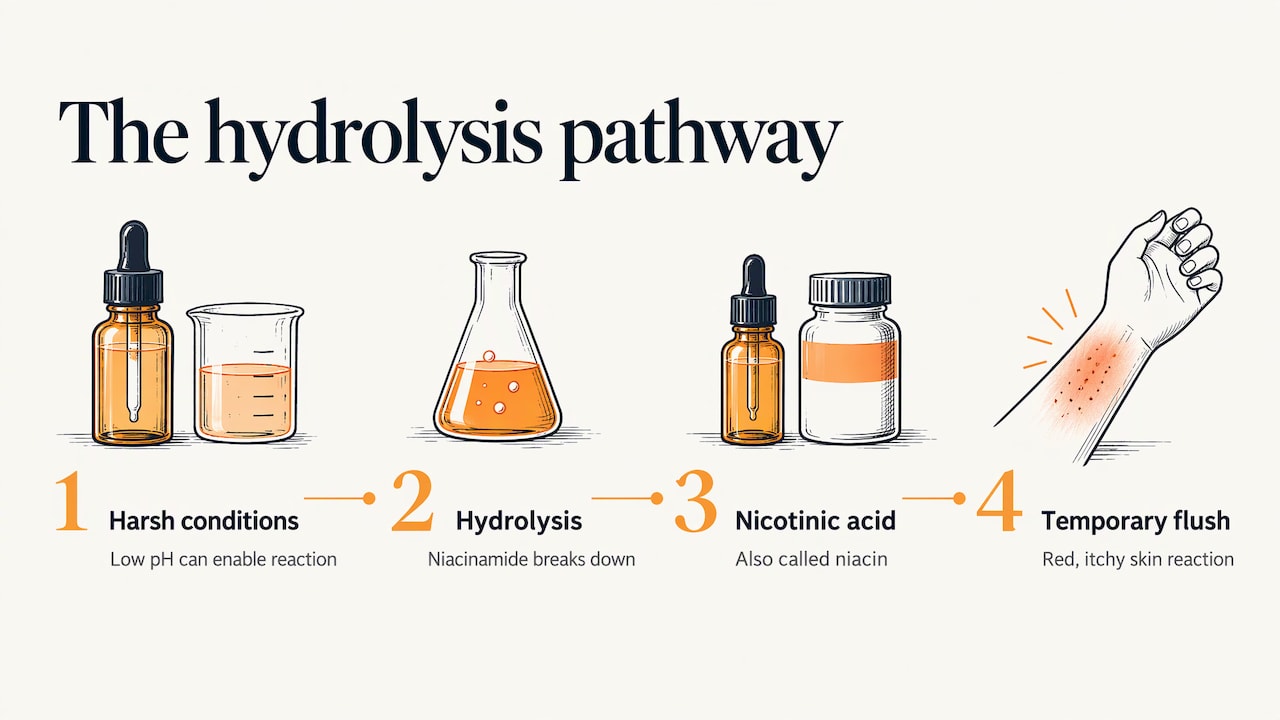
Niacinamide is a form of vitamin B3. It is a stable, water-soluble ingredient, and most formulas work best at a near-neutral pH. The trouble starts with one chemical route: under harsh conditions, niacinamide can hydrolyse into nicotinic acid (niacin), which can cause a temporary red, itchy flush on skin.
Aesthetic doctor Dr Ho, quoted in Vogue Singapore, explains that niacinamide performs best at a neutral pH, and that very low-pH ingredients such as AHAs, BHAs and L-ascorbic acid can compromise it. At low pH, she notes, hydrolysis to nicotinic acid becomes possible, and at high doses that can produce a niacin flush.
That is the origin of the “never mix” lists. The real picture is more specific, as the sections below show: what matters is the pH of the finished products, the temperature, how long they sit together and how sensitive your skin is.
Niacinamide and vitamin C: can you use them together?
Yes, for most people. This is the question readers type most, and the answer has changed over the years.
The old warning traces back to early research in which pure niacinamide and ascorbic acid were combined at very high temperature, forming nicotinic acid. Dermatologist Meena Singh, quoted by Healthline, points out that this does not describe what happens when you use products at room temperature at home, so the same risk does not apply.
Not every source agrees. A L’Officiel Singapore guide suggests leaving at least 10 minutes between the two if you use them together, and warns of breakouts or diminished benefits. Other sources say no wait is needed at all. The sensible reading is that the interaction is mild at worst, and that how your own skin behaves counts for more than any fixed rule.
What the combination can do for skin
Vitamin C is best known for brightness and antioxidant support, while niacinamide supports the skin barrier and helps with oil balance and uneven tone. Used together, they target dullness and uneven tone from two angles. Neither replaces sunscreen, which stays essential every morning, particularly in Singapore’s year-round UV.
Who should be more careful
The most common side effect of using both is irritation. According to Healthline, redness, itching or stinging during a patch test suggests the product is unlikely to suit your skin. If that is you, try this:
- Use vitamin C in the morning and niacinamide in the evening.
- Introduce one ingredient at a time, and give your skin about two weeks before adding the second.
- Avoid layering both straight after exfoliating, when skin is more reactive.
There is a useful lesson here for routines in general: a split schedule is easy to follow, and it gives your skin a clear answer about which product it prefers. For ideas on how to divide actives between day and night, this guide to a morning and night skincare routine shows how one base can stay constant while a single active swaps.
How to layer niacinamide with other actives
Layering order follows texture first, chemistry second. The usual rule is to apply the thinnest, most watery product first and the thickest last. Between two similar textures, put the lower-pH product, normally vitamin C, on first.
A simple morning routine for Singapore’s heat and humidity looks like this:
- Gentle cleanser
- Vitamin C serum on clean, dry skin
- Niacinamide serum
- Lightweight moisturiser
- Broad-spectrum sunscreen
And an evening routine:
- Cleanser (double cleanse if you wore sunscreen or makeup)
- Niacinamide, which is fine to use nightly
- Retinol or an exfoliating acid on selected nights
- Moisturiser to seal everything in
A wait of one to two minutes between layers is a comfortable habit, since it lets each product settle and keeps the texture from pilling. It is a matter of feel more than chemistry.
Compatibility at a glance
| Pairing | Verdict | How to use it |
|---|---|---|
| Niacinamide + hyaluronic acid | Very compatible | Apply together, any order that follows texture |
| Niacinamide + ceramides | Very compatible | Niacinamide first, then the ceramide moisturiser |
| Niacinamide + retinol | Compatible | Niacinamide can help buffer dryness from retinoids; start retinol a few nights a week |
| Niacinamide + salicylic acid | Compatible | Popular for oily, congested skin; watch for tightness |
| Niacinamide + glycolic or other AHAs | Compatible with care | Layering several exfoliants raises irritation risk; alternate nights if skin stings |
| Niacinamide + azelaic acid | Compatible | Often suggested for reactive, redness-prone skin |
| Niacinamide + vitamin C | Usually compatible | Vitamin C first; split AM and PM if skin flushes |
| Niacinamide + benzoyl peroxide | Use separately | Morning and evening, or alternate days, to limit dryness |
The table is a guide to everyday layering, drawn from the sources above and from Singapore-based skincare guidance. Your skin type and the exact products you use always shape the result.
Niacinamide with retinol, acids and azelaic acid
Retinol
Retinol can dry the skin and cause peeling in the first weeks. Niacinamide is often added to the routine because it supports the barrier, which can make retinol easier to live with. Many brand owners now pair the two in one formula for that reason. If you are developing a retinoid product, our note on retinol encapsulation explains how the ingredient can be protected and delivered.
Exfoliating acids
The L’Officiel guide claims niacinamide used with AHAs and BHAs can cancel out the acids and cause redness, because the pH of niacinamide sits above that of the acids. Other Singapore sources say salicylic and glycolic acids are generally fine with niacinamide, with the real risk being too many exfoliants stacked together. In practice, the safer approach is to use exfoliating acids on some nights, niacinamide on the others or after the acid has settled, and to scale back if skin feels tight or stings. This peel aftercare guidance is a good example of why alternating nights helps when your skin is freshly treated.
If you have had a professional peel or other treatment, follow your practitioner’s aftercare advice before restarting any active.
Azelaic acid
Azelaic acid and niacinamide are commonly combined for skin with redness or visible capillaries. Both are generally gentle, and the pair is often used in the same routine.
The pH question, in plain words
The pH debate is the heart of niacinamide compatibility, so here is the short version.
- Niacinamide is most comfortable at a pH of around 5 to 7.
- L-ascorbic acid works best at a low pH, often 3.5 or below.
- Glycolic acid and other AHAs also work at low pH, around 3 to 4.
These ranges do not overlap neatly. That is why some experts advise caution, and why others say the concern is exaggerated. Both can be true: sources that dig into the chemistry report that niacinamide stays stable at room temperature, and that significant hydrolysis needs extreme conditions. A brief look at how formulators handle this, for example in this overview of stabilising niacinamide with glycolic acid in production, shows the main levers: choose a compromise pH, use buffering agents, add niacinamide at a lower temperature and control the process.
One more point from skin-health experts: mixing two products on your fingertips is not the same as using a product designed to hold several actives together. A formulator builds the second to be stable. Layering finished products, on the other hand, relies on each product being stable by itself, which they are when well made.
Concentration matters too
More is not always better. Experts quote a useful range of about 3 to 5 percent for niacinamide, and a higher strength is more likely to cause flushing or stinging, especially on freshly exfoliated or sensitised skin. Starting with a modest percentage and building up is the easier path.
What brand owners should know about niacinamide compatibility
If you are launching a skincare line, readers’ questions about compatibility become your customer-service questions. The best answer is a product that does not need a warning label.
These are the points that matter at the formulation stage:
- Target pH. Decide whether niacinamide is your lead active. If so, a finished-product pH close to its comfortable range protects stability and comfort. Pairing it with another active may call for a deliberate compromise pH and a buffering system.
- Stability. Heat, light and time all test a formula. Our article on why stability testing matters in skincare manufacturing explains what is checked and why.
- Ingredient choice. If vitamin C is part of the plan, the form of the vitamin matters for pH and stability. We compare the options in ascorbic acid versus ascorbyl glucoside, and go deeper on vitamin C serum formulation.
- Compatibility checks. Testing how the formula behaves with its packaging and its other ingredients is routine in good development. See our guide to cosmetic compatibility testing.
- Evidence for your claims. If your marketing says a product is gentle or brightening, your testing should be able to support it. Read about skincare efficacy testing methods.
Our perspective
Most niacinamide advice is written for the person standing at the bathroom shelf, telling them what to avoid. We look at it from the other side of the shelf, where the product is made.
In our experience, a good formula should do the compatibility thinking so the customer does not have to. That means choosing a pH deliberately, selecting stable forms of each active, and checking the finished product, not just the raw ingredients. Our approach to development is collaborative: we work with each client on the concept, the formulation, quality control and packaging, so the active combinations in a range suit its market and its customers.
We are GMP certified through Singapore’s HSA, and we develop for home use, professional salons and medical formulations. A salon line and a doctor’s formulation have different needs from a home-use serum, and the compatibility questions differ with each. That is why we start with the user and the routine, and work back to the formula.
If you are planning a niacinamide product, or a range where niacinamide sits beside other actives, bring us your routine idea early. It is far easier to design compatibility in than to explain it afterwards.
Edmund
Planning a niacinamide product or range?
If you want a niacinamide serum, a vitamin C and niacinamide duo, or a salon or clinic line, we can help you move from concept to market. Our team covers R&D, custom formulation, quality control and packaging under one roof in Singapore.

See our R&D and manufacturing services and our product lines. To understand the process first, read how custom skincare formulation works from concept to production, or contact us through our site to talk through your brief.
FAQ
What can you not use with niacinamide?
There is no ingredient that is strictly off-limits for most people. Benzoyl peroxide is best used at a different time of day or on alternate days to limit dryness. Some experts advise caution with strong AHAs, BHAs and L-ascorbic acid because of their low pH, so use them at separate times if your skin is sensitive.
What happens if you use niacinamide every day?
Niacinamide is generally well tolerated and is commonly used once or twice daily. Some people notice redness, stinging, itching or warmth, more often with higher-strength serums or when several actives are layered. If that happens, reduce the frequency or the strength and keep using sunscreen, since niacinamide does not protect against UV.
Can I use azelaic acid and niacinamide together?
Yes. The two are widely combined, particularly for reactive or redness-prone skin. Introduce them one at a time and give your skin a couple of weeks to settle before using both.
Do I need to wait between niacinamide and vitamin C?
Not for chemical reasons. Apply the thinner product first, and a minute or two between layers helps with feel. If your skin is easily sensitised, use vitamin C in the morning and niacinamide in the evening instead.
Sources
- Vogue Singapore: skincare ingredients to keep apart
- L’Officiel Singapore: skincare ingredients you should never mix
- Healthline: niacinamide and vitamin C
- Skymedia: niacinamide and skincare actives, Singapore guide
- Elchemy: stabilising niacinamide and glycolic acid in production