If you want to sell a cosmetic product in Singapore, you usually have to notify the Health Sciences Authority (HSA) before the first sale. HSA states that a notification usually needs to be submitted before you can sell, so that it can follow up if safety concerns arise. Notification is not approval. It is an administrative step, and the safety of the product stays your responsibility. This guide covers who files, what it costs, how long it takes, what trips brands up and how to plan it into a launch.
TL;DR
- Notify HSA before you supply or sell a cosmetic product in Singapore. Selling a non-notified product can lead to fines of up to $100,000 and imprisonment.
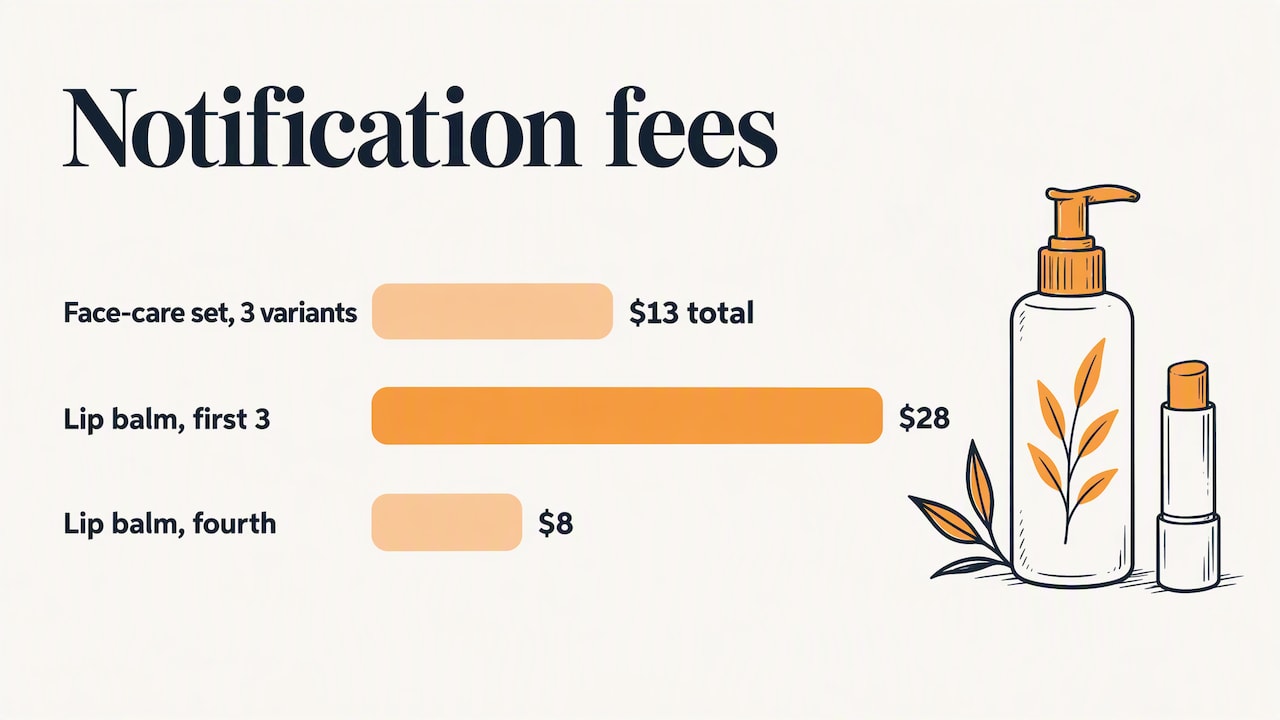
- The fee is $13 for the first 3 variants of most products, or $28 for eye, lip, oral care and certain hair dye products, plus $8 per extra variant.
- Every variant needs its own notification, but different pack sizes of the same variant do not.
- The acknowledgement is not a safety certificate. Formulation, labelling and records are still on you.
- Build the 10-working-day turnaround, and the chance of a clarification request, into your launch timeline.
Table of Contents
- What HSA cosmetic notification actually is
- Who needs to notify, and who does not
- What it costs and how long it takes
- Variants: the part that catches people out
- A step-by-step route to notification
- Labelling and ingredient rules to get right at the same time
- After notification: your ongoing duties
- Where your manufacturer fits in
- Our perspective: plan notification before you lock the formula
- Working with Harmony Skin Lab
- Common mistakes to avoid
- FAQ
- Sources
What HSA cosmetic notification actually is
Cosmetic products in Singapore are regulated under the Health Products (Cosmetic Products – ASEAN Cosmetic Directive) Regulations, a piece of subsidiary legislation under the Health Products Act. Notification is the front door to that system. You tell HSA what the product is, who is placing it on the market and which variants exist, and you pay a small fee. In return you receive an acknowledgement that allows you to supply the product.
There is no pre-market evaluation. According to HSA, notification is an administrative requirement that supports post-market surveillance, and the regulator relies on a risk-based system of sampling, testing and adverse reaction monitoring. That is why the real work sits outside the form: getting the formula right, keeping evidence and labelling correctly.
Notification is not approval
This is the most common misunderstanding we hear from first-time founders. An acknowledgement does not mean HSA has checked your ingredients, your claims or your stability data. HSA describes it as an administrative acknowledgement, and dealers remain legally liable for product safety. Never write “HSA approved” on packaging or in ads. Say “notified with HSA” if you mention it at all, and keep your marketing claims inside what you can back up.
Who needs to notify, and who does not
The person or company placing the product on the Singapore market is the one who notifies. In practice that is a Singapore-based brand owner, importer or distributor. Labels must carry the name and address of the responsible company in Singapore, so the notifying entity and the label should line up.
If you outsource production, the contract manufacturer does not automatically take over your obligations as the brand owner. You agree who prepares the data, who submits and who holds the records, and you write it down in the manufacturing contract.
HSA lists a few cases where notification is not required:
- products used solely as samples for advertising or promotion
- products used for research and development testing
- products made to a medical practitioner’s specifications and supplied only by that practitioner to their own patients
The last point matters to clinics with custom formulations. Even so, exempted products must still meet ingredient safety, labelling and adverse event reporting requirements. Exempt from notification does not mean exempt from the rules.
What it costs and how long it takes
Fees are set per notification and depend on the type of product. The figures below were last updated by HSA on 4 September 2026 and are payable via GIRO or eNETS.
| Product type | First 3 variants | Each further variant |
|---|---|---|
| Products used around the eyes, on the lips, oral/dental care products, and hair dyes containing diamine compounds | $28 | $8 |
| All other cosmetic products | $13 | $8 |
The service standard is 10 working days, counted from completion of the technical assessment or from the application date. The clock stops when HSA asks you for clarification or technical information, and it resumes only when you reply. A brand that answers in two days is on a very different schedule from one that answers in two weeks.
A worked example
Say you are launching a face care range: one cleanser, one toner and one serum, each in a single formulation. That is three variants of products in the “all other” category, so the notification fee is $13 for the set. Now add a lip balm in four flavours. Each flavour is a variant, and lip products sit in the higher bracket, so that is $28 for the first three and $8 for the fourth. The fees are modest. The bigger cost is the time it takes to prepare clean data for every variant.
Always check the HSA fee page before budgeting, because fees and categories can change.
Variants: the part that catches people out
A variant, for notification purposes, is not only a different formula. Even if the formulation is identical across shades of lipstick or scents of a shampoo, each variant requires its own notification. Different pack sizes of the same variant do not need separate notifications.
This changes how you plan a range. A line with five scents and three shades each is 15 variants, not 1. Before you commit to a wide launch, ask whether each variant earns its place. Many of our clients start with a tight core range, notify it and add variants once sales justify them.
A step-by-step route to notification
- Settle the product category and variants. Decide what is a cosmetic and what is not. A product that promises to treat a medical condition may fall under a different regime. If you are unsure, ask HSA before you invest in stock.
- Check every ingredient against the ASEAN Cosmetic Directive. HSA treats the ASEAN Cosmetic Directive as the guiding framework, and expects dealers to know its lists of prohibited and restricted substances. The lists are updated, so check the current version rather than an old formulation sheet.
- Prepare the product information. Gather the name, function, full ingredient list, variants, manufacturer details and the responsible company’s details.
- Submit through HSA’s online system and pay. Choose the right fee bracket for each product type.
- Answer questions quickly. If HSA asks for clarification, the 10-working-day clock pauses until you reply.
- Keep the acknowledgement and your records. You will need them if a product is ever queried.
- Only then supply or sell. Do not take pre-orders for non-notified stock on the assumption that approval will come in time.
The public can also look up notified products through HSA’s product search for cosmetic notifications. It is useful for checking that a supplier’s product is listed, but a listing is still not an endorsement.
Labelling and ingredient rules to get right at the same time
Notification and labelling go together. Labels sold in Singapore must carry the following in English, according to HSA’s published requirements:
- product name and function
- full ingredient list, in descending order by weight (ingredients below 1% can be in any order)
- country of manufacture
- name and address of the responsible company in Singapore
- batch number
- manufacturing or expiry date
A label that is missing any of these is a problem even if the notification went through. Build the artwork brief around this list. If you work with a packaging team, give them the checklist at the start rather than at proof stage. Our packaging design and printing work starts from these requirements for exactly that reason.
Claims are where products get into trouble
HSA has repeatedly warned about products that promise dramatic results. Its public alert on one case advises consumers to be wary of claims such as “super whitening” and “100% safe”, which in the case it describes concealed potent prohibited ingredients, including mercury and hydroquinone. For a legitimate brand, the lesson is simple: keep claims modest, specific and supported by your own testing.
After notification: your ongoing duties
The acknowledgement is the start of your obligations as a dealer, not the end. HSA’s guidance asks dealers to report serious adverse events and to keep supply records for two years, as set out in its published requirements. HSA also publishes an advisory for suppliers of cosmetic products that sets out the supplier’s responsibility to ensure products are safe, of appropriate quality and compliant.
A simple routine keeps you on the right side:
- keep a batch-linked sales log so a recall can be traced
- set up a single inbox and a named person for customer complaints and reactions
- recheck ingredient lists whenever the ASEAN lists change
- renotify when HSA’s rules say a change requires it, and check the notification pages for updating and cancelling
If you ever need to review how regulators document manufacturer problems elsewhere, public inspection data such as FDA inspection records show what a cosmetic facility audit looks at, from complaint handling to record keeping. It is a useful way to think about the records your own supplier chain should be able to produce.
Product liability is a separate matter from notification. If you are scaling, read our note on product liability insurance for cosmetics in Singapore.
Where your manufacturer fits in
Notification is filed by the brand owner, but a good manufacturer makes it much easier. The data HSA asks for comes from the formulation and production records, so a manufacturer that documents batches well saves you days of back and forth.
When you compare manufacturers, ask these questions:
- Will they give you the full ingredient list with concentrations, so you can check it against the ACD lists?
- Do they run stability and quality checks, and can you see the results? See our overview of stability testing and QC.
- Is the facility GMP certified? Our explainer on HSA GMP and skincare manufacturing standards covers what that means in practice.
- Can they label and fill to Singapore requirements in one workflow?
For a wider checklist, see how to choose the right OEM skincare manufacturer.
Our perspective: plan notification before you lock the formula
Most delays we see are not caused by the HSA form. They come from decisions made months earlier. A founder falls for a preservative or an active that turns out to be restricted. A range grows to 20 variants before anyone counts the notification workload. A label is printed before the responsible company’s address is final.
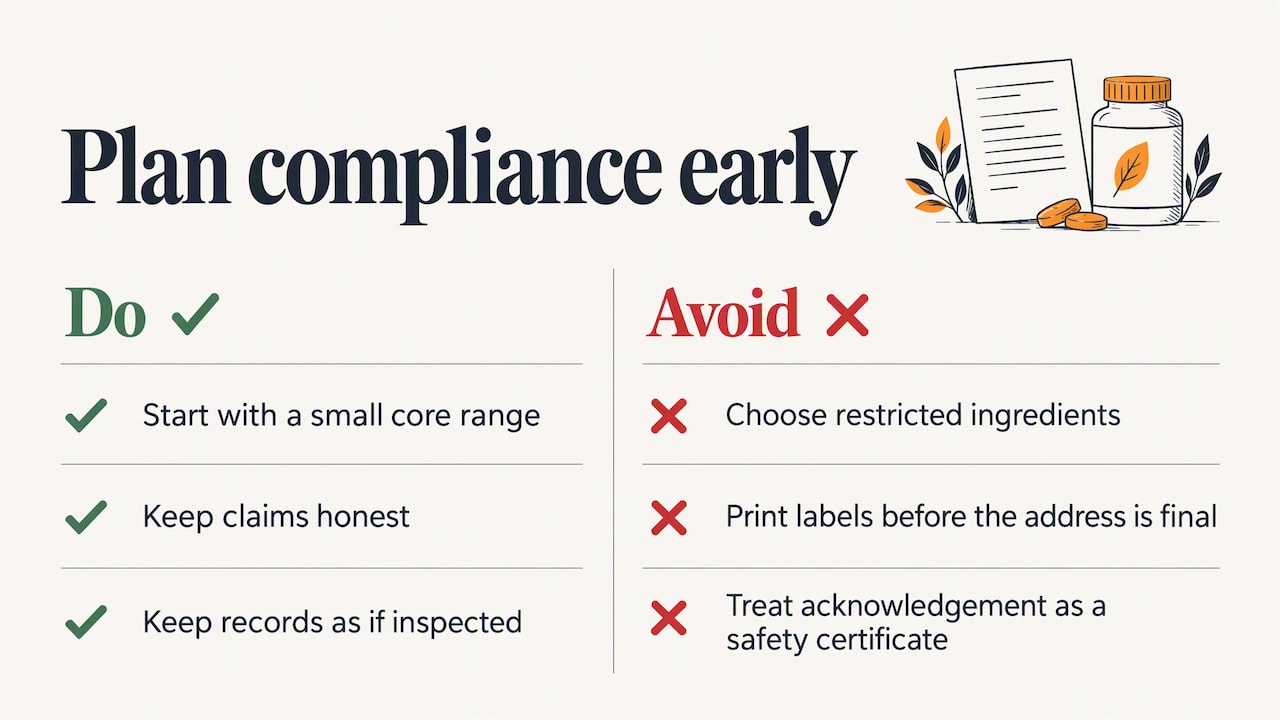
Our approach is to put compliance in the brief on day one. We work with clients on the formulation, then check ingredients against the ASEAN Cosmetic Directive lists, and then move to packaging and filling with the label requirements already in hand. As a Singapore manufacturer with GMP certification from HSA, we see the regulator’s expectations as design constraints, not paperwork at the end.
The advice we give every new brand is the same. Start with a small core range. Keep claims honest. Keep records as if an inspector will read them tomorrow. And never confuse the acknowledgement with a safety certificate, because customers, retailers and regulators will not.
— Edmund
Working with Harmony Skin Lab
If you are launching a private label, salon or clinic line in Singapore, we can take you from concept to finished, labelled product. Our services cover R&D, custom formulation, quality control, packaging and filling, and our ranges include home-use essentials, professional salon skincare and doctor’s formulations. See our services or read the seven steps to launch private label cosmetics in Singapore to see how notification fits into a launch timeline.
Common mistakes to avoid
- Treating the acknowledgement as approval. It is not, and you carry the liability.
- Forgetting variants. Every shade and scent needs its own notification.
- Ignoring the stop-clock. Slow replies to HSA queries push back your launch date.
- Using a foreign label. Singapore requires English information and a responsible company address in Singapore.
- Assuming exemptions are broad. Samples, R&D and practitioner-supplied products are exempt from notification, but not from safety, labelling or adverse event rules.
- Relying on old ingredient lists. Restricted substance lists get updated.
FAQ
Is HSA cosmetic notification the same as HSA approval?
No. Notification is an administrative step that lets HSA keep track of products on the market. HSA does not evaluate cosmetics for safety or quality before sale, so you remain responsible for the product being safe and compliant.
How much does it cost to notify a cosmetic product in Singapore?
As of HSA’s fee page updated on 4 September 2026, the fee is $13 for the first 3 variants of most products and $28 for eye, lip, oral care and certain hair dye products. Each further variant costs $8. Fees are paid through GIRO or eNETS.
How long does notification take?
HSA’s service standard is 10 working days. The clock pauses if HSA asks for clarification, and resumes once you provide it, so quick replies keep your timeline intact.
Do I need a separate notification for each size or shade?
Each shade, scent or other variant needs its own notification, even if the formulation is the same. Different pack sizes of the same variant do not.
How can I check whether a product has been notified?
Use HSA’s public search for cosmetic product notifications. A listing shows that a product has been notified, but it does not mean HSA has endorsed its quality or efficacy.
Sources
- Regulatory overview of cosmetic products, HSA
- Submit notification and re-notification, HSA
- Cosmetic product notification, HSA
- Fees and turnaround time, HSA
- ASEAN Cosmetic Directive, HSA
- How cosmetic products are regulated by HSA
- HSA alert on Meiyong cosmetic products
- Search by Product, Cosmetic Product Notification, HSA
- FDA inspection records