
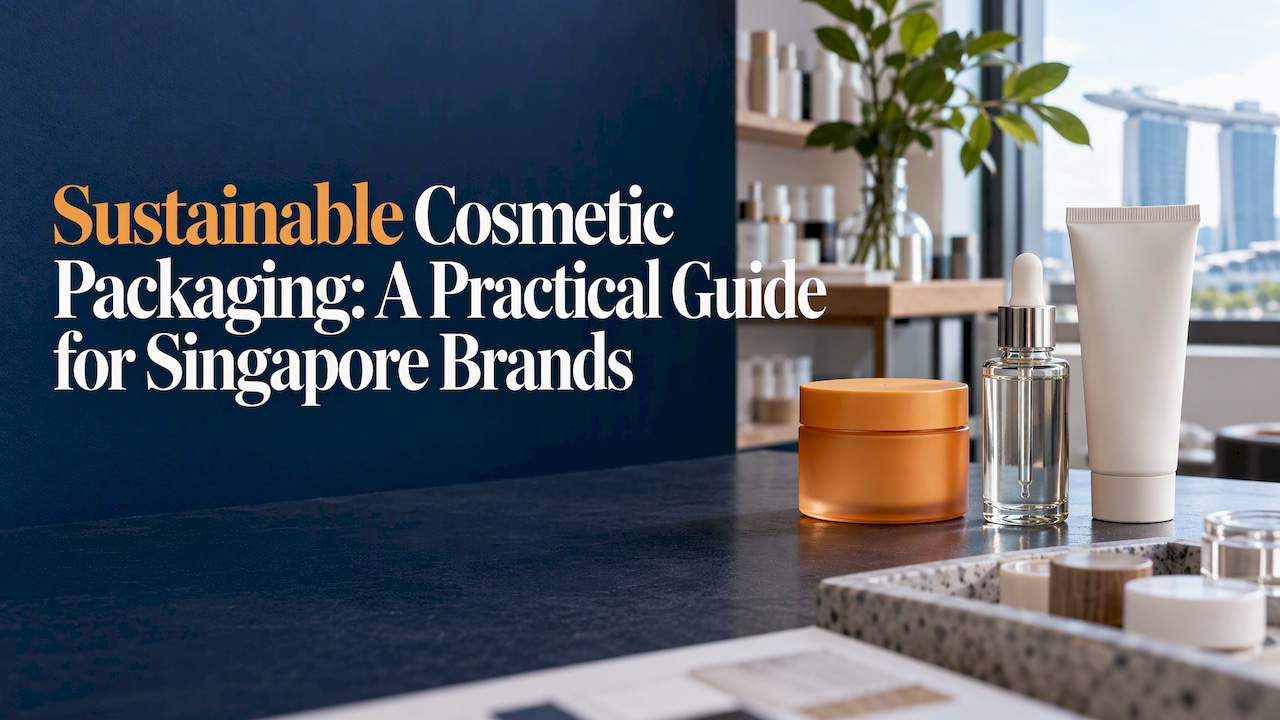
Sustainable cosmetic packaging means using less material, choosing formats that can be reused or recycled where you sell, and proving that the pack protects the formula. It does not mean the most “natural”-looking jar. For a Singapore skincare brand, the best choice is usually the one that cuts total environmental impact, survives stability testing and fits the rules you may face under the Resource Sustainability Act.
This guide is for founders, salon owners and clinic professionals who are about to commit to a pack. We cover materials, refills, biodegradable options, the Singapore reporting rules and a step-by-step way to decide.
TL;DR
- Start with less: reducing material and adding recycled content cut impact more than most material swaps. A life cycle study found 100% recycled content can reduce a pack’s overall impact by 42 to 60%.
- Glass is not automatically greener. Weight and manufacturing can push its footprint above that of recycled plastic, so compare options on a life-cycle basis.
- Refills work when they save the customer money as well as waste. In one survey cited in Singapore, cost-saving drove refill choices more than the environment did.
- Singapore companies with annual turnover above S$10 million must report packaging to NEA each year, with a 3R plan. Smaller brands should still collect the data early.
- Test any new pack with your formula before you order it in volume. Sustainable packaging that fails stability testing is waste.
Table of Contents
- What “sustainable” should mean for a skincare pack
- Materials compared: glass, plastic, metal, paper and bio-based
- Refillable packaging: when it works and when it does not
- Singapore rules that touch your packaging
- Sustainable packaging does not excuse skipping the tests
- How to choose: a five-step decision path
- Our perspective: sustainability starts in the formula brief
- Working with us on your pack
- FAQ
- Sources
What “sustainable” should mean for a skincare pack
Most pages on this topic list nine or ten ideas and leave you to guess which matters. The research points to a short hierarchy.
- Dematerialise. Use less material for the same protection: thinner walls, smaller secondary cartons, no unnecessary outer box.
- Add recycled content. The same multi-attribute life cycle assessment reports that 100% recycled material can lower overall packaging impact by 42 to 60%, and that cutting manufacturing energy by 50% adds a further 7 to 13% reduction.
- Design for recycling or refilling. A single-material pack is easier to sort and recycle than a jar with a metal collar, a plastic liner and a foil seal.
- Only then consider novelties. Edible films and nanotechnology-enhanced biopolymers are emerging, but a recent review cautions that they are still being optimised for product stability in cosmetics. A new brand is better served by the established pillars first.
The common thread is life-cycle thinking: design, production, transport and end of life. Swapping one material for another can quietly move the problem from one category to another. Singapore’s National Environment Agency (NEA) has published Technical Reference 109 (TR 109), which sets out guidelines and best practices for applying the 3Rs (Reduce, Reuse, Recycle) to business-to-business and business-to-consumer packaging.
Materials compared: glass, plastic, metal, paper and bio-based
No material wins everywhere. What matters is the product, the weight, the recycling route and the barrier the formula needs.
| Material | Where it works | Watch out for |
|---|---|---|
| Recycled plastic (PET, PP, HDPE) | Tubes, bottles, jars, pumps for creams, serums, cleansers | Needs a clear single-material design to be recyclable; check the formula does not react with it |
| Glass | Premium serums, oils, essential oils | Weight raises transport emissions; breakage in transit; heavier manufacturing footprint |
| Aluminium | Tubes, tins, pump cans | Linings and mixed components can complicate recycling |
| Paper and board | Cartons, sleeves, inserts | Choose it for secondary packaging; it is rarely a primary barrier for water-based formulas |
| Bio-based or biodegradable polymers | Selected rinse-off and low-risk products | Stability with the formula, and whether local facilities can actually process them |
Why polypropylene often surprises people
In the life cycle study above, polypropylene (PP) showed the lowest environmental impact among the fossil-based polymers in most scenarios, by an average of 46%. That does not make it the right pack for every formula, but it shows why a blanket rule such as “avoid plastic” can mislead.
The glass myth
Glass feels sustainable because it feels solid and is recyclable in principle. It is also heavy and energy-intensive to make. Aesop, which sells skincare in Singapore, explains on its sustainability page how its minimalist bottles and tubes are an ethos, not only an aesthetic. The lesson for your own brand: write down why you chose a material, with numbers if you can, rather than following what looks green.
Biodegradable and compostable claims
Biodegradable packaging is a popular search, but it carries the most risk. The material may only break down in industrial composting conditions, and those conditions may not be available to your customer in Singapore. Research is moving: a 2025 paper in Scientific Reports describes a fully bio-based composite for cosmetic packaging, and an earlier review of future perspectives notes that consumer concern about plastic waste is pushing the sector towards bio-based and biodegradable materials. Both are signs of direction, not a ready answer for a launch next quarter. If you use a biodegradable pack, ask for evidence that it is compatible with your formula and be specific about where it can be disposed of.
Refillable packaging: when it works and when it does not
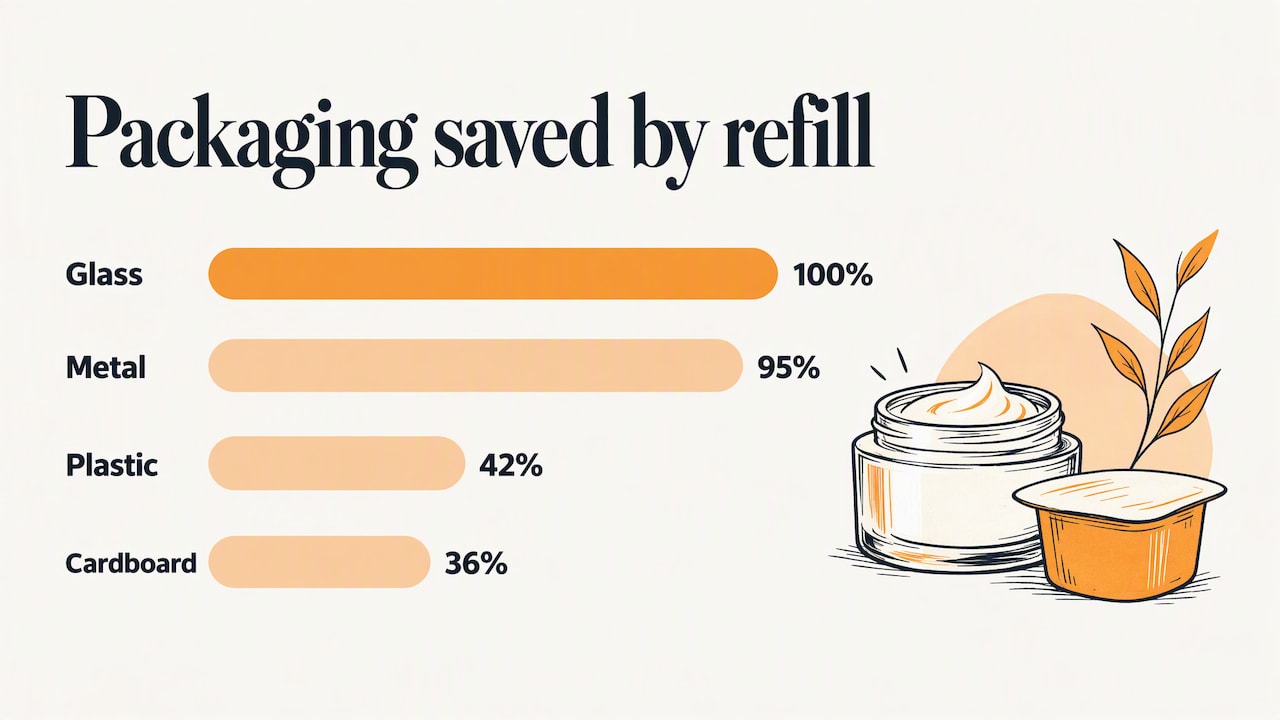
Refills are the most visible sustainable format in beauty. A report on L’Oréal’s refill programme gives a clear example: a Lancôme Absolue Longevity cream refill can save 100% of the glass, 95% of the metal, 42% of the plastic and 36% of the cardboard compared with buying a new full jar. The same article says L’Oréal has expanded its refill offerings 3.7-fold across its portfolio since 2019.
The more useful number for a small brand is the motive. Of the consumers surveyed, 87% cited cost savings as the reason to choose refills, ahead of 68% who cited environmental impact. So a refill only works commercially when:
- the refill is clearly cheaper than a full pack;
- the outer container is attractive enough that customers want to keep it;
- refilling is easy (a pod or pouch that clicks in beats a messy decant);
- the formula is stable in both the outer jar and the refill format.
For professional use, refills make sense in a different way. A salon or clinic that buys a large-volume back-bar format and decants into small treatment dispensers uses less packaging per treatment. Sachets suit sampling and travel, where you want a trial size without a full jar; our page on sachet packaging and filling services in Singapore explains how they are filled.
Singapore rules that touch your packaging
This is the part most global articles miss. Under the Resource Sustainability Act 2019, companies whose annual turnover exceeds S$10 million fall under the Mandatory Packaging Reporting (MPR) scheme. The Packaging Reporting Regulations set out the details:
- Obligated producers report annually, by 31 March, on the packaging of the preceding year.
- The report covers the weight and form of specified packaging (plastic, paper, metal and glass) that the company uses or imports.
- A 3R plan accompanies the report, with a completion timeline of no later than three years.
- Records are kept for five years.
The regulations also list packaging that is excluded from the definition of specified packaging. Do not assume your pack is in or out because it is reusable or because you are small. Read the exclusions and the NEA guidebook on Mandatory Packaging Reporting, and confirm with NEA if your case is not clear. NEA also publishes a simplified guide for assessing whether your company is required to comply.
Most new skincare brands are far below S$10 million, so the scheme will not apply on day one. The practical advice is still to record packaging material, weight and format for every SKU from the start. Reporting is far easier when your data is clean before you grow into the threshold, and the same data lets you make sustainability claims you can defend.
Sustainable packaging does not excuse skipping the tests
The fastest way to turn a sustainable pack into waste is to launch without testing. A new material can interact with oils, surfactants, fragrance or preservatives. The risks include discolouration, leaching, pump failure, odour change and loss of potency over shelf life.
Before you commit to volume:
- Share your formula and pack specification with the lab early. Our page on packaging compatibility testing sets out what labs need from you.
- Run stability testing in the final pack, not only in a glass lab jar. See why stability testing matters and our stability testing and QC services.
- Check the filling line. A lightweight bottle or an unusual closure can change how it fills and caps. Our guide to cosmetic filling services covers what to confirm.
- Confirm the claim. If your label says recyclable or refillable, be able to explain how and where.
How to choose: a five-step decision path
- Define the product and its risk. A water-based serum, an anhydrous balm and a massage oil need different barriers.
- Reduce first. Ask whether you need the outer carton, the insert or the extra cap.
- Pick one primary material and keep the pack mono-material where possible. Fewer components make recycling realistic.
- Ask for recycled content, and ask the supplier for documentation instead of a logo.
- Decide on refill or sample formats only if the customer economics work.
For the commercial side of the decision, see our guides on how to choose skincare packaging and eight packaging options for Singapore brands.
Our perspective: sustainability starts in the formula brief
We are an OEM/ODM skincare manufacturer in Singapore, and the packaging conversations we find most productive happen at the formulation stage, not after it. A formula and a pack are one system. If you pick an elegant refillable jar after the formula is approved, you may discover the oil phase attacks the gasket or the pump cannot handle the viscosity. Then the choice is a reformulation or a compromised pack.
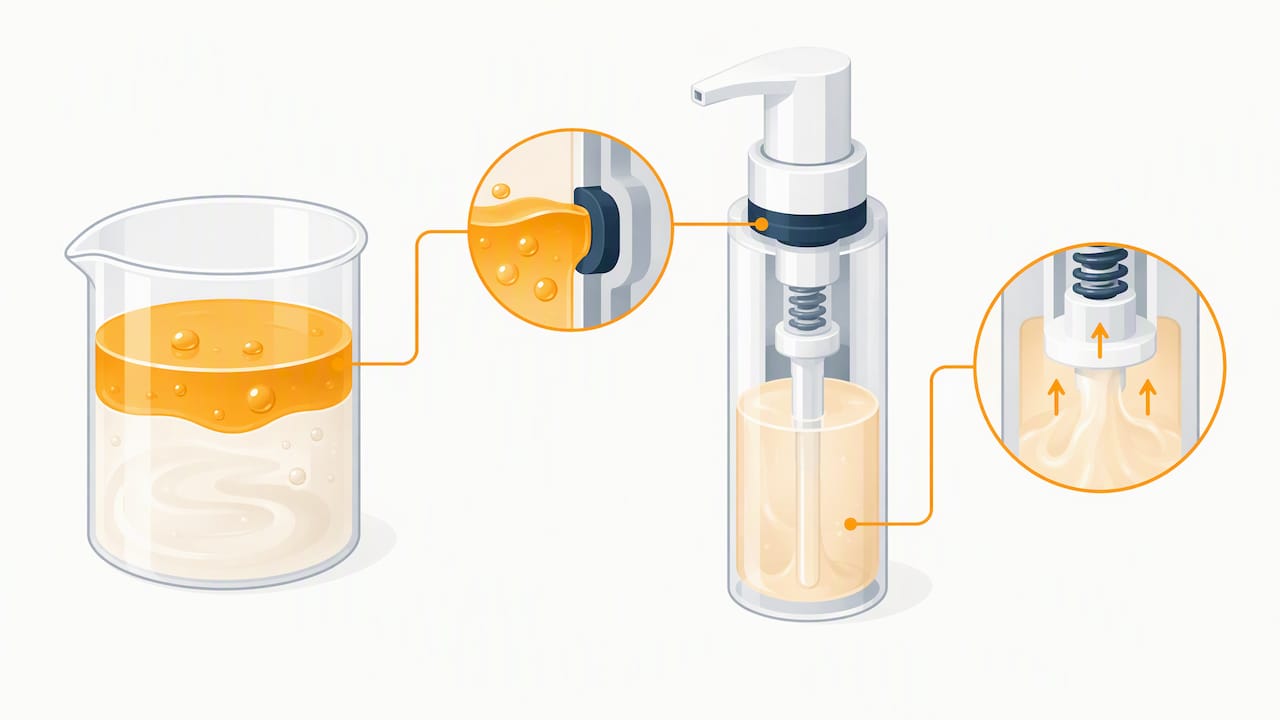
We work with clients collaboratively, and our R&D, design, packaging and quality control sit under one roof. That lets us raise packaging questions early: does this formula need an airless pump, or would a simpler mono-material tube protect it just as well? Our HSA GMP certification means the production steps around the pack are documented and controlled, which is what a brand needs when it later wants to substantiate its claims.
Our honest advice to new brands is to resist chasing the most novel material. Choose a well-understood pack, use less of it, and spend your effort on testing and on telling customers truthfully what to do with it at end of life. A small, clear claim you can prove builds more trust than a large green one you cannot.
— Edmund
Working with us on your pack
If you are planning a private label, salon or clinic range and want packaging considered alongside the formula, our R&D, manufacturing, design and packaging services cover the full path from concept to filled product. For design and print, see our skincare packaging design and printing services. Starting small? Read about low MOQ skincare manufacturing, or follow our seven steps to launch private label cosmetics in Singapore.
FAQ
Is glass or plastic more sustainable for skincare?
Neither wins by default. Glass is heavy and energy-intensive to produce, so its footprint can exceed that of recycled plastic, as Aesop’s sustainability page discusses in relation to its own choices. Compare options on weight, recycled content, recyclability and the protection your formula needs.
Do I have to report my packaging to NEA?
Only if your company meets the criteria in the Resource Sustainability Act, which include annual turnover above S$10 million. If you do, the report is due by 31 March for the preceding year, with a 3R plan. Check the NEA guidebook or contact NEA if you are unsure.
Is biodegradable packaging a safe choice for a new brand?
It carries more uncertainty than established options. Newer materials are still being optimised for stability in cosmetics, according to a recent review, so test the pack with your formula and be precise about how it should be disposed of.
Are refillable cosmetics worth it for a small brand?
They can be, if the refill is cheaper for the customer and easy to use. The L’Oréal refill report shows that cost savings motivate more shoppers than environmental benefit. Make sure the formula is stable in both formats before you launch.
Sources
- Resource Sustainability (Packaging Reporting) Regulations 2020, Singapore Statutes Online
- NEA Guidebook on the Mandatory Packaging Reporting
- NEA simplified guide to Mandatory Packaging Reporting
- NEA: New Technical Reference to guide companies on sustainable packaging practices
- Reducing the Environmental Impacts of Plastic Cosmetic Packaging: A Multi-Attribute Life Cycle Assessment
- a+ Singapore: With Refills, L’Oréal Makes Sustainable Beauty More Desirable
- Sustainability at Aesop Singapore
- Review of new generation packaging, ScienceDirect
- A novel fully biobased material composite for cosmetic packaging applications, Scientific Reports
- Cosmetic Packaging to Save the Environment: Future Perspectives