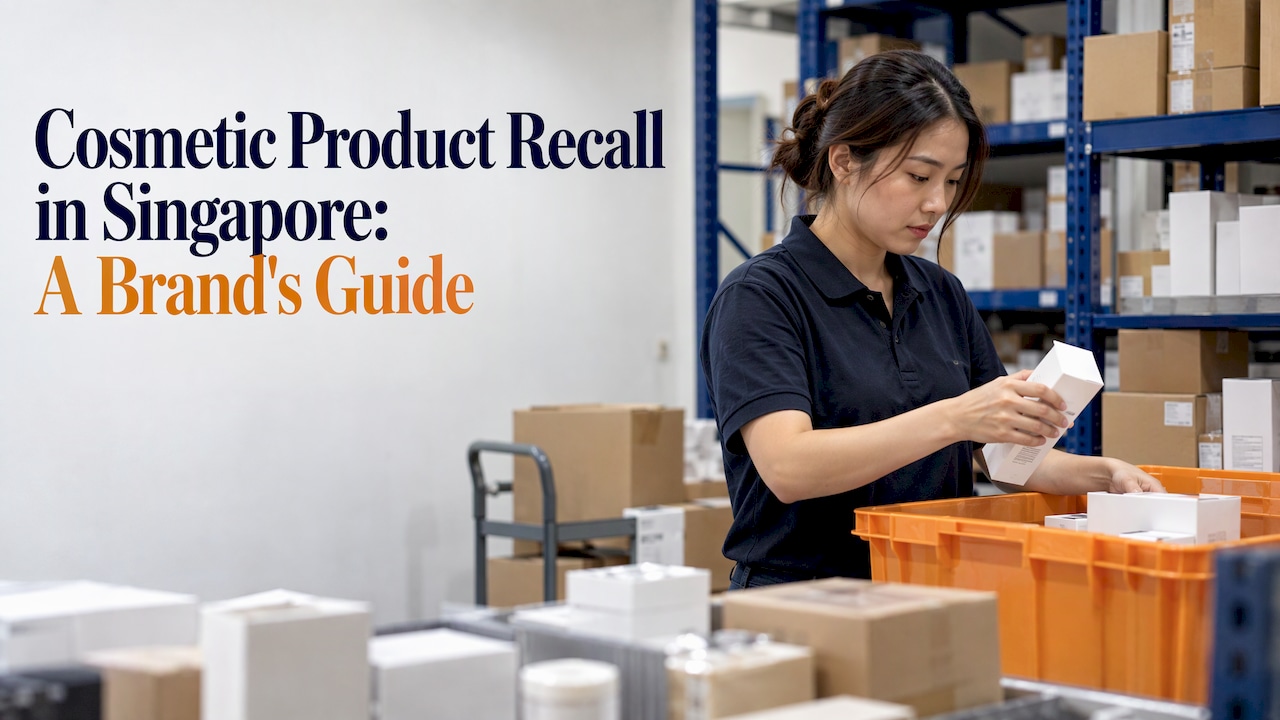
If you sell skincare in Singapore, a cosmetic product recall is a regulated process, not just a PR problem: you must tell the Health Sciences Authority (HSA) before it starts, contact every customer you supplied, and prove the stock came back. The best protection is a product that is formulated, tested and labelled correctly before it ships, which is why the choice of manufacturer matters as much as the recall plan itself. This guide explains how recalls work in Singapore, what they demand of you, and where they are usually prevented.
TL;DR
- A recall can be started by the company or requested by HSA, and it does not always mean the product is unsafe: it can also remove quality defects.
- You must notify HSA of a cosmetic recall and its reasons at least 24 hours before it begins (Sundays and public holidays excluded).
- You need supply records, a customer list and a ready letter to purchasers, so build them before you ever need them.
- Most recalls trace back to ingredients, contamination, labelling or batch quality, all of which are controlled at formulation and production stage.
- Choose a GMP-certified manufacturer that tests and documents each batch, so a problem is caught at the factory and not on a shelf.
Table of Contents
- What a cosmetic product recall actually is
- Why skincare products get recalled
- What the law asks of your business
- How an HSA-supervised recall runs, step by step
- Adverse reactions: when a customer complaint becomes a regulatory matter
- Prevention starts at the formulation bench
- Where Harmony Skin Lab fits
- Our perspective
- FAQ
- Sources
What a cosmetic product recall actually is
In Singapore, HSA regulates cosmetics as part of health products. Its recall announcements explain that a recall may be carried out on the company’s own initiative or at HSA’s request to remove products with quality, safety or efficacy issues. The same page makes a point many founders miss: a recall does not necessarily mean the product is unsafe, because it can also pull a quality defect that does not affect safety.
Recalls come in levels. HSA’s notice for one eyelash serum, for example, lists a Class 2 recall at retail level, with all batches affected. Retail and wholesale suppliers were told to stop supplying the product and return remaining stock to the company. That is the practical shape of a recall: stop selling, stop distributing, collect, and report.
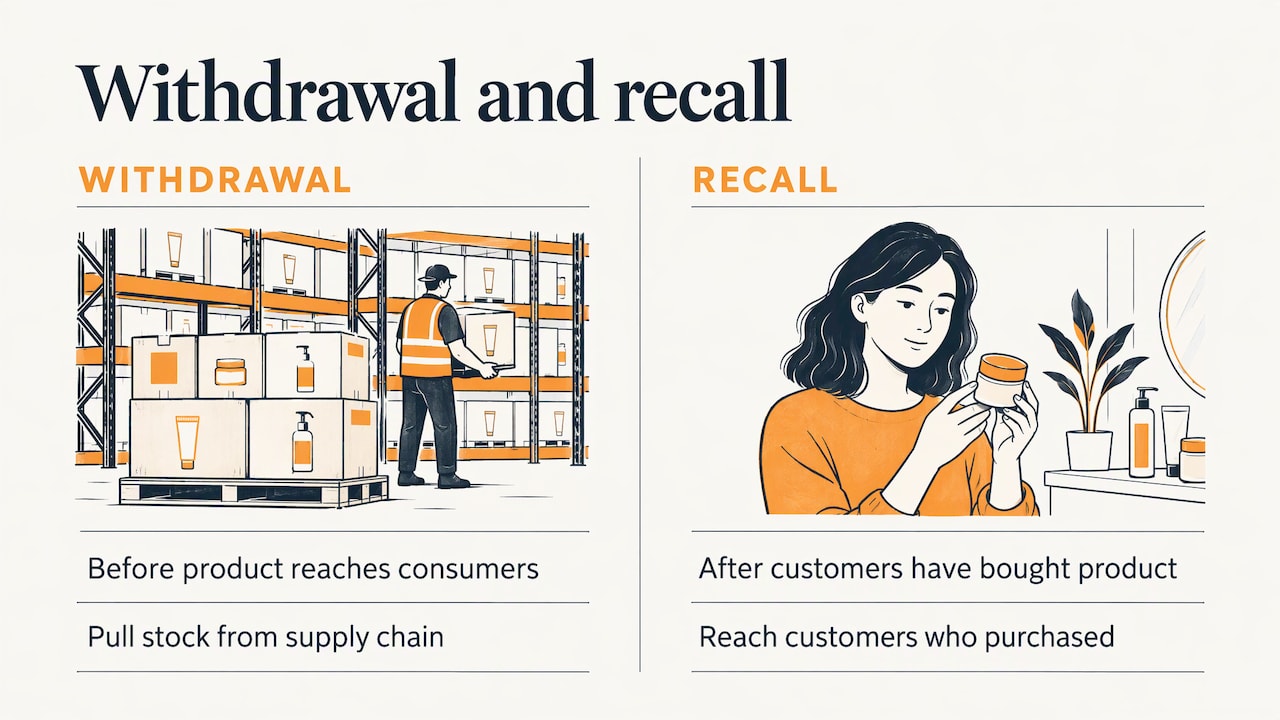
You may also hear “withdrawal”. In everyday use it means pulling stock from the supply chain before it reaches consumers, while a recall reaches customers who have already bought. Which one applies depends on risk and how widely the product has been sold. In Singapore, treat any decision to pull a product on health grounds as something to discuss with HSA straight away rather than to settle internally.
Why skincare products get recalled
The reasons fall into a few groups, and nearly all of them start long before a product reaches a customer:
- Prohibited or over-limit ingredients. Singapore follows the ASEAN Cosmetic Directive framework, which bans some substances outright and caps others. Our guide to the ASEAN Cosmetic Directive covers how this affects brands.
- Microbial contamination. Water-based creams, toners and serums are the most exposed when preservation or hygiene in production is weak.
- Labelling errors. Missing ingredients, wrong batch details or an absent local company name can trigger action.
- Batch defects. Separation, discolouration or a texture change tied to one production run.
- Patterns of harm. Several customers reporting rashes or burns from the same product.
A recent Singapore example
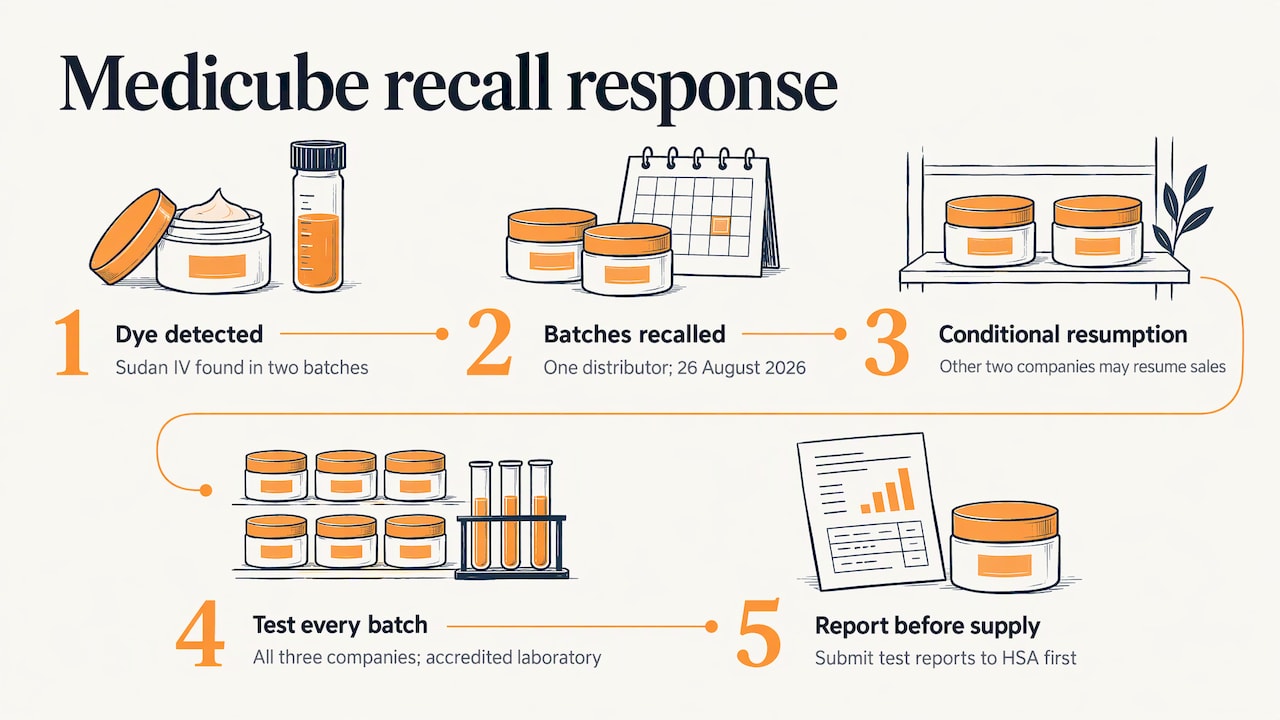
The Medicube PDRN Pink Collagen Capsule Cream case in 2026 shows how fast this moves. HSA detected small amounts of the prohibited dye Sudan IV in two batches sold by one distributor, and those batches were recalled on 26 August 2026. Sales by the other two companies marketing the cream were allowed to resume, but all three must now have every batch tested by an accredited laboratory for Sudan Red dyes and submit the reports to HSA before supplying.
Two lessons apply to any brand. First, a problem in one batch can bring conditions on every company selling the product. Second, HSA said the amounts were unlikely to pose serious health risks from previous use, yet the product was still recalled, because a prohibited ingredient has no permitted level. Sudan Red dyes are prohibited in Singapore cosmetics because of potential carcinogenic and allergenic effects.
What the law asks of your business
HSA’s rules sit on top of the Health Products (Cosmetic Products – ASEAN Cosmetic Directive) Regulations 2007, which were most recently amended with effect from 1 December 2025. Always check the current text on Singapore Statutes Online, since amendments have come in several recent years.
The duties that matter most in a recall:
| Duty | What it means | Source |
|---|---|---|
| Notify HSA of a recall | Manufacturer, importer or supplier must report the recall and its reasons no later than 24 hours (excluding Sundays and public holidays) before it starts; failure can mean a fine of up to S$20,000 and/or up to 12 months’ imprisonment | Pharma To Market summary of HSA guidance |
| Report serious adverse effects | Death or life-threatening effects within 7 days of becoming aware; hospitalisation within 15 days | SingaporeLegalAdvice.com |
| Keep supply records | Two years from each supply: product name and notification number, date, recipient, quantity and identifying details; breach can mean a fine of up to S$10,000 and/or up to 6 months’ jail | SingaporeLegalAdvice.com |
| Stop supply of risky products | Stop selling or withdraw any product suspected to pose a health risk | HSA |
HSA also requires cosmetic firms to notify products before sale, to label them in English with ingredients, country of manufacture, batch number, a manufacturing or expiry date where shelf life is under 30 months, and the Singapore company’s name and address. A product notification is not HSA approval or endorsement, which means responsibility for safety stays with the company. Our practical guide to HSA cosmetic notification walks through that step.
The 24-hour window is not only paperwork. It gives HSA time to review and comment on your recall strategy, so treat the call as collaboration and not just a form. HSA also runs post-market surveillance: risk-based sampling and testing of products on the market, plus adverse reaction monitoring through healthcare professionals. When it finds a concern, companies must remove unsafe products and the public is alerted.
This article is general guidance for brands. For a live recall, speak to HSA directly and take legal advice on your exposure.
How an HSA-supervised recall runs, step by step
HSA sets out its procedure on its recall products page. In plain order, it looks like this.
- Contain and identify. Stop supply of the product. Establish which batches are affected using batch numbers on your packaging and production records. Brands with clean batch coding can often narrow a recall to one run; those without may have to recall everything.
- Notify HSA. Report the recall and the reasons at least 24 hours before it starts. Have the product name, notification details, batch numbers, quantities supplied and the defect described clearly.
- Compile your customer list. HSA expects a list of the customers you supplied in electronic spreadsheet format. This is where good supply records pay off.
- Send the Dear Purchaser Letter. It states the brand, affected batch number, a product image, the reason for the recall, the recall level, what the recipient must do (remove from sale, stop distributing, return the product), the refund mechanism and a signed return response card.
- Collect and reconcile. Track what was delivered against what came back. HSA asks for a Product Recall Completion Form with that reconciliation.
- Destroy and certify. A certificate of destruction is submitted within three months of the recall’s completion.
- Fix before you resume. HSA requires corrective actions for the defect and preventive actions against recurrence. Quarantined stock can be released only with HSA’s concurrence once there is no safety risk or the corrective actions have addressed it.
The weakest points are almost always step 1 and step 3. Unclear batch coding and patchy distributor records turn a contained recall into a broad, expensive one.
Adverse reactions: when a customer complaint becomes a regulatory matter
A recall often begins with a complaint. Treat a pattern of similar reports, such as the same smell change or the same rash from the same batch, as a signal, not as isolated noise. A simple internal routine helps:
- Log every complaint with product name, batch number, purchase channel and symptoms.
- Ask the customer to stop using the product, keep it and see a doctor if they are unwell. In Singapore, consumers can also contact HSA at hsa_info@hsa.gov.sg and should preserve evidence such as photos and medical reports.
- Check whether the severity triggers the 7-day or 15-day reporting deadlines above.
- Compare the batch against retained samples and production records.
The legal commentary on the 2007 Regulations notes that the duty to report defects and adverse effects moves the regulatory focus from pre-market compliance to ongoing post-market monitoring. In other words, launching compliantly is only the start.
Prevention starts at the formulation bench
Most of the recall causes above can be designed out. Consider where each one is controlled:
| Recall cause | Where it is prevented |
|---|---|
| Prohibited or over-limit ingredient | Ingredient selection and screening at formulation. See cosmetic ingredient safety for Singapore brands |
| Contamination, separation, colour or smell change | Preservation design, stability testing and hygienic production. See stability testing and QC |
| Wrong or missing label information | Artwork checked against HSA labelling rules before print. See packaging design and printing |
| Wide, untraceable recall | Batch coding and records. See cosmetic SDS requirements for the documentation brands need |
| Counterfeit or grey-market product | Packaging that is hard to copy. See anti-counterfeit packaging |
The counterfeit and grey-market point matters more than it looks. HSA advised consumers in the Medicube case to buy from reputable retailers with an established presence in Singapore, so that there is recourse if problems arise. A brand with traceable batches and secure packaging is easier to defend and easier to recall cleanly.
Questions to put to any manufacturer
If you are launching a private label, salon or clinic line, ask your manufacturer these before signing:
- Is the facility GMP certified, and by whom? Our overview of HSA GMP and skincare manufacturing standards explains what to look for.
- Who checks each formula against Singapore’s prohibited and restricted ingredient lists?
- Which stability and quality tests are run, and are results shared with you?
- How are batches coded and records kept, so a problem can be traced to one run?
- Who prepares the information you need for notification?
Our longer piece on how to choose an OEM skincare manufacturer and the list of nine questions before choosing a skincare manufacturer go deeper on each.
Where Harmony Skin Lab fits
Harmony Skin Lab is a Singapore OEM/ODM skincare manufacturer with GMP certification from HSA. We cover product design, customised formulation, quality control, R&D and packaging in one place, for private label brands, salon lines and doctor’s formulations. Because formulation, QC and packaging sit with one collaborating team, the checks that prevent a recall (ingredients, stability, labels) are part of the same project and not handed between separate suppliers.
If you are planning a launch and want recall risk reduced from day one, see our R&D, manufacturing and packaging services.
For clinics, our aesthetic skincare products are built for professional use, and the skincare launch roadmap shows where each compliance check sits in the timeline.
Our perspective
We see a recall as a documentation and design problem long before it is a logistics problem. When a brand can show which ingredients were chosen and why, which tests a formula passed and which batch a unit came from, a difficult day stays manageable.
That is why our approach is built on collaboration with the client during R&D. We want the brand owner, the salon or the doctor to understand the formula, the label and the quality checks behind it, not just receive finished bottles.
Our GMP certification from HSA reflects how we want every project run: controlled processes, quality control and records. If you are weighing manufacturers, ask where formulation, testing and packaging happen and who is accountable for each. Our view is that one team handling them together gives a brand the clearest picture of its own product.
Edmund
FAQ
Who can start a cosmetic product recall in Singapore?
The company can start a recall on its own initiative, or HSA can request one. Either way, the manufacturer, importer or supplier must notify HSA of the recall and its reasons at least 24 hours before it begins, excluding Sundays and public holidays.
Does a recall mean the product is dangerous?
Not always. HSA states that a recall can address quality defects that do not affect safety or efficacy. Where a banned ingredient such as a Sudan Red dye is found, the product is recalled even when the amounts are small, because no level is permitted.
How long must I keep supply records?
Sellers and suppliers in Singapore must keep supply records for two years from each supply. They include the product name and notification number, the supply date, the recipient’s name and address, the quantity and identifying details of the product.
Can I resume sales after a recall?
Only after corrective actions address the defect and preventive actions reduce the chance of recurrence. Quarantined stock can be released with HSA’s concurrence once there is no safety risk or the corrective actions have resolved it. HSA may also add conditions, such as batch-by-batch laboratory testing, as it did in the 2026 Medicube case.
What should a customer do if a cosmetic causes a reaction?
Stop using it, see a doctor and bring the product, and keep photos and medical reports. They can also contact HSA by email at hsa_info@hsa.gov.sg. Brands should log the complaint with its batch number straight away.
Sources
- HSA recall announcement: Cavilla eyelash serum
- AsiaOne: Medicube PDRN Pink Collagen Capsule Cream sale to resume
- Singapore Statutes Online: Health Products (Cosmetic Products – ASEAN Cosmetic Directive) Regulations 2007
- Pharma To Market: HSA cosmetic products guidance on recalls
- SingaporeLegalAdvice.com: How cosmetic products are regulated in Singapore
- HSA: How cosmetic products are regulated
- HSA: Recall products
- Legal Wires: Health Products (Cosmetic Products) Regulations 2007