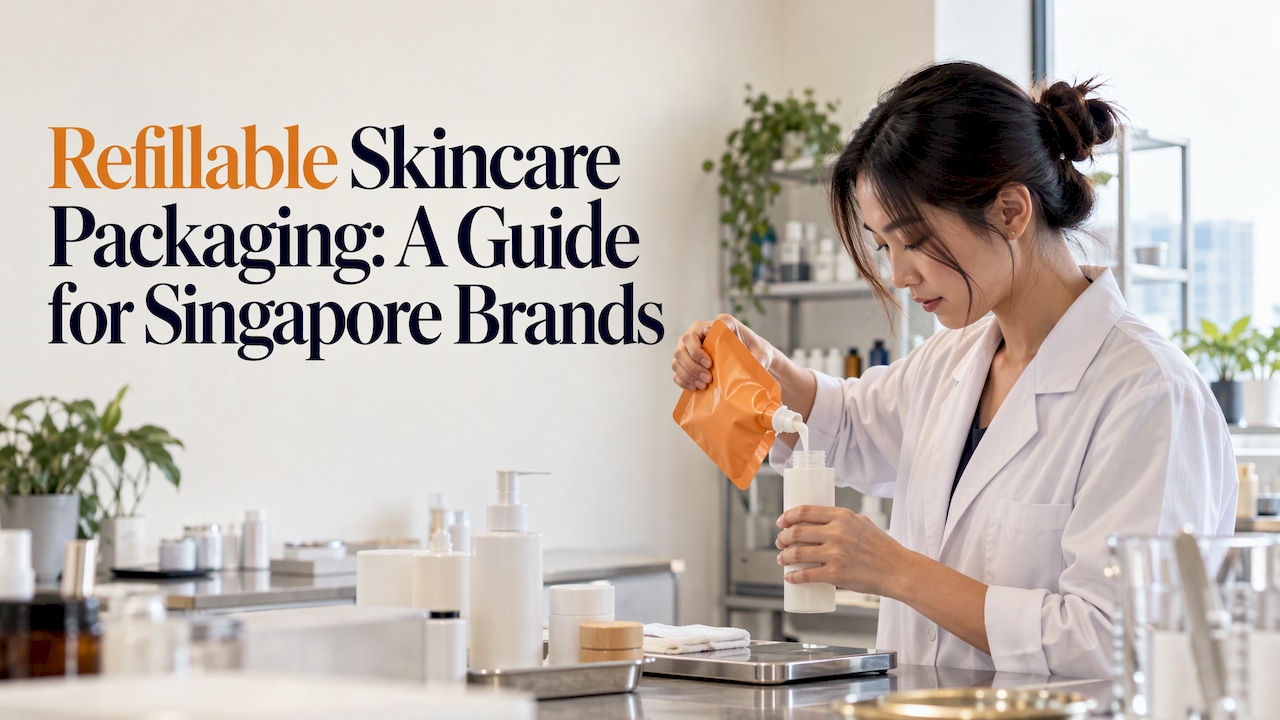
Refillable skincare packaging lets a customer keep the original container and top it up with a new refill, so far less plastic, glass and metal is used per purchase. For a brand, it only works when the formula, the refill format and the filling process are chosen together, before the artwork is approved. This guide covers the formats, the evidence behind the waste claims, the hygiene and stability checks, and the Singapore rules that apply.
TL;DR
- Refillable means the customer replenishes the contents of the original pack. Reusable and replaceable are different things, so use the terms precisely on pack and in marketing.
- Four formats cover most skincare: pour-in refills, refill jars or inner cups, refillable airless bottles and airless refill pouches. Match the format to the texture and the actives.
- Refilling changes the safety picture. Contamination risk, preservative performance and material compatibility need to be assessed, not assumed.
- In Singapore, cosmetics fall under HSA, and packaging data may need reporting to NEA. Environmental claims need evidence behind them.
- Decide the refill system with your manufacturer at the formulation stage, not after the jar has been designed.
Table of Contents
- What refillable skincare packaging actually means
- The four refill formats and what suits each
- What the evidence says about waste reduction
- Formula compatibility, protection and hygiene
- Design and customer experience before launch
- Singapore rules that touch refillable packaging
- Sourcing and manufacturing: what to settle with your manufacturer
- Our perspective
- Plan your refillable range with Harmony Skin Lab
- FAQ
- Sources
What refillable skincare packaging actually means
Three terms get mixed up on websites and on pack, and the difference matters when you write claims.
- Refillable: the customer replenishes the product inside the original container. Packaging technologist Dan Coppins, quoted by Good On You, describes it as a pack that allows the consumer to replenish the contents of the original packaging.
- Reloadable or replaceable: an inner component, such as a cartridge or pod, is swapped while the outer shell stays. In practice this is how many premium creams and serums work.
- Reusable: the container is used again, perhaps for something else entirely, such as a glass jar kept for storage. This is not a refill system.
The model changes the business as well as the pack. The customer keeps the primary packaging, so the outer container has to look good and work well for many months, while the refill has to be light, cheap to ship and easy to use.
The four refill formats and what suits each
Most refillable skincare falls into four formats. The right one depends on the product texture, how sensitive the actives are to air and light, and what experience you want the customer to have.
| Format | How it works | Usually suits |
|---|---|---|
| Pour-in refill | A pouch or bottle is emptied into the original container | Cleansers, body care and other rinse-off products |
| Refill jar or inner cup | A rigid inner jar is swapped inside a reusable outer jar | Creams and balms |
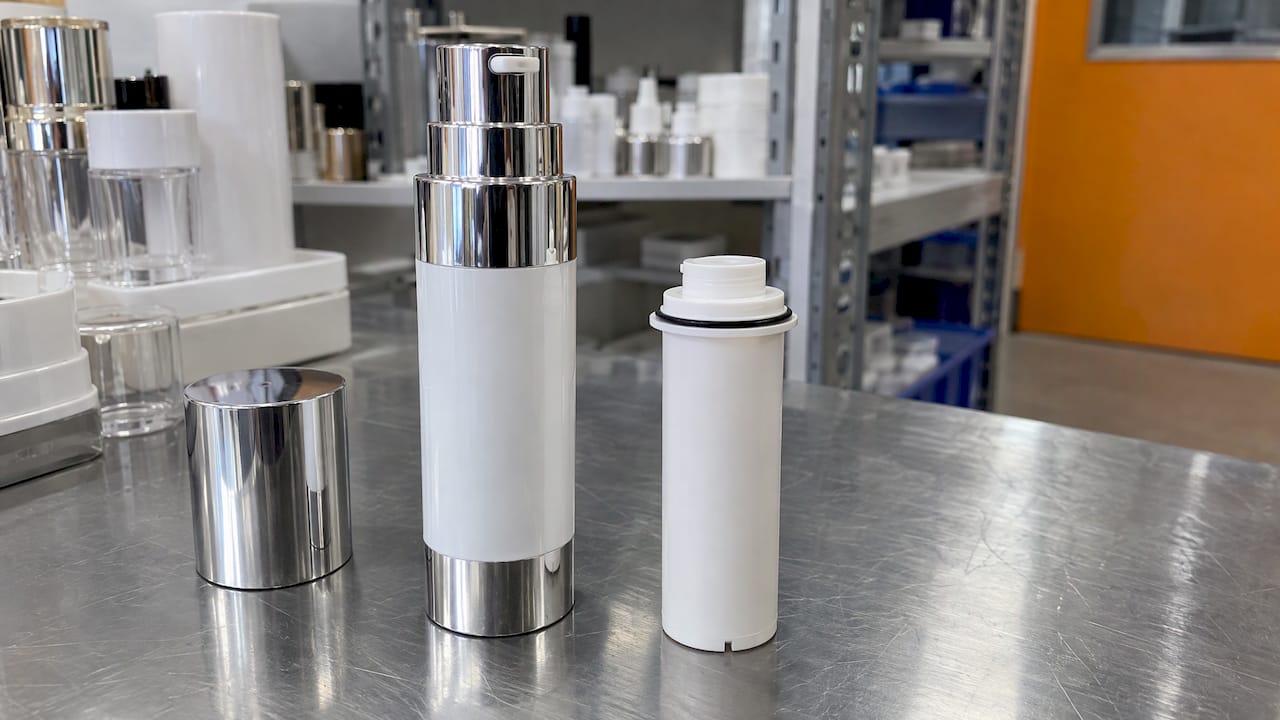
| Refillable airless bottle | A rigid inner cartridge is swapped inside an outer shell | Serums and fluid textures |
| Airless refill pouch | A flexible pouch with a spout is attached or decanted | Serums, lotions, gels, creams and sunscreen |
This grouping follows a comparison of cosmetic refill systems published in 2026. Treat it as a starting point rather than a rule: your own formula and filling line decide what is practical.
Pour-in refills
The simplest route. The customer opens the original bottle and pours in the refill. It suits products used quickly and products that are not very sensitive to air. The weakness is hygiene at the point of transfer, which is why clear consumer instructions and a pouch with a controlled spout matter.
Refill jars and inner cups
Creams are the classic jar product, and jars carry the heaviest packaging per gram of product. Swapping only an inner cup keeps the weighty outer jar in use. The inner cup is sealed at the factory, which protects the formula until the customer opens it.
Airless bottles and cartridges
Airless systems limit exposure to air and are often chosen for serums and treatment products with sensitive actives. A refill cartridge clicks into a reusable outer. Think about whether the cartridge can be recycled in a single material stream, because mixed construction undermines the benefit.
Airless refill pouches
Pouches are the lightest option and ship efficiently. One caution from Dan Coppins, again reported by Good On You: multi-laminate pouches can be hard to recycle. If you choose a pouch, ask about the film structure and be careful about what you say on pack regarding recyclability.
What the evidence says about waste reduction
Refills reduce packaging mass per purchase, and brands operating in Singapore now publish figures you can see for yourself.
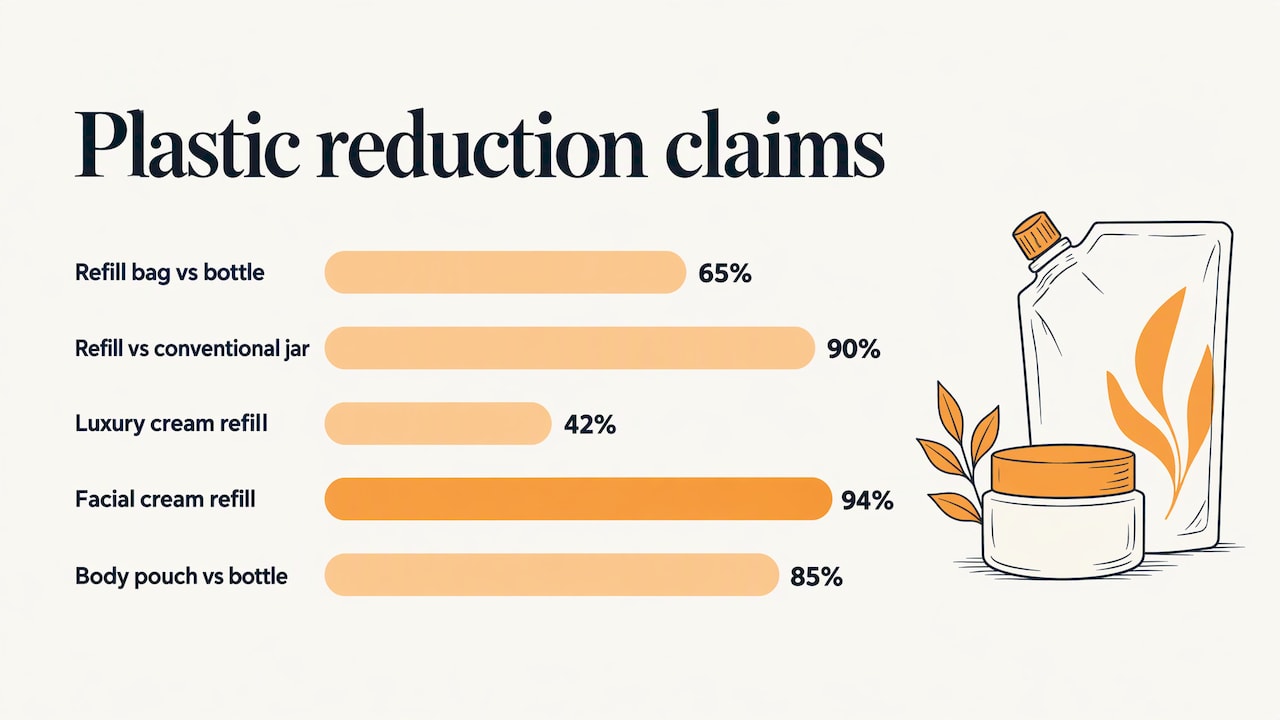
- A dermatology skincare brand reports on its Singapore sustainability page that its refill bags result in 65% less plastic waste than a standard 400 ml bottle, and that its newer refill jar uses 90% less plastic than the conventional jar.
- In a 2026 report on L’Oréal’s refill programme in Singapore, a refill of a luxury cream is said to reduce 100% of glass, 95% of metal, 42% of plastic and 36% of cardboard compared with a fresh jar, while a facial cream refill is said to save 94% of plastic.
- A 2024 Good On You explainer cites a body-care brand’s claim that its eco-refill pouches use 85% less plastic than single-use bottles.
These are the brands’ own figures, each measured against a particular baseline pack. Your numbers will differ, so measure your own refill against your own original. The Pact Collective sourcing guide calls reuse and refill models the gold standard for beauty packaging, and says a Life Cycle Assessment is the most comprehensive way to compare designs, though it can be costly and slow. Even a simplified weight comparison of pack components, before and after, gives you a defensible starting point.
The benefit also depends on behaviour. The chief sustainability officer of L’Oréal’s region noted in the same a+ Singapore piece that refills only make a difference if people choose them consistently. Design the refill to be the easy default: cheaper, simple to use and visibly worth it.
Supply chain choices count as well. Refills need to be stored, handled and distributed with care, and sustainable supply chain practices in warehousing and transport affect how much of the packaging benefit survives the journey to the customer.
Formula compatibility, protection and hygiene
This is where refillable projects succeed or fail. A refill system puts the formula in contact with new materials and, in some designs, with the customer’s hands and containers.
Safety and contamination
Cosmetics Europe guidance on refillable products advises the person responsible for the product to assess how refilling affects product safety, consider contamination risks, prepare a hygiene concept for the whole refill system, and define hygienic and microbial quality management with a microbiologist in line with cosmetic GMP. It is European guidance, but the reasoning applies to any market.
The same document makes two points worth knowing:
- If a refillable container is washed and sanitised, the water introduced may affect the formula’s microbial susceptibility, and the preservative level may need to increase.
- Containers that previously held non-cosmetic products may leach substances and are not recommended for refilling with cosmetics.
Tests to ask for
When you specify a refill system with your manufacturer, build the following into the development plan:
- Compatibility testing: confirms the packaging does not react with the formula.
- Migration testing: checks that packaging materials do not release substances into the product.
- Stability testing: appearance, odour, pH and key actives over time, including under heat and humidity.
- Challenge testing: confirms the preservative system keeps working after repeated handling and opening.
- Dispenser and closure checks: repeated actuation, leakage, torque and seal integrity.
- Light exposure testing, for formulas with light-sensitive actives.
The Cosmetics Assessment guide to refillable packaging lists compatibility, migration, microbiological stability, challenge testing and toxicological assessment as items the safety assessor should cover for both the formula and the refill packaging. Run tests on production-quality packaging, not hand-made lab samples, so the results reflect what customers will receive.
Protecting the actives
Material choice is a formulation decision. One Singapore skincare brand explains on its sustainability page that it balances formulation compatibility, global compliance and circular systems, using amber glass to protect botanical actives from UV light. The lesson for your project: pick the refill material after you know how sensitive your formula is to light, air and temperature, not before.
Design and customer experience before launch
The technical system can be perfect and still fail if customers find refilling awkward or unrewarding. Before you lock the design, work through these points.
- Make the outer pack worth keeping. The customer will look at it for months. Weight, finish and a reliable dispenser tell them it is a keeper, not a throwaway.
- Keep the refill obviously good value. A refill that costs almost as much as a full product gives no reason to switch. Decide the price gap with your own costs in view.
- Make the action simple. Pouring, clicking or twisting should be obvious in one try. Put a short illustrated instruction on the refill and on your site.
- Match refill and outer. A refill that does not fit the outer, or looks like a different product, creates returns and complaints. Keep tolerances tight and label the refill clearly with product name, batch and expiry.
- Plan for hygiene in use. Tell customers whether to wash the outer, whether to let it dry, and not to top up a partly used pack with an old product.
- Decide what you will claim. Refill figures should compare like with like. A 2026 packaging industry article advises that statements match the real pack construction, refill method and available evidence, and that terms like zero waste or guaranteed sustainable are avoided without substantiation.
For wider packaging decisions, our guides on how to choose skincare packaging and skincare packaging options for Singapore brands compare the alternatives, and our sustainable cosmetic packaging guide puts refills in context with other material choices.
Singapore rules that touch refillable packaging
Refillable packaging does not sit outside the normal rules. Several apply at once.
Cosmetics regulation (HSA)
Cosmetic products supplied in Singapore must comply with the Health Products Act and the ASEAN Cosmetic Directive regulations. According to the HSA regulatory overview, a cosmetic product notification usually needs to be submitted before sale. Check HSA’s page for the exceptions and current guidance. Your refill SKU is a product in its own right, so confirm with your regulatory contact how the refill and the original should be notified and labelled.
Packaging reporting (NEA)
Under the Resource Sustainability Act, the Mandatory Packaging Reporting scheme requires businesses supplying regulated goods in Singapore, above an annual turnover of S$10 million, that import or use specified packaging to submit packaging data and 3R plans (reduce, reuse, recycle) to NEA each year. Reporting runs on a yearly window, so check NEA for the current dates. The Packaging Reporting Regulations 2020 also state that the end-user reuse exclusion does not apply to packaging for cosmetic products, so do not assume that refillable packaging falls outside reporting. If you are close to the threshold or unsure, ask NEA or your adviser.
Green labelling
If you want third-party recognition, the Singapore Green Labelling Scheme has a standard for cosmetic products covering restricted chemicals, biodegradability and packaging. The scheme lists a new certification fee of S$3,500 and a two-year certificate validity. Confirm current terms with the scheme before budgeting.
Sourcing and manufacturing: what to settle with your manufacturer
A refill system touches formulation, filling and packaging, which is why we prefer to plan them together. Settle these before artwork is approved:
- The formula and its sensitivities: viscosity, preservative system, light and air sensitivity.
- The refill format from the table above, and the reason for choosing it.
- The filling route: how pouches, cartridges or jars are filled, sealed and capped, and at what speed and temperature.
- The test plan: compatibility, migration, stability and challenge testing on production-quality packaging.
- Minimum order quantities for the outer pack and the refill, since they will not be used at the same rate.
- Labelling: ingredient list, batch code, net contents and manufacturer details on both outer and refill.
- Distribution: how refills ship and are stored.
Singapore is a compact market with strong retail and salon channels, so plan early for how refills will reach customers: online, in salons, in clinics or in store.
Our perspective
We see refills succeed when the brand treats them as a product development project, not a packaging add-on. The formula, the pack and the filling process all have to agree with each other.
Our approach starts from the formula. We work with you on the formulation and the research behind it, then look at which pack protects it best. A cream, a serum and a cleanser each point to a different refill format, and a salon-size product has different needs from a home-use one.
We would rather agree the hygiene, stability and labelling plan at the start than fix it after launch. As a GMP-certified Singapore manufacturer, our quality control sits alongside design and packaging, so the questions in this article get answered in one conversation rather than across several suppliers.
Refills also give a brand something lasting. A customer who keeps your outer pack and returns for refills is building a routine with you.
Edmund
Plan your refillable range with Harmony Skin Lab
Harmony Skin Lab is an OEM/ODM skincare manufacturer in Singapore. We handle custom formulation, R&D, quality control, design and packaging for private label, salon and medical skincare lines, so your refill system can be planned alongside the formula from the first brief.
To discuss a refillable line, see our manufacturing and packaging services or read how we approach skincare packaging design and printing in Singapore.
FAQ
Is refillable packaging the same as reusable packaging?
No. Refillable packaging is designed to be filled again with new product, while reusable packaging is used again for the same or another purpose, such as a jar kept for storage. A replaceable pack swaps one part, such as a pump head. Keep the terms separate on pack and in marketing.
Which refill format works best for creams and serums?
Creams and balms usually suit refill jars or inner cups, because a sealed rigid insert is swapped inside a reusable outer jar. Serums often suit airless cartridges or airless pouches, which limit air exposure. Your manufacturer should confirm the choice through compatibility and stability testing on your actual formula.
Does refillable skincare need special safety testing?
Refilling adds contamination and material-contact risks, so the assessment should cover both formula and packaging. Typical checks include compatibility, migration, microbiological stability and preservative challenge testing. Cosmetics Europe guidance also recommends a hygiene concept for the whole refill system, developed with a microbiologist.
Do I need to notify HSA for a refill product in Singapore?
A cosmetic product notification usually needs to be submitted before a cosmetic product is sold in Singapore, as set out on the HSA website. Check with HSA or your regulatory contact how your refill and original should be handled, as the answer depends on your products.
Can I say my refill is sustainable on pack?
Only with evidence that matches your actual pack. State what you can measure, such as the reduction in plastic weight against your own original, and avoid absolute phrases such as zero waste. Keep the supporting data on file.
Sources
- Refillable Packaging, Explained (Good On You)
- Choosing a Cosmetic Refill System (BOTTLESS)
- Packaging sustainability (Eucerin Singapore)
- With Refills, L’Oréal Makes Sustainable Beauty More Accessible (a+ Singapore)
- Guide: Sourcing smart packaging and materials (Pact Collective)
- Sustainable supply chain practices in medical warehousing
- Cosmetic Products that are Refillable at Points of Sale (Cosmetics Europe)
- EU PPWR Refillable Cosmetic Packaging (Cosmetics Assessment)
- Sustainability (Aesop Singapore)
- Refillable Cosmetic Packaging: 9 Smart Ways to Avoid Waste (STCUSTM)
- Regulatory overview of cosmetic products (HSA)
- Mandatory Packaging Reporting (NEA)
- Resource Sustainability (Packaging Reporting) Regulations 2020
- Personal Care Products (Singapore Green Labelling Scheme)