
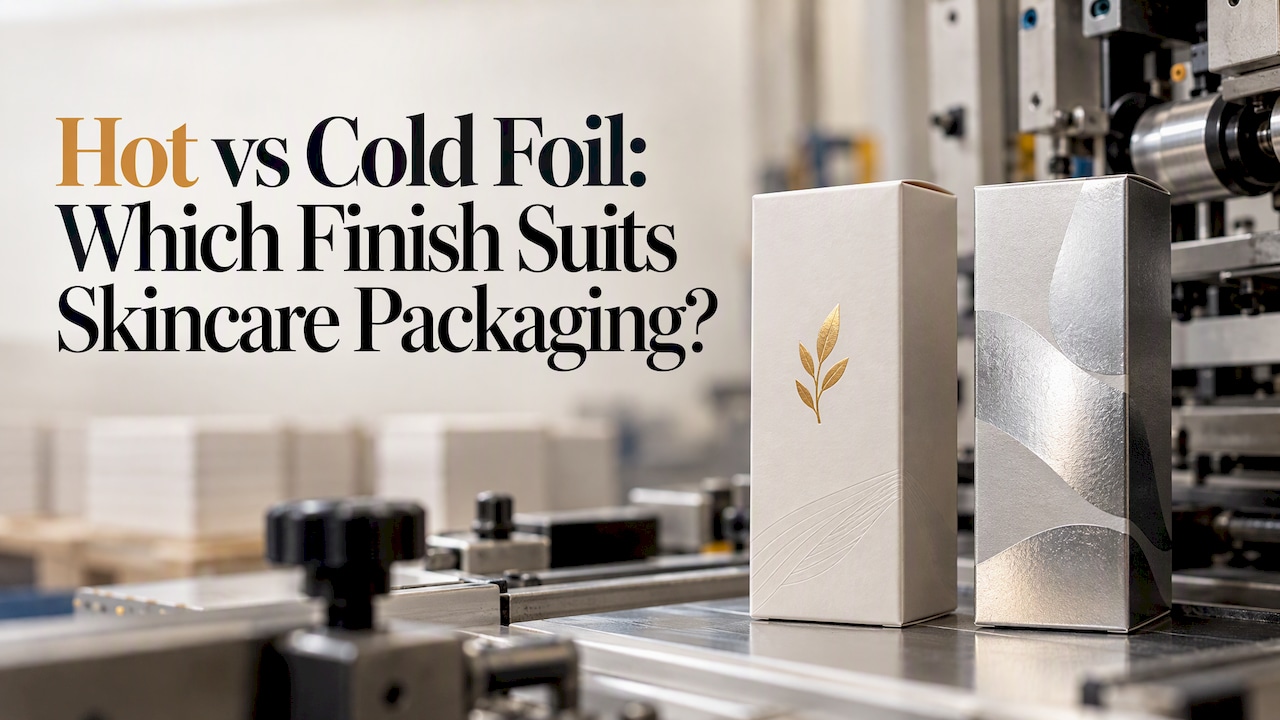
Hot foil gives a dense, tactile metallic finish and works on a wide range of stocks, but it needs a metal die. Cold foil is applied in line with printing using adhesive, so it suits larger runs, fine detail and metallic colour effects on smooth, coated board. For a skincare brand, the choice usually comes down to four things: run size, substrate, how much you want the foil to be felt, and budget. This guide explains how each process works, where they differ, and how to brief your packaging so the foil you choose behaves well on a carton or label.
TL;DR
- Hot foil uses a heated metal die and pressure to transfer foil. It looks richest, can be combined with embossing, and handles textured and uncoated stocks.
- Cold foil prints a UV-curable adhesive, presses foil onto it and strips the excess. It runs in line with printing, copes with fine detail and can create gradients.
- Hot foil carries tooling cost, so it is least attractive for very short runs. Cold foil avoids dies, but needs smooth, coated substrates.
- Decide on run size, substrate, tactile effect and budget, then ask your printer for a proof on your actual material before committing.
- Test the foiled pack with your formula. Oils, alcohol and fragrance can affect inks and coatings.
Table of Contents
- What hot foil is and how it works
- What cold foil is and how it works
- Hot foil vs cold foil at a glance
- Finish and feel: what your customer will notice
- Cost and run size
- Materials and artwork rules
- Foil on skincare packaging: what is different
- How to choose: a simple decision path
- Perspective: foil is a late decision, not a first one
- Where Harmony Skin Lab fits in
- Sourcing foil work in Singapore
- FAQ
- Sources
What hot foil is and how it works
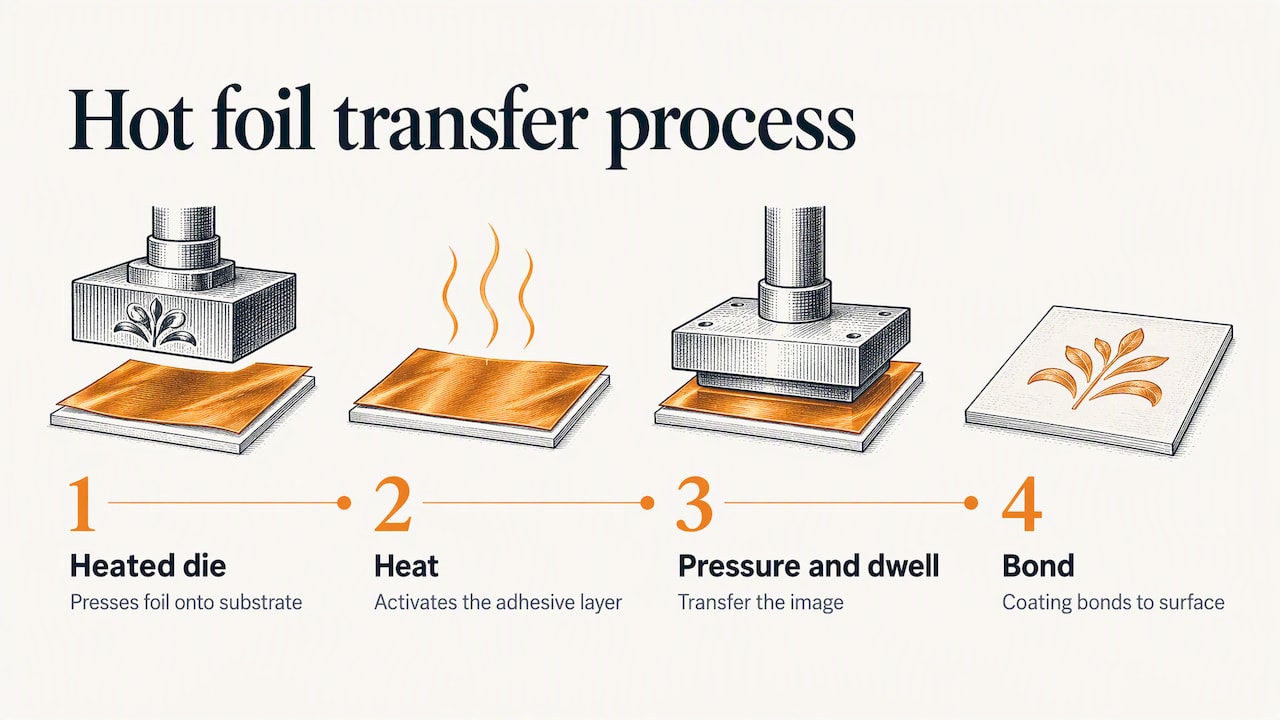
Hot foil, also called hot foil stamping or simply foil stamping, is a dry decorative technique. A heated engraved die presses a thin metallic or pigmented foil onto the substrate. Heat activates the foil’s adhesive layer, while pressure and dwell time transfer the image, leaving the coating bonded to the surface.
A typical hot-foiling unit has a controlled heating system, a flat or rotary die, and an impression platen or anvil cylinder. Even temperature and even pressure across the whole image matter for consistent results, according to the same Labels & Labeling guide to foil stamping. That is why a good converter spends time on make-ready: the die, the foil grade and the board must all agree.
Hot foil can produce gold, silver and other coloured, patterned or special-effect finishes. It is used to create reflective, opaque, high-density images, which is why it reads as “premium” on a cosmetic carton. Because the die can be made with relief, hot foil can also be combined with embossing so the logo is both shiny and raised.
The flip side is the die. Traditional hot foiling requires a die, which has to be made for each artwork. A new logo, a new variant name or a regulatory text change on the foiled area means a new die.
What cold foil is and how it works
Cold foil needs no heat and no metal die. The adhesive is printed only where foil is required, the process can run in line with the press, and it can create halftone metallic effects. In practice the sequence is:
- A UV-curable adhesive is printed in the shape of the foiled area.
- A foil web is pressed against the adhesive.
- UV light cures the adhesive so the foil bonds.
- The excess foil is stripped away.
Because the adhesive is printed like an ink, fine lines and small type are easier to hold than with a die. The foil can also be overprinted with process colours, so a single metallic layer can become a copper, a rose gold or a gradient without separate foils. That flexibility is the main reason cold foil has become common on labels and folding cartons.
The limit is the surface. Cold foil relies on consistent adhesive transfer, so it performs best on smooth, coated board and film. Rough, porous or heavily textured stock can make adhesion patchy. Qualify the material first, then print.
Hot foil vs cold foil at a glance
| Factor | Hot foil | Cold foil |
|---|---|---|
| How foil transfers | Heated metal die and pressure | UV adhesive printed, foil pressed on, excess stripped |
| Tooling | Custom die for each design | No metal die; adhesive is printed from the plate or digital file |
| Look | Dense, mirror-like metallic, can be embossed | Flatter metallic, good for detail, halftones and colour effects |
| Feel | Tactile, often with slight impression | Mostly flat to the touch |
| Substrates | Wide range, including textured and uncoated stocks | Best on smooth, coated substrates |
| Production | Often a separate pass, can be in line | In line with the printing run |
| Best for | Short to mid runs where feel and shine matter | Medium to large runs, fine detail, multi-colour metallic |
Treat the table as a starting point. Press configuration, foil grade and board all change the outcome, so the same logo can look noticeably different between two converters.
Finish and feel: what your customer will notice
Hold a hot-foiled carton and you often feel it: the foil sits slightly into or above the board, the edges are crisp and the metal looks like a mirror. This is why hot stamping on product labels is associated with a tactile, reflective finish that signals premium quality. For a serum box or a clinic-grade line, that physical cue does a lot of the brand’s talking before anyone reads a word.
Cold foil looks bright but behaves more like a printed ink. You will see it most clearly when the design asks for:
- fine line patterns or small serif type in metal;
- a gradient from silver into a colour, or a foil that appears in several tints;
- foil covering a large area, such as a full-bleed pattern across a sachet or wrap.
Neither is better in the abstract. A minimalist brand with a single small logo often looks best in hot foil. A brand with a pattern-led, colourful pack often looks best in cold foil.
Cost and run size
The cost logic follows from the tooling. Hot foil carries a one-off die charge, so the cost per pack falls as the run grows. Cold foil removes that charge and moves cost into adhesive, foil consumption and press time, so it tends to be more economical once volumes are medium to large, especially where the foil covers a wide area.
For a young brand, this matters more than the finish. A first batch of a few hundred or a couple of thousand cartons may bear the full die cost on a small number of units. Ask your printer for quotes at two or three quantities, with the die cost shown separately, so you can see the break-even point for yourself. Do not compare only the per-unit price at the largest quantity.
There are two ways to soften the cost of a first run:
- Reuse the same logo die across several SKUs, rather than putting variant names in foil.
- Keep variable text, such as shade, size or batch information, in normal ink, so a single die serves the whole range.
Our own pre-production checklist for printing boxes covers the wider point: lock the formula, claims and artwork before you commit to tooling, because changes after the die is cut are the expensive ones.
Materials and artwork rules
The foil is only as good as the surface under it. Results depend on matching the foil formulation and release characteristics to the substrate, while controlling die temperature, pressure, press speed and foil tension, as the foil stamping guide from Labels & Labeling explains. For cold foil, the adhesive system and the surface tension of the board are equally critical, so ask for a trial on the real material.
Some practical artwork rules that apply to both processes:
- Keep foil elements bold enough. Hairlines and tiny reversed type are risky, especially in hot foil.
- Allow for registration tolerance. Foil is applied separately from the printed colours, so plan for a small shift of around half a millimetre to one millimetre. Avoid foil sitting tightly against a printed edge, or use a slight overlap, so gaps and halos do not appear.
- Separate foil artwork from the rest. Supply the foiled elements as a dedicated spot layer so the printer can build the die or adhesive plate correctly.
- Mind the board. Soft-touch laminate, heavy texture and some varnishes can stop foil sticking. Tell the printer about every coating before the proof.
- Think about the fold. Foil across a crease can crack on certain boards, so keep large foiled areas away from score lines where possible.
Foil on skincare packaging: what is different
A skincare pack is not a name card. It sits in a bathroom, gets touched with wet or oily hands, and sits next to a formula that may contain oils, solvents or fragrance. Three things follow.
Rub and moisture resistance. A foiled outer carton is rarely touched with product. A foiled label on a bottle or jar is another matter. Ask the printer how the foil is protected, for example with an overprint varnish, and test the label against your actual formula.
Compatibility. Inks, adhesives, coatings and the container itself can react with the product. The foil is one layer in that stack. Our guide to packaging compatibility testing for cosmetics sets out what a lab needs from you before it can judge a pack.
Market positioning. Demand for premium packaging is growing in the region. One market report notes that the expansion of luxury beauty segments in developing Asia-Pacific markets is driving incremental demand for foil-stamped packaging. If your competitors on the shelf already use metallic accents, foil is no longer a differentiator on its own. The design, the finish combination and the formula behind it matter more.
We also see brands overuse foil. A single small foiled mark on a clean carton often looks more expensive than foil across every panel.
How to choose: a simple decision path
Work through these questions in order.
- What is the first run? Under a few thousand units, hot foil’s die cost weighs heavily, so consider limiting foil to one small logo. Over several thousand, ask for cold foil quotes too.
- What is the substrate? Uncoated, textured or recycled board points to hot foil. Smooth coated board or film opens up cold foil.
- Do you want to feel it? If a raised, pressed, embossed logo is part of the brief, choose hot foil.
- Is it a detail or colour piece? Fine patterns, gradients and multi-tint metallics point to cold foil.
- Is the design stable? If you expect to change names, claims or variants soon, minimise foil or keep it to a stable logo.
- Does your sustainability brief limit options? Foil can complicate recycling on some formats, so check it against your end-of-life goals. Our guide to sustainable cosmetic packaging covers the trade-offs.
If you still cannot decide, ask the printer for two proofs of the same artwork, one in each process, on your chosen board. Looking at them side by side settles most debates in five minutes.
Perspective: foil is a late decision, not a first one
We make skincare for brands, so we see foil from the formula side as well as the pack side. Our view is simple: decide the foil after the formula, the container and the claims are settled, not before.
Brands often start with a mood board that has a beautiful gold-foiled box on it, then discover that the formula needs a different container, that the label needs more regulatory text than expected, or that the first run is much smaller than the one the quote assumed. Each of those changes alters the foil decision. A small first batch usually favours restraint: one hot-foiled logo on a stable design, reused across the range. A scale-up to larger runs is the moment to revisit cold foil for pattern-led or colourful packs.
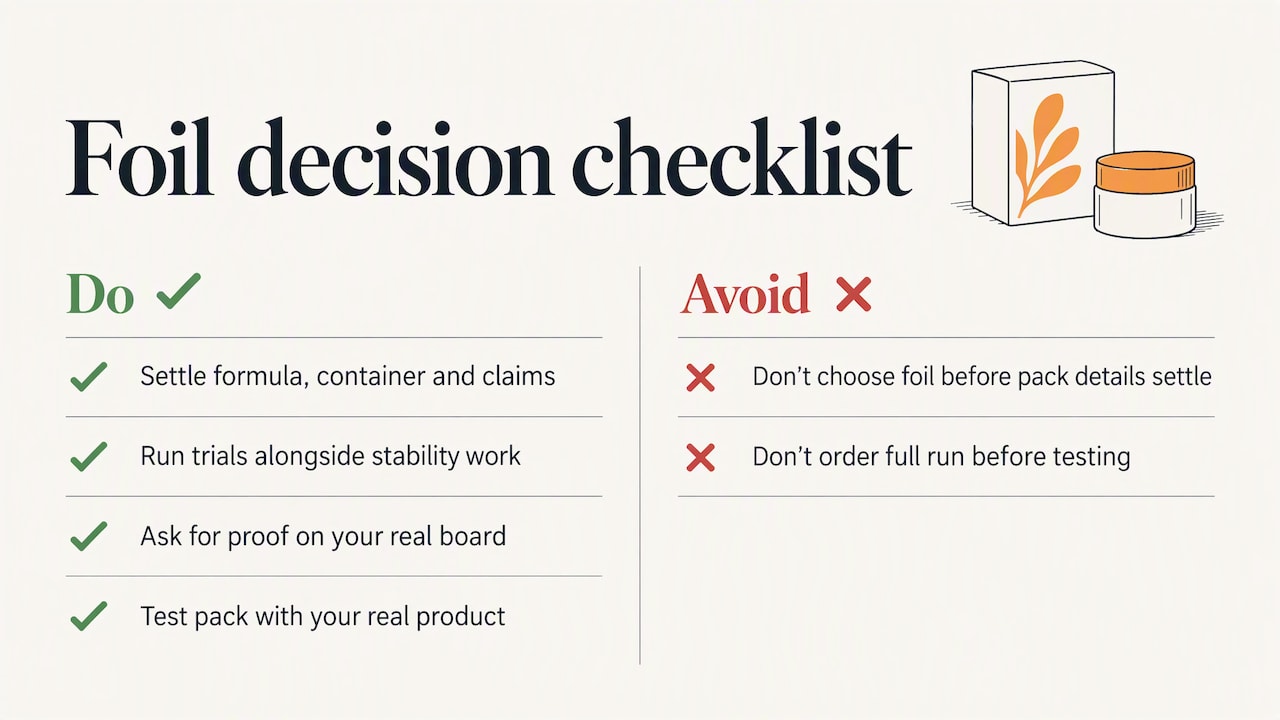
We also push clients to treat the pack as part of the product. A finish that looks perfect on a flat proof can scuff, lift or mark in a bathroom with an oil-based formula. That is why we like foil trials to run alongside stability and compatibility work, not after it. Our design and packaging services sit next to our R&D and manufacturing for exactly this reason: the formula, the container and the finish get decided together.
If you remember one thing, make it this: ask for the proof on your real board, and test the finished pack with your real product before you order the full run.
— Edmund
Where Harmony Skin Lab fits in
Harmony Skin Lab is a GMP-certified OEM/ODM skincare manufacturer in Singapore. We handle custom formulation, R&D, quality control and packaging solutions for private label, salon and medical skincare lines. If you are weighing foil options for a new line, we can help you specify the pack around your formula and your first-run quantity, and keep the decisions in the right order. See our skincare design and packaging services or read how a launch roadmap for market-ready brands fits packaging into the wider plan.

To compare packaging formats before you settle on a finish, our overview of skincare packaging options for Singapore brands is a good next read. If you are still choosing a partner, see how to choose an OEM skincare manufacturer.
Sourcing foil work in Singapore
Foil stamping is a standard service locally. Printers use it widely for name cards, packaging, folder covers, invitations, certificates and luxury brochures, and Singapore packaging units run equipment for hot foil stamping, embossing and creasing for the regional market. Capability does vary between workshops, so brief them with the same checklist:
- Which process do you run in house, and which do you outsource?
- What boards and laminates have you foiled successfully?
- Is die cost quoted separately, and is the die kept for reorders?
- Can I see a proof or a sample on my chosen board?
- What is your registration tolerance on foiled elements?
Also remember that a foiled carton still has to carry the right label information. Our guide on how to label cosmetic products for market helps you plan the space, so the foil design does not squeeze out required text.
FAQ
Is cold foil cheaper than hot foil?
Often, for medium to large runs, because it needs no metal die and runs in line with printing. For very short runs the gap narrows or reverses, because the adhesive and set-up still cost money. Get quotes at two or three quantities with the die shown separately.
Which looks more premium on a skincare box?
Hot foil usually has the denser shine and a tactile feel, especially when combined with embossing. Cold foil can look equally premium when the design relies on fine detail or colour effects. The board and the artwork matter as much as the process.
Can I use foil on uncoated or textured board?
Hot foil generally handles these stocks better. Cold foil depends on consistent adhesive transfer, so rough or porous surfaces are risky. Ask your printer to trial the exact board before you order.
Will foil affect my product’s compatibility or shelf life?
Foil on an outer carton is unlikely to touch the formula. A foiled label on a primary container can meet oils, alcohol or fragrance, so test it with the actual product. Raise this with your manufacturer’s quality team before you finalise artwork.
Can I mix hot and cold foil on one pack?
Yes, some designs use both, for example a hot-foiled embossed logo with a cold-foiled pattern. It adds cost and complexity, so use it only when the design truly needs both effects.
Sources
- Embellishments: foil stamping processes, Labels & Labeling
- A Golden Age: Traditional vs Digital techniques for foil print effects, Large Format Review
- Digital Foil Stamping Market Research Report, Marketintelo
- Foil Stamping Singapore guide, Express Print
- Foil Stamping and Metallic Finishes Explained, Printing.com.sg
- VMOM of Singapore opts for a fleet of three Autoprint Dextra 80 machines, Press Ideas