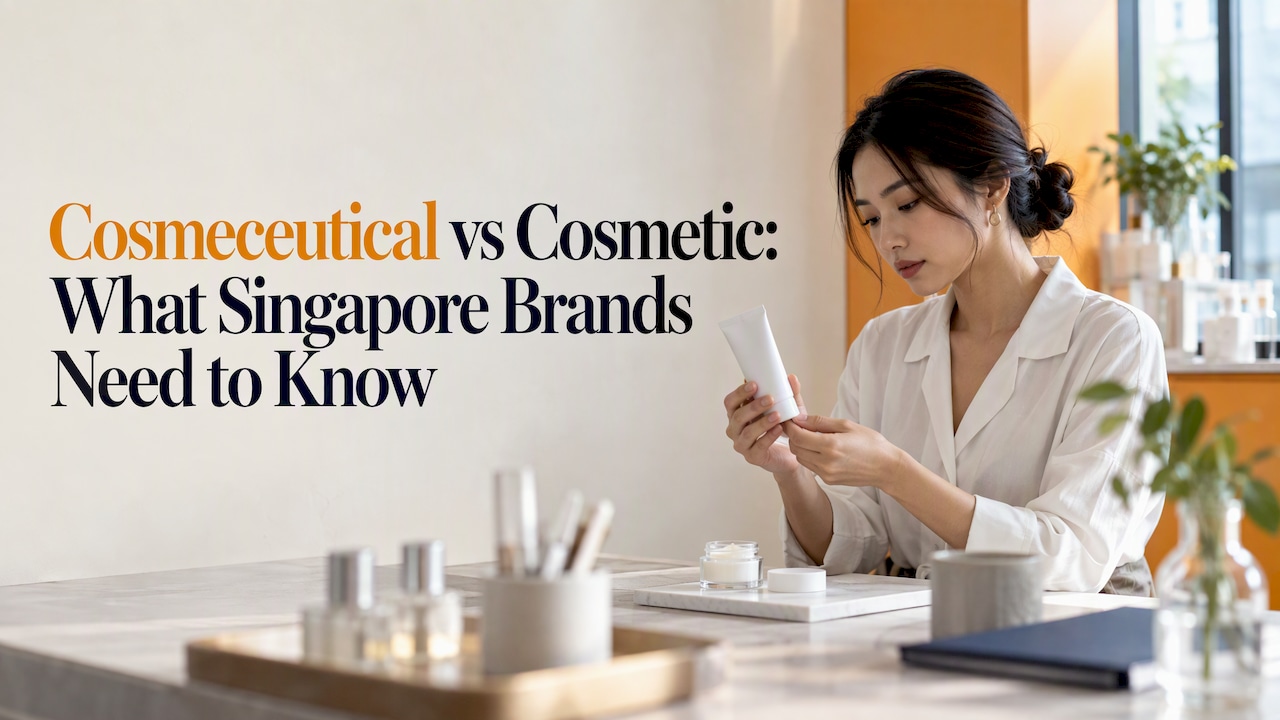
In Singapore there is no separate legal category called “cosmeceutical”. A product is either a cosmetic, which the Health Sciences Authority (HSA) regulates under its cosmetic framework, or it makes medicinal claims and falls outside that definition. “Cosmeceutical” is a marketing word for cosmetics built with stronger actives, tighter formulation work and more evidence behind them. The difference matters most when you decide what your product is allowed to say.
TL;DR
- “Cosmeceutical” is an industry term, not a regulatory class. In Singapore, what counts is whether your product meets the HSA definition of a cosmetic.
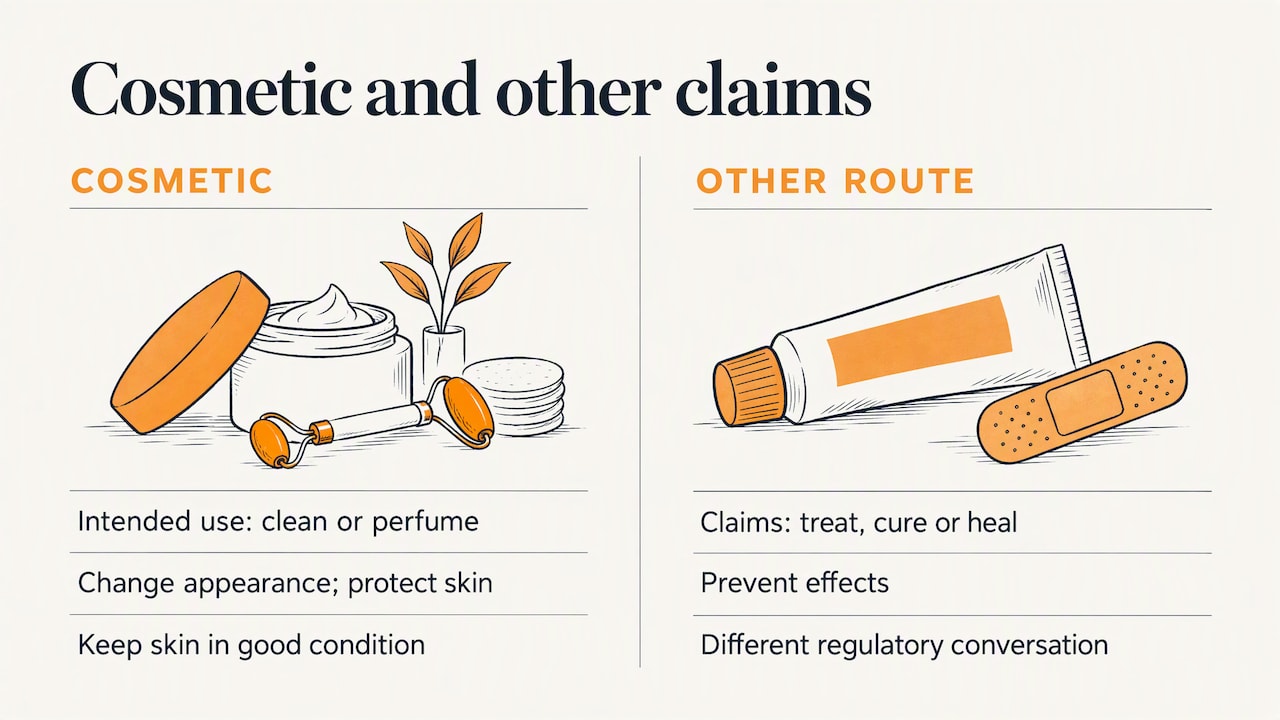
- Cosmetics clean, perfume, change appearance, correct body odour, protect or keep the body in good condition. They cannot claim to treat disease or modify a physiological process.
- A “cosmeceutical-grade” formula is a formulation and evidence story. Your claims still have to stay within cosmetic wording.
- Acne, eczema and psoriasis treatments, medicated oils and antiseptic creams are not cosmetics under HSA’s guide.
- If you are developing a line, decide the claim ceiling first, then design the formula, testing and packaging to support it.
Table of Contents
- What “cosmetic” means in Singapore
- What “cosmeceutical” really means
- Cosmeceutical vs cosmetic at a glance
- Where the line falls: cosmetic or not
- What you can and cannot claim
- Ingredients, evidence and “clinical-grade” language
- What this means if you are launching a line
- Our perspective: performance without overpromising
- Develop your formula with Harmony Skin Lab
- FAQ
- Sources
What “cosmetic” means in Singapore
HSA defines a cosmetic product by what it is meant to do. In its regulatory overview of cosmetic products, a cosmetic is a substance or preparation meant to touch external parts of the body, the teeth or the oral mucosa, mainly to clean, perfume, change their appearance, correct body odour, protect them or keep them in good condition.
Two things follow from that wording.
First, the test is intended use, not how advanced the ingredients are. A cream with a sophisticated active complex and a simple moisturiser can both be cosmetics, provided they are meant to improve appearance, protect or maintain the skin.
Second, the verbs matter. Clean, perfume, change appearance, protect, keep in good condition: this is the vocabulary of cosmetics. Words such as treat, cure, heal or prevent belong to a different regulatory conversation.
Singapore’s cosmetic rules sit within a wider regional framework. HSA explains that the ASEAN Cosmetic Directive harmonises cosmetic requirements across ASEAN countries and provides the main technical documents on definitions, claims, ingredient annexes, labelling, GMP, safety assessment, adverse-event reporting and Product Information Files. If you plan to sell beyond Singapore, that shared framework is one reason to design to cosmetic rules from the start.
What “cosmeceutical” really means
The word blends “cosmetic” and “pharmaceutical”. Academic papers describe it as a hybrid, a product placed between the two that aims to improve both the health and the beauty of skin. That is a useful description of the idea, but it is not a legal status.
The US regulator is explicit about it. The FDA’s page on the term says “cosmeceutical” has no meaning under US law, and that the cosmetic industry uses it for cosmetic products with medicinal or drug-like benefits. Singapore’s HSA pages on cosmetics do not set up a cosmeceutical category either: the classification guide sorts products into cosmetics and non-cosmetics.
So when a brand, clinic or supplier says “cosmeceutical”, read it as a signal of positioning. It usually points to some mix of:
- higher-performing active ingredients;
- more attention to stability and how the actives are delivered to the skin;
- testing and evidence behind the formula;
- sale through professional channels such as clinics and salons.
None of these changes the legal question. Whatever the marketing label, the product must still fit the cosmetic definition, or be handled under a different regime.
Cosmeceutical vs cosmetic at a glance
| Standard cosmetic skincare | “Cosmeceutical” skincare | |
|---|---|---|
| Legal status in Singapore | Cosmetic product under HSA | Not a separate category; must still qualify as a cosmetic, otherwise it is not a cosmetic |
| Typical positioning | Cleansing, hydrating, comfort, appearance | Performance-led, often sold through clinics or salons |
| Formulation emphasis | Pleasant, safe, stable | Pleasant, safe, stable, plus attention to active levels and delivery |
| Allowed claims | Cosmetic claims only | The same cosmetic claims only |
| Evidence expected | Claims justified by data, evidence or the formulation | The same, and brands usually invest more in it |
| Disease claims | Not permitted | Not permitted if sold as a cosmetic |
The bottom rows are the point. The extra performance in a cosmeceutical-style product is real work for the formulator, but it does not buy extra claim freedom.
Where the line falls: cosmetic or not
HSA’s cosmetic product classification guide gives practical examples. Products that may be cosmetics include:
- skin creams, emulsions, lotions, gels and oils;
- facial masks;
- skin-whitening products;
- anti-wrinkle products;
- sunbathing products;
- facial wipes.
Products the same guide lists as not cosmetics include:
- preparations to treat acne, eczema or psoriasis;
- antifungal or antiseptic creams;
- medicated oils and balms;
- health supplements;
- medical devices and injectables;
- insect repellents;
- antiseptic or antimicrobial hand sanitisers.
Notice what this means for a typical “cosmeceutical” idea. A brightening serum or an anti-wrinkle cream sits comfortably on the cosmetic list. An acne treatment cream does not, and neither does a medicated balm, however well made. If your concept is closer to the second list, you are in a different regulatory route, and you should speak to HSA before you invest in development and packaging.
The ASEAN Cosmetic Claim Guideline adds that classification depends on several factors together: composition, application site, main intended function, presentation and physiological effects. It also states that claims and the context in which they appear are relevant. A modest label can be undermined by a bolder website, social post or sales deck. Read the ASEAN guideline as applying to everything you publish about the product, not only the box.
What you can and cannot claim
This is where most brands feel the cosmetic versus cosmeceutical difference in practice.
HSA states that advertisements cannot claim to modify a physiological process or to prevent or treat disease. Claims must align with the cosmetic definition and be justified by scientific data or evidence and/or the formulation. That requirement is in the regulatory overview.
The ASEAN guideline lists skin-product claims that are unacceptable, including claims to:
- prevent, heal, treat or stop acne;
- remove scars;
- reverse age-related physiological changes;
- treat cellulite;
- reduce swelling or oedema;
- remove or burn fat;
- provide fungicidal or virucidal action.
The same guideline shows how wording can move back into cosmetic territory. Instead of claiming a product “removes all oil from skin”, acceptable examples include “helps to remove oil”, “reduces the shine of oily skin”, “suitable for oily skin types” or “makes your skin feel less oily”.
A practical way to write claims
The examples point to a conservative approach: describe appearance, feel, suitability and maintenance benefits, not disease treatment, permanent physiological reversal or structural change. A few worked rewrites show the idea:
| Risky wording | Cosmetic-safe direction |
|---|---|
| Treats acne | Suitable for oily or blemish-prone skin; helps skin look clearer |
| Reverses ageing | Helps reduce the look of fine lines |
| Removes scars | Helps improve the look of uneven skin texture |
| Burns fat | Leaves skin feeling smooth and firm |
These rewrites follow the pattern in the ASEAN examples, but they are our illustration, not approved wording. Each claim still needs support from data, evidence or the formulation, and the final text should be checked against HSA’s requirements before it is printed.
Ingredients, evidence and “clinical-grade” language
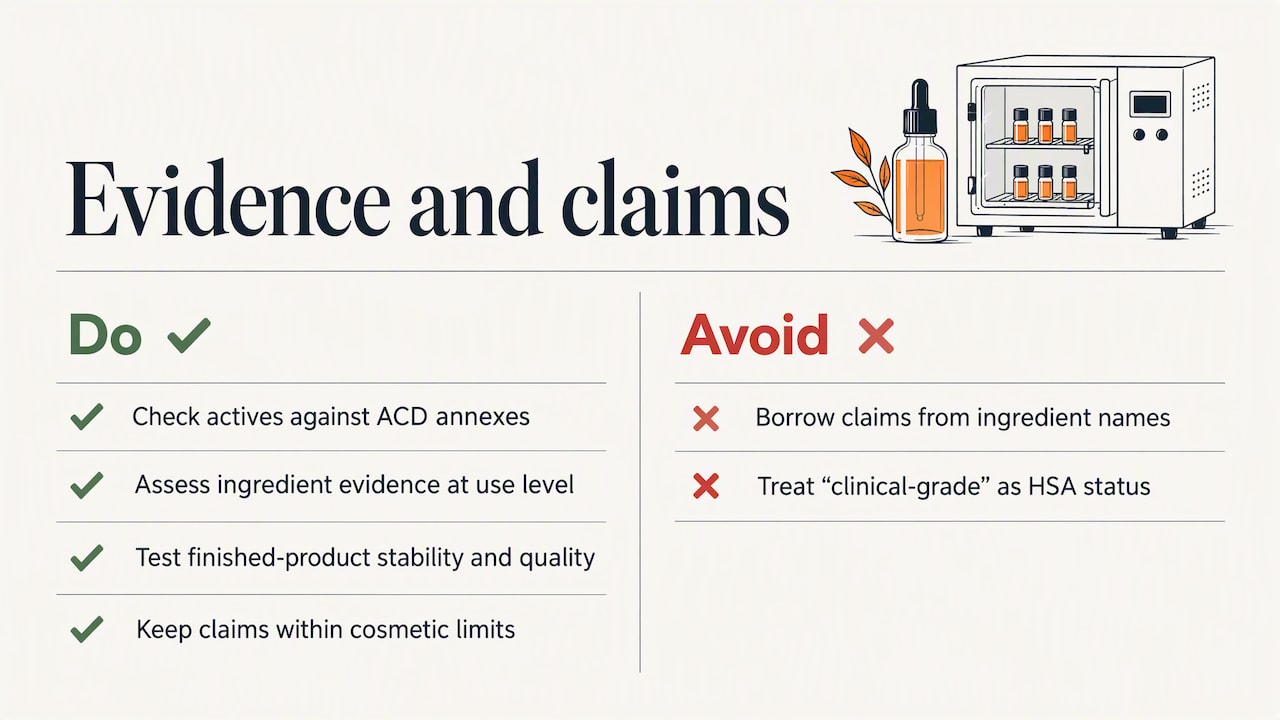
Many pages describe cosmeceuticals as products with well-known actives such as vitamin C, retinol and peptides. Active ingredients are a legitimate part of a stronger formula, but the name of an ingredient is not a claim you can borrow. Under the ASEAN framework, ingredients are controlled through annexes covering prohibited and restricted substances, permitted colouring agents, preservatives and UV filters, and HSA points businesses to these on its ACD page. Any active you want to use has to be checked against them first.
Evidence has two layers. One is the ingredient: what is known about it at the level you plan to use. The other is your finished product: how it behaves, stays stable and feels over its shelf life. This is why formulation, stability work and quality control matter more to a performance-led line than to a basic one. Our pages on stability testing and QC and on how custom formulation works from concept to production cover how that work is organised.
The phrase “clinical-grade” deserves the same caution as “cosmeceutical”. It describes ambition, not a status HSA recognises. If you use it, make sure the surrounding claims, testing and presentation stay within cosmetic limits.
What this means if you are launching a line
Different buyers read the term differently, so the right approach depends on who you serve.
Entrepreneurs and private label brands. You can legitimately position a line as performance-led. Build the story around formulation quality, ingredient choice, feel and visible results, and keep it in cosmetic wording. Our guide to launching private label cosmetics in Singapore walks through the steps.
Salons. Professional ranges are often where “cosmeceutical” language appears. The product still has to work as a cosmetic in the treatment room and at home. See what salons need from professional skincare.
Clinics and medical professionals. Doctors often want formulas that support their practice, such as post-procedure care or maintenance. Those can be cosmetics if they stay within the definition. Anything intended to treat a condition falls on the non-cosmetic side of HSA’s guide. Our page on aesthetic skincare products for clinics explains how we approach this.
A short pre-development checklist
- Write the claims you want to make, in plain words, before any formulation begins.
- Compare each claim to the cosmetic definition and the ASEAN unacceptable examples.
- Check your planned ingredients against the ASEAN annexes.
- Confirm notification, labelling and adverse-event obligations in HSA’s overview. HSA also notes that serious adverse effects and product defects must be reported, and that re-notification is required after one year.
- Choose a manufacturer whose quality system fits. HSA GMP is part of that; see our facts about HSA GMP and skincare manufacturing standards.
Our perspective: performance without overpromising
We get asked for “cosmeceutical” products often, and the request usually hides a more useful question: what do you want the product to do for the skin, and what will you say about it?
Our view is that the strongest cosmetic lines are the ones that decide this early. A brand that starts from the claim ceiling can choose actives, textures and packaging to deliver an honest benefit. A brand that starts from a bold slogan tends to discover late that the formula, the testing or the regulation cannot support it, and then pays for rework.
That is why we work with clients from the idea stage. Research and development, formulation, quality control and packaging happen under one roof, and as an HSA GMP-certified manufacturer in Singapore we build each batch to the standard the cosmetic category expects. We would rather help you make a good product with an accurate label than a loud product with a fragile one. If your idea truly sits on the medicinal side of the line, we will say so early, because it changes the route you need to take.
— Edmund
Develop your formula with Harmony Skin Lab
If you are planning a performance-led range for home use, salons or clinics, we can take it from concept through formulation, stability and quality control to filled, packaged product. Our team works with you on the market need first, then on the formula that fits it. Our OEM and ODM services cover R&D and manufacturing, design and packaging, and more.
To see how a project runs, read about our skincare product development service, or browse the product lines we already make, including home-use essential skincare, professional salon skincare and aesthetic or doctor’s formulations.
FAQ
What is the difference between a cosmeceutical and a cosmetic?
A cosmetic is a legally defined product category: it is meant to clean, perfume, change appearance, correct body odour, protect or keep the body in good condition. A cosmeceutical is an industry term for a cosmetic with drug-like or more active benefits. In Singapore, the second still has to meet the first definition.
Is cosmeceutical an official category in Singapore?
No. HSA’s cosmetic guidance does not list a cosmeceutical class. The term also has no meaning under US law, according to the FDA. Treat it as marketing language and classify your product by its intended use and claims.
What is the difference between a cosmeceutical and a pharmaceutical?
A pharmaceutical or medicinal product is intended to treat or prevent disease or modify a physiological process, and it follows a different regulatory route. A cosmeceutical, sold as a cosmetic, cannot make those claims. HSA’s guide lists acne, eczema and psoriasis treatments and medicated balms as not being cosmetics.
What are examples of cosmeceutical-style products?
Brands commonly apply the term to serums, creams and masks with stronger actives. HSA’s examples of products that may be cosmetics include skin creams, lotions, gels, oils, facial masks, skin-whitening products and anti-wrinkle products. Whether any one product qualifies depends on its composition, intended function and claims.
Can I say my skincare product treats acne or reverses ageing?
Not as a cosmetic. The ASEAN claim guideline lists claims to treat acne or reverse age-related physiological changes as unacceptable for skin products. Describe appearance and feel instead, and have each claim supported by evidence or the formulation.
Sources
- Regulatory overview of cosmetic products, Health Sciences Authority
- Cosmetic product classification guide, Health Sciences Authority
- ASEAN Cosmetic Directive, Health Sciences Authority
- ASEAN Cosmetic Claim Guideline (Appendix III)
- “Cosmeceutical”, US FDA