To substantiate a cosmetic claim in Singapore, you need evidence that the finished product delivers what the wording says, and that the wording stays within what a cosmetic is allowed to do. The evidence can be test data, published science on the ingredients, or the formulation itself, but it must be on file and ready to produce when a regulator asks. This guide explains the rules, shows which claims are safe and which are not, and sets out how to build a claims file that holds up.
TL;DR
- Cosmetic claims in Singapore must fit the cosmetic definition and be justified by scientific data or evidence and/or the formulation itself.
- Anything that treats or prevents disease, or changes a physiological process, is outside cosmetic territory, however it is phrased.
- Evidence must match the finished product and the exact words on the pack, not just a hero ingredient.
- Keep one claims file per product: wording, evidence, test reports, dates and limits. Update it when the formula or the wording changes.
- Plan claims before formulation, so the testing budget and the stability and efficacy work line up with what you want to say.
Table of Contents
- What counts as a cosmetic claim in Singapore
- Where the line sits: acceptable and unacceptable claims
- What evidence substantiates a claim
- Match the evidence to the exact words
- Build a claims file you can produce on request
- Plan claims before you formulate
- Our perspective: claims are a formulation decision
- How we can help
- FAQ
- Sources
What counts as a cosmetic claim in Singapore
A claim is anything your label, website, social post, brochure or salon menu says or implies about what a product does. “Hydrates for 24 hours”, “dermatologist tested”, “clinically proven brighter skin”, “for sensitive skin” and “fragrance-free” are all claims. So are before-and-after photos and the product name itself if it suggests a result.
Cosmetic products supplied in Singapore fall under the Health Products Act and the Health Products (Cosmetic Products – ASEAN Cosmetic Directive) Regulations 2007. The Health Sciences Authority (HSA) sets out the requirements in its regulatory overview of cosmetic products. On advertising, it says claims must be aligned with the cosmetic product definition, justified by scientific data or evidence and/or the formulation, and aligned with Appendix III of the ASEAN Cosmetic Claim Guideline. They must also be fully substantiated when requested.
Three layers therefore apply at once:
- The definition. The claim has to describe a cosmetic function, such as cleansing, perfuming, protecting, keeping in good condition or changing appearance.
- The ASEAN claim guideline. It sorts claims into those that are acceptable, those that need softening, and those that are not acceptable.
- The evidence. You must be able to show the basis for the claim on request.
The ASEAN guideline also makes a point that surprises new brand owners: claims are one of the factors used to decide whether a product is a cosmetic at all. The ASEAN Cosmetic Claim Guideline treats the claim as part of that assessment. A cream with a harmless formula can still be pushed out of the cosmetic category by what is printed on it.
Where the line sits: acceptable and unacceptable claims
The simplest test is the one HSA states. A cosmetic advertisement cannot claim to modify a physiological process, such as reversing hair loss, or to prevent or treat a disease or medical condition. Everything else is a matter of degree, wording and evidence.
Claims that cross the line
The ASEAN guideline lists examples of unacceptable cosmetic claims, including preventing, reducing or reversing physiological changes associated with ageing, numbing effects, treating cellulite, and removing or burning fat. Common marketing phrases that land in the same territory:
| Wording | Why it is a problem |
|---|---|
| “Reverses ageing” or “stops wrinkle formation” | Claims to change a physiological process |
| “Cures acne” or “treats eczema” | Names a disease or medical condition |
| “Burns fat” or “melts cellulite” | Listed as unacceptable in the ASEAN guideline |
| “Regrows hair” | Modifies a physiological process, as HSA’s own example shows |
| “Heals scars” | Implies medical treatment |
Claims that can work with the right wording
The ASEAN guideline explains that a claim can be made less functional and more cosmetic by adding a modifier. Its own example is changing “remove oil” to “helps to remove oil”. The same logic applies to softer wording on skin feel and appearance:
| Too strong | Closer to acceptable cosmetic wording |
|---|---|
| “Eliminates wrinkles” | “Helps reduce the appearance of fine lines” |
| “Fixes acne” | “Helps cleanse oily, blemish-prone skin” |
| “Repairs the skin barrier” | “Helps moisturise and leave skin feeling comfortable” |
| “Whitens skin permanently” | “Helps improve the look of uneven skin tone” |
These are illustrations of the principle, not pre-approved phrases. The guideline also notes that cosmetic effects are typically not permanent and need regular use to be maintained, so wording that promises a lasting result after one use invites trouble. A modifier is not a loophole, either: the softened claim still needs evidence behind it.
One useful habit: read your draft claim and ask, “Would a reasonable consumer think this product treats a medical problem?” If yes, rewrite it, or consider whether the product belongs in a different regulatory category.
What evidence substantiates a claim
The ASEAN Harmonised Cosmetic Regulatory Scheme, in Article 7 of the ASEAN Cosmetic Directive agreement, requires claimed benefits to be justified by substantial evidence and/or by the cosmetic formulation or preparation itself. It adds that supporting data should be available to the regulatory authority to justify the nature of the effect.
Singapore’s consumer watchdog uses similar language for all products. In its 2025 guide on product claims, the Competition and Consumer Commission of Singapore (CCS) says claims should rest on evidence that is valid, specific and up to date. That gives you three questions to put to any piece of evidence:
- Valid: was the method sound, and does it actually measure what the claim says?
- Specific: was it done on this product, or this formula, at the concentration you sell?
- Up to date: does it still describe the current formula, the current packaging and the current wording?
Three kinds of evidence
1. The formulation itself. Some claims are justified by what is, or is not, in the product. “Contains glycerin” is supported by the ingredient list and the batch record. “Fragrance-free” is supported by the formula and supplier declarations. These need documentation, not a clinical study, but the documentation must be real and current.
2. Published science. Peer-reviewed studies on an ingredient can support a claim about what that ingredient does. The weak point is concentration and delivery. A study of an active at 5% in a lab model says little about a serum containing 0.2% of it in a different base. If you rely on literature, record the concentration used in the study and compare it with your own formula.
3. Testing on your product. This is the strongest basis for performance claims such as hydration, smoothness, oil control or brightness. Typical approaches are:
- Instrumental measurements, for example skin hydration or surface measurements taken before and after a defined period of use.
- Clinical or dermatological assessment, where a trained assessor grades the skin under a written protocol.
- Consumer perception studies, where volunteers use the product and answer a structured questionnaire.
Our separate guide to skincare efficacy testing methods walks through how these fit together. As a rule, an instrumental result supports a claim about measured change, while a consumer study supports claims phrased as “X out of Y users agreed”. Do not swap one for the other. A questionnaire showing that people felt their skin looked smoother cannot back a statement that a device measured smoother skin.
Safety-related claims need their own proof
Some claims are really safety or quality claims. “Preservative-free”, “gentle” and “suitable for sensitive skin” all imply testing that goes beyond efficacy. Preservation is a good example: the ASEAN preservative efficacy documentation describes a harmonised challenge test that measures the survival of inoculated microorganisms in a product. If you want to say a product is protected against contamination, that is the kind of evidence to hold. We explain the practical side in our guides to cosmetic challenge testing and natural preservative systems.
Match the evidence to the exact words
Most substantiation failures are mismatches, not missing paperwork. The common ones:
- Ingredient evidence, product claim. Data on a plant extract is used to say the finished cream “visibly firms”. The test was never done on the cream.
- Old formula, new label. The formula was adjusted after the study, but the claim stayed.
- Narrow result, broad wording. A four-week study on 30 volunteers with normal skin becomes “works on all skin types”.
- Time frame inflation. A result seen after four weeks of daily use is advertised as “instant”.
- Unnamed comparison. “Twice as hydrating” with no stated comparator or conditions.
The CCS guidance that businesses should clearly state any assumptions, limits or conditions behind a claim applies here. If the result needed four weeks of twice-daily use, say so beside the claim. If the claim comes from a self-assessment by volunteers, label it as that.
Write each claim in the form of a small table before you print it:
| Claim as printed | Basis | Evidence on file | Conditions to state |
|---|---|---|---|
| “Helps moisturise skin for 8 hours” | Instrumental test on finished product | Report, protocol, date, panel size | Single application, defined conditions |
| “Fragrance-free” | Formulation | Full formula, supplier declarations | None |
| “9 in 10 users felt skin was smoother” | Consumer perception study | Questionnaire, raw results | Use period, number of users |
This layout makes gaps obvious. If the “Evidence on file” cell is empty, the claim is not ready.
Build a claims file you can produce on request
HSA can ask for substantiation, and a retailer, distributor or competitor can too. The brands that cope best are those that keep the file as they go rather than rebuilding it under pressure.
- List every claim. Include the pack, the website, marketing emails, social posts, salon menus and sales decks. Claims drift between channels, and the loosest wording is the one most likely to be challenged.
- Assign a basis to each claim. Formulation, literature, or product testing.
- Collect the evidence in one place. Test reports with protocol, method, panel description, dates and the batch tested. Supplier declarations. Literature with the concentration noted.
- Link the evidence to the formula version. Record which formula and which packaging the data covers.
- Record the limits. Conditions, time frames and who the product was tested on.
- Review on change. A new supplier, a new preservative, a new pack or a new claim triggers a review.
- Check the label separately. Claims sit alongside mandatory label information; our guide on how to label cosmetic products for market covers that side.
The CCS also reminds consumers not to take marketing claims at face value. Expect your audience, and the authorities, to look at the proof.
Plan claims before you formulate
The cheapest time to decide on claims is before the first sample. A brand that wants “for sensitive skin” needs a formula built with that in mind, a testing plan that supports it, and packaging that does not undermine it. A brand that decides after launch usually faces a choice between expensive retrospective testing and watering down the wording.
A sensible sequence for a new line:
- Decide the three or four claims that matter commercially.
- Check each against the cosmetic definition and the ASEAN guideline.
- Choose the evidence route for each: formulation, literature or test.
- Build the formula and run stability and compatibility work, so the data reflects the product that will actually be sold. See why stability testing matters and our packaging compatibility testing guide.
- Run the claim tests on the final formula in its final pack.
- Finalise the wording from what the data supports, not the other way round.
Our skincare launch roadmap shows where this fits in the wider schedule.
Our perspective: claims are a formulation decision
We see claims trouble start early, usually in the brief. A founder arrives with a promise (“brightening”, “anti-ageing”, “repairs”) and a benchmark product, and the question is how to make the formula carry that promise. We try to turn that around: what can this formula honestly support, and what is the best wording for that?
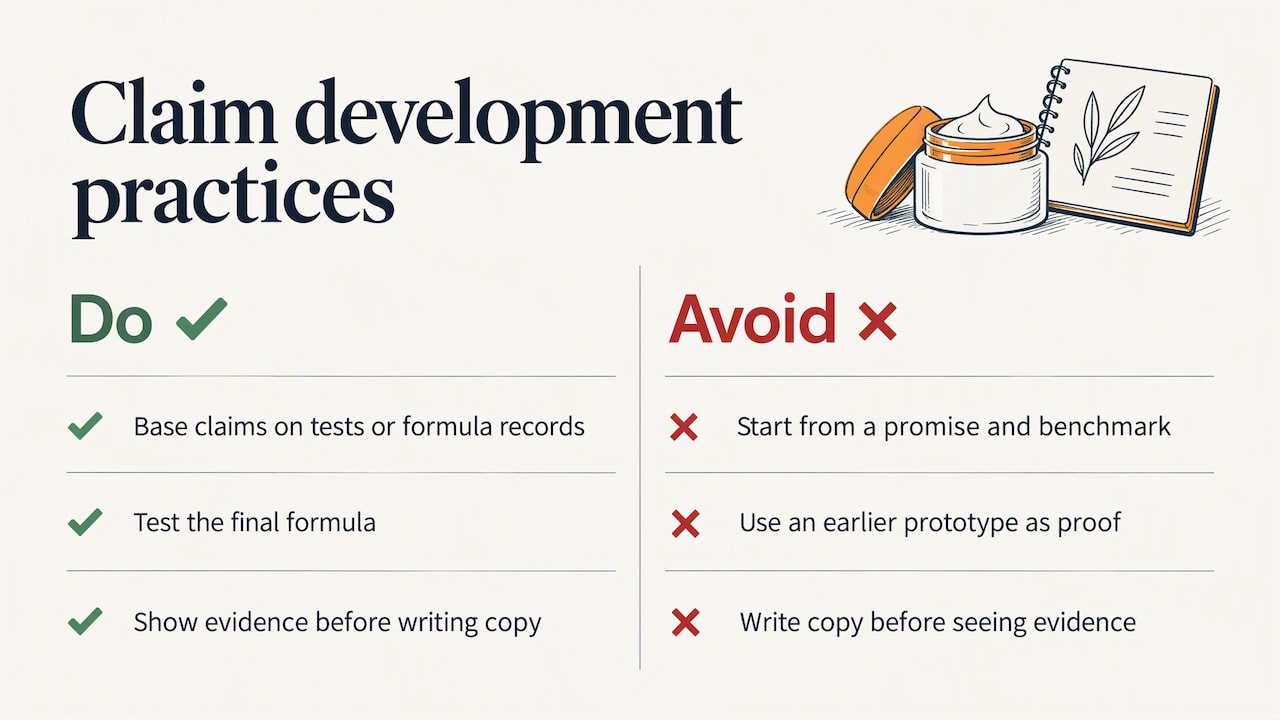
In our experience as a GMP-certified manufacturer under HSA, the strongest claims files share three habits. The brand states fewer claims, each one tied to a specific test or documented formula feature. The test is done on the final formula, not an earlier prototype. And the people writing the marketing copy see the evidence summary before they write.
We work with clients on R&D and formulation with market trends in mind, but trend-driven does not mean claim-driven. A trending ingredient is a good story only if the concentration, the base and the testing back it up. Where a claim sounds closer to treatment than to cosmetic benefit, we would rather say so at the brief stage than after printing. For medical-professional formulations the same discipline applies, and the product category and its rules should be settled first.
— Edmund
How we can help
If you are building a private label, salon or clinic line, we can work from your intended claims back to formulation, stability and quality control, and on to packaging. Our R&D, manufacturing and packaging services cover the stages in one project, and our product lines include home-use, professional salon and aesthetic or doctor’s formulations. Bring your claim list to the first conversation and we will tell you what the formula can support and what testing it will need.
FAQ
Do I need clinical studies to make any cosmetic claim?
No. The rule is that claims must be justified by scientific data or evidence and/or by the formulation itself. A claim such as “fragrance-free” rests on the formula, while a performance claim such as “helps moisturise for 8 hours” is better supported by testing on the finished product. The more specific or measurable the promise, the stronger the evidence you should hold.
Can I use the same claim as a competitor’s product?
Not safely on that basis alone. Another brand’s claim tells you nothing about its evidence, and it may itself be challenged. Your claim has to be supported by evidence on your own formula, and it has to stay within the ASEAN guideline.
What happens if my wording sounds therapeutic?
HSA says cosmetic advertisements cannot claim to modify a physiological process or to prevent or treat a disease or medical condition. Wording like that risks having the product treated as something other than a cosmetic. Rewrite to cosmetic functions and, where in doubt, check the HSA guidance or ask your manufacturer or a regulatory adviser before printing.
Does a softened claim like “helps reduce the look of lines” still need proof?
Yes. The ASEAN guideline treats modifiers as a way to make a claim more cosmetic in nature, not as a way to avoid evidence. The softened wording still needs data or formulation support that matches what it says.
How long should I keep substantiation records?
The sources we reviewed do not set a single retention period for Singapore, so check HSA’s current guidance. As a working rule, keep the file for as long as the product and its claims are on the market, and update it whenever the formula, pack or wording changes.
Sources
- HSA: Regulatory overview of cosmetic products
- ASEAN Cosmetic Claim Guideline (Appendix III)
- Agreement on the ASEAN Harmonized Cosmetic Regulatory Scheme
- CCS guide on clear and accurate product claims
- ASEAN preservative efficacy test for cosmetic products