The ASEAN Cosmetic Directive (ACD) is a regional agreement that harmonises cosmetic product requirements across ASEAN countries, so that a product made to one standard can move through the region with fewer technical barriers. In Singapore it has applied since 1 January 2008, and it shapes three things you will deal with as a brand owner: which ingredients you may use, how you label, and what you tell the Health Sciences Authority (HSA) before you sell.
This guide explains the ACD in practical terms: the annexes, the requirements for the Singapore market, where GMP fits, and how to keep a formulation compliant when the lists change.
TL;DR
- The ACD sets common rules across ASEAN. In Singapore it is enforced through the Health Products Act and the Health Products (Cosmetic Products – ASEAN Cosmetic Directive) Regulations 2007, overseen by the HSA.
- The annexes control ingredients: Annex II (prohibited), Annex III (restricted), Annex IV (colourants), Annex VI (preservatives) and Annex VII (UV filters).
- Before selling, you generally notify the HSA through PRISM, label in English to the prescribed format, and keep your product information in order.
- Annexes are updated regularly, so a formula that passed last year needs rechecking against the current versions.
- Your manufacturer should build compliance into the formula from the first brief, not bolt it on at the end.
Table of Contents
- What the ACD is and how it works in Singapore
- The ACD annexes, one by one
- Requirements for selling a cosmetic product in Singapore
- What happens after launch
- Where GMP fits in
- A compliance workflow for a new product
- Different buyers, different pressure points
- Perspective: compliance is a design input
- How Harmony Skin Lab can help
- FAQ
- Sources
What the ACD is and how it works in Singapore
The ACD sits inside the ASEAN Harmonized Cosmetic Regulatory Scheme, signed in 2003. That scheme combines the Directive itself with a mutual recognition arrangement on product registration approvals, and establishes common technical documents across member states.
The Directive is not a law that applies directly to your product. Each member state writes it into national rules. In Singapore, cosmetics are regulated under the Health Products Act and the 2007 ACD Regulations, overseen by the HSA. So when someone says “ACD requirements” in Singapore, they usually mean two layers: the regional annexes and technical documents, and the Singapore regulations that make them binding.
One point trips up new founders. Singapore does not licence cosmetic manufacturers, and the product itself is not “approved” in advance. The system rests on the dealer being responsible. The HSA states that dealers are legally responsible for the safety of the cosmetic products they supply, including compliance with ingredient restrictions and labelling standards.
The ACD annexes, one by one
Searchers often ask what the annexes are. They are the ingredient lists attached to the Directive, and the HSA summarises them as follows (HSA, ASEAN Cosmetic Directive):
| Annex | What it covers | What it means for your formula |
|---|---|---|
| Annex II | Substances that must not form part of a cosmetic product | Absolute ban. Any trace you can avoid must be avoided, so check raw material specifications |
| Annex III | Substances allowed only with specific conditions | Check the maximum concentration, product type, body area and any required warning |
| Annex IV | Permitted colouring agents | Colourants in the product must appear here, with any stated conditions |
| Annex VI | Permitted preservatives | Your preservative system must use listed substances within their limits |
| Annex VII | Permitted UV filters | Relevant to sunscreens and any product claiming UV protection |
The ASEAN Cosmetic Committee (ACC) coordinates the Directive, and a scientific body assists it in reviewing ingredient lists and technical and safety issues. That is why the annexes are versioned documents rather than fixed text. The HSA notes that its annexes were updated in June 2026, and the HSA page also links the ASEAN claim guideline and the illustrative list of cosmetic product categories.
A practical way to read Annex III
Annex III is where most real-world compliance work happens, because it rarely says “no”. It says “yes, if”. A single entry can limit concentration, restrict use to rinse-off products, exclude use near the eyes or on children, and require a particular warning on the label. A formulator reading it should note four things for each restricted ingredient: the limit, the product types it applies to, any other conditions, and the wording required on the pack.
This also links to labelling. The Singapore regulations require special precautions on labels in line with the Third Schedule, so an Annex III condition often becomes a printed line on your carton.
Requirements for selling a cosmetic product in Singapore
The HSA’s guidance gives dealers a short checklist: confirm ingredients comply with the ACD annexes, meet the labelling requirements, and submit a notification through PRISM before selling. Here is how that works in practice.
Notification
Notification is generally required for cosmetic products. The HSA lists exceptions: samples for promotional activities, products used for R&D testing or trials, and products a medical practitioner makes for their own patients. Failing to notify, or giving misleading information, is an offence. According to a Baker McKenzie summary of the regime, the penalty can be a fine of up to S$20,000 and/or up to 12 months’ imprisonment. The same summary notes that the responsible person must keep records and a Product Information File, and report serious adverse events.
Labelling
The regulations set out what must appear on the pack. In summary, the label must be in English and include, per the 2007 Regulations:
- The product name and its function, unless clear from the presentation.
- Instructions for use, unless clear from the name or presentation.
- A full ingredient list.
- The country of manufacture.
- The Singapore address of the responsible person.
- The contents by weight or volume.
- The batch number.
- The manufacturing date, or an expiry date for products with durability under 30 months.
Plus any special precautions required by the Third Schedule. Small packs, sachets and tubes make this hard to fit, so packaging design should start from the label content, not the other way round. Our notes on skincare packaging options for Singapore brands cover the space trade-offs.
Rules change, so recheck
The regulations are amended periodically. The 2025 Amendment Regulations, in effect from 1 December 2025, updated Third Schedule requirements, including conditions for Methyl-N-methylanthranilate and Octocrylene. If you sell sunscreens or fragranced products, an amendment like this can mean a label or formula change on a product you already launched.
What happens after launch
Compliance does not stop at notification. The HSA runs post-market surveillance, which includes risk-based product sampling and monitoring of adverse reactions reported by healthcare professionals.
The consequences of getting it wrong are not abstract. The HSA has publicly warned consumers about a whitening underarm cream after testing found very high mercury levels and a potent steroid. Those are exactly the kinds of substances the prohibited list exists to keep out. Reputable brands do not come near that territory, but the case shows why raw material sourcing and batch testing matter.
Where GMP fits in
The ACD does not stop at ingredients. It also includes recommendations on good manufacturing practice. In Singapore, cosmetic manufacturers do not need a manufacturer’s licence, but they may apply for a voluntary GMP certificate to help export products. The HSA audits against its GMP Guidelines for Manufacturers of Cosmetic Products, which it says cover all the ACD’s GMP recommendations. Applications go through PRISM.
For a brand owner the difference is simple. The annexes tell you what may go into the product. GMP tells you how it is made, checked, stored and traced. A formula can be perfectly compliant on paper and still fail you if a contract manufacturer has weak batch controls. Our explainer on HSA GMP and skincare manufacturing standards goes through what an audit looks at, and the benefits of a GMP skincare manufacturer shows what it changes in day-to-day supply.
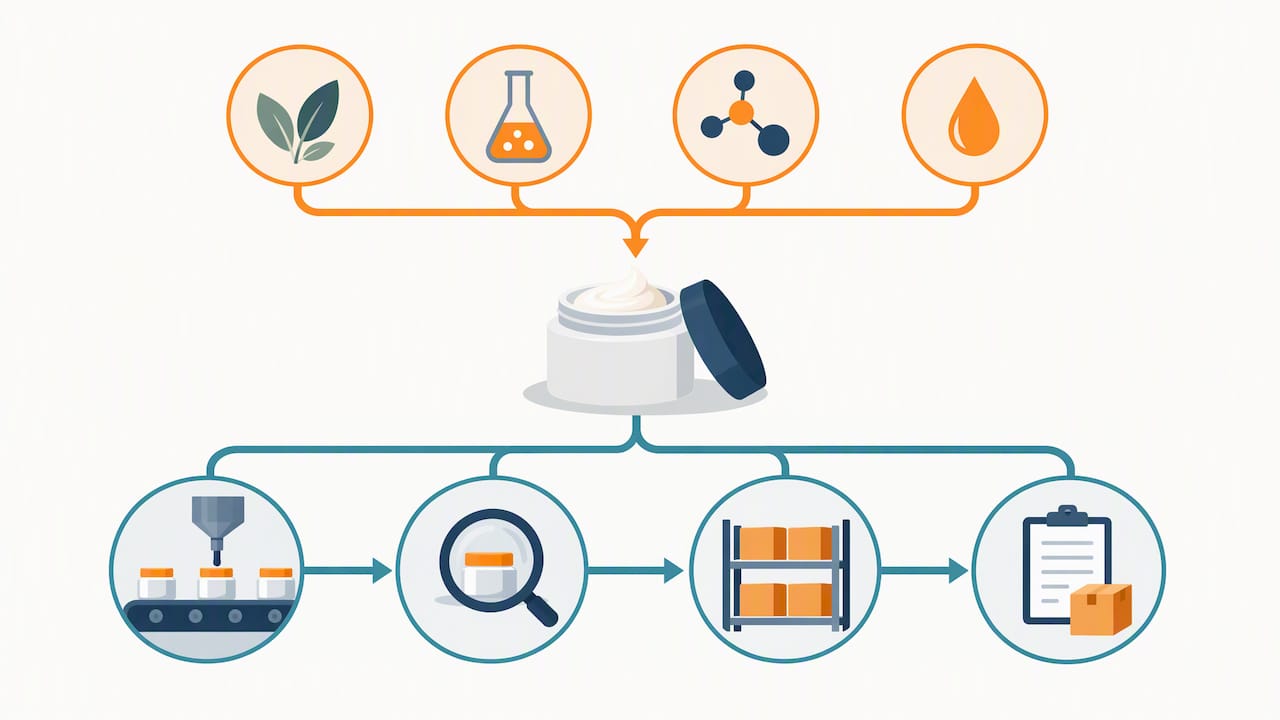
A compliance workflow for a new product
Whether you are a founder with a first serum or a clinic adding a line, the same order saves rework:
- Define the product category and claims. A cleanser, a sunscreen and a product with therapeutic-sounding claims sit in different places. Check claims against the ASEAN claim guideline linked from the HSA page.
- Screen the ingredient list against the current annexes. Do this before the first sample, not after. Remove anything in Annex II, then note every Annex III condition.
- Check the functional ingredients. Colourants against Annex IV, preservatives against Annex VI, UV filters against Annex VII.
- Build the label from the Third Schedule. Draft the label text with the formula, including warnings.
- Test stability and quality. A preservative that is permitted still has to work in your base. See our page on stability testing and QC.
- Prepare your product information and notify through PRISM before the first sale.
- Set a review date. Recheck against the latest annex versions at least when the HSA announces an update.
If you are earlier in the journey, our seven steps to launch private label cosmetics in Singapore puts these checks in the wider launch sequence.
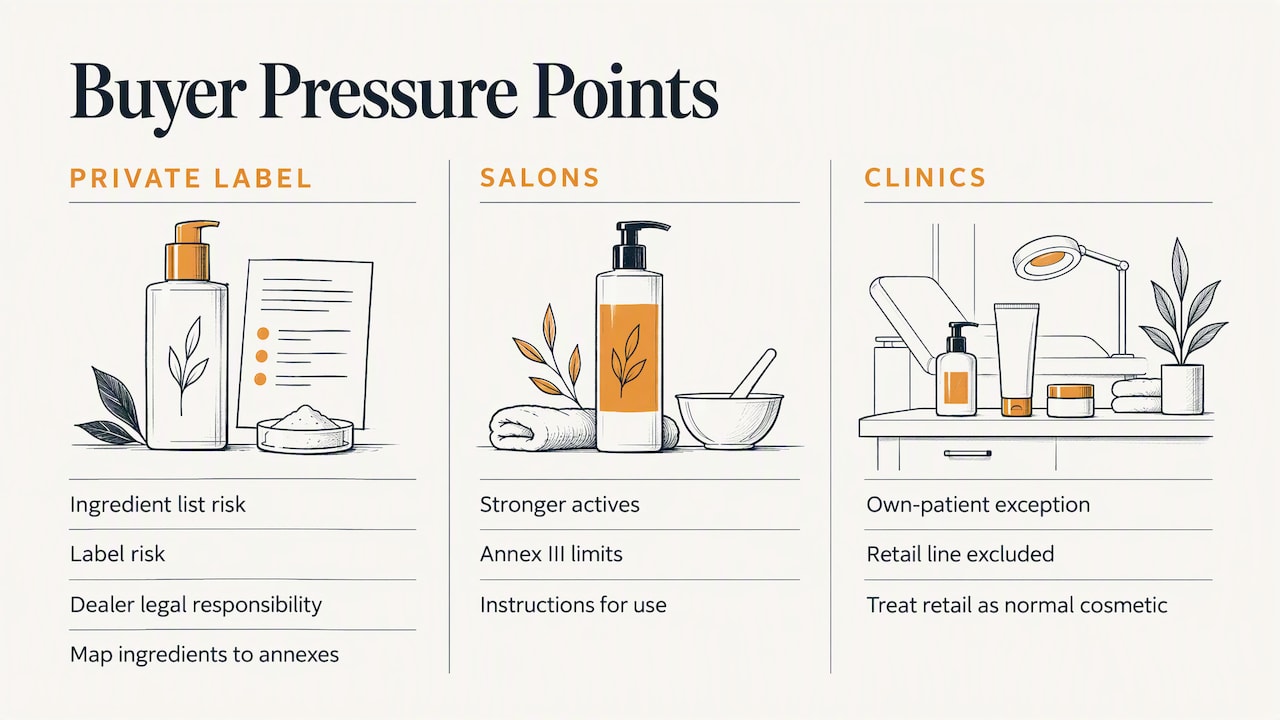
Different buyers, different pressure points
Private label and new brands. Your risk is the ingredient list and the label, because you are the dealer carrying legal responsibility. Ask your manufacturer to show how each ingredient maps to the annexes.
Salons. Professional lines often use stronger actives. Annex III limits matter more here, and so do instructions for use. See professional salon skincare manufacturing.
Clinics and doctors. The notification exception covers products a medical practitioner makes for their own patients. It does not cover a line you sell more widely. If you plan to retail, treat it as a normal cosmetic and plan for aesthetic skincare for clinics with that in mind.
Perspective: compliance is a design input
We see the ACD less as a hurdle at the end and more as a brief at the start. When a client arrives with a finished idea, the questions that cost time are rarely scientific. They are things like a favourite fragrance ingredient with a concentration cap, a preservative system that does not hold in a high-oil base, or a pack too small for the mandatory label text.
Our approach is to put the annexes on the table in the first formulation conversation. We screen the ingredient list, flag conditions that will need label wording, and agree packaging dimensions early. Our positioning rests on working with the client, on research and development, and on GMP certification from the HSA, and compliance is where those three meet. A product that reaches the market without a recall or relabel is worth more than one that is slightly more exciting on paper.
One habit we recommend to every brand owner: keep a single sheet that lists each ingredient, the annex entry it falls under, the limit, and the label consequence. Update it whenever the HSA announces a change.
— Edmund
How Harmony Skin Lab can help
Harmony Skin Lab is a Singapore OEM/ODM skincare manufacturer. We cover product design, custom formulation, quality control and packaging for home-use, professional salon and medical-grade lines. If you want a formula built with the annexes in mind from day one, see our services or read how custom skincare formulation works from concept to production. To discuss a specific product, start from our Singapore OEM manufacturing page.
FAQ
What are the ACD requirements in short?
Ingredients must comply with the ACD annexes, labels must meet the Singapore format, and the product is generally notified to the HSA through PRISM before sale. The dealer remains legally responsible for safety. Each stage is covered in the sections above.
Is the ASEAN Cosmetic Directive a law in Singapore?
Not directly. Singapore applies it through the Health Products Act and the Health Products (Cosmetic Products – ASEAN Cosmetic Directive) Regulations 2007, overseen by the HSA. The annexes are the ASEAN-level ingredient lists those regulations rely on.
Do I need a licence to manufacture cosmetics in Singapore?
No manufacturer’s licence is required for cosmetics. A GMP certificate from the HSA is voluntary, although it helps with exports. You do still need to notify products and meet ingredient and labelling rules.
How often do the annexes change?
They are revised from time to time by ASEAN’s cosmetic bodies, and the HSA links the current versions on its ACD page, last shown as updated in June 2026. Check that page before every new formulation and before reorders of older products.
Sources
- HSA: ASEAN Cosmetic Directive
- HSA: Regulatory overview of cosmetic products
- HSA: How cosmetic products are regulated
- HSA: Good Manufacturing Practice certification for cosmetic products
- HSA alert on a whitening underarm cream
- Health Products (Cosmetic Products – ASEAN Cosmetic Directive) Regulations 2007
- 2025 Amendment Regulations, Singapore Statutes Online
- Agreement on the ASEAN Harmonized Cosmetic Regulatory Scheme
- ASEAN General Information Booklet on the Harmonized Cosmetic Regulatory Scheme
- Baker McKenzie: Cosmetic Product regulations in Singapore