A vegan skincare formula is one with no ingredient of animal origin, and the hard part is proving it. Names like glycerin or stearic acid can come from plants or animals, so a vegan product is built from supplier documents as much as from a recipe. For a Singapore brand, the sound route is a brief written around vegan from day one, a formulation partner that audits every raw material, and the HSA notification and labelling work done in parallel. At Harmony Skin Lab, a GMP-certified OEM/ODM manufacturer in Singapore, we develop formulations with brands from brief to packaging, and this guide sets out what that process needs when the product must be vegan.
TL;DR
- “Vegan” refers only to ingredient origin: no animal-derived materials and no animal testing. It does not mean natural, organic or safe by default.
- Most animal-derived materials hide in emollients, waxes, pigments and processing aids, not in the hero actives, so every raw material needs a supplier declaration.
- Singapore has no separate legal definition of “vegan” for cosmetics, but the product still needs HSA notification, a compliant English label and a substantiated claim.
- Third-party certification such as V-Label checks composition and production steps, and is worth planning before you lock the formula.
- Build the brief, documentation and stability testing together, so a formula change never forces a restart.
Table of Contents
- What “vegan” does and does not mean in a formula
- Where animal-derived materials hide
- Designing the formula: performance, stability and preservation
- Vegan certification: what it involves
- What Singapore requires
- From brief to launch: a vegan product path
- Where we fit in
- Our perspective
- FAQ
- Sources
What “vegan” does and does not mean in a formula
Vegan cosmetics contain no ingredients of animal origin and are not tested on animals at any stage. A 2026 academic review of clean beauty definitions adds that vegan refers exclusively to ingredient origin, and that vegan products may be synthetic. That matters for your brief, because the three words customers use interchangeably describe different things:
| Claim | What it says about the formula |
|---|---|
| Vegan | No animal-derived ingredients and no animal testing. Ingredients can be natural or synthetic. |
| Natural | Minimally processed materials from plant, animal or mineral sources. The same review notes synthetic ingredients are generally capped at about 5% in natural cosmetics. |
| Organic | Certification typically requires at least 95% organic ingredients grown without synthetic pesticides or fertilisers. |
A product can be vegan and not natural, or natural and not vegan: beeswax and honey are natural yet animal-derived. H&M’s guide to vegan and natural beauty gives beeswax, carmine and xanthan gum made using animal products as examples of what a vegan claim rules out, and notes that natural claims follow ISO 16128, under which a naturally derived ingredient keeps more than 50% of its original natural structure.
Decide at the start which of these claims you actually want to print on the pack. A brand that wants “vegan” and “natural” needs a brief that meets both tests, and that choice shapes the ingredient list, the cost and the certification route.
Where animal-derived materials hide
Readers new to formulating tend to check the actives and stop. The animal-derived material is usually elsewhere. Glamour UK’s explainer on vegan, natural and organic beauty lists glycerin, collagen, gelatine and retinol among common animal-derived cosmetic ingredients. Typical offenders in a skincare formula include:
- Waxes and structurants: beeswax (Cera alba) and lanolin.
- Pigments: carmine (CI 75470), made from cochineal insects, common in lip and cheek products.
- Proteins: collagen, elastin, keratin, silk and hydrolysed silk.
- Fatty acids and emulsifiers: stearic acid, glycerin and some emulsifier families can come from tallow or from plants.
- Bee and dairy products: honey, propolis, royal jelly, milk and egg derivatives.
The trap is the shared name. V-Label’s compliance guide states that ingredients such as glycerin and stearic acid can be derived from either animal or plant sources, so verifying vegan status needs detailed supplier documentation. The INCI list on a label, the standard international ingredient naming system, cannot tell you which grade went into the tank.
The same logic applies to processing aids (substances used during manufacture that may not appear on the label) and to compound materials, where a raw material is itself a blend. V-Label’s FAQ notes that an ingredient list alone offers little security because some origins are unclear and processing aids are often not listed.
The supplier file you need
For each raw material, collect and keep:
- A written supplier declaration that the material and its processing aids are free of animal-derived substances.
- For blends, the same confirmation for every component.
- The grade or source of any ingredient that exists in both plant and animal forms.
- Notes on cross-contamination controls where the supplier or factory also handles animal-derived materials.
- Any certificates the supplier holds.
- A dated summary of how you concluded the formula is vegan, to sit with the product’s documentation.
This is the paperwork a certifier will ask for, and it is far easier to assemble while the formula is being developed than after launch. Our guide to cosmetic ingredient safety in Singapore covers how ingredient records fit into a brand’s safety documentation.
Designing the formula: performance, stability and preservation
Swapping out animal-derived materials changes how a product feels and behaves. Beeswax gives body to balms and sticks, lanolin gives occlusion in rich creams, and animal proteins are used for film-forming and conditioning. Plant waxes, butters and other emollients can fill those roles, but each substitution shifts texture, melting point, spreadability and sometimes the emulsion itself.
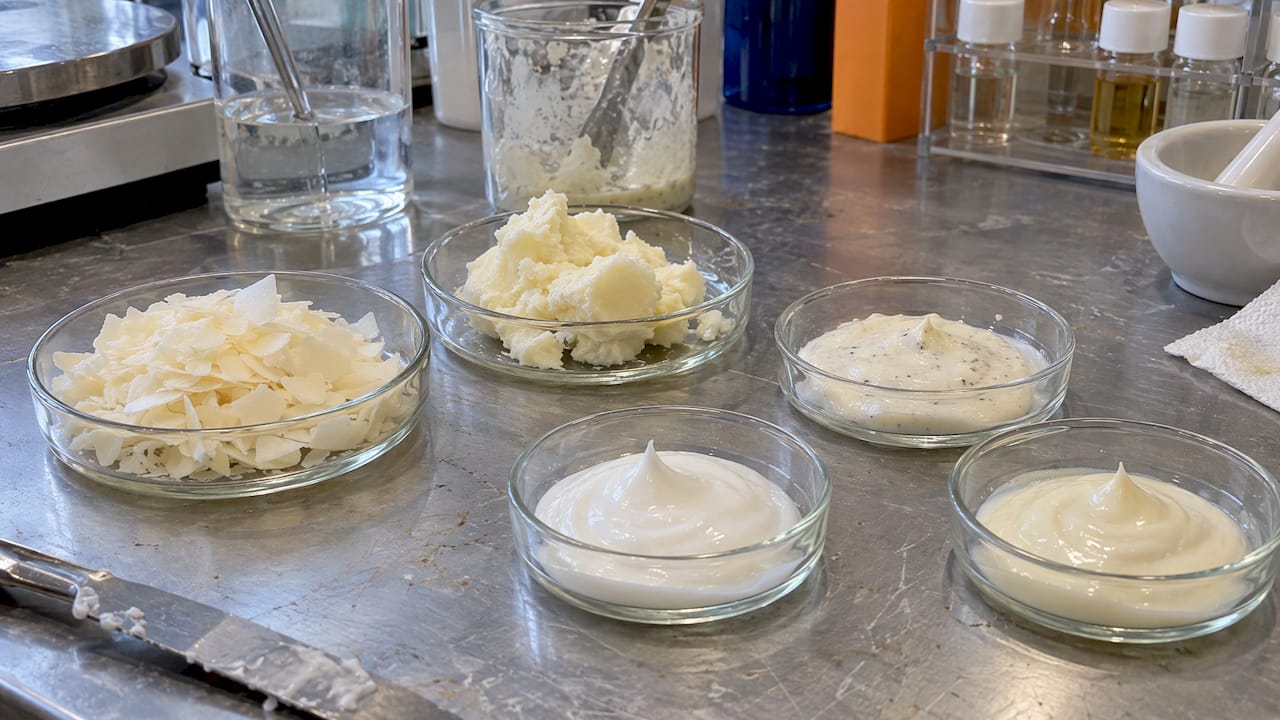
That is why the emulsifier system deserves attention early. If your emulsifier or co-emulsifier is a stearate or a fatty acid derivative, its origin has to be confirmed before anything else is built on it. Our emulsifier selection guide explains how formulators approach that choice.
A vegan formula then needs the same proving as any other:
- Stability testing: does it hold its texture, colour, scent and viscosity over time and across temperatures? Substituted waxes and butters are exactly where separation or grain can appear. See our overview of cosmetic stability testing and QC in Singapore.
- Preservation: natural-leaning, water-containing formulas still need a preservation system that works.
- Safety assessment: vegan is not a safety claim. Botanical extracts are among the common causes of cosmetic allergy, and essential oils bring declarable fragrance allergens that have nothing to do with animal origin. Read our cosmetic risk assessment guide for how a safety assessment is structured.
If the product is for salons or clinics, say so in the brief. Professional-use and doctor-led formulations carry different expectations for performance and tolerance than a home-use moisturiser.
Vegan certification: what it involves
A vegan claim made by the brand alone is a claim. A certification mark is an independent body checking it. V-Label’s FAQ states that cosmetics have been licensable since 2018, that applicants disclose the full composition including processing aids, and that independent external bodies run risk-based audits at production facilities. Formula or process changes must be reported immediately. It also sets a threshold: animal contamination above 0.1% (1 g/kg) prompts the manufacturer to make improvements.
Three practical consequences follow for a brand:
- The factory is part of the claim. Certifiers look at production steps, not just the recipe. A certified-ready formula made on shared lines without controls can still fail.
- Changes need reporting. Switching a supplier or a grade after certification is a formula change in the certifier’s eyes.
- Local audit support exists. SGS Singapore lists certification services for cosmetics covering ISO 22716 (cosmetics GMP), V-Label for vegan cosmetics and NATRUE for natural and organic cosmetics.
Certification is optional, but if you plan to use a logo, talk to your manufacturer about it before the first pilot batch. Retrofitting a documentation chain is slower than building one.
What Singapore requires
Singapore regulates cosmetics through the Health Sciences Authority (HSA). According to HSA’s regulatory overview, cosmetics supplied here must comply with the Health Products Act and the Health Products (Cosmetic Products – ASEAN Cosmetic Directive) Regulations 2007. A product notification is usually required before sale, and it must be renewed after one year. Our HSA cosmetic notification guide walks through the process, and the ASEAN Cosmetic Directive explainer covers the framework behind it.
The same HSA page sets the labelling rules. Labels must be in English and show:
- product name and function;
- the full ingredient list in descending order of weight;
- country of manufacture;
- the name and address of the company or person placing the product on the local market;
- batch number;
- a manufacturing or expiry date, with an expiry date mandatory when minimum durability is under 30 months.
The overview also notes that ASEAN member countries may require a statement signalling ingredients of animal origin, with bovine or porcine origin declared exactly. For a vegan product, that is a useful cross-check: your supplier file should already show there is nothing to declare.
Two points catch new brands out. First, the research I reviewed found no separate Singapore legal definition of “vegan” for cosmetics (the UK position, per Glamour, is similar: the only legal labelling requirement is the INCI ingredient list). In practice, the claim must be true and misleading statements are not allowed, so the dated substantiation file above is your protection. Second, a label must never imply HSA endorsement.
On manufacturing standards, HSA states that Singapore cosmetic manufacturers do not need a manufacturer’s licence but may apply for a voluntary GMP certificate to facilitate export, assessed against the GMP guidelines that encompass the ASEAN Cosmetic Directive’s recommendations. HSA’s own Cosmetics Laboratory tests products sold in Singapore for prohibited and restricted substances, so ingredient compliance is checked in the market as well as on paper. For the wider picture, see our summaries of cosmetic regulations in Singapore and HSA GMP and manufacturing standards.
From brief to launch: a vegan product path
This is the sequence we would follow for a brand starting from an idea.
- Write the claim into the brief. State “vegan” (and any other claims, such as natural or certified) alongside the product type, target skin concern, texture, price tier and who will use it: home, salon or clinic.
- Set ingredient rules. Agree up front that every raw material, including processing aids and blends, needs a supplier declaration, and name the animal-derived materials to exclude.
- Develop and substitute. The formulation work picks plant-derived grades of emulsifiers, waxes, emollients and pigments, then adjusts texture and performance.
- Test. Run stability and QC checks on pilot batches, then complete the safety assessment for the final formula.
- Document. Compile the Product Information File, supplier declarations and the dated vegan substantiation summary.
- Decide on certification. If you want a mark such as V-Label, share the full composition and production steps with the certifier.
- Notify and label. Complete HSA notification and check the English label against the rules above.
- Package and fill. Packaging should not undo the claim: check any adhesives or coatings your supplier uses with the same declaration approach.
- Launch, then control change. Any new supplier or grade goes back through steps 2 and 5, and a formulation change needs a new notification.
For the commercial side of steps 1 to 8, our 7 steps to launch private label cosmetics in Singapore and skincare launch roadmap give the timeline.
Where we fit in
The part brands underestimate is the amount of coordination: formula, supplier paperwork, testing, packaging and regulatory filing all depend on each other. Harmony Skin Lab is an OEM/ODM skincare manufacturer in Singapore with a GMP certification from HSA, and we cover product design, customised formulation, quality control and packaging under one roof. Our approach is collaborative: we build the product around your brief and the market you are targeting, with research and development behind each formulation. Our lines span home-use essential skincare, professional salon skincare and aesthetic or doctor’s formulations, so the same team can work with an entrepreneur launching a first range or a clinic wanting a custom formulation.
To see how a project is structured, start with our skincare product development service and the full list of R&D, manufacturing and packaging services.
If you already have a brief, bring it with your vegan requirements and we can start from there. Our 9 questions to ask before choosing a skincare manufacturer is a useful checklist for any conversation.
Our perspective
Most brands come to us thinking vegan is a matter of picking a clean-sounding ingredient list. It is a matter of evidence. A formula is only as vegan as the least documented raw material in it, and the least documented material is rarely the one on the front of the box.
That is why we want the vegan requirement in the first conversation, not after the first sample. When the brief says vegan, the work changes from the start: which emulsifier, which wax, which pigment, which supplier can put the origin in writing. Substituting later means reformulating, retesting and reworking documents.
We build products around our clients’ goals and the market they are entering, with R&D, quality control and packaging handled together as a Singapore GMP-certified manufacturer. For a vegan line, that single chain of responsibility is what keeps the claim, the formula and the paperwork consistent.
Edmund
FAQ
Is a vegan skincare product the same as cruelty-free?
Not exactly. Vegan covers ingredient origin, while cruelty-free covers animal testing. The academic review cited above describes vegan cosmetics as having no animal-derived ingredients and no animal testing at any stage. The Vegan Society logo, per Glamour UK, certifies both no animal extracts or by-products and no animal testing.
Do I need certification to say my product is vegan in Singapore?
Certification is not required by the HSA rules I reviewed, but the claim must be accurate and supportable. Keeping supplier declarations and a dated substantiation summary protects the claim. A certification such as V-Label adds independent audits of composition and production steps.
Does vegan mean natural?
No. Vegan products can be synthetic or natural. Natural claims follow different standards, such as ISO 16128, and organic claims need a minimum share of organic ingredients, so decide which claims you want before formulating.
Do I still need HSA notification for a vegan product?
Yes. Vegan status does not change the rules: cosmetic products supplied in Singapore are subject to the Health Products Act and the ASEAN Cosmetic Directive regulations, with notification usually required before sale and renewed after one year.
Sources
- Clean beauty: definitions, distinctions among natural, organic and vegan cosmetics (academic review, 2026)
- Glamour UK: Vegan, natural, organic and cruelty-free beauty
- H&M: Our guide to vegan and natural beauty
- V-Label: Guide to compliance for vegan cosmetics
- V-Label: FAQ
- SGS Singapore: Pharmaceutical, cosmetics and personal care
- HSA: Regulatory overview of cosmetic products
- HSA: Good Manufacturing Practice certification for cosmetic manufacturers
- HSA: Cosmetics Laboratory