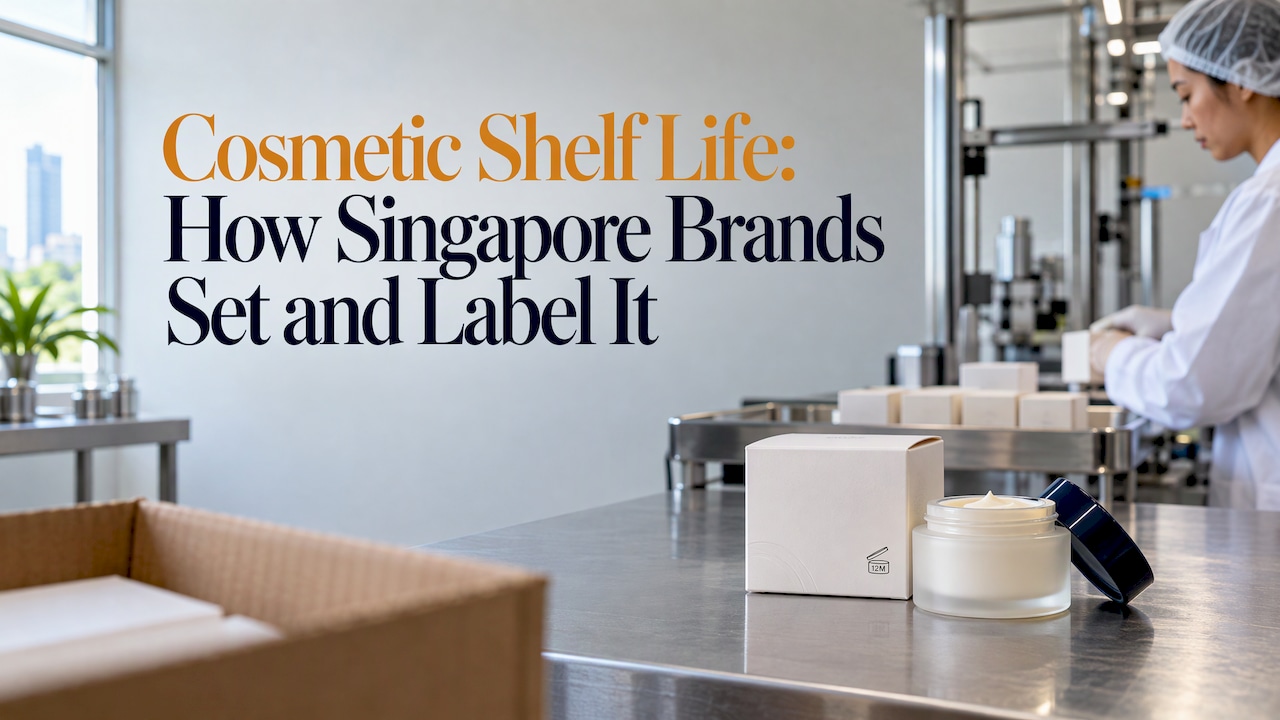
For a skincare brand, shelf life is a decision backed by evidence, not a number picked from a competitor’s label. In Singapore, the date on your pack must be clear, in English and, for products lasting under 30 months, an expiry date. Stability testing on the finished formula in its final packaging is what lets you print that date with confidence. We build that testing into product development at Harmony Skin Lab, an HSA GMP-certified OEM/ODM manufacturer in Singapore.
TL;DR
- Shelf life is how long an unopened product stays safe and performs as expected under stated storage conditions. Period after opening (PAO) is how long it stays suitable once opened.
- In Singapore, an expiry date is mandatory when minimum durability is under 30 months, and labels must be in English.
- Stability testing, accelerated and real-time, is how a manufacturer supports the date. It covers the formula and its packaging together.
- Heat, light, air and contamination from fingers are the usual causes of early spoilage, so formulation, preservation and packaging decide the real shelf life.
- Plan testing before launch, because the results can change the packaging or the formula.
Table of Contents
- What shelf life means for a brand owner
- What Singapore requires on the label
- Expiry date versus PAO symbol
- What shortens the life of a skincare product
- How stability testing sets the date
- A worked example
- What consumers see, and what it means for you
- Perspective
- Plan your range with a manufacturer that tests early
- Keeping up with ingredient rules
- FAQ
- Sources
What shelf life means for a brand owner
The FDA describes shelf life as how long a product can be expected to look and act as intended and stay safe, which varies by product type, use and storage. It also notes that cosmetics degrade over time and that the manufacturer is responsible for product safety and for determining shelf life.
That last point is the one that matters to you. Whether you are launching a private label serum, a salon range or a clinic formulation, the date on the pack is your claim. Singapore’s HSA defines the date of minimum durability as the date until which a product, stored under appropriate conditions, continues to fulfil its initial function. Your customers and your regulator will read it that way.
What Singapore requires on the label
HSA’s labelling rules, last updated on its regulatory overview page, set out the following:
- The expiry date is mandatory where minimum durability is less than 30 months.
- The date is written as day (if applicable), month and year, and is preceded by the words “expiry date” or “best before”.
- Labels must be in English. Other languages may be added only as identical translations.
The underlying law, the Health Products (Cosmetic Products, ASEAN Cosmetic Directive) Regulations 2007, adds that where the expiry date is not stated, the manufacture date must be. It also requires label information to be legible, permanent, indelible and prominent.
A product with durability of 30 months or more does not need an expiry date under these rules. In practice many brands still choose to show a PAO symbol, which is covered below. For the wider notification and labelling picture, see our guides to HSA cosmetic notification and cosmetic regulations in Singapore.
Expiry date versus PAO symbol
The two are easy to confuse, and customers ask about both.
| Expiry date | PAO symbol | |
|---|---|---|
| What it measures | Life of the unopened product in its original container | Life of the product after the container is first opened |
| How it appears | Hourglass symbol or the words “expiry date” with a date | Open-jar icon with a number and “M”, for example 12M |
| Typical use | Products with shorter shelf life | Products with longer shelf life |
This follows a labelling guide on PAO, which also notes that PAO does not apply to single-use products or aerosol dispensers. Under the EU framework, a product cannot carry both an expiry date and a PAO, and PAO is irrelevant for single-use, aerosol or airless packs and low-microbiological-risk products. Singapore follows the ASEAN directive, so if you sell in both the EU and ASEAN, plan the label once for both.
The PAO is an assessment of resistance to microbial contamination after first use. Sensitive areas such as around the eyes, or products for children under 3, call for a shorter PAO. The American Academy of Dermatology notes that in the US PAO is not required on cosmetics, but it advises users to note the date each product is opened.
What shortens the life of a skincare product
The FDA lists the main causes of early deterioration:
- Microorganisms introduced by dipping fingers into a jar or by applicators.
- Preservatives breaking down over time.
- Emulsions separating.
- Moisture exposure, or the product drying out.
- Temperature swings and exposure to sunlight and air, which change colour, texture or odour.
This list is a useful design brief. Singapore is hot and humid, and products travel through warehouses, shipping containers and retail shelves. Each cause points to a decision made before launch:
- Preservation system. It must hold up for the full period you claim, including repeated opening.
- Emulsion design. The choice of emulsifier affects whether a cream separates over months. See our emulsifier selection guide.
- Packaging. Pumps and airless formats limit contact with fingers and air, and opaque or tinted containers limit light. Our guide to skincare packaging options for Singapore brands covers the choices.
- Microbial safety. Our guide to cosmetic microbiological testing explains how contamination risk is checked.
How stability testing sets the date
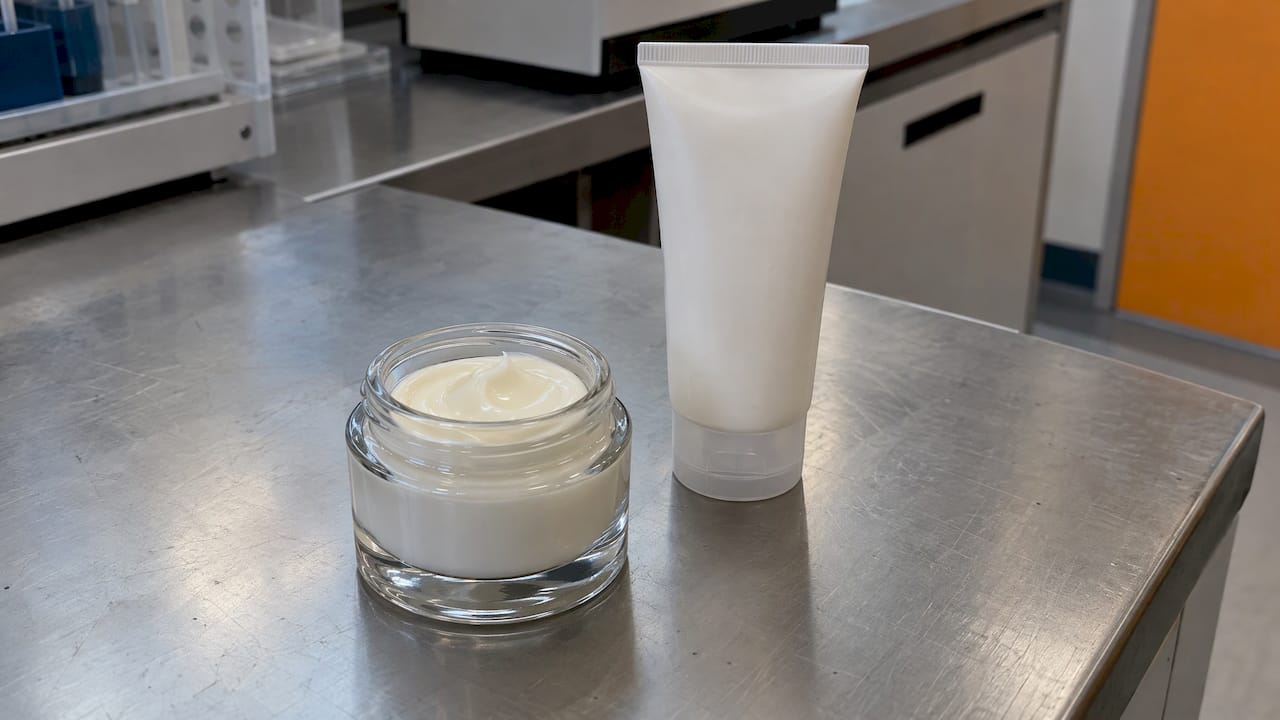
Stability testing is how a shelf-life claim is earned. ISO/TR 18811:2018 describes it as determining whether a product in its marketed container has adequate shelf life under market conditions, including storage, shipment and use. The profile covers the formula’s own chemical and physical stability and any interaction with its primary packaging. That is why a formula tested in a glass jar tells you little about the same formula in a plastic tube.
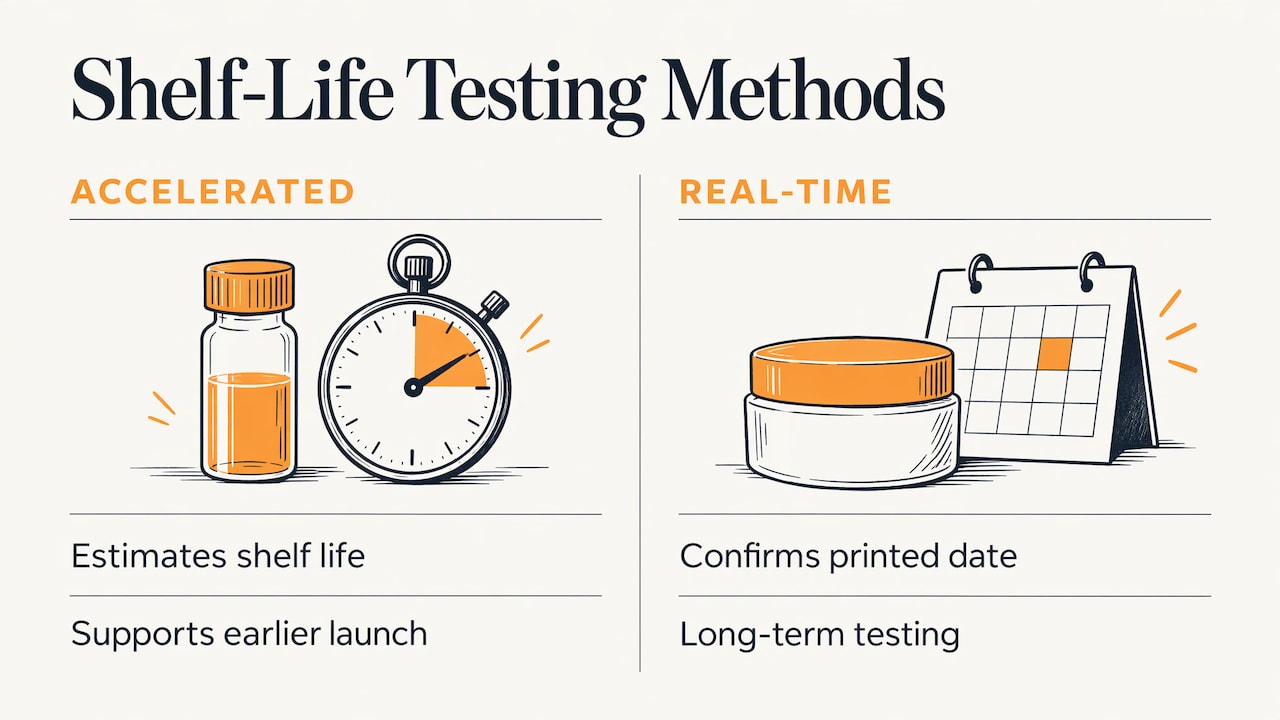
Accelerated testing
Accelerated studies speed up the ageing processes using heat, cycling or mechanical stress. The ISO report lists common conditions between 30°C and 50°C, with durations from one week to three months. Freeze-thaw cycling shows emulsion stability, crystallisation or clouding, and whether the change reverses. Testing services in Singapore also describe photostability testing and rapid temperature-change testing for products in packaging that lets light through.
Real-time testing
The same ISO report says shelf life may be estimated by accelerated tests and confirmed by real-time, long-term tests. Accelerated data gets you to launch sooner. Real-time data confirms the date you printed.
Reading the results sensibly
ISO also notes that no single standard test suits every cosmetic, given their variety, and that results from temperatures far from normal need careful interpretation. A formula may show a change at 50°C that would never happen on a shelf. This is why test design should be agreed with the formulator who knows the product. Our articles on why stability testing matters and cosmetic stability testing for lasting products go deeper.
For products below 30 months of stability, PAO determination is also recommended, so plan both studies together.
A worked example
Suppose you launch a 30 ml vitamin C serum.
- The formulator selects the preservative system and an antioxidant-friendly packaging format.
- Samples in the final bottle go through accelerated storage and freeze-thaw cycles. You check colour, odour, pH, viscosity and appearance against the day-zero sample.
- Samples also go into real-time storage at ambient conditions, checked at set intervals.
- The accelerated results support a provisional shelf life. If the serum is under 30 months, an expiry date goes on the pack under HSA rules.
- Real-time checks continue after launch to confirm the date.
If the serum darkens early, you adjust the formula or move to an opaque, airless pack before you have stock in the market, not after.
What consumers see, and what it means for you
Shoppers search for how to tell if a product has turned. The AAD lists colour change, a different or foul odour, separation into layers and dry, flaky texture as signs a sunscreen has spoiled, and says heat, such as a hot car, speeds breakdown. Customers will judge your product by these signs long before the printed date. Stable formulation and protective packaging mean your customers rarely see them.
Perspective
Many first-time brand owners treat shelf life as a label detail to settle at the end. We see it the other way round: it is a formulation and packaging decision made at the start.
Our approach is collaborative. We work with you on the formula, the packaging and the quality checks together, because a date only means something when the formula, the container and the storage conditions have been considered as one system. Our R&D and quality control sit alongside design and packaging, so findings from stability work can feed straight back into the formula or the pack.
We manufacture under GMP certification from Singapore’s HSA, for home-use, professional salon and aesthetic or doctor’s formulations. Each has different expectations: a salon product is opened and handled often, and a clinic formulation may need a tighter approach to preservation and packaging. Shelf life is where those expectations meet reality.
Ask for stability planning at the brief stage, not after the first batch.
Edmund
Plan your range with a manufacturer that tests early
If you are launching a private label, salon or clinic line, our team at Harmony Skin Lab handles R&D, formulation, quality control and packaging as one project, so the shelf life you print has been considered from the first brief. Explore our OEM and ODM services, or see how the launch roadmap works from concept to market.
For a sense of the product lines we make, see our product range.
Keeping up with ingredient rules
Shelf life depends on the preservatives and filters in your formula, and those lists change. HSA notes that the ASEAN Cosmetic Directive has applied in Singapore since 1 January 2008 and that its annexes, covering prohibited and restricted ingredients, colourants, preservatives and UV filters, were updated in June 2026. The ASEAN committees meet twice a year to discuss amendments, so check the HSA page before you notify or re-notify a product. Singapore also adopts the ISO guideline for identifying microbiologically low-risk cosmetic products as SS ISO 29621, which feeds into how a product’s microbial risk is assessed.
FAQ
Do skincare products expire?
Yes. Cosmetics degrade over time, and the product’s performance and safety depend on formulation, packaging and storage. In Singapore, the expiry date must be shown when minimum durability is under 30 months.
What does the PAO symbol mean?
It is an open-jar icon with a number and “M”, for example 12M, meaning the product stays suitable for 12 months after the pack is first opened. It does not apply to single-use products or aerosol dispensers.
What is accelerated stability testing?
It stores samples under raised temperature or other stress to speed up ageing, so a likely shelf life can be estimated in weeks or months. Real-time testing then confirms it over the full period.
Is stability testing required to set an expiry date?
HSA requires the date to be shown and to reflect the period the product stays fit for purpose when stored properly. Stability testing is the way a manufacturer supports that date, in the actual packaging used.
Sources
- Shelf Life and Expiration Dating of Cosmetics, FDA
- Regulatory overview of cosmetic products, HSA
- Health Products (Cosmetic Products, ASEAN Cosmetic Directive) Regulations 2007
- ASEAN Cosmetic Directive, HSA
- What is Period After Opening (PAO)?
- Period After Opening vs Expiration Date
- Expiration date and PAO for Cosmetics
- When to toss your makeup and sunscreen, AAD
- ISO/TR 18811:2018 Cosmetics Stability Testing Guidelines
- Stability Testing, SGS Singapore
- SS ISO 29621:2017(2024), Singapore Standards