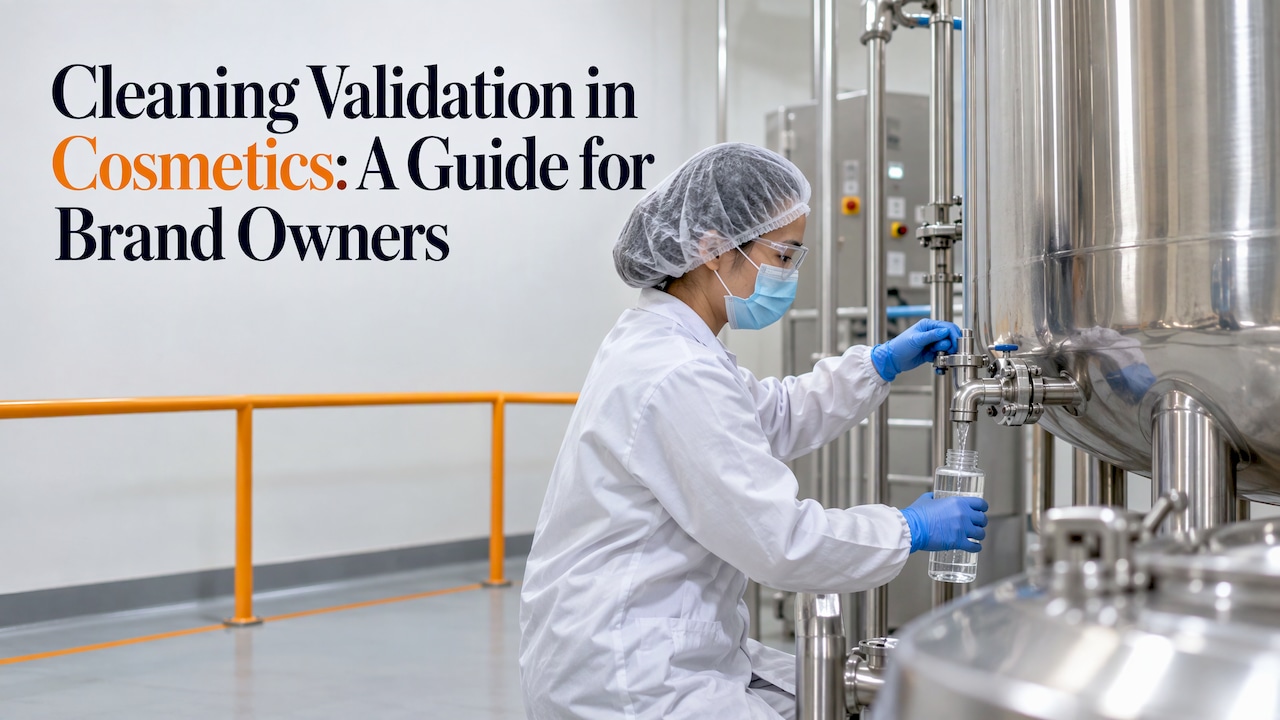
Cleaning validation is documented proof that a manufacturer’s cleaning procedure reliably removes the previous product, cleaning agent and microbes from equipment to a set, justified limit. For a skincare brand, it is what lets you trust that your serum was not made in a tank that still held someone else’s formula. If you launch through a contract manufacturer, you do not run the studies yourself, but you do need to know what a sound programme looks like. At Harmony Skin Lab, our GMP certification from Singapore’s Health Sciences Authority (HSA) is the framework within which we make private label, salon and medical-grade skincare for brand owners.
TL;DR
- Cleaning validation proves, with data, that cleaning removes product residue, cleaning agents and microbes. A “looks clean” check alone does not.
- It rests on a written protocol: worst-case swab and rinse sites, a justified residue limit, validated test methods and an approved report.
- In Singapore, manufacturers need no licence, but can apply for a voluntary HSA GMP certificate, which helps with exports.
- Validation is not a one-off. Good programmes verify and review cleaning on a schedule and tie it to batch records.
- Ask any manufacturer what was cleaned, how, who released it and what ran next.
Table of Contents
- What cleaning validation means for a cosmetic brand
- Cleaning validation, verification and routine cleaning
- How a validation study is built
- The questions to ask any manufacturer
- What Singapore requires
- Who does what: brand owner and manufacturer
- How we work with brand owners
- Perspective
- Talk to us about your product line
- FAQ
- Sources
What cleaning validation means for a cosmetic brand
Every mixing vessel, pump, hose and filling line carries a film of whatever it last made. Cleaning validation answers one question: after our routine cleaning, is what remains below a level that cannot affect the next product?
A 2024 conference paper on cosmetic and topical drug facilities explains that global cGMP rules require cleaning and sanitising to be controlled so that ingredients, dyes, fragrances, cleaning agents, microbes and endotoxins do not affect product quality. It adds that the acceptable level depends on the contaminant, the product, how it is stored and who uses it.
That last point matters to you. A body oil, a salon peel and a clinic-grade formulation do not carry the same risk, so they should not be judged by the same limit.
Why it matters beyond the factory floor
- Cross-contamination. A fragrance, active or colourant carried into the next batch can cause a reaction or a complaint you then have to answer for.
- Microbial control. Water-based creams and lotions can support microbial growth if residues or damp equipment are left behind.
- Claims and consistency. A residue that alters the product also alters texture, scent or stability.
- Audit readiness. Retailers, distributors and export markets increasingly ask for evidence of GMP, not assurances.
Cleaning validation, verification and routine cleaning
These three terms are often mixed up.
| Term | What it is | When it happens |
|---|---|---|
| Routine cleaning | The standard operating procedure carried out after each batch | Every changeover |
| Cleaning validation | A study proving the procedure works to a set limit | Before the procedure is relied on, and after meaningful changes |
| Cleaning verification | Ongoing checks that the validated state still holds | Periodically, and when a risk appears |
The US FDA’s inspection guide notes that cleaning between batches of the same product only needs to meet a visibly clean criterion and does not call for full validation. It also says documentation should scale with process complexity, cleaning history and test variability. Validation effort goes where the risk is: product changeovers, difficult-to-clean formulas and hard-to-reach equipment.
How a validation study is built
The guidance in this area comes largely from pharmaceuticals, and it is the best-documented model. ASTM E3106, a standard guide to science-based and risk-based cleaning, applies a life-cycle approach of development, qualification and verification to pharmaceuticals and is also applicable to cosmetics and consumer products. The same pattern works for skincare.
Step 1: Group products and rank the risk
Nobody validates every product on every machine. Products are grouped into families with similar behaviour, and the hardest-to-clean member represents the group. An article in ISPE’s Pharmaceutical Engineering describes grouping topical products such as surfactant systems, silicone-water systems, heated oil-water emulsions, high-wax anhydrous products, high-titanium-dioxide products and carbomer systems. A risk matrix then rates solubility, toxicity, ease of cleaning and active concentration, weighted by criticality.
Two points follow for you as a brand owner. Risk ranking is specific to the equipment geometry, because cleanability varies with the equipment. And a well-justified grouping strategy saves time, people and cost, which is one reason an established manufacturer with several product lines can validate efficiently.
Teams that want to structure this work digitally, including setting residue limits and choosing which equipment areas to cover, can look at cleaning validation software built for the purpose.
Step 2: Design the cleaning process
This covers the choice of cleaning agent, the critical parameters (agent concentration, contact time, temperature, rinse volume) and lab or pilot testing. The ISPE article describes design as the first of three stages, followed by qualification and continued verification. A process that has never been tested on your actual formula, with a real worst-case residue, is a hope rather than a validated procedure.
Step 3: Set acceptance limits
The limit must be justified, not picked because it is easy to pass. Health Canada’s cleaning validation guide (GUI-0028) describes the logic for pharmaceuticals: the maximum safe carryover is calculated so that the largest daily dose of the next product contains no more than a health-based exposure limit of the first product’s active. Preliminary swab or rinse limits are then derived from the equipment surface area.
Cosmetics are not dosed like medicines, so a manufacturer adapts this reasoning to the ingredient, the next product and the intended use. The principle is the same: the protocol states the criteria for product residue, cleaning-agent residue and microbial counts, and gives the rationale for each figure.
Step 4: Choose sampling and test methods
A typical protocol, as laid out in the Health Canada guide, specifies:
- swabs from scientifically determined worst-case locations;
- rinse volumes large enough to cover every product-contact surface;
- tests for product residue, cleaning-agent residue and total aerobic microbial count;
- a visual cleanliness check;
- correction of results for the recovery factor.
Recovery is the step most often misunderstood. The same guide requires validated analytical methods with defined limits of detection and quantification, and recovery studies for each sampling method and each product-contact material. Low or variable recovery points to poor sampling or extraction technique.
The FDA’s inspection guide makes a related point: a negative result does not prove there is no residue, only that residue above the method’s detection limit is absent. That is why the sampling and analytical methods are challenged together before any conclusion is drawn.
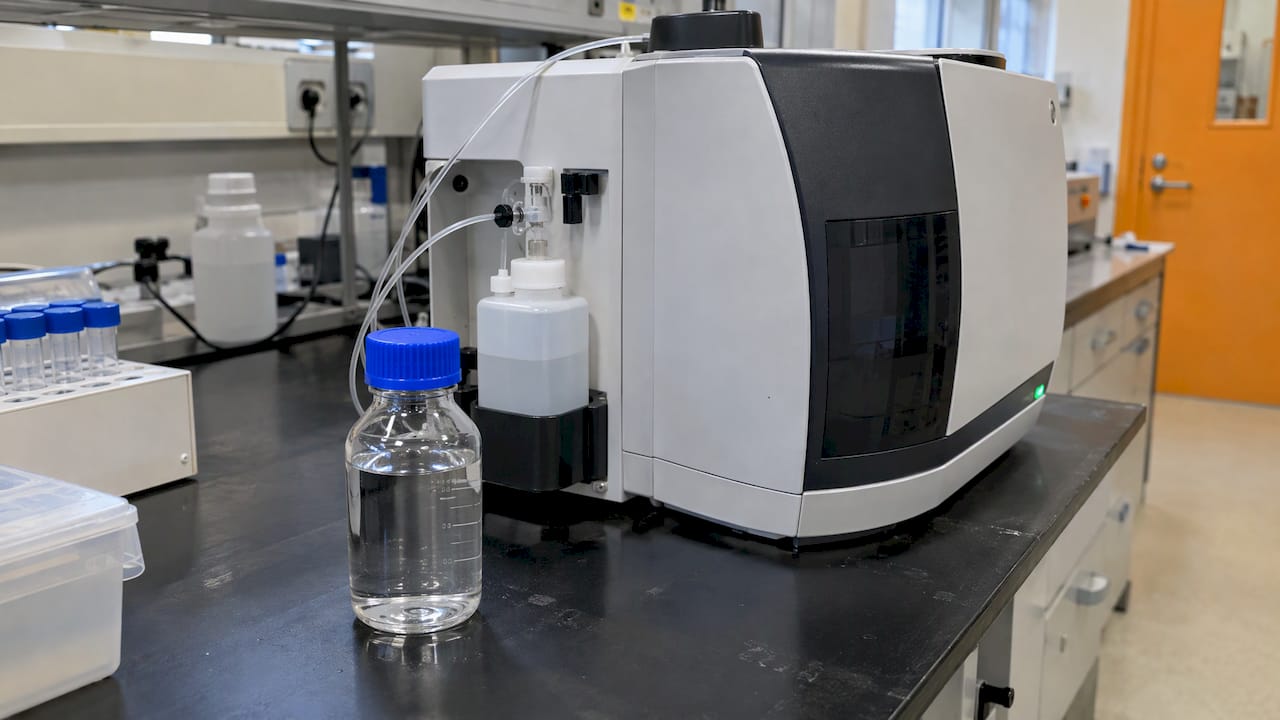
For water-rinse checks, some laboratories use total organic carbon analysis. One analytical-instrument article explains that ISO 22716 expects a suitable cleaning programme for all equipment and discusses how final rinse water can be analysed to judge cleaning efficiency.
Step 5: Write the protocol, run it, approve the report
The FDA guide expects written protocols prepared in advance, covering sampling procedures and the sensitivity of the analytical methods. Studies are run as written, and management approves a final report stating whether the process is valid and whether residues fall to an acceptable level.
Step 6: Keep it valid
Validation does not end with the report. The ISPE article describes continued verification through periodic review, monitoring, preventive maintenance and periodic revalidation. It recommends verifying each cleaning procedure at least once every three years and trending critical parameters such as cleaning-agent concentration, time, temperature and rinse-water conductivity. A new formula, new equipment or a change of cleaning agent should trigger a review sooner.
The questions to ask any manufacturer
You do not need to read a protocol line by line. You need to know that one exists and that the answers below are documented, not verbal.
- Which equipment will make my product, and how is it cleaned between products?
- What residue limits apply, and how were they justified?
- Which sampling and test methods confirm cleanliness, and have they been validated?
- Who releases the equipment for the next batch? Release should be a separate decision from the person who cleaned.
- How is the cleaning record linked to my batch record? You should be able to trace what was cleaned, how, who released it and which batch ran next.
- What triggers a re-check?
The last two matter most when you are a small brand sharing lines with others. The ASEAN Cosmetic GMP Guidelines, the standard HSA audits against, require a documentation system that records each batch’s complete history from starting materials to finished product, including maintenance and quality-control activities. Corrections must be initialled and dated, and documents must be dated and authorised.
For a wider checklist when comparing producers, see our guide to choosing an OEM skincare manufacturer and nine questions to ask before choosing a skincare manufacturer.
What Singapore requires
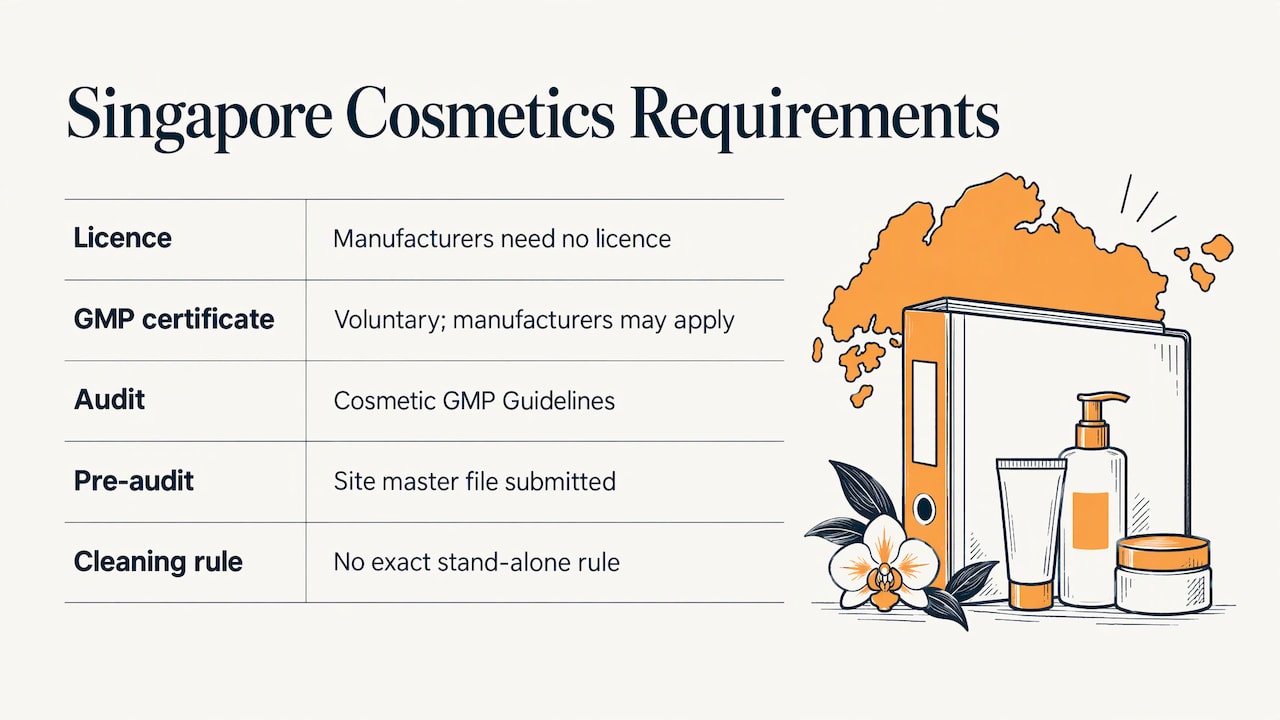
Singapore handles cosmetics under the Health Products Act and its ASEAN Cosmetic Directive regulations. According to the HSA’s page on GMP certification, manufacturers do not need a licence, but may apply for a voluntary GMP certificate. Audits are made against the GMP Guidelines for Manufacturers of Cosmetic Products, which cover all the ASEAN Cosmetic Directive GMP recommendations, including equipment, sanitation, hygiene and batch documentation. A site master file is submitted before the audit. HSA notes the certificate can facilitate export of cosmetic products.
So there is no stand-alone Singapore rule that says “validate cleaning in this exact way”. Cleaning control sits inside the GMP expectations on equipment, sanitation and records, and the pharmaceutical guides above show what a rigorous version looks like. For the regulatory background, see our articles on GMP in cosmetics, the ASEAN Cosmetic Directive and HSA cosmetic notification.
Rules change, and ingredient lists change with them. The Health Products (Cosmetic Products, ASEAN Cosmetic Directive) (Amendment) Regulations 2025 took effect on 1 December 2025 and updated the restricted-ingredient schedule, as the HSA page above records. Check HSA’s site for the version in force when you formulate.
Who does what: brand owner and manufacturer
Under an OEM or ODM arrangement, the manufacturer owns the cleaning procedures, the studies and the equipment records. You own the brief and the approval of what is made. In practice:
| Task | Usually led by |
|---|---|
| Cleaning procedure and its validation | Manufacturer |
| Residue limits and test methods | Manufacturer, informed by your formula and use |
| Sharing formula sensitivities (fragrance, actives, colour) | You and the manufacturer together |
| Batch records and traceability | Manufacturer, reviewed by you |
| Product claims and notification | You |
A brand that tells its manufacturer early that the product is for sensitive skin, a salon treatment or a clinic protocol gives the manufacturer what it needs to set a suitably tight limit.
How we work with brand owners
Our positioning is collaboration. We develop products with clients through research and development, quality control and packaging, for home-use, professional salon and medical formulations. We hold GMP certification from the HSA, which means our site is audited against the guidelines described above. When you start a project with us, you can ask about equipment, cleaning and records as part of the same conversation as formulation and packaging. Our pages on GMP skincare manufacturing in Singapore and the benefits of a GMP skincare manufacturer explain what that certification covers.
Perspective
Brand owners often ask us about formulas and packaging first, and about cleaning last. We think the order should be closer to the other way round for anyone selling into salons or clinics, where one bad reaction travels fast.
Our view is that cleaning is part of product design. A formula with a strong fragrance, a heavy wax or a pigment needs a cleaning plan from the day it is developed, not after the first batch. That is why we treat R&D, quality control and production as one collaboration with the client rather than separate hand-offs.
Our GMP certification from Singapore’s HSA gives you a standard to hold us to. The proof of clean equipment is a record, not a promise, and records are what a GMP audit reads. We would rather you ask about them early.
Edmund
Talk to us about your product line
If you are planning a private label range, a professional salon line or a doctor’s formulation, we can take the product from concept through formulation, quality control and packaging. See our services and our product lines, or read how the launch process works.
For salon ranges specifically, our page on professional salon skincare manufacturing is the place to start.
FAQ
Is cleaning validation legally required for cosmetics in Singapore?
Singapore requires no manufacturing licence for cosmetics, but HSA offers a voluntary GMP certificate audited against the ASEAN-based guidelines, which cover equipment, sanitation and batch documentation. Cleaning control is therefore expected within GMP rather than set out as a stand-alone rule. Brands that export, or sell to professional channels, often want that certificate behind their supplier.
How often should cleaning be revalidated?
There is no single figure for every site. The ISPE article recommends verifying each cleaning procedure at least every three years and trending critical parameters in between. A new formula, new equipment or a change of cleaning agent should prompt an earlier review.
What is a swab test and what is a rinse test?
A swab test wipes a defined area of equipment, chosen as a worst-case location, and tests the swab for residue. A rinse test collects the final rinse and tests it, covering surfaces that are hard to swab. Results are corrected by the measured recovery of the method.
Does cleaning validation apply to small batches and low minimum orders?
Yes. Equipment is shared whatever the batch size, so the next product’s exposure to the last one is the same. Validation is built around product families and equipment, not order volume, which is how small runs can still follow a rigorous programme.
Sources
- Cleaning and Microbial Control within Cosmetic, Consumer Products and Topical Drug Manufacturing, AIChE 2024
- Validation of Cleaning Processes (7/93), FDA
- ASTM E3106 Standard Guide for Science-Based and Risk-Based Cleaning Process Development and Validation
- Life-Cycle Approach to Cleaning Topical Drug Products, ISPE
- Cleaning validation guide (GUI-0028), Health Canada
- GUI-0028 full document (PDF), Health Canada
- Cosmetics: how clean is clean? TOC-based cleaning validation
- ASEAN Guidelines for Cosmetic Good Manufacturing Practice
- Good Manufacturing Practice certification for cosmetic products, HSA
- Regulatory overview of cosmetic products, HSA