
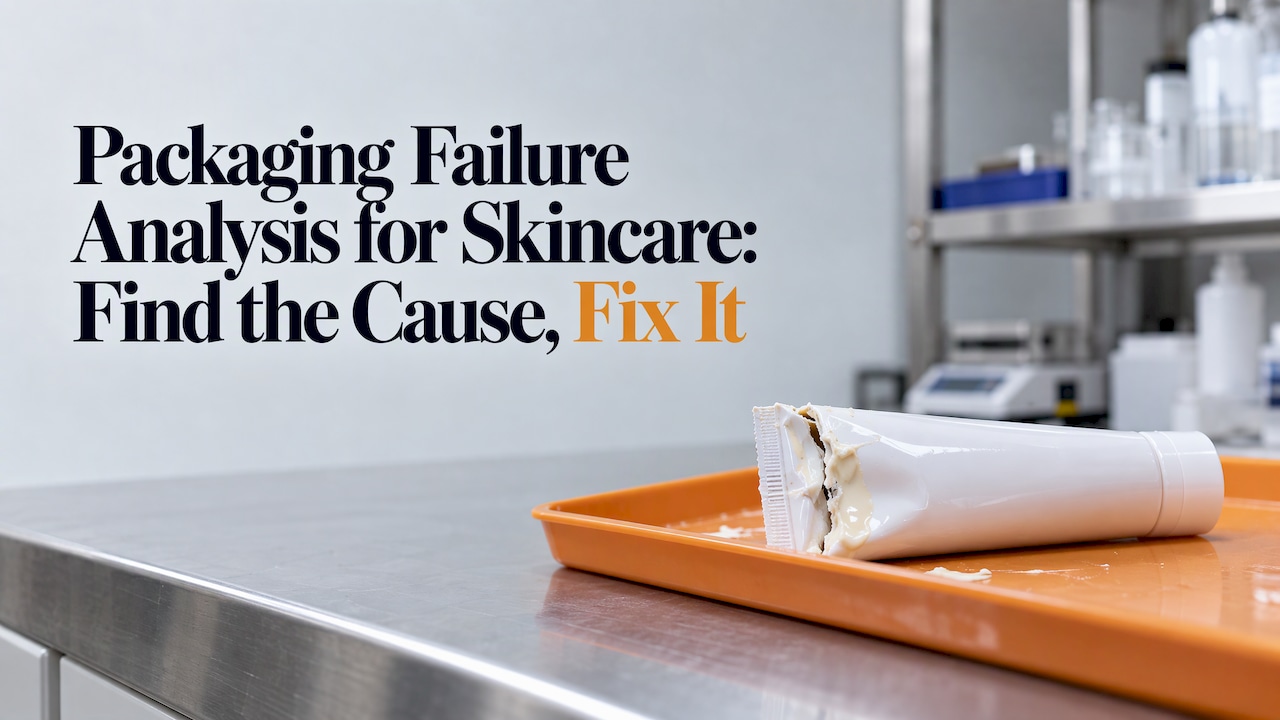
Packaging failure analysis is a structured investigation that finds out why a skincare pack leaked, cracked, clogged or lost its seal, and proves that the fix works. The answer is rarely “bad bottle”. It usually sits where the formula, the container, the closure and the filling line meet, which is why a brand that develops formula, packaging and filling under one roof reaches the root cause faster than one passing complaints between three suppliers. At Harmony Skin Lab, a GMP-certified OEM/ODM manufacturer in Singapore, formulation, packaging and quality control are part of the same project.
This guide is for brand owners, salons and clinics that have a defective batch, a complaint pile or a launch they want to protect. It covers the failure types, a step-by-step investigation, the tests and vision inspection that confirm a diagnosis, and what Singapore law expects you to do when a defect is serious.
TL;DR
- Treat failure analysis as a decision tool: the cause decides whether you change the material, the closure design, the filling settings or the supplier.
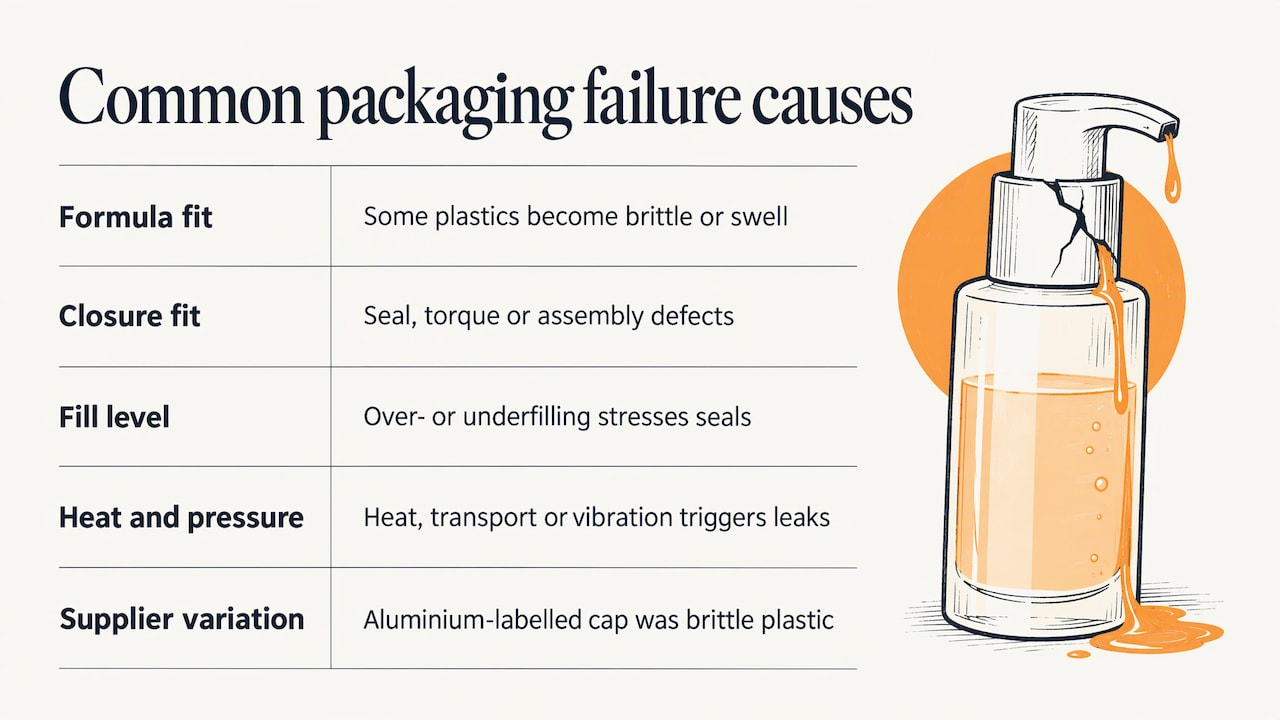
- Most leaks and cracks come from a handful of causes: formula and plastic incompatibility, wrong closure torque, poor closure design, temperature and transport stress, and filling variability.
- Investigate in order: record the defect, trace the batch, inspect the pack, test it with the real formula, confirm the cause, fix it, then verify the fix on new production.
- Vision inspection catches visible defects at line speed, but only the ones it is set up to look for. Leak and compatibility testing still covers what a camera cannot see.
- In Singapore, a defect that may endanger life must be reported to HSA within days, so keep batch and supply records ready before anything goes wrong.
Table of Contents
- What packaging failure analysis means for skincare
- Why skincare packs leak, crack and clog
- How to investigate a packaging failure, step by step
- Testing methods that confirm a diagnosis
- Vision inspection: what it catches and what it does not
- Preventing the same failure twice
- What Singapore requires when a defect is serious
- Where Harmony Skin Lab fits
- Our perspective
- FAQ
- Sources
What packaging failure analysis means for skincare
In skincare, failure analysis is not the chip-and-metal laboratory work that dominates general search results for the phrase. It is a practical investigation of a pack: a pump that will not prime, a tube that splits at the crimp, a jar lid that weeps in a delivery van, a bottle that has gone soft after three months on a shelf.
The goal has two parts. First, identify what failed and why. Second, change something so it does not happen again, and show that the change worked. Without the second part, you have a post-mortem, not an analysis.
Failures fall into three groups, which is a useful way to sort your complaints:
| Group | Typical examples | Why it is easy to miss |
|---|---|---|
| Functional | Airless pump that fails to prime, dropper that dispenses inconsistently, clogged or sticking pump, leak at the closure or pump collar | Often invisible on inspection and only appears with the actual formula inside (Packfolio) |
| Structural or material | Uneven wall thickness, stress cracking, swelling, colour change, odour | Can build slowly. A high-alcohol toner in polyethylene of the wrong resin grade can fail within weeks (Packfolio) |
| Closure | Over-torqued caps stripping threads, under-torqued caps leaking, cross-threading | Looks fine on a quick check, then fails in transit |
A fourth type deserves attention: the product changing without the pack visibly changing. A pack can quietly let moisture or volatile ingredients escape, so the product loses weight and potency with no visible leak. Weight loss over time is therefore one of the most useful numbers to track in a compatibility study (Formula Chemistry).
Why skincare packs leak, crack and clog
The same few causes recur across suppliers’ technical guidance. Before you commission any test, check whether your complaint pattern matches one of them.
Formula and material incompatibility. High-alcohol, oil-based or low-pH formulas can make some plastics brittle or make them swell (Stark Packmate). Essential oils and massage oils are a common example, which matters if your range includes them.
Closure fit and torque. Defective seals, incorrect closure torque, damaged components and variability in filling, capping or assembly are listed among the common leak causes (A&T Formulation). A bottle and closure that do not match, a wrong liner or a pump not fully locked belong here too (AC Packaging).
Fill level and headspace. Overfilled or underfilled containers change the pressure behaviour of the pack and stress the seal.
Temperature and pressure. Leaks can appear only after heat exposure, repeated opening or transport, and a low-viscosity product may leak only after vibration (Cosmeta). A Singapore brand shipping across the region deals with heat on the dock, cool air-conditioned warehouses and air-freight pressure changes within a single journey.
Supplier variation. A 2025 case study on a sunscreen product found by compression testing that a cap labelled as aluminium was in fact brittle plastic. The authors called for verified material sourcing, a redesigned cap and supplier accountability (Journal of Advanced Research in Business and Management Studies). The lesson is that the drawing, the purchase order and the part in your hand can disagree.
How to investigate a packaging failure, step by step
GMP guidance expects deviations and suspected product defects to be investigated with an appropriate level of root cause analysis, and the batch history to be traceable (HPRA guide to GMP for cosmetics). In practice, that becomes the routine below. At each step the common mistake is listed, because that is where investigations stall.
1. Record the defect before anyone touches it
Note the batch number, filling date, pack component lots, the failure description and where the product has been: warehouse, courier, retail shelf, consumer bathroom. Photograph the pack and keep the unit sealed in a bag.
Where it goes wrong: opening, wiping and re-closing the complaint sample, which destroys the evidence on seal marks and residue.
2. Pull the batch history
Collect the batch record, the incoming inspection results for the container, closure and pump, the filling and capping settings, and any line deviations on the day. ISO 22716, the cosmetics GMP guideline, covers incoming control of packaging, defined packaging processes with in-process controls, batch identification and traceability, and the handling of deviations and complaints (ISO 22716:2007). If those records exist, this step takes hours. If they are scattered across a formulator, a packaging supplier and a filler, it takes weeks.
Where it goes wrong: assuming the fault is in the pack because that is where it shows. The cause may be a capping setting changed mid-run.
3. Compare failed units with retained and good units
GMP guidance expects samples of packaging materials and finished products to be taken by approved personnel and methods (HPRA). Keep a reserve of finished units and empty components from each batch, so a failed pack can be set against a good one from the same run. Check wall thickness, thread finish, liner seating, pump lock, dip-tube length and cap torque retention.
Where it goes wrong: comparing against a pack from a different batch or supplier lot.
4. Reproduce the failure with the real formula
A pack that passes with water can fail with your serum. Fill production-representative packs and test them upright and inverted, under heat and under vibration, before drawing conclusions (AC Packaging). Compatibility programmes commonly store samples at 4°C, 25°C and 40°C for at least 12 weeks, with a glass control, and typical errors include testing in a lab jar instead of the real container and ignoring the pump, dropper or gasket (Formula Chemistry). Our own guides on packaging compatibility testing and cosmetic compatibility testing explain what to prepare for these studies.
Where it goes wrong: changing a component halfway and carrying on as if the earlier results still apply.
5. Separate the cause from the trigger
Heat in transit may be the trigger, but an under-torqued cap is the cause. Ask three questions: did the failure appear in every unit or in a pattern (one filling head, one pallet position)? Does it track a component lot? Does it track a formula change? A pattern points to the line. A lot points to the supplier. A formula change points to compatibility.
6. Choose and document the corrective action
Corrective action might be a different resin, an added liner, a redesigned closure, a torque specification, a narrower fill window or a changed supplier. Write it down with an owner and a date, and define in advance what evidence will show it worked.
7. Verify the fix on fresh production
This step separates analysis from guesswork. Run new filled units through the same tests that exposed the fault, and track complaints over the following batches. A CAPA effectiveness check is the formal version of this: confirming that a corrective and preventive action actually removed the problem rather than assuming it did.
Testing methods that confirm a diagnosis
No single test answers every question. Match the method to the suspected cause.
- Leak and integrity testing on filled packs, in several orientations, checks seals, closures and pumps. Leak testing is best planned during packaging development, since formula, primary pack and closure interact and early testing exposes design weaknesses before expensive late changes (A&T Formulation).
- Material compatibility testing looks for cracking, swelling, softening, delamination, discolouration and loss of pump or closure function after storage in contact with the product.
- Stability testing shows how formula and pack behave together over time. See why stability testing matters and how cosmetic stability testing is structured.
- Transit simulation applies vibration, drops, compression and inversion. A package surviving a week on a bench has not shown it will survive warehousing, courier handling and retail storage, and parcels sent direct to consumers face conditions very different from a pallet (Cosmeta).
- Imaging of seals can reveal defects in flexible packs. A Singapore study using optical coherence tomography detected every artificially created seal defect down to 15 µm in height, but its author cautions that the method is indirect and a structural defect does not necessarily mean a leak (NDT.net, SINCE 2019). Read imaging results alongside a functional leak test.
The same paper reports industry packaging failure rates as high as 1 to 3 per cent depending on pack type and size. On a 10,000-unit run, that is 100 to 300 packs, which is why a small start-up brand cannot treat an occasional failure as noise.
Vision inspection: what it catches and what it does not
Vision inspection uses cameras and lighting to compare each pack against a reference, and it is the practical answer to “how do I stop defects reaching the customer?”
It is well suited to visible defects. A vision system can reject underfilled containers, wrong or misapplied labels and caps that do not fit properly, and it can measure label position, label skew and cap height (MVT Vision Inspection Guide). It checks every unit, not a sample.
A Singapore example makes the speed difference concrete. In a 2021 JTC feature, a local machine-vision company’s AI system inspected 150 bottles a minute for scratches, dents and dirt, while the packing line it served ran at 30 to 50 bottles a minute with staff inspecting empty bottles by eye (JTC).
Three points help you use it well:
- It finds what it is programmed to find. A vision system detects the defects it has been set up to capture, so the defect list comes from your failure analysis. Every root cause you find becomes a new inspection rule.
- Positioning matters. Valid inspection needs products at a consistent distance from cameras and lights, little vibration, proper spacing and the right orientation. Round, unoriented bottles may need several cameras (MVT Vision Inspection Guide).
- Each application needs its own set-up. JTC notes that machine-vision systems rarely suit every industry’s needs unchanged, so each application needs its own research and design.
Vision inspection therefore handles cosmetic and closure defects on the line. Slow leaks, compatibility problems and transport damage still need the functional and stability tests above.
Preventing the same failure twice
Most repeat failures come from the same few gaps: packaging chosen on appearance before testing with the formula, no incoming checks, no change control, and no single owner of the whole system.
- Choose packaging with the formula in mind. Our guide on how to choose skincare packaging and the overview of skincare packaging options for Singapore brands show how format, material and formula type fit together.
- Inspect incoming components. The sunscreen case study traced its failure to gaps in material traceability and supplier oversight (Journal of Advanced Research in Business and Management Studies). Check material and dimensions against the specification on arrival.
- Control filling and capping. Set torque and fill windows, and record them per batch. Leakage at the closure is a leading problem for e-commerce beauty packs, and fixes include a changed liner and verified application torque (BlueSky Solutions).
- Control change. Any change to a component, supplier or formula restarts compatibility testing.
- Know your suppliers. Our note on how cosmetic suppliers shape product success covers why.
What Singapore requires when a defect is serious
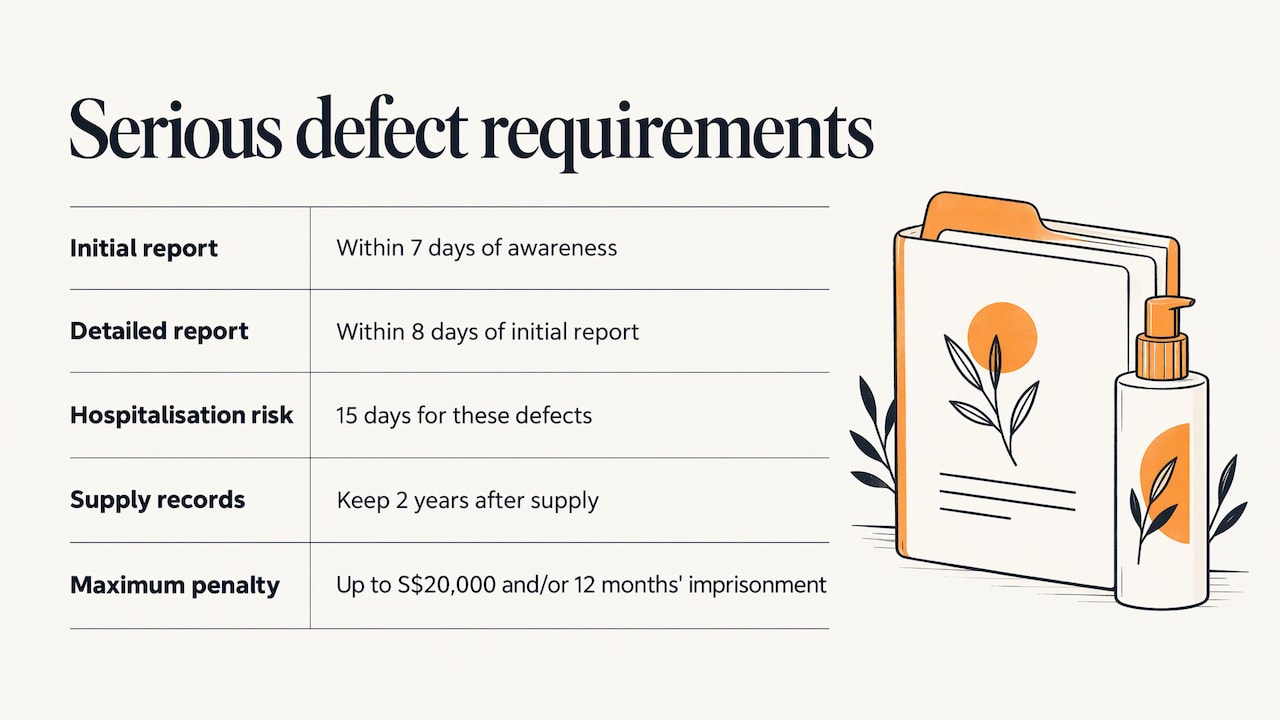
If you place cosmetics on the Singapore market, you are the responsible person, and the rules apply to you even if a contract manufacturer made the product. Under the Health Products (Cosmetic Products — ASEAN Cosmetic Directive) Regulations 2007, as in force from 1 December 2025, you must inform the Health Sciences Authority (HSA) within 7 days of becoming aware of a defect that may cause death or be life-threatening, with a detailed report within 8 days of the initial report. For defects that may hospitalise someone or cause persistent or significant disability, the period is 15 days. Non-compliance or false reporting carries a fine of up to S$20,000 and/or up to 12 months’ imprisonment (Singapore Statutes Online).
The same regulations require supply records for each product: notification number, supply date, recipient name and address, quantity and batch, lot or serial number. They must be kept for 2 years after supply. Those records are exactly what step 2 of your investigation needs, and they are what lets you trace and recall affected units quickly.
A pack that leaks an ordinary face cream is a quality problem. A pack defect that contaminates a product used on broken skin, or a clinic formulation, may be a reportable one. If you are unsure which side a defect falls on, speak to HSA directly.
Where Harmony Skin Lab fits
If you are launching a private label range, supplying a salon line or developing a clinic formulation, the cheapest failure analysis is the one you never need. Harmony Skin Lab is a GMP-certified OEM/ODM manufacturer in Singapore (certification from HSA) that handles research and development, formulation, quality control and packaging for private label, professional salon and medical skincare lines. Because those stages sit in one collaborative project, the formula and the pack are developed together instead of being matched after the fact.
See our stability testing and QC services, our cosmetic filling services and our packaging design and printing services, or go straight to the full list of services.
If you already have a packaging problem or want to avoid one on your next launch, talk to our team through harmonyskinlab.com.
Our perspective
Most packaging failures we hear described to us start with a decision made early and tested late. A brand chooses a bottle for its look, a formulator writes the formula for its texture, and a filler is handed both. Nobody owns the system, so when a pump clogs or a lid weeps, each party points at another.
We build skincare products as one project: formulation, research and development, packaging and quality control, in a GMP-certified facility in Singapore. Working this way means the questions in this article, such as what the formula does to the closure, which torque the line should hold and what to check on arrival, are asked at the start, when the answer costs a decision rather than a recall.
Our advice to every client is the same: write down what the pack must survive, test the real formula in the real pack, and keep batch records you can trace. That is the best failure analysis there is, because it is done before the customer finds the fault.
Edmund
FAQ
What is packaging failure analysis in skincare?
It is an investigation into why a skincare pack leaked, cracked, clogged or lost its seal, covering the batch history, the pack components, the formula and the conditions the pack met. It ends with a corrective action and evidence that the action worked. The point is to change a material, design, process or supplier, not just to describe the damage.
How long does a packaging failure investigation take?
It depends on how quickly you can reach batch records and reproduce the fault. Stability and compatibility studies are commonly run for at least 12 weeks, so confirming a slow, formula-related failure takes longer than diagnosing a capping error found on the line. Complete, traceable batch records shorten the early steps considerably.
Can vision inspection find leaks?
Not reliably on its own. Vision systems detect visible defects such as wrong or skewed labels, ill-fitting caps, underfilled containers, scratches and dents, and they can flag some closure faults. Slow leaks, product and pack interaction and transport damage need functional leak testing, compatibility testing and transit simulation.
Do I have to report a packaging defect to HSA in Singapore?
Yes, if the defect may cause death or be life-threatening (within 7 days of becoming aware) or may hospitalise someone or cause persistent or significant disability (within 15 days). The duty falls on the person responsible for placing the product on the market. Keep batch and supply records, which must be retained for 2 years after supply.
Sources
- Packfolio: cosmetic packaging defect types
- Formula Chemistry: cosmetic packaging compatibility
- Stark Packmate: skincare packaging that won’t crack or leak
- A&T Formulation: cosmetic leak test
- AC Packaging: why cosmetic bottles leak
- Cosmeta: packaging compatibility testing
- Journal of Advanced Research in Business and Management Studies: packaging quality case study
- HPRA: guide to GMP for cosmetic products
- ISO 22716:2007 cosmetics GMP guidelines
- NDT.net: defects in flexible plastic seals via OCT
- MVT Vision Inspection Guide
- JTC: local SME machine-vision feature
- BlueSky Solutions: e-commerce safe packaging for beauty
- Singapore Statutes Online: Health Products (Cosmetic Products) Regulations 2007
- Qualitum: CAPA effectiveness check