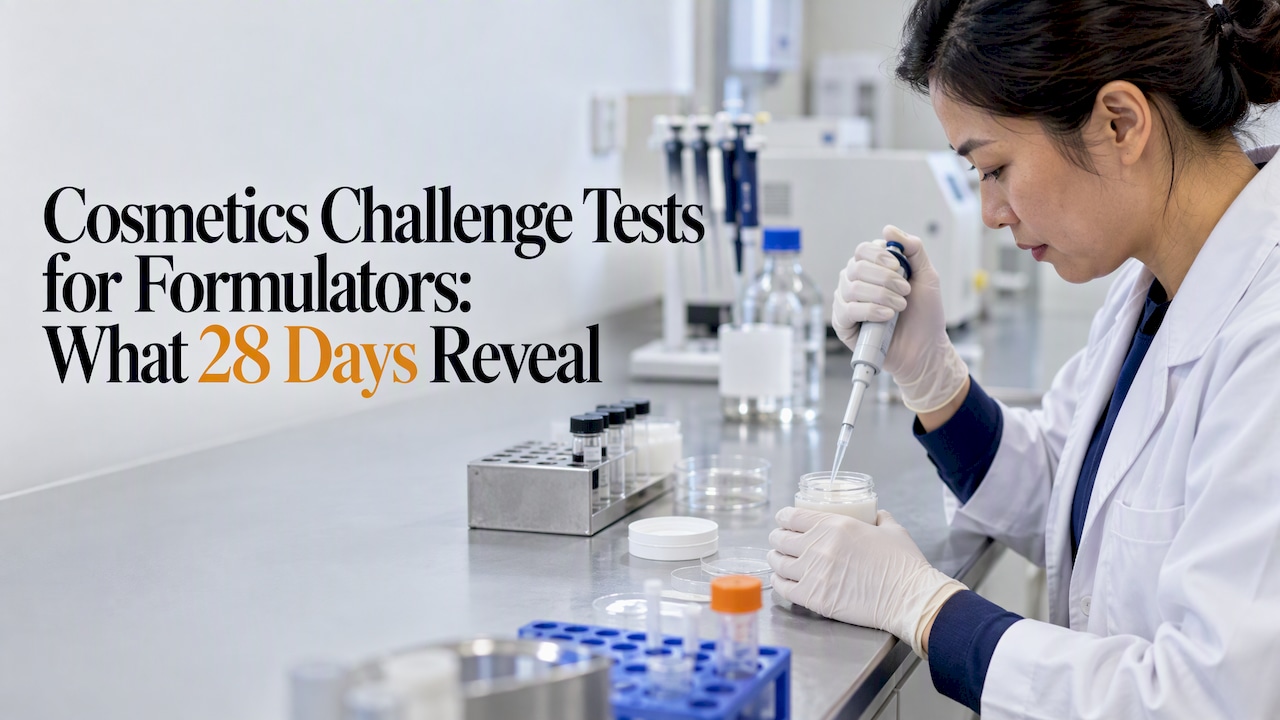
A preservative challenge test intentionally inoculates a cosmetic formulation with defined microbes to confirm the preservative system prevents microbial growth over a 28 day exposure period. Its purpose is to prove, before a product reaches the market, that the formula resists contamination under realistic consumer use. ISO 11930:2019 sets the international framework for this assessment, and the result feeds directly into the Cosmetic Product Safety Report that regulators such as Singapore’s HSA expect to see.
TL;DR:
- Products containing water usually need challenge testing, while anhydrous oils and wax balms may qualify for exemption from full testing under ISO 29621.
- A development challenge test does not replace batch checks: run total viable count and pathogen screening on each production batch throughout its commercial life.
- Common criteria require a 3 log reduction in bacteria and a 2 log reduction in yeast or mould by day 14, with no rebound.
- Marginal results call for adjusting preservative levels, adding a booster, or improving packaging, then retesting; failures require reformulation before safety or stability work continues.
- Submit samples in retail packaging and require written confirmation that the laboratory validated its neutralizer, since residual preservative can distort colony counts.
Table of Contents
- What does challenge testing cover, and how does it differ from routine microbial checks
- Standards and acceptance criteria: ISO 11930 and pharmacopeial thresholds
- Protocol detail: organisms, inoculum, sampling schedule and lab validation
- When to test, and how results shape your development and safety files
- Practical considerations for submitting samples and reading lab reports
- Treating the challenge test as a validation step, not paperwork
- FAQ
- Sources
- Build preservative confidence into your product development
What does challenge testing cover, and how does it differ from routine microbial checks
A challenge test is a development exercise, not a batch release check. We deliberately introduce known microorganisms into a formulation at defined levels, then store the samples under conditions that mimic how a consumer might stress the product through repeated opening, dipping fingers in, or leaving it in a warm bathroom. The question it answers is whether the preservative system can still knock back contamination after that kind of abuse, not whether a single production batch happens to be clean on the day it was made.
Water containing or water miscible products are the usual candidates, because water activity is what allows bacteria, yeast and mould to multiply. Anhydrous products, such as pure oils or wax based balms with no free water, often carry a lower microbial risk and may be exempt from full challenge testing under ISO 11930:2019, which references ISO 29621 for low risk product categories.
The distinction that trips up a lot of teams is this:
- A challenge test validates the preservative system once, during formulation development or at major reformulation.
- Routine QC uses total viable count and pathogen screening on individual production batches to confirm manufacturing hygiene, not preservative capacity.
- A formula that passes its challenge test still needs batch level microbial limit testing throughout its commercial life.
Confusing the two leads either to unnecessary repeat testing or, more dangerously, to assuming a clean batch count means the preservative system is sound.
Standards and acceptance criteria: ISO 11930 and pharmacopeial thresholds
ISO 11930:2019 (+A1:2022) is the reference method most laboratories and safety assessors work to. It specifies inoculation with defined microbial strains and monitors survival across a 28 day incubation window, giving a structured way to judge whether a preservative system offers adequate protection.
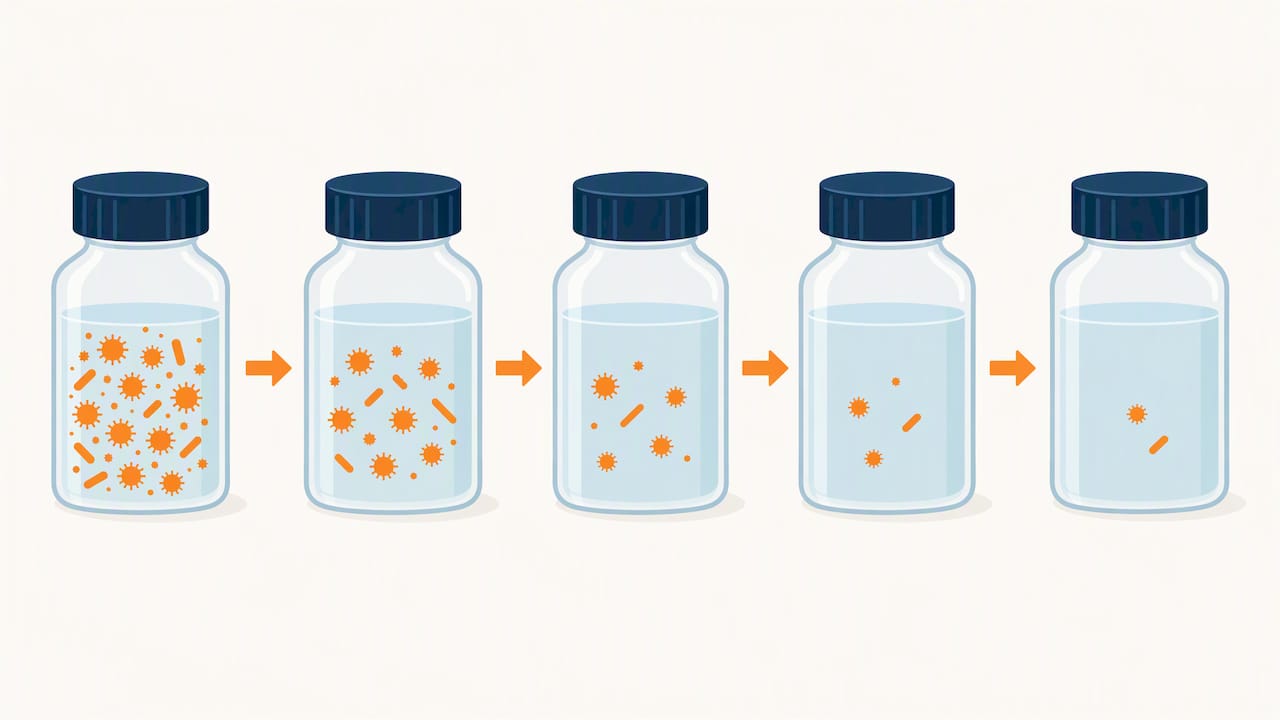
Pharmacopeial variants, including European Pharmacopoeia based protocols, apply specific log reduction thresholds at defined timepoints. A widely used criterion requires bacteria to be reduced by 3 log10 units by day 14 with no increase afterwards, and mould or yeast reduced by 2 log10 units by day 14 with no subsequent rebound, as set out in guidance for water miscible products.
A product classed as “well preserved” under pharmacopeial challenge criteria showed no contamination in consumer use testing, while poorly preserved formulations returned high contamination rates in the same study. This correlation between laboratory challenge results and real world contamination is why safety assessors treat the test as predictive, not theoretical.
In practice, labs and assessors tend to describe outcomes in bands:
- A clear pass meets or exceeds the log reduction criteria at every specified timepoint with no later rebound.
- A marginal result meets the criteria narrowly, often with slower kill rates for fungi than bacteria, and usually prompts a closer look at preservative loading.
- A fail misses the reduction thresholds, shows regrowth after an initial drop, or fails against one organism while passing against others.
Protocol detail: organisms, inoculum, sampling schedule and lab validation
A typical challenge test follows a structured sequence, and knowing the steps helps when briefing a laboratory or reading a report.
- Select test organisms. Challenge-test examples include Pseudomonas aeruginosa, Staphylococcus aureus, Candida albicans and Aspergillus brasiliensis.
- Prepare the inoculum. Formulations are typically spiked at 10⁵ to 10⁶ CFU per millilitre or gram, though some standards call for lower inocula in eye area products given their lower contamination tolerance.
- Sample on a fixed schedule. Counts are taken at time zero, then day 7, day 14, day 21 and day 28, tracking the decline (or failure to decline) in viable organisms at each point.
- Neutralise before plating. Labs wash or dilute samples with a validated neutraliser to stop residual preservative from suppressing colony counts during plating, which would otherwise understate the true microbial load.
- Validate the neutralisation step itself. A separate check confirms the neutraliser does not harm the test organisms on its own, so the colony counts reflect genuine survival rather than an artefact of the neutralising agent.
Pro Tip: Ask your laboratory to confirm neutraliser validation in writing before testing starts, not after you see the results, since an unvalidated neutraliser can produce a false pass or a false fail.
For formulations that need tighter proof of robustness, such as products aimed at compromised skin or extended shelf life claims, some labs offer a D-value approach that calculates the time needed for a one log reduction in organism count, giving a more granular picture of kill kinetics than the standard pass or fail schedule.
When to test, and how results shape your development and safety files
Timing matters as much as method. A challenge test may be useful during formulation selection, before scale-up, and when stability testing flags a change that could affect preservative performance.
What you do with the result depends on the band it falls into.
- A clear pass supports moving straight into the Cosmetic Product Safety Report with confidence in the preservative claim.
- A marginal result usually calls for adjusting preservative concentration, adding a synergistic booster, or tightening packaging to reduce contamination exposure, followed by a retest.
- A fail requires reformulation before any further safety or stability work proceeds, since no packaging change fixes an inadequate preservative system on its own.
The HSA advisory for suppliers of cosmetic products advises suppliers to institute microbial contamination checks, use accredited laboratories and include testing results and anomalies in product safety files. The challenge test report becomes a cited reference in that file, and the safety assessor who signs it carries the responsibility for judging whether the evidence supports the product’s safety for its intended use. If you are weighing up when a challenge test fits against broader stability testing, the two should run on a coordinated schedule rather than as separate afterthoughts.
Practical considerations for submitting samples and reading lab reports
Getting a clean, interpretable result starts before the sample reaches the lab. Send products in their intended retail packaging where possible, since the packaging itself (pump, jar, dropper) affects contamination exposure and is part of what the test is meant to evaluate. Label every sample with its batch code and full ingredient declaration so the lab can match neutralisers to your preservative system rather than guessing.
Give the laboratory enough context to choose the right method:
- Share the full product matrix, including pH, water content and any emulsifiers or surfactants that might interfere with plating.
- State intended storage and use conditions, since a product left in a hot car behaves differently from one kept refrigerated.
- Declare every preservative and booster by name so the lab selects a neutraliser that actually stops it working during plating, rather than one that leaves residual antimicrobial activity in the sample.
Pro Tip: If your formulation contains natural extracts or botanicals, flag them explicitly so the laboratory can account for the full product matrix when interpreting results.
A common pitfall is an invalid neutraliser result that nobody questions, so always ask the lab to confirm the neutraliser validation step was run and passed before accepting the headline counts. More background on how these checks sit within broader cosmetic microbiological testing is worth reviewing if your team is new to commissioning this kind of work.
Treating the challenge test as a validation step, not paperwork
Challenge testing works best when it sits inside a cross functional process rather than being bolted on at the end as a compliance formality. Formulators, QC and the safety assessor each read the same report differently, and getting all three in the room when a marginal result comes back saves weeks of back and forth guessing at the cause.
My own view is that teams who treat the test purely as a one off gate miss its real value: a validated preservative system, properly documented, gives you a stronger basis for shelf life and safety claims later, and it narrows the guesswork when a stability study turns up an unexpected result months down the line.
— Edmund
FAQ
How do they test cosmetics if not on animals?
Preservative efficacy and microbial safety are assessed through in vitro laboratory methods such as the challenge test, which inoculates the formulation itself with defined microorganisms and tracks survival over time rather than testing on live animals. This approach, standardised under ISO 11930, is the accepted method referenced in regulatory and safety assessment documentation.
How much does microbial testing cost?
Pricing is not published by standards bodies or regulators and varies by laboratory, product type and the scope of testing requested, so we are not able to state a figure here. A microbiology lab can quote based on your specific formulation and the organisms and timepoints required.
What is the procedure for a preservative effectiveness test?
The formulation is inoculated with standard organisms, typically including Pseudomonas aeruginosa, Staphylococcus aureus, Escherichia coli, Candida albicans and Aspergillus niger, at 10⁵ to 10⁶ CFU per millilitre or gram. Samples are then counted at day 0, 7, 14, 21 and 28 to confirm the required log reduction is reached and sustained.
What are the major challenges facing the cosmetic industry?
Formulators may need to balance interest in naturally derived ingredients with the challenge of designing an effective preservative system. Balancing adequate preservation with lower preservative loads, while meeting evolving regulatory expectations such as those set out by HSA for suppliers, remains an ongoing formulation challenge.
Sources
- ISO 11930:2019 – Cosmetics — Microbiology — Evaluation of the antimicrobial protection of a cosmetic product
- Appendix 2: Challenge test of water miscible cosmetic products – Environmental Project No. 1336 2010 – A guidance document on microbiological control of cosmetic products
- The use of the challenge test to analyse preservative efficiency in non-sterile cosmetic and health products: applications and critical points – Analytical Methods (RSC Publishing) DOI:10.1039/C0AY00597E
- Microbiological Quality Assessment of Skin and Body care Cosmetics by using Challenge test
Build preservative confidence into your product development
Reading a challenge test report is only useful if the formulation behind it was built to pass. We work with brands from early formulation through to final sign off, coordinating preservative selection, stability testing and documentation so the safety file holds together rather than being assembled after the fact. Our R&D and manufacturing services cover custom formulation, quality control and packaging, which means preservative system design and challenge test readiness are part of the same process rather than two disconnected steps.
If you are developing a water based serum, a professional salon line or a medical grade formulation and want a manufacturing partner who treats preservative efficacy as a design input rather than a last minute hurdle, get in touch about our product development service to discuss your formulation and testing timeline.