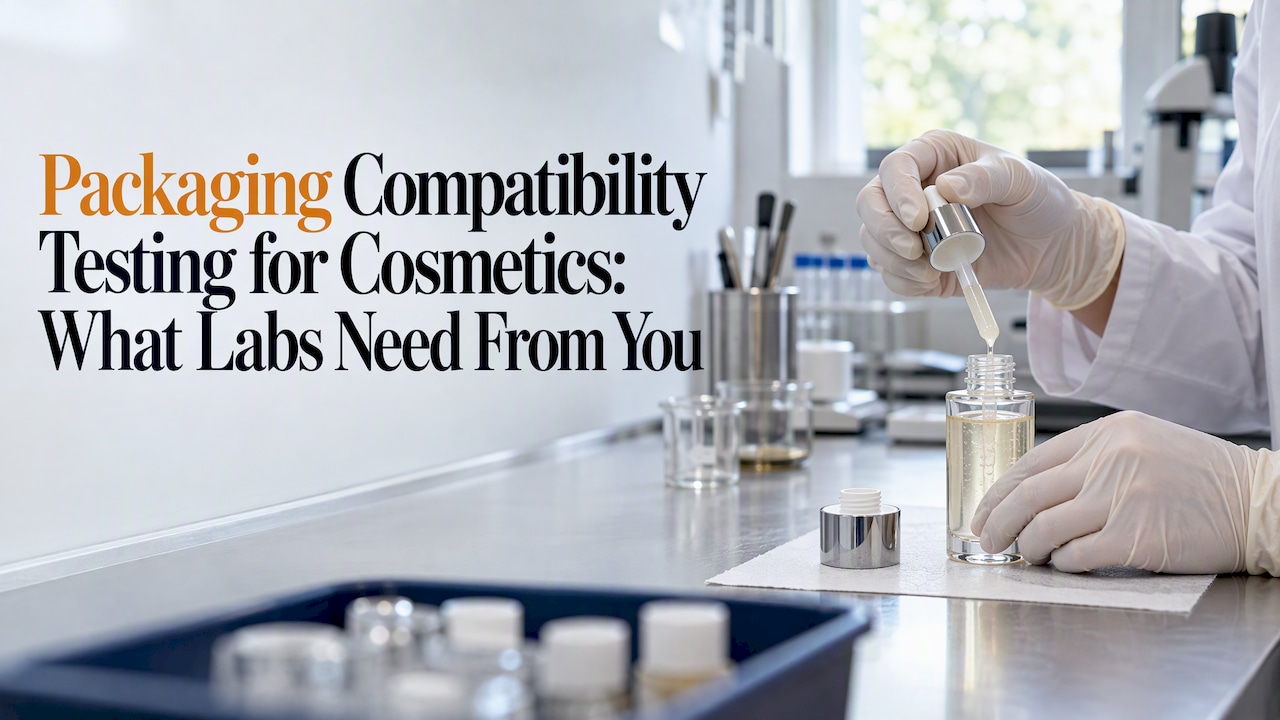
Packaging compatibility testing verifies that a formula and its chosen container behave together over the intended shelf life, checking for odour or colour shifts, pump failure, preservative loss and contamination risk. If you’re planning a launch, the next step is simple: start a tailored testing plan with your manufacturer or an accredited laboratory before you commit to production tooling.
TL;DR:
- Run screening after formula freeze with actual intended packaging, then repeat at pilot fill; any component, supplier, resin, fragrance, or active change warrants retesting.
- Send the finished formula, a placebo, and every product contact component, including closures and seals; identify each sample by batch, fill date, and packaging lot.
- Use complementary lab methods: gas chromatography mass spectrometry detects volatile compounds, while liquid chromatography and pyrolysis can reveal migrants one method may miss.
- Define pass thresholds before testing, require an accredited lab’s written interpretation, and investigate unidentified peaks with full profiling or targeted leachables work before tooling.
- Schedule testing early: screening can take days to weeks, and follow up analytical work may add further weeks before a launch.
Table of Contents
- What packaging compatibility testing actually covers
- Key test methods and what each one reveals
- When to run tests, and when to re-test
- How to build a testing plan your lab can actually act on
- Regulatory responsibilities and standards worth knowing
- Common mistakes that create avoidable risk
- How testing fits into a real OEM/ODM launch sequence
- Environmental and sustainability considerations
- Case studies of packaging compatibility issues and their resolution
- Why early testing protects more than the product
- How we support compatibility testing and GMP manufacturing
- FAQ
- Sources
What packaging compatibility testing actually covers
Compatibility testing looks at how a formula and its container behave as one system, often called container-content interaction (CCI). A fragrance oil that is harmless in a glass jar can degrade a plastic resin; a preservative that works in bulk can lose potency once headspace, closure material and dispensing mechanism enter the equation.
The assessment generally spans four risk areas:
- Physical and chemical stability: separation, colour drift, odour change, viscosity shift and loss of active potency over time.
- Dispensing and closure function: whether pumps, droppers, cap and inner seals keep working and keep the product sealed from air and contamination.
- Microbiological integrity: whether the chosen preservative system still performs once the formula sits against the packaging material, not just in a glass stability jar.
- Extractables and leachables risk: whether chemicals migrate out of the packaging into the formula, or whether formula components migrate into the packaging.
Most of these checks run in parallel rather than sequence, because a failure in one area (say, a seal that lets in air) often causes a failure in another (preservative efficacy, then microbial contamination). A testing plan that only checks colour and odour at set intervals, without touching the closure or the migration question, leaves real gaps.
Key test methods and what each one reveals
Different methods answer different questions, and a lab brief that asks for the wrong one wastes both time and budget.
- Migration testing exposes the finished product, or a simulant that mimics it, to the packaging under realistic or accelerated conditions, then checks what has moved from pack to product. It tells you whether a known risk has actually transferred, not just whether it theoretically could.
- Extractables screening identifies everything a solvent or extraction method can pull out of the packaging material itself, independent of the formula; it is a broader net than migration testing.
- Leachables confirmation narrows that list down to what genuinely migrates into the real product under real use and storage conditions. Extractables tell you what is possible; leachables confirm what is happening.
- GC‑MS and LC‑MS separate and identify volatile and non-volatile compounds respectively, and thermal desorption or pyrolysis techniques complement solvent-based extraction when a compound would never dissolve out on its own.
A peer-reviewed study using microchamber thermal extraction and pyrolysis-GC-MS found that plasticisers, residual monomers, degradation products and non-intentionally added substances (NIAS) in cosmetic plastic packaging often require more than one analytical technique to detect reliably, since no single method captures both volatile and non-volatile migrants.
Pro Tip: Ask your lab to specify in writing which technique targets volatiles and which targets non-volatiles. A report that lists “no leachables detected” without naming the method used is not a complete answer.
Multiple techniques are often required precisely because a single GC‑MS run misses heavier, less volatile compounds that only show up under LC‑MS or pyrolysis conditions. When a lab report flags an unidentified peak, that is the moment to request a full profiling study rather than accept a narrow pass or fail on the headline markers alone.
When to run tests, and when to re-test
Compatibility testing is not a once-only checkbox. It belongs at specific points in development, and certain changes should trigger it again regardless of what came before.
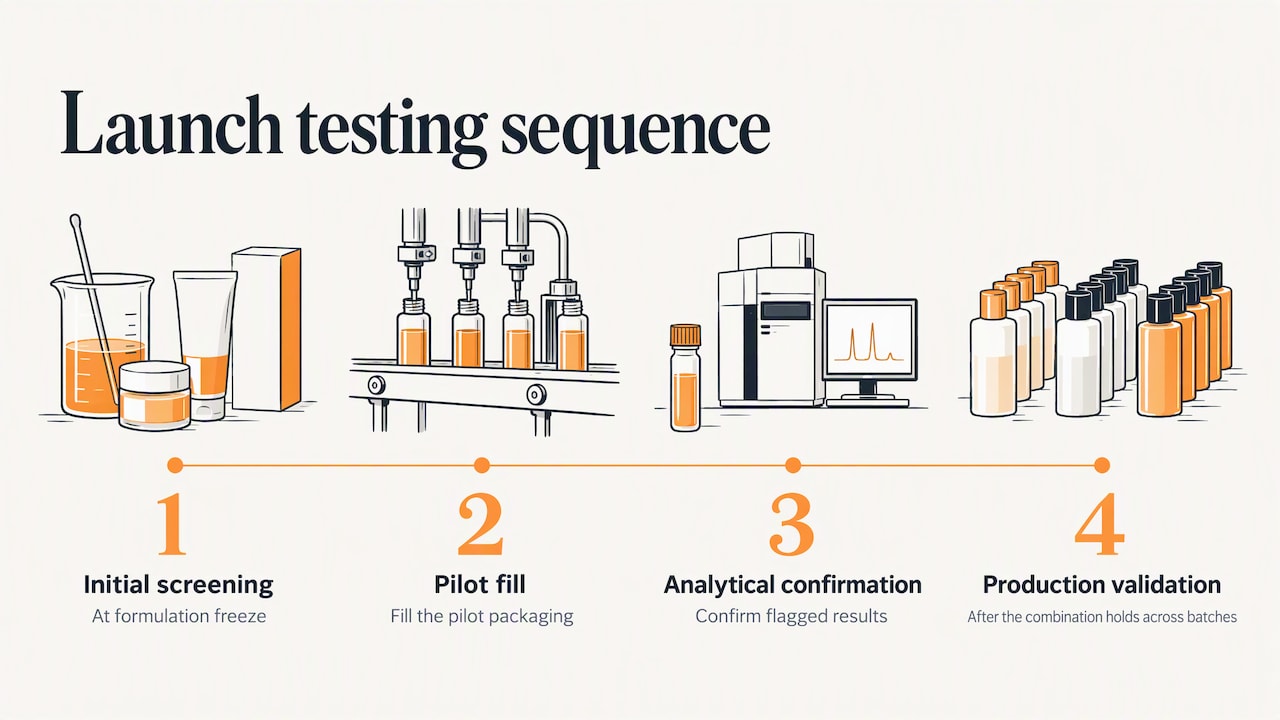
- Formulation freeze: run initial screening once the formula is locked, using the actual packaging components you intend to launch with, not a placeholder container.
- Pilot fill: repeat screening at pilot batch scale, where fill levels, headspace and real dispensing mechanisms match production conditions.
- Analytical confirmation: follow up any flagged result with targeted migration or leachables work before committing to full production tooling.
- Re-test triggers: any change to a packaging component, pump supplier, resin batch, fragrance or active ingredient resets the compatibility question and should prompt a fresh round of testing.
Build in conservative lead times. Screening results can take days to weeks, and follow-up analytical work (particularly full profiling after an unexpected peak) adds further weeks. Scheduling this early avoids compressing it into the final weeks before a launch date.
How to build a testing plan your lab can actually act on
A lab or contract manufacturer can only test what you send them, in the form you send it. A vague brief produces a vague report.
Send the finished formula, a placebo (the base without actives, useful for isolating packaging-driven changes), and every packaging component that will touch the product: closures, pumps, droppers and inner seals, not just the main container. Include supplier certificates of analysis and batch specifications for the packaging materials, since a resin batch change can shift results even when the component looks identical.
- Screening quantities are typically smaller and faster, aimed at flagging obvious issues early.
- Full studies need larger sample sets across multiple time points and, often, multiple batches to confirm a result holds consistently.
- Labelling and traceability matter: every sample should be tied to a specific batch, fill date and packaging lot so a flagged result can be traced back to its source.
- Acceptance criteria need to be defined before testing starts: visual thresholds (colour, clarity), chemical marker limits, and preservative efficacy endpoints that count as a pass.
Pro Tip: If a result flags an unidentified peak, explicitly request NIAS (non-intentionally added substances) follow-up rather than accepting a summary pass. A written interpretation, not just raw data, is what makes a report usable for a go or no-go decision.
Insist on accredited laboratories and a written interpretation alongside the raw data. A spreadsheet of peaks and retention times is not an answer; a paragraph explaining what those peaks mean for your specific formula and packaging combination is.
Regulatory responsibilities and standards worth knowing
Dealers carry legal responsibility for the safety and quality of cosmetic products placed on the market, and this duty does not transfer to a supplier or packaging vendor. Under the ASEAN Cosmetic Directive as implemented through HSA guidance, dealers are expected to ensure appropriate quality and safety assurance for their products.
That guidance also points practically towards verification: HSA’s advisory for suppliers recommends discussing appropriate tests with contract laboratories, particularly where a product category carries specific known risks, and carrying out testing for prohibited or restricted ingredients.
On the technical side, ISO/TR 18811 offers guidance on stability testing but deliberately does not prescribe fixed conditions or pass criteria. The framework exists to help you justify a protocol tailored to your product, not to hand you a universal checklist.
In practice, this means:
- Keep documented records of testing protocols, results and the reasoning behind acceptance criteria.
- Use accredited laboratories so results carry recognised weight if questioned.
- Respond to anomalies with investigation rather than dismissal, since an unexplained peak left unaddressed becomes a liability later.
Common mistakes that create avoidable risk
A surprising number of compatibility failures trace back to a handful of recurring habits rather than genuinely novel problems.
- Relying on supplier datasheets alone: a resin datasheet describes the material in isolation, not how it behaves against your specific formula, fill volume and container geometry.
- Testing too late or with too narrow a scope: screening only colour and odour, or only at one time point, misses dispensing failures and slow-developing migration issues.
- Leaving acceptance criteria undefined: without agreed pass or fail thresholds set before testing, a borderline result becomes a dispute rather than a decision.
- Ignoring unexpected chromatogram peaks: an unidentified peak is a prompt for NIAS investigation, not something to average away.
Pro Tip: Treat an accredited lab and a written interpretation as the minimum bar, not an upgrade. A result without context is not a result you can act on.
How testing fits into a real OEM/ODM launch sequence
In practice, compatibility work runs alongside formulation and packaging engineering rather than after it. A typical sequence moves from initial screening at formulation freeze, through pilot fill, into analytical confirmation of any flagged result, and finally into production validation once the combination has held steady across batches.
At each stage, formulation, packaging engineering and quality control need to coordinate directly: a packaging change proposed by engineering should trigger a formulation review, not just a packaging-side check. Test outcomes then become the basis for batch release criteria and supplier change controls, so that a future resin or pump supplier swap automatically re-opens the compatibility question rather than slipping through unchecked.
Environmental and sustainability considerations
Packaging compatibility and sustainability goals increasingly intersect, and not always comfortably. A lighter-weight plastic, a recycled-content resin or a mono-material pouch chosen for environmental reasons can behave differently against a formula than the virgin or multi-layer material it replaces.
Recycled-content plastics may have a different residual-compound profile from virgin resin, so assess the specific material through appropriate testing. That makes extractables screening more, not less, important when a brand switches to a recycled or bio-based packaging material, rather than a reason to skip it.
Sustainable packaging substitutions may affect barrier properties. Assess the specific material’s protection against oxygen and moisture as part of compatibility testing. None of this argues against sustainable packaging choices; it argues for testing the specific combination you intend to use rather than assuming a greener material behaves like the one it replaces.
The practical takeaway is sequencing: treat a sustainability-driven packaging change exactly like any other packaging change, with its own round of screening, before locking it into production.
Case studies of packaging compatibility issues and their resolution
One possible failure pattern is an interaction between a fragrance or active ingredient and a plastic resin, which may soften, discolour or crack the container at stress points such as the neck or pump collar. The resolution typically involves either reformulating to remove or reduce the offending component, or switching to a resin with better chemical resistance, confirmed by repeating migration testing on the new combination rather than assuming it will pass.
Another possible issue is a change in preservative efficacy that appears when the formula is stored in its intended packaging rather than a glass stability jar. The closure material or an incompatible liner can interact with the preservative system in ways a bulk stability test never reveals. Resolution usually means adjusting the preservative blend or liner material and re-running a preservative efficacy test specifically in the intended packaging, not just the formula alone.
A dispensing issue can occur when a pump suited to a thin lotion does not perform as intended with a thicker serum. Here the fix is mechanical rather than chemical, choosing a pump rated for the formula’s actual viscosity range, and confirming it under repeated-use conditions rather than a single dispense test. In each case, the issue surfaced because testing used the real formula-package combination rather than a generic assumption about how either component behaves on its own.
Why early testing protects more than the product
The real cost of skipping early compatibility work rarely shows up at launch. It shows up months later, as a complaint pattern, a recall conversation or a reformulation under time pressure, each one more expensive and more visible than the test would have been.
My practical recommendation for a first programme: treat the placebo and the full packaging assembly as mandatory inputs, not optional extras, from the very first screening round.
— Edmund
How we support compatibility testing and GMP manufacturing
We coordinate formulation, packaging design and testing timelines during product development so results can inform manufacturing decisions.
- We handle formulation, packaging design and testing coordination, so a flagged result can prompt a formulation or packaging review.
- We provide manufacturing support.
- We work with your formula and packaging details to support product development.
If you’re planning a launch and want to discuss formulation and product development, our product development service is the place to start that conversation.
FAQ
What are the ASTM standards for packaging?
ASTM maintains several standards covering packaging performance, including distribution testing and material properties, though cosmetic compatibility work more often references ISO guidance such as ISO/TR 18811 for stability testing frameworks. A lab brief should specify which standard applies to the specific property being measured rather than citing ASTM generically.
What are the criteria for packaging?
Packaging criteria typically cover physical protection, chemical compatibility with the formula, dispensing function and regulatory compliance for the target market. For cosmetics, this means confirming the packaging protects against light, oxygen and moisture while not reacting with the formula over its intended shelf life.
What is GSM for packaging?
GSM, or grams per square metre, measures the mass per unit area of paper, card or laminate packaging. Ask the supplier for separate information about thickness, barrier properties and structural strength. It is a specification detail to confirm with a supplier, not a substitute for testing how the material performs against your specific formula.
What are the 3 C’s of packaging?
Compatibility testing considers how the container, closure and product interact as a system. Treating these as one connected system, rather than three separate specifications, is the core idea behind container-content interaction testing.
How do I know if my packaging is incompatible with my formula?
Signs include colour or odour change, visible separation, a pump or dropper that stops working smoothly, or an unexpected peak on a lab chromatogram during extractables or leachables screening. Any of these should prompt a full round of migration or leachables testing before the packaging combination moves to production.
Sources
- Regulatory overview of cosmetic products | Health Sciences Authority
- ISO/TR 18811:2018 – Cosmetics — Guidelines on the stability testing of cosmetic products
- Identification of Potential Extractables and Leachables in Cosmetic Plastic Packaging by Microchambers-Thermal Extraction and Pyrolysis-Gas Chromatography-Mass Spectrometry